You are currently viewing 《当我开始看懂一艘船:终于走进 PEKING》|When I Began to Understand a Ship: Finally Entering the World of PEKING
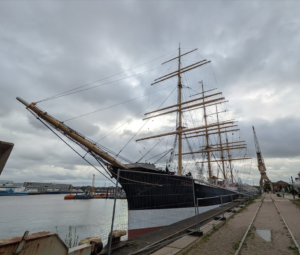
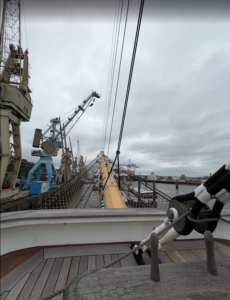
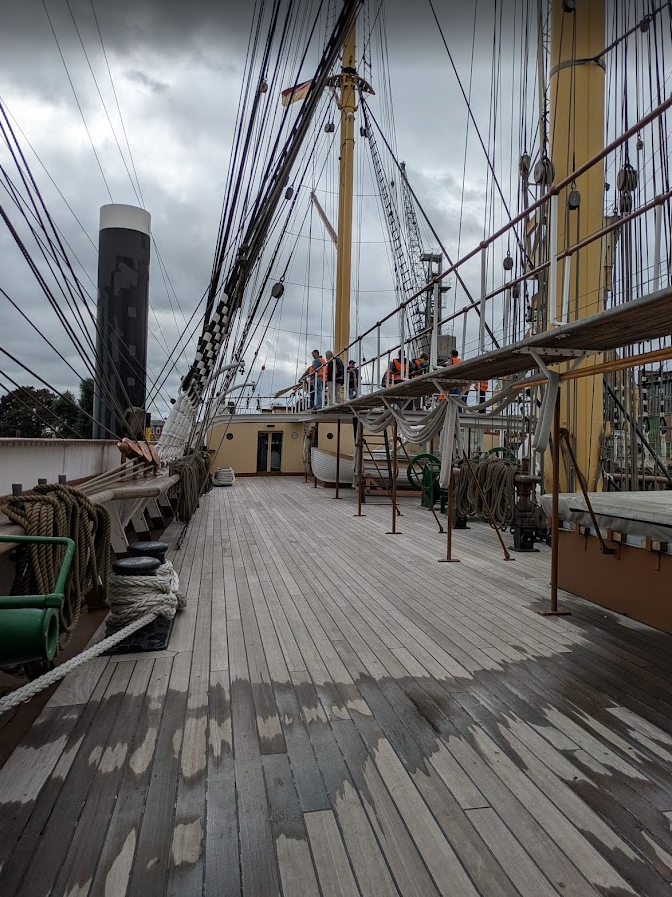
北京号甲板,作者摄于2026年8月30日汉堡田野。

《当我开始看懂一艘船:终于走进 PEKING》|When I Began to Understand a Ship: Finally Entering the World of PEKING

封面图说明|

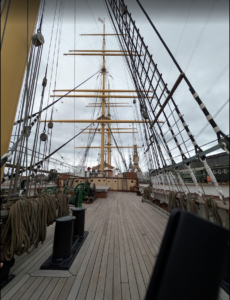
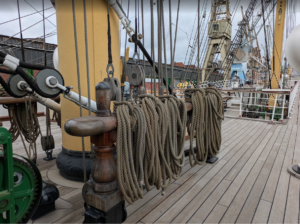
PEKING 的木质甲板向前延伸,
四根桅杆撑起密集的帆桁与索具,
绳索、滑轮与甲板机械散布其中,
这里曾是风被转化为航行动力的工作现场。

图片说明|除特别注明外,本文照片均由作者摄于 2026 年 08 月 30 日汉堡田野;馆内展板、模型及展示内容之版权归原权利人所有。

引文|以前我看见船,现在我开始看见船里面的关系

看懂一艘船,
也许不是记住更多名字,
而是开始看见,
一件东西为什么在那里,
又怎样与另一件东西发生关系。

📅 时间:2026年08月30日 (日)
📍 行程|汉堡 · 北京号登船导览

An Bord der PEKING – SHMH

一艘船没有因为我学了航海学,
突然变得不一样,
真正改变的,是我的眼睛,
以前看见桅杆、绳索、舵轮和甲板,
现在开始看见,它们怎样彼此连接。

2026年8月30日,我再次来到 PEKING,
关于这艘船,我已经写过两次,
但这一天,我第一次真正走上甲板,
眼前还是那些熟悉的桅杆与绳索,
我看的东西,却已经不太一样了。

我开始学习航海学,
也碰到一点船体结构的知识,
Schott、Ballast、Ruder、Takelage,
这些词,我其实还没有真正学懂,
却让我开始注意,以前忽略的地方。

我当然还没有真的懂船,
有些设备,我甚至叫不出名字,
可是从这一次登船开始,
一艘船不再只是许多部件的集合,
我开始看见,它们之间的关系。
我只是终于知道,
自己以前有多少东西没有看见。

一、一艘船,原来有自己的身体

船不是一个装着东西的大壳子,
它有前后,有上下,也有内外,
每一个空间承担自己的工作,
它们一起,才成为一艘船。

1. 先找到船的前后

真正走上 PEKING 的甲板,
我先做了一件很幼稚的事,
我开始确认哪里是船艏,
哪里是船艉,
自己现在又站在哪里。

船艏是 Bug,船艉是 Heck,
前部升高的甲板叫 Back,
后部还有 Poop,也就是艉楼甲板,
中间又有 Brückendeck 等不同区域,
一艘船开始有了方向和层次。

以前从岸上看 PEKING,
最容易看见的是整个轮廓,
船身很长,桅杆很高,
许多绳索交错在天空里,
它首先是一艘漂亮的大帆船。

真正走到它的身体里面,
视线却被空间一点点切开,
我沿着甲板向前走,
再从楼梯进入下一层,
一艘船也跟着一层层打开。
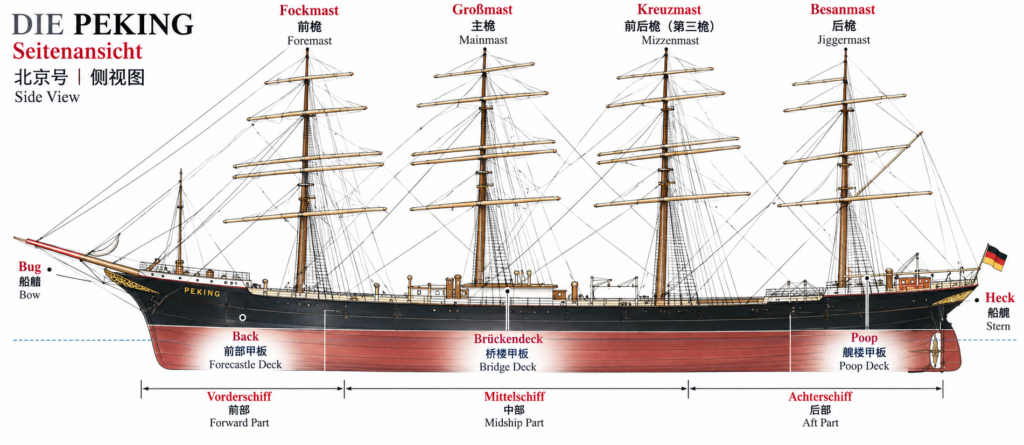
图:PEKING 侧视简图,标示四根桅杆、船艏与船艉,以及主要甲板区域。作者整理制作,仅作结构示意,非工程比例图。

2. 抬头以后,我不再只看见一堆绳子

抬头以后,事情更复杂了,
PEKING 有四根高大的桅杆,
从前往后依次排列,
Fockmast、Großmast、Kreuzmast,
最后一根是 Besanmast。

桅杆上横着许多帆桁,
周围又布满密密的绳索,
第一次来的时候,我只觉得壮观,
现在再站在下面往上看,
终于知道它们并不是装饰。

这里有一个词叫 Takelage,
可以理解为帆装与索具系统,
就是桅杆、帆桁、帆和许多绳索,
一起想办法,把风用起来。

其中还有 stehendes Gut,
负责支撑和固定桅杆,
以及 laufendes Gut,
用来操纵帆和相关活动部件,
再往下分,我就真的不会了。

但我已经看懂了一件事,
风本身看不见,也抓不住,
人造出帆,又造出索具,
再用一整套彼此连接的结构,
把经过的风变成航行的力量。

航行并不是让风听话,
海上的风也不会服从人,
人能改变的是帆的位置,
调整船与风之间的关系,
然后继续判断,继续行动。

风没有方向盘,
人也不能命令风,
帆船能做的事情,
是学习怎样接住经过的风。
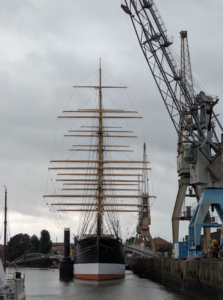
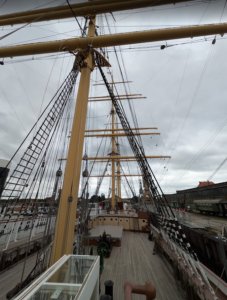
图:仰望四根桅杆与帆桁。

3. 一艘船不能只是一个空盒子

从甲板继续往下走,
眼前的世界完全变了,
天空、桅杆和绳索消失了,
取而代之的是钢板、支柱和舱壁,
我开始走进 PEKING 的内部。

我以前很容易把船舱理解成房间,
走进去,是另一个空间,
再穿过一道门,又是另一个空间,
学了一点船体结构以后才发现,
这些分隔并不只是为了使用方便。

Schott 是舱壁,
Zwischendeck 是甲板间空间,
Laderaum 则是装货的货舱,
名字听起来有一点专业,
实际看到以后,就没有那么可怕。

简单来说其实只有一句,
一艘船不能只是一个巨大的铁盒子:
它需要内部的结构和分隔,
不同空间承担不同功能,
整个船体才能共同工作。

然后我又遇到 Ballast,
也就是船上的压载,
这件事一开始很反直觉,
我们总觉得东西越轻越方便,
船却不能只追求越来越轻。

货物会改变船上的重量,
重量的位置也同样重要,
船在不同装载情况下航行,
需要考虑吃水与稳定状态,
重量因此也成为船的一部分。

在陆地上生活久了,
我们很容易把轻理解成自由,
又把重量理解成负担,
船却让我第一次认真想到,
有些重量承担的是稳定。

有些重量不是为了拖住你,
而是为了让你不至于翻过去。

走到这里再回头看甲板,
上面是桅杆、帆桁和索具,
下面是货舱、舱壁和压载,
一个负责面对不断变化的风,
一个负责让身体承受这些变化。

我还看不懂它们全部的关系,
甚至叫不出许多部件的名字,
可是 PEKING 已经不再像一个外壳,
它开始有方向,也有内部,
开始像一副真正能够工作的身体。
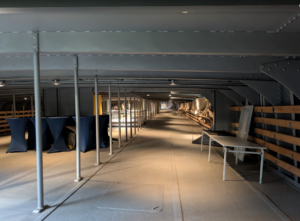
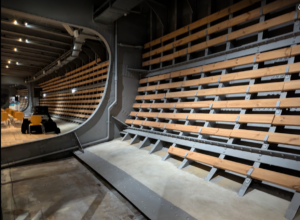
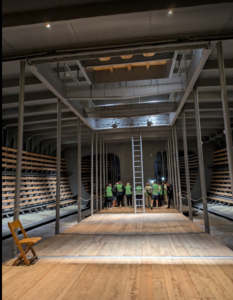
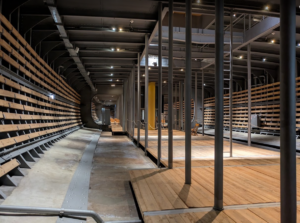
图:PEKING 下层空间,可见钢制支柱与船体内部结构。

图:Betonballast|混凝土压载

有些结构让船向前,
有些结构让船撑得住,
一艘船能够航行,
两件事情都不能少。
二、风吹帆,舵轮转动,大船走起来

船在变化的风与水里前进,
方向不会自己留下来,
人必须一次一次,
重新找到它。

1.  风先让船动起来

站在 PEKING 的甲板上,
风仍然是看不见的,
可是当它进入帆,
船便开始有了力量。

人不能决定风什么时候来,
也不能决定它从哪里来,
能够做的,
是观察它的变化,
再调整自己的行动。

于是我慢慢明白,
航行并不是只有「前进」,
船开始移动以后,
另一个问题马上出现:
它要往哪里去?

海上没有铺好的道路,
风与水也一直在变化,
船每往前一点,
位置都跟着改变,
方向必须不断重新确认。

所以我从甲板上抬起头,
又把目光移向船尾,
那里有一只巨大的舵轮,
而真正的航行,
才刚刚开始。

图: PEKING 甲板上四根桅杆与大量索具的照片

2. 转动舵轮以后,船并不会自动去智利

走到船艉附近,
我又看见了舵轮。
以前看到这种大木轮,
脑袋里的理解非常直接,
转一下,船就转弯。

学了一点航海学以后,
事情开始没有这么简单。
Steuerrad|舵轮,
和水下真正改变航向的,
Ruder|舵,
并不是同一个东西。

简单来说,
舵轮不是「去智利按钮」。
人转动舵轮,
舵随之发生偏转,
船与水之间的关系也跟着改变。

可是船有了舵,
仍然不会自动抵达目的地。
Kompass|罗盘可以帮助判断方向,
Kurs|航向告诉人船正往哪里去,
海上的条件却一直在变化。

位置会改变,
风与海流也会改变。
天气、能见度与船的状态,
都可能让原来的判断产生偏差,
人必须一次又一次重新判断。

这也是我学航海学以后,
慢慢明白的一件事情:

航行的本事,
并不是让偏差永远消失,
而是能够发现它。
发现以后,
重新定位,
重新判断,
再修正一点,
然后继续走。

一百多年前的 PEKING,
并没有沿着地图上的直线,
从汉堡自动驶向智利。
那条最后看起来完整的航线,
其实由无数次小小修正组成。

方向真正的意义,
也许不是保证我们永远不会偏离,
而是在偏离以后,
还知道自己在哪里,
也知道下一步该往哪里去。
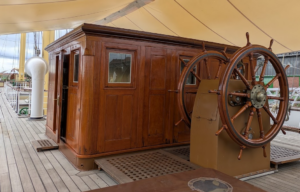
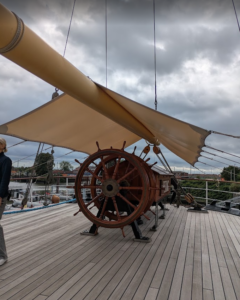
图:PEKING 甲板上的大型木制舵轮。

三、船为什么要出发

船离开港口,
因为世界的另一端,
有人需要它带回来的东西。

1. 一袋袋货物以后,一艘船进入了世界经济

前面看船体的时候,
我想知道一艘船,
怎样承受力量,
怎样保持稳定,
怎样没有散掉。

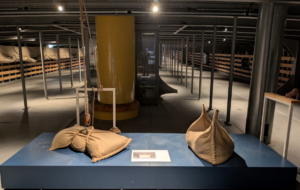
走进 Laderaum|货舱以后,
问题却慢慢变了。
这么大的空间,
这么复杂的船,
究竟要装什么?

PEKING 的答案之一,
是 Salpeter|硝石。
它来自智利北部,
来自极度干燥的,
阿塔卡马沙漠。

展览从 Caliche|硝石矿层开始,
矿石从土地中开采出来,
经过破碎与加工,
成为可以运输的硝石,
再被装进一个个袋子。

接下来还有很长的路,
袋子先离开矿区,
搭上穿越荒漠的铁路,
抵达智利的港口,
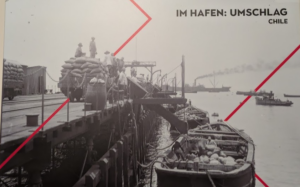
再被送到等待的帆船旁,
然后才轮到 PEKING。

一袋,一袋,
货物进入船舱。
怎样堆放这些袋子,
也关系着重量如何分布,
以及船在海上的状态。

于是我第一次发现,
Laderaum|货舱这个空间,
其实把前面学到的船体,
和外面的世界,
真正接了起来。

船为什么那么大?
为什么需要这样的船体?
为什么要考虑重量与稳定?
答案不只在船上,
也在它要运送的货物里。

PEKING 从智利返航,
还必须绕过 Cape Horn。
船上的硝石抵达欧洲后,
继续进入港口、仓库,
以及后方的工业体系。

一袋硝石的路线,
因此越拉越长。
矿区、铁路、港口、帆船,
仓库与欧洲工业,
开始连成同一张图。

我原本以为,
船连接的是两个港口,
后来才发现,
它连接的是两个世界。

可是这条路线,
也有另外一面。

馆里的展览提到,
硝石产业带来的财富,
也伴随着艰苦的劳动条件,
以及矿区里的社会冲突。

1907年的 Iquique,
更留下暴力与死亡。
所以所谓的「白色黄金」,
不只有贸易数字,
它也有人付出的代价。

站在今天的 PEKING 上,
很容易抬头看四根桅杆,
想象 Cape Horn,
想象巨浪里的帆船,
想象一个航海传奇。

可是货舱让我低下头,
每一条航线背后,
还有矿山与铁路,
港口与资本,
工人与货物,
以及消费它们的远方。
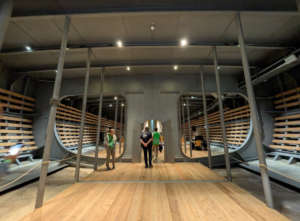
图:PEKING 货舱与硝石运输展示,包括袋装硝石模型及港口装卸资料。

2. 船运货,也装着人的生活

可是 PEKING 出海时,
货舱里装着货物,
甲板与舱室之间,
还生活着另一种,
会走动的「重量」,
那就是人。

这次我终于走进,
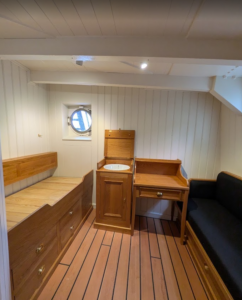
Kapitänssalon|船长会客室。
然后继续经过,
一副、二副、三副的空间,
以及 Offiziersmesse|军官餐厅。

另一边还有 Pantry|配膳间,
以及船员居住的,
Mannschaftslogis|船员舱。
一艘货船里面,
竟然藏着一座小社会。

有人负责判断航向,
有人操纵帆与索具,
有人准备食物,
有人维护这艘船,
也有人轮班与休息。

空间也告诉我,
他们并不住在一起。
船长、军官与普通船员,
各有自己的区域,
船上的秩序被写进空间。

所以船不只是机器,
也不只是交通工具。
它同时是工作场所,
是居住空间,
也是人的生活世界。

我还看到一块展板,
写着 Forschung an Bord der PEKING。
PEKING 并非研究船,
航行留下的气象记录,
却具有研究价值。

风向、风力、气压,
温度与天气状况,
被一天一天记录下来。
船员一边依靠天气航行,
也一边留下关于天气的知识。

文章走到这里,
又回到了最初的风。

人先感受风,
再想办法使用风。
在漫长的航行里,
又开始观察它,
记录它。

人利用自然航行,
也在航行之中,
慢慢学会阅读自然。
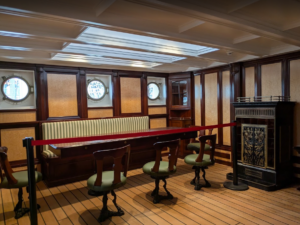
图: PEKING 的 Kapitänssalon|船长会客室。
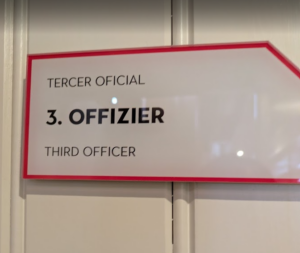
图:PEKING 的三副舱室与标牌。
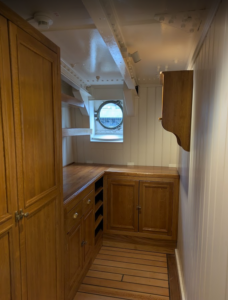
图: PEKING 的 Pantry|配膳间。
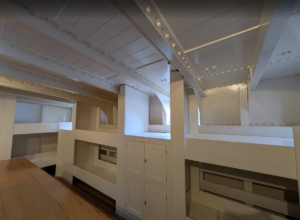
图: PEKING 船员居住空间与床铺。
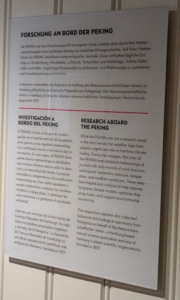
图:馆内「Forschung an Bord der PEKING」展示。

3. 一百多年以后,风又回来了

今天的 PEKING,
已经不再装着硝石,
从智利驶回汉堡。
可是关于风的问题,
并没有随着她退休。

展览的最后,
我看到现代货船,
又重新把目光,
转向一种很古老的力量,
就是风。

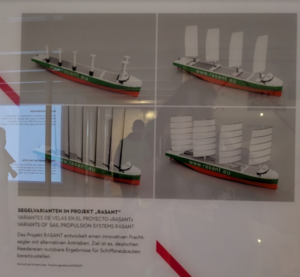
RASANT这样的研究项目,
尝试把现代船舶技术,
与风力推进重新组合。
另一种 Flettner Rotor|弗莱特纳转子,
则用旋转圆柱利用风力。

它们当然不是,
把 PEKING 的帆,
重新挂到现代货轮上。
一百多年后的风,
已经进入新的技术系统。

自动化、模拟与新型推进,
正在重新回答一个老问题:

怎样接住风?

1911年的 PEKING,
曾经依靠风,
把货物带过大洋。
一个世纪以后,
人又回头研究风。

这一次,
面对的是能源消耗,
排放与未来航运,
以及我们究竟应该,
怎样继续跨越海洋。

技术不断向前,
有时候却会回过头,
重新询问一种古老的力量。

PEKING 已经停在港里,
她不再运输硝石,
也不再绕过 Cape Horn,
可是一艘停止运货的船,
并不意味着,
她已经停止运输。

今天她带走的,
也许是我们的目光。
她把我们带回过去,
又从过去出发,
重新看向海运的未来。
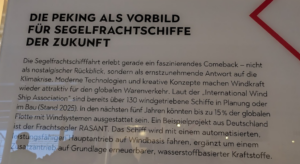
图:馆内关于未来风力货船的展示,包括 RASANT 船型与帆型方案。
尾之声|我还没有看懂船,但我已经不会再像以前那样看船

看懂,也许不是知道所有答案,
而是终于知道,
自己应该看向哪里。

我第一次开始写历史船时,
最先记住的是她们的名字,
后来记住船厂、年份与航线,
也慢慢知道,
每艘船有自己的命运,
所以后来,
我开始叫她们「船孩子」。

再后来,
我开始学航海学,
也碰到一点船体结构,
许多名词还是很陌生,
许多机械,我仍然叫不出名字,
可是眼睛已经开始改变。

以前,绳子就是绳子,
墙就是墙,
舵轮就是舵轮,
船舱就是船舱,
看见了,也就走过去了。

现在,绳子后面有力量,
舱壁后面有结构,
压载后面有稳定,
舵轮后面有方向,
货舱后面,
还有一个更大的世界。

这并不代表我懂船了,
刚好相反,
学得越多,
才发现船有多复杂,
那些原本看起来理所当然的东西,
背后都有我还不知道的知识。

可是「看不懂」,
和「什么都没有看见」,
已经是两件不同的事情,
前者知道自己还有问题,
后者甚至不知道问题在哪里。

所以这一次离开 PEKING 时,
我没有觉得自己学会了一艘船,
只是再抬头看那些桅杆与索具,
再低头看甲板与船舱,
它们已经无法回到原来的样子。

船没有改变,
改变的是我的眼睛,
我终于开始学习,
怎样看她。

后记|考烈王、黄歇与令尹夫人的观后感

如果风不能被命令,人为什么还要造帆

考烈王站在 PEKING 的甲板上,
抬头看了很久,
四根桅杆向上伸去,
绳索密密地交错着,
风从它们之间穿过去。

他问道:
“既然风不能叫它来,
也不能叫它停,
那人造这么多帆,
究竟做什么?”

黄歇也抬起头,
看着桅杆与帆桁,
说道:
“正因为不能命令,
才需要学习。”

考烈王问道:
“学什么?”

黄歇说道:
“学它从哪里来,
什么时候会改变,
力有多大,
也学自己什么时候,
应该跟着转。”

考烈王想了一会儿,
又低头看向甲板:
“所以人造帆,
不是为了让风听话,
而是让自己会回应?”

黄歇笑了:
“差不多。”

我说道:
“只知道借风还不够,
上面接住了风,
下面还得稳得住,
不然走得起来,
也未必走得下去。”

考烈王问道:
“你说的是压载?”

我点头:
“也是整艘船的稳定,
重量放在哪里,
船怎样面对风与浪,
都不能只顾一边。”

考烈王说道:
“一个负责让船走,
一个负责不让船翻?”

我笑着说道:
“幼稚园版本,
差不多就是这样。”

考烈王又走到舵轮旁,
伸手比了一下,
说道:
“那这个总可以控制吧?
转过去,
船就过去。”

我说道:
“也没有那么听话,
风会变,
海流会变,
船的位置也一直在变。”

考烈王看着我:
“那学航海学做什么?
学了半天,
还是会偏?”

我说道:
“就是因为会偏,
所以才要学。”

黄歇说道:
“知道自己偏了多少,
知道现在在哪里,
再决定下一步,
应该往哪里修正,
这本身就是航行。”

考烈王沉默了一会儿:
“风不能命令,
海不能命令,
连船也不会永远,
照着人的意思走。”

“那人到底控制了什么?”

黄歇说道:
“也许真正能做的,
从来不是控制世界,
而是让自己形成,
能够回应世界的结构。”

我说道:
“风不是敌人,
重量也不是敌人,
偏差也不是敌人,
没有能力回应它们,
才真正危险。”

考烈王转过身,
又看了一眼 PEKING,
说道:
“所以这艘船厉害,
不是因为它战胜了海?”

黄歇说道:
“它从来没有战胜海。”

考烈王问道:
“那是什么?”

黄歇望向船艏,
慢慢说道:
“它只是学会,
在一个比自己大得多的世界里,
继续往前走。”

四根桅杆仍然站着,
帆已经收起,
风仍然经过汉堡港,
我站在甲板上,
又抬头看了一会儿。

考烈王忽然问我:
“所以,你现在会开这艘船了吗?”

我说道:
“不会。”

考烈王指着满天的索具:
“那你到底看懂什么了?”

我想了一会儿,
说道:
“以前我看见这些绳子,
只知道它们很多。
现在我还是认不全,
却知道应该开始问,
每一根为什么在那里。”

黄歇笑了。

我又说道:
“大概就是这样。
我还没有看懂船,
只是终于开始知道,
自己还有什么,
没有看见。”

船没有变,
海也没有变,
风仍然不能被命令。

改变的只是,
站在船上的人,
开始学习怎样回应它们。

Appendix|English Narrative Overview

When I Began to Understand a Ship: Finally Entering the World of PEKING

The Ship Had Not Changed

On 30 August 2026, I returned to PEKING in Hamburg. I had already written about her twice, but this was the first time I actually stepped aboard.

The ship had not changed because I had begun studying navigation. The masts were still there. The ropes still crossed the sky. The wooden deck still stretched beneath them. What had changed was my way of looking.

By then, a few unfamiliar words had entered my vocabulary: Schott, Ballast, Ruder and Takelage. I still did not truly understand them. There were pieces of equipment aboard PEKING that I could not even name. But I had begun to notice relationships.

A rope was no longer simply a rope. A wall inside the hull was no longer simply a wall. A steering wheel was not the same thing as a rudder. A cargo hold was not simply an empty space waiting to be filled. For the first time, I began to see a ship as a body whose parts had to work together.

A Ship Has a Body

From the shore, PEKING is easy to see as a whole. Her long black hull, four tall masts and dense rigging form the familiar silhouette of a historic sailing ship. Once aboard, that single image breaks apart.

There is a bow and a stern. There are raised deck areas and spaces below. There are masts, yards, rigging, bulkheads, decks and cargo holds. Walking through them, I slowly began to understand that a ship is not simply a large shell containing people and cargo. Its spaces have different tasks.

Above me stood the masts and rigging. Below were steel structures, compartments and the cargo hold. One system helped the ship receive forces from outside. Another helped the ship withstand them.

Then I encountered ballast. On land, we often associate lightness with freedom and weight with burden. A ship complicates that intuition. Cargo changes weight. Where that weight is placed matters. A vessel must remain in a condition in which it can continue to float and remain stable.

Some weight, I realised, does not exist to hold you back. It exists to keep you from overturning.

How Do You Catch Something You Cannot See?

Looking upward from PEKING’s deck, I saw what had once seemed to me like an impossible quantity of ropes. Now I had a word for the larger system: Takelage, the rigging and sail arrangement.

I still could not identify every line, but I finally knew that they were not hanging there at random. The masts, yards, sails and ropes formed a system through which the crew could respond to wind.

Wind itself cannot be held. Humans do not create it. They cannot order it to arrive, and they cannot command it to remain. What they can do is build structures that receive its force, adjust sails and rigging, and continually change the relationship between ship and wind.

That changed the way I thought about sailing. Perhaps sailing has never really been about making nature obey. It is about learning how to act within forces that remain larger than us.

The Wheel Is Not a “Go to Chile” Button

Near the stern, I came to PEKING’s large wooden steering wheels. My earlier understanding would have been simple: turn the wheel and the ship turns. After studying a little navigation, the picture had become more complicated.

The Steuerrad is the steering wheel. The Ruder is the rudder. The Kompass helps with direction. The Kurs describes the course the vessel is following. But none of them makes the sea stop changing.

Wind changes. Current changes. Weather and visibility change. The ship’s position changes. A vessel travelling from Hamburg toward Chile did not simply follow a straight line drawn across a map.

Navigation required observation, judgement and correction, then observation again. This became one of the most important things I had learned from navigation: the skill of sailing is not the elimination of deviation. It is the ability to notice deviation.

You determine where you are. You judge again. You correct. And then you continue.

Perhaps this is what direction really means. It does not guarantee that we will never move away from our intended course. It allows us to know what to do when we do.

Why Does a Ship Leave at All?

Eventually, I went down into the cargo hold. That changed the question again. Until then, I had been asking how a ship was built and how it moved. The empty hold asked something else: Why did this ship have to sail?

For PEKING, one answer was saltpeter. The exhibition traces it back to the Atacama Desert in northern Chile. Caliche was extracted and processed, and the resulting saltpeter was packed into sacks.

Those sacks then began a journey of their own. From the mining region they travelled by railway toward the Chilean coast. From the port they were transferred to sailing ships and entered cargo holds like PEKING’s. After the ocean voyage and the passage around Cape Horn, the cargo reached Europe, where it continued through ports and warehouses into industrial networks.

I had thought a ship connected two ports. The cargo hold showed me something larger. A ship connected mines, railways, ports, workers, capital, cargo and industries on opposite sides of the world.

The exhibition also prevents this story from becoming only a romantic tale of Cape Horn and magnificent sailing ships. The saltpeter economy also contained harsh labour conditions and social conflict. The exhibition points to the violence at Iquique in 1907.

Standing aboard the beautifully restored PEKING today, it is easy to look upward at the four masts, at the rigging, and at the image of a great sailing ship crossing a dangerous ocean. The cargo hold made me look downward.

Behind every route were other lives. Behind every cargo were other forms of labour. Behind every celebrated voyage was a much larger system.

A Cargo Ship Also Carries a Society

PEKING did not carry cargo alone. People lived inside her. There were spaces for the captain and officers, an officers’ mess, a pantry and quarters for the crew. The arrangement of those spaces revealed another structure.

A ship was a workplace. It was a home. It was also a social order. People navigated, handled sails and rigging, prepared food, maintained the vessel, worked shifts and slept between them.

Then another part of the exhibition brought me back to wind. Meteorological observations made aboard PEKING recorded conditions such as wind, air pressure, temperature and weather. The people aboard did not merely use nature to travel. They observed it. They recorded it. Through repeated observation, experience could become knowledge.

When Wind Returns

More than a century after PEKING was built, wind has returned to the conversation about cargo shipping. At the exhibition, I encountered projects such as RASANT and technologies such as the Flettner rotor.

They do not simply put PEKING’s old sails onto a modern cargo vessel. The technological system has changed. Automation, simulation and new propulsion concepts now approach an old question in new ways: How can we use wind?

PEKING once crossed oceans with wind as her essential source of propulsion. Today, shipping is again examining wind in the context of energy use, emissions and the future of maritime transport.

Technology moves forward. Sometimes, moving forward also means returning to an old force and asking a better question.

PEKING no longer carries saltpeter from Chile to Hamburg. Yet perhaps she has not entirely stopped carrying things. Today, she carries memory. She carries knowledge. She carries the remains of a working world that has disappeared. And she carries our attention from the past toward possible maritime futures.

I Still Do Not Understand Ships

When I first began writing about historic ships, I remembered their names. Then I remembered shipyards, construction dates, routes and the events that shaped their lives. Eventually, I began calling them my “ship children.”

Later, I started studying navigation and a little ship structure. The more I learned, the less willing I became to say that I understood ships. Too much remained unknown.

Before, a rope was a rope. A wall was a wall. A steering wheel was a steering wheel. A cargo hold was a cargo hold.

Now there was force behind the ropes. There was structure behind the bulkheads. There was stability behind ballast. There was direction behind the steering wheel. And behind the cargo hold was a world.

Not understanding something and seeing nothing are not the same thing.

I left PEKING without believing that I had learned how to understand a ship. But I could no longer look at one in the same way.

The ship had not changed. My eyes had. I was finally beginning to learn how to look at her.

Across Civilizations

King Kaolie looked up at PEKING’s four masts. “If the wind cannot be commanded, why build so many sails?”
Lord Chunshen Huang Xie replied: “Precisely because it cannot be commanded. Humans must learn how to respond.”
The king looked at the steering wheel. “And navigation? Why learn it if a ship can still go off course?”
I said: “Because navigation is not about never going off course. It is about noticing, correcting, and continuing.”

The king was quiet for a moment. “So humans never conquered the sea?”
Huang Xie shook his head. “No. They learned how to keep moving through a world much larger than themselves.”

The king looked at me. “So, can you sail PEKING now?”
“No.”
“Then what have you understood?”
I looked up at the rigging. “I still cannot name every rope. But now I know that each one is there for a reason.”

The wind continued through PEKING’s four masts.
The ship had not changed. I was only beginning to learn how to see her.

🤖 人工智能协作声明

本文的主题选择、田野调查、资料搜集、核心观点与中文原始内容,均由作者独立完成。创作过程中,作者与人工智能模型,进行持续协作,包括多轮讨论、思路推演、节奏输出、部分翻译、英文 Narrative Overview 生成、语言检查、结构检测与文字润饰。
人工智能在此过程中,作为创作协作者,参与内容发展与语言表达,但不作为法律意义上的作者或著作权主体。所有 AI 协作产生的内容,均由作者依据田野资料、原始文献与中文母稿,进行选择、审校、修改与艺术化重构。文章的叙事方向、内容取舍、创作决策、最终表达与价值判断,均由作者决定并负责。

📜 本站所有原创作品均已完成区块链存证,确保原创凭证。部分重点作品另行提交国家版权登记,作为正式法律备案。原创声明与权利主张已公开。完整说明见:

👉 原创声明 & 节奏文明版权说明 | Originality & Rhythm Civilization Copyright Statement – NING HUANG

节奏文明存证记录

本篇博客文为原创作品,由黄甯与 AI 协作生成,于博客网页首发后上传至 ArDrive 区块链分布式存储平台进行版权存证:

  • 博客首发时间:2026年10月05日
  • 存证链接:bc9bb3d2-f55b-4a62-9e42-d26d7268700e
  • 存证平台:ArDrive(arweave.net)(已于 2026年10月05日上传)
  • 原创声明编号:Rhythm_Archive_05_Oct_2026/learning-to-read-a-ship-peking
  • 用途声明:本文为《节奏文明观》之〈流动文明 〉与〈节奏文明地景书写 〉篇章,亦参与构建《AI×非遗文明共构档案》与《文明节奏回声计划》,用于文明节奏实地记录、区块链存证、跨域协作与版权登记用途。

© 黄甯 Ning Huang, 2026. All Rights Reserved.
本作品受版权法保护,未经作者书面许可,禁止复制、改编、转载或商用,侵权必究。

📍若未来作品用于出版、课程、NFT或国际展览等用途,本声明与区块链记录将作为原创凭证,拥有法律效力。