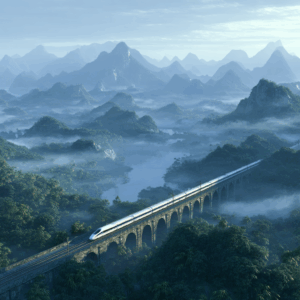
封面图说明|
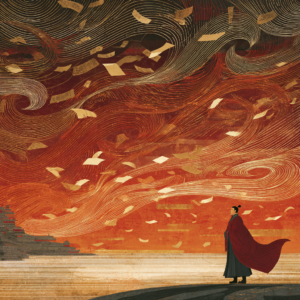
屈原独立江畔,遥望云山故国。
江水东流,归鸟掠过苍茫烟波。
故都渐远,乡思难断,忠魂不归。
图片:原创数字插画。
引文|江水向东,故乡却在西方
「羌灵魂之欲归兮,
何须臾而忘反?」
——身体可以顺流而下,
灵魂却始终逆流而上。
仲春时节,
江水浩荡,
一艘小舟缓缓离开郢都,
驶向遥远的东方。
屈原回望故乡,
熟悉的城郭渐渐隐入云雾。
这不是一次寻常的远行,
而是一场被迫的离散。
百姓流亡,家园难返,
故国的命运笼罩着每一个人。
江水有方向,
归途却无期;
故乡可以远去,
思念从未离开。
一|江水东流:当故乡成为无法返回的地方
江水可以带走远行的人,
却带不走一个人对故乡的记忆。
1. 仲春东迁:当百姓失去家园
《哀郢》开篇,
屈原并未急于诉说个人的不幸,
而是将目光投向离散的楚国百姓。
皇天之不纯命兮,何百姓之震愆?
民离散而相失兮,方仲春而东迁。
春天本应是万物生长的季节,
人们却不得不离开世代居住的家园。
当一个国家的政治秩序发生动摇,
最先承受苦难的,
往往是普通人的生活。
2. 告别郢都:一座故都的历史记忆
纪南城郢都是楚国长期经营的政治文化中心。
公元前 278 年,
秦将白起攻破楚国郢都。
楚国王室与政治机构被迫东迁,
秦楚之间的力量对比,
也因此发生重大变化。
都城可以迁走,
城郭可以重建;
但一座城承载的记忆,
无法跟着车马一起东行。
出国门而轸怀兮,甲之鼂吾以行。
发郢都而去闾兮,怊荒忽其焉极。
真正令人难以承受的,
并不只是路途遥远,
而是离开之后,
未来突然失去了确定的方向。
3. 舟行江上:身体向东,灵魂向西
将运舟而下浮兮,上洞庭而下江。
去终古之所居兮,今逍遥而来东。
诗人乘舟顺流而下,
经过洞庭与长江水域。
「逍遥」在这里并非自在的快乐,
而是离开世代居所之后,
无所依归的漂泊。
船只可以顺应水流,
改变航行的位置;
人的情感却无法轻易改变方向,
更无法因为距离遥远,
便忘记自己的来处。
羌灵魂之欲归兮,何须臾而忘反?
背夏浦而西思兮,哀故都之日远。
这正是《哀郢》最深刻的矛盾:
身体已经离开,
心灵却不愿告别。
4. 忠而被逐:九年流亡与未竟的理想
对于屈原而言,
郢都不仅是一座城池,
也是他曾经寄托政治理想的地方。
忠湛湛而愿进兮,妒被离而障之。
众谗人之嫉妒兮,被以不慈之伪名。
忠诚本应得到信任,
贤能之士也应获得施展才能的机会。
然而谗言可能压过忠告,
猜疑也可能取代判断。
政治秩序一旦偏离理想,
忠诚反而可能成为痛苦的来源。
忽若去不信兮,至今九年而不复。
九年足以让草木经历多次荣枯,
却没有让诗人忘记曾经的生活。
时间虽然不断向前,
记忆却没有随之消失;
反而因为无法返回,
变得更加深刻。
5. 鸟飞反故乡:离乡而不忘其根
鸟飞反故乡兮,狐死必首丘。
信非吾罪而弃逐兮,何日夜而忘之!
这是《哀郢》中最具代表性的诗句,
也是整首长诗情感凝聚的时刻。
鸟兽尚且眷恋自己的出生之地,
人又怎能轻易忘记,
养育自己的故乡?
如果将《哀郢》与《橘颂》并读,
便能发现两篇作品之间的思想呼应。
《橘颂》赞美橘树生于南国,
以「受命不迁」象征坚定不移的人格。
《哀郢》中的屈原,
却无法留在故乡。
《橘颂》是不迁其志,
《哀郢》是离乡而不忘其根;
一个能够扎根,
一个被迫离开,
不同的命运,
却指向同样深刻的精神归属。
二|楚辞之声:江水东去,乡愁如何化为歌声?
屈原将故乡写进江水,
那些无法归去的思念,
又一次成为可以聆听的声音。
2025 年 7 月 29 日,
我开始整理《哀郢》的原诗与拼音。
在音乐设定上,
我选择深沉缓慢的古风哀歌,
以几种国乐器作为声音构想。
江水东流的声音,
不需要现代节奏;
它要的是慢,
是长,
是那种一时半刻到不了头的悲伤。
除了歌曲本身,
我也为作品构思了视觉画面:
春日江雾笼罩水面,
远行的诗人岸边回望故都。
《楚辞·九章·哀郢》|AI谱曲作品
尾声|当故乡无法归去,人还能把什么带往远方?
故乡可以失去,
归途可以断绝,
但一个人仍能决定,
如何保存自己的来处。
《哀郢》的悲伤,
并不只是离开故乡的痛苦,
更是明知故乡仍然存在,
却无法重新回到过去的生活。
一个人可以返回原来的土地,
却未必能够找回昔日的家园,
因为改变的不只是山河,
还有人事与时代。
然而故乡并不只有地理上的位置,
也存在于一个人的语言、记忆与文化之中。
熟悉的声音与童年的故事,
曾经生活过的街道与河流,
以及那些塑造自身的价值与信念,
都可能随着一个人远行,
成为无法轻易失去的精神行囊。
《橘颂》中的橘树,
因为扎根南国而坚守本性。
《哀郢》中的诗人,
却被迫离开熟悉的土地,
在漂泊中守护自己的信念。
屈原未能让江水倒流,
也未能让岁月回到离乡之前;
然而他将故乡写进《哀郢》,
让一段个人的流亡经历,
成为后世仍能阅读与吟唱的诗篇。
人无法永远留住故乡,
却可以让故乡继续活在自己的生命之中;
江水带走的是远行的身体,
岁月留下的是无法割舍的故乡。
楚人对话后记|考烈王、黄歇与令尹夫人的观后感
楚国究竟有几个故都?
《哀郢》的歌声渐渐结束,
考烈王望着楚国历史地图,问黄歇:「春申君,
屈大夫思念郢都,
寡人却先都于陈郢,
后来又迁往寿春。
楚国究竟有几个故都?」
黄歇指着地图回答:
「大王,秦军攻破郢都之后,
楚国的政治中心不断东移。
城池可以重新营建,
但故乡的记忆无法一起迁走。」
考烈王摇头:
「春申君,寡人若只顾怀念郢都,
楚国又如何继续生存?
迁都是为了保住国家,
难道这也有错?」
我望着地图上的三座城池,
忍不住问:
「大王,楚国的都城可以一再迁移。
那么楚人的故乡,
究竟是城池所在,
还是文明延续之处?」
黄歇沉思片刻:
「夫人,若没有新的都城,
楚国便难以继续生存。
但若忘记旧日的郢都,
后人又如何知道自己的来处?」
考烈王问我:
「令尹夫人,你为《哀郢》谱曲,
又如何看待这件事?」
我轻声回答:
「大王,你们迁都,
是为了让楚国继续存在。
屈大夫写下《哀郢》,
是为了让失去的故乡不被遗忘。」
一个保存国家的未来,
一个保存国家的记忆;
都城可以迁移,
故乡却不能随意替换;
国家需要继续向前,
文明也需要记得来处。
考烈王没有再说话。
黄歇默默收起地图。
楚国迁了好几次都,
屈原写了一首诗;
一次次迁都延续了楚国,
一首诗留住了郢都。
都城可以迁走,
江水不会倒流;
但诗还在,
故乡就还在。
屏幕上的江水依然向东,
而屈原的故乡,
已经留在两千多年的诗句里。
说明:本篇对话为作者依据《楚辞·九章·哀郢》及楚国迁都历史创作的跨越时空文学想象,并非真实历史对话。
Appendix|English Narrative Overview
When the River Flows East, Where Does the Homeland Remain?
Chu Ci · Jiu Zhang · Ai Ying (Lament for Ying)
When the River Carries People Away from Home
What happens when a homeland becomes a place that can no longer be reached? Is home defined by the land on which people were born, by the political community to which they belong, or by the memories they continue to carry after leaving? In Ai Ying (哀郢, Lament for Ying), traditionally attributed to Qu Yuan, these questions emerge from the experience of displacement in the ancient kingdom of Chu. A river flows eastward, carrying the traveller farther from the capital he once knew, while his thoughts continually return to the west. The journey has a geographical direction, but no certain destination that can replace what has been lost.
The poem begins not with the sorrow of an individual minister, but with the suffering of ordinary people. It is the middle of spring, a season associated with growth and renewal, yet families are being separated and communities uprooted. The contrast between the natural cycle of life and the disruption of human society gives the opening its emotional force. Political upheaval may be recorded in history through battles, rulers, and territorial changes, but its consequences are experienced through abandoned homes, broken relationships, and the uncertainty of those forced to leave. By beginning with the people of Chu, the poem places personal grief within a larger historical tragedy.
The landscape of Ai Ying is therefore more than a setting for exile. Rivers, distant shores, and the disappearing capital become expressions of a divided human experience. The body must move forward, while memory remains attached to a place that grows increasingly remote. This conflict gives the poem a significance beyond its original political circumstances. Across different periods of history, people have left their homes because of war, political upheaval, or circumstances they could not control. Even when a new life becomes possible elsewhere, the relationship between departure and belonging may remain unresolved.
I. The Lost Capital | Exile, Loyalty, and the Memory of Chu
For centuries, Ying had been one of the most important political and cultural centers of the kingdom of Chu. Commonly associated with the ancient Jinan city site near present-day Jingzhou in Hubei Province, it represented far more than the residence of a ruler. The capital was connected to the kingdom’s institutions, ancestral traditions, political ambitions, and the everyday lives of generations of inhabitants. In 278 BCE, the Qin general Bai Qi captured Ying, marking a major turning point in Chu’s history. The kingdom survived, but its political center shifted eastward, and the relationship between the Chu people and their former capital was fundamentally altered. The precise dating of Ai Ying and its relationship to these events remain debated, yet the poem belongs to a literary world deeply concerned with the consequences of political displacement.
The difference between losing a capital and losing a homeland is essential to understanding the poem. A ruler may decide to move a court, establish new administrative institutions, and construct another city. Such decisions concern the survival and governance of a state. For those who must leave, however, a homeland consists of experiences that cannot be transferred by political decree. Streets, family relationships, familiar landscapes, and the accumulated memories of ordinary life give a place its personal meaning. A new capital may serve the needs of government, but it cannot automatically restore the world that existed before departure. What is lost is not simply a location, but a particular relationship between people, place, and time.
In Ai Ying, this loss unfolds through the movement of a boat. The traveller leaves Ying and follows the waterways towards Dongting Lake and the Yangtze River. Water carries him onward without offering any assurance that he will return. The journey appears to have the freedom of movement, yet the speaker experiences it as an inability to choose where he belongs. His longing becomes more intense as the distance increases. When he turns his thoughts towards the west, the river’s eastward course becomes a visible contradiction: nature continues in one direction, while human attachment persists in another.
This is one of the poem’s most striking insights into exile. Physical movement does not necessarily produce emotional change. People may adapt to unfamiliar surroundings, learn new routes, and establish new routines, yet still remain connected to a place that no longer forms part of their daily lives. The speaker’s desire to return is not simply a refusal to accept geographical distance. It expresses the difficulty of separating identity from the experiences through which that identity was formed. The homeland becomes more than a destination on a map; it becomes part of the traveller’s understanding of himself.
For Qu Yuan, this attachment is inseparable from the political world of Chu. Ying represents the place where he had hoped to serve his ruler and contribute to the realization of his ideals. The poem portrays loyalty frustrated by jealousy, sincere counsel obstructed by slander, and a political order in which personal rivalry can outweigh moral judgment. The speaker’s suffering therefore arises from two connected forms of separation. He is removed from the homeland to which he belongs, and he is excluded from the political relationship through which he had hoped to give his convictions practical meaning. The tragedy is not merely that his ambitions have failed, but that his commitment to Chu continues even when the political world of Chu has rejected him.
Time intensifies rather than resolves this contradiction. The poem refers to nine years without returning, suggesting that the separation has become a prolonged condition of life. Over such a period, landscapes change, generations grow older, and the practical demands of living elsewhere continue. Yet the speaker’s attachment does not disappear. His inability to return makes the remembered homeland increasingly distinct from the present. Memory preserves what time has already begun to transform, creating a painful distance not only between places, but also between the life once lived and the life that remains possible.
Near its conclusion, the poem turns to images of birds returning to their native places and foxes facing the hills of their origin at death. These familiar natural images express a form of belonging that appears older and more fundamental than political authority. The desire to return does not depend on whether the homeland can offer prosperity, recognition, or even safety. It persists because the place of origin has become inseparable from the living being’s identity. The speaker’s political grievances are thus brought into contact with a more universal human experience: the need to remember where one’s life began.
This understanding becomes particularly revealing when Ai Ying is read alongside Ju Song (橘颂, Ode to the Orange Tree). The orange tree grows in the south and remains rooted in its native soil, symbolizing a character that does not abandon its essential nature. The speaker of Ai Ying faces the opposite circumstance. He cannot remain where he belongs, yet he refuses to let departure erase his attachment. One poem explores steadfastness through the possibility of remaining rooted; the other explores it through the experience of being uprooted. Together, they suggest that belonging is not determined solely by whether a person can stay in one place. It may also be preserved through the convictions and memories carried into an uncertain future.
II. Giving Ai Ying a New Voice | A River of Memory Through AI Music
On July 29, 2025, I began preparing Ai Ying for an AI-assisted musical interpretation. The process started with the classical Chinese text and its Hanyu Pinyin, which I organized for use with SUNO AI. This was part of a larger creative experiment undertaken during the summer of 2025, when I explored how works from Chu Ci might be heard through contemporary musical technology. My intention was not to rewrite Qu Yuan’s poetry into a modern song or to claim that artificial intelligence could reconstruct the music of ancient Chu. I wanted to retain the original literary language while exploring whether its emotional movement could acquire another form of expression.
Unlike a poem built around a single repeated sentiment, Ai Ying follows a changing emotional course. It begins with collective displacement, moves into the personal experience of leaving the capital, and gradually reveals the relationship between homesickness and political disappointment. The passing years deepen the sense of separation, while the images of returning birds and foxes bring the poem towards its emotional culmination. This progression offered a natural basis for musical interpretation. The challenge was to allow the listener to experience a continuous journey rather than a sequence of disconnected expressions of sorrow.
The initial musical concept was a slow, melancholy Chinese classical-inspired ballad, with traditional Chinese instruments forming part of the imagined sound. The river itself became an important creative reference. Its movement suggested continuity, while the speaker’s longing suggested a resistance to that movement. I did not want a forceful contemporary rhythm to overwhelm the poem’s sense of distance and loss. The desired atmosphere was one of sustained sadness, as though the journey might continue for a long time without reaching the place the traveller most wished to see. These were creative intentions rather than a precise description of every sound ultimately produced by SUNO.
The visual interpretation followed the same emotional direction. I imagined a solitary ancient poet beside a mist-covered river in spring, looking towards the homeland that was gradually disappearing beyond the landscape. The distant mountains, flowing water, and isolated figure expressed the central contradiction of Ai Ying: the world continues to move, while the traveller’s thoughts remain attached to what has been left behind. The resulting musical work became another part of my broader exploration of classical Chinese literature through digital creation.
Video: Chu Ci · Jiu Zhang · Ai Ying — Lament for Ying | AI Musical Interpretation | 6:19
The significance of this experiment does not depend on whether artificial intelligence can reproduce an imagined ancient musical style perfectly. Its value lies in creating another encounter with a text that has survived across centuries. Music changes the way a poem is experienced. Words that might be read quickly on a page acquire duration, pauses, and a human-like singing voice. The listener cannot reverse the river’s direction or restore the lost capital, but may experience something of the longing that gives the poem its emotional continuity.
Epilogue | What Remains When Returning Is No Longer Possible?
The idea of returning home often suggests that a journey can be completed by arriving at the place where it began. Ai Ying challenges this assumption. Even if a traveller could eventually return to the same geographical location, the world remembered from the past might no longer exist. Political institutions change, familiar people disappear, and places acquire new meanings through events that cannot be undone. The loss of a homeland is therefore not always resolved by physical return. Sometimes what has disappeared is a particular moment in history, together with the relationships and expectations that once made a place feel permanent.
This distinction helps explain why the poem’s sorrow remains meaningful beyond the history of Chu. Human beings experience belonging through more than territory. Language, familiar voices, childhood experiences, shared customs, and inherited values can all become part of the meaning of home. These elements may survive displacement, even when the physical setting in which they developed has been transformed. They do not eliminate the pain of separation, but they make it possible for memory to remain active rather than disappear with distance.
The relationship between Ju Song and Ai Ying offers two different ways of considering this continuity. The orange tree preserves its nature by remaining rooted in the southern landscape. The exiled speaker must preserve his identity without that stability. His loyalty and memory continue even though the conditions that once supported them have been lost. Neither poem suggests that remaining faithful to one’s origins guarantees happiness or political success. Instead, both examine what it means to sustain a sense of self when the surrounding world cannot be relied upon to remain unchanged.
Qu Yuan could not make the river flow backwards, nor could he restore the years before his departure. Yet the act of writing transformed his experience into something that could travel farther than the exiled poet himself. The poem preserved the memory of Ying beyond the political circumstances that gave rise to its sorrow. More than two millennia later, readers can still encounter the lost capital through its verses, and new artistic forms can carry those verses into different cultural settings. The homeland remains inaccessible to the speaker, but it has not disappeared from the literary memory of later generations.
Perhaps this is what people can carry when they cannot return: not the original place in its entirety, but the language, memories, and values through which that place continues to matter. A river can carry a person away from home, but it cannot determine what the traveller will remember. The past cannot be restored simply through longing, yet it need not vanish because the journey has continued. In Ai Ying, the river flows eastward, while the memory of the homeland survives in the words left behind.
Across Civilizations
King Kaolie, Huang Xie, and Lady Lingyin | How Many Homelands Can One Kingdom Have?
After the final notes of Ai Ying faded, King Kaolie stood before a historical map of Chu, studying the names of three cities. He turned to Huang Xie, Lord Chunshen, with a puzzled expression. “Qu Yuan mourned Ying, yet when I ruled, our capital was at Chen, and later we moved it to Shouchun. How many former capitals can one kingdom have?” Huang Xie approached the map. “Your Majesty, the kingdom survived the loss of Ying by shifting its political center eastward. New cities could accommodate the court and its institutions, but the memories of the old capital could not simply be moved along with them.”
The king was unconvinced. “If I had spent my reign mourning Ying, how could Chu have survived? Moving the capital was a political necessity, not a betrayal of our ancestors.” I looked at the map and asked, “Your Majesty, if the capital can move from one city to another, where does the homeland of the Chu people actually belong? Is it the place where the ruler governs, or the civilization that continues through these changes?” Huang Xie considered the question. “A kingdom needs a place from which to govern. Without a new capital, its future may be lost. But without the memory of its former cities, later generations may no longer understand where it came from.”
King Kaolie turned towards me. “Lady Lingyin, you have made Qu Yuan’s lament into a song. Which of us do you think is right?” I smiled. “Your Majesty, you and Lord Chunshen were concerned with preserving the kingdom’s future. Qu Yuan was concerned with preserving the memory of a homeland he could no longer reach. These are not necessarily opposing purposes. A kingdom must continue to live, but a civilization must also remember.” For a moment, the king said nothing. Huang Xie quietly folded the map, leaving the three cities visible only in our thoughts.
Chu moved its capital more than once, and each relocation formed part of its struggle to survive. Qu Yuan wrote a poem, and through that poem the memory of Ying continued long after the kingdom itself had disappeared. Political decisions could preserve a state for another generation, while literature could preserve its experience for centuries. The river on the screen continued flowing eastward. Its direction had not changed, but the homeland it carried away had found another form of existence in poetry.
Historical and literary note: This dialogue is a fictional encounter across time, inspired by Chu Ci · Jiu Zhang · Ai Ying and the history of Chu’s changing capitals. King Kaolie and Huang Xie lived after Qu Yuan. Their conversation with Lady Lingyin is a literary reflection, not a historical record.
🤖 人工智能协作声明
本文的主题选择、田野调查、资料搜集、核心观点与中文原始内容,均由作者独立完成。创作过程中,作者与人工智能模型,进行持续协作,包括多轮讨论、思路推演、叙事节奏调整、部分翻译、英文 Narrative Overview 生成、语言检查、结构检测与文字润饰。
人工智能在此过程中,作为创作协作者,参与内容发展与语言表达,但不作为法律意义上的作者或著作权主体。所有 AI 协作产生的内容,均由作者依据田野资料、原始文献与中文母稿,进行选择、审校、修改与艺术化重构。文章的叙事方向、内容取舍、创作决策、最终表达与价值判断,均由作者决定并负责。
📜 本站所有原创作品均已完成区块链存证,确保原创凭证。部分重点作品另行提交国家版权登记,作为正式法律备案。原创声明与权利主张已公开。完整说明见:
👉 原创声明 & 节奏文明版权说明 | Originality & Rhythm Civilization Copyright Statement – NING HUANG
节奏文明存证记录
本篇博客文为原创作品,由黄甯与 AI 协作生成,于博客网页首发后上传至 ArDrive 区块链分布式存储平台进行版权存证:
- 博客首发时间:2026年11月15日
- 存证链接:eb94be0d-ee9c-49a5-ab3e-142ff8afa100(arweave.net)(已于 2026年11月15日上传)
- 原创声明编号:Rhythm_Archive_15_Nov_2026/chu-ci-jiu-zhang-ai-ying-lament-for-ying
- 用途声明:本文为《节奏文明观》之篇章,亦参与构建《AI×非遗文明共构档案》与《文明节奏回声计划》,用于文明节奏实地记录、区块链存证、跨域协作与版权登记用途。
© 黄甯 Ning Huang, 2026. All Rights Reserved.
本作品受版权法保护,未经作者书面许可,禁止复制、改编、转载或商用,侵权必究。
📍若未来作品用于出版、课程、NFT或国际展览等用途,本声明与区块链记录可作为创作时间及原创性的佐证。