封面图说明|
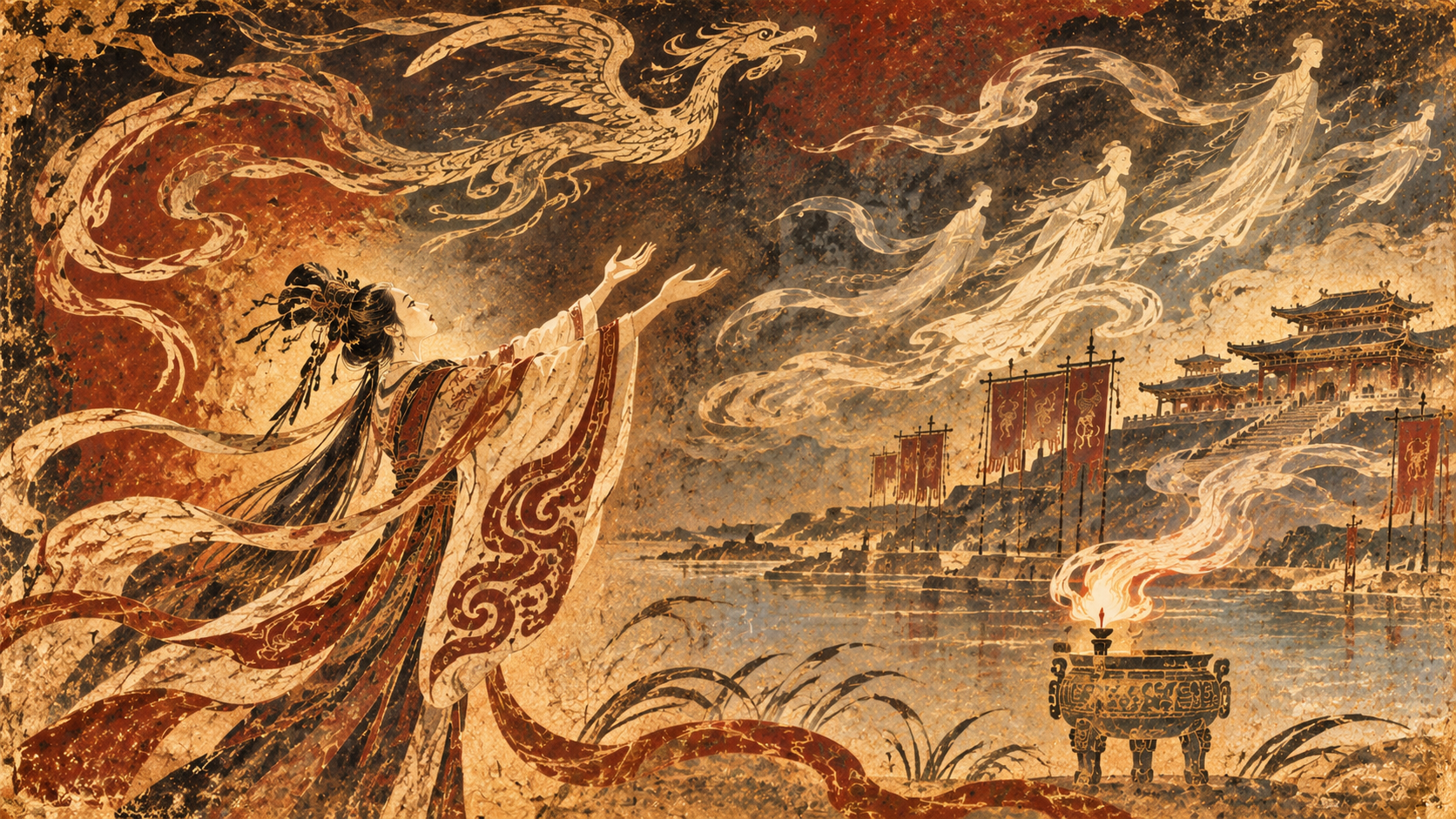
参考战国楚地《人物龙凤帛画》的古画语言,
以凤鸟、魂气、巫者与古老纹饰,
呈现楚人招魂的神秘意境。
色彩沉静而古朴,
仿佛一幅从楚墓中,
重新展开的帛画。
图片:原创数字插画。
引文|当古老的楚辞,重新成为可以聆听的声音
魂兮归来,哀江南;
两千年前的呼唤,
至今仍在江水上回响。
2025 年的夏天,
我在《楚辞》的谱曲旅程中,
走进了神秘的楚地巫仪世界,
聆听一声声「魂兮归来」的呼唤。
神巫巫阳奉命招魂,
四方险境阻挡灵魂的归途。
宫室、香草与歌舞次第展开,
一幅楚人想象中的生活画卷,
随着古老的辞章缓缓浮现。
我尝试借助人工智能谱曲,
让沉睡在古籍中的文字,
重新化作可以聆听的声音。
最终完成了五首《招魂》歌曲。
这不是对古代楚乐的复原,
而是一次跨越文字与声音的实验。
一|魂兮归来:楚人的招魂世界
招魂的本质,
不是命令灵魂归来,
而是给它一个值得归来的理由。
1. 招魂:楚地的巫仪与灵魂观念
在古代楚人的精神世界里,
巫者通过祭祀、占卜与祝祷,
尝试沟通天地与人间的界限。
《招魂》先以清廉自守的序辞开篇,
随后转入上帝与巫阳的对话。
上帝命巫阳召回离散的魂魄,
巫阳则先陈述招魂的为难之处,
并担心占筮耽误了时机。
灵魂被呼唤着离开险境,
返回熟悉的宫室与人间生活。
2. 《招魂》的作者与历史背景
《招魂》收录于《楚辞》之中,
其作者归属历来存在不同说法。
王逸《楚辞章句》将其归于宋玉,
司马迁则曾将《招魂》联系屈原。
这些不同的文献记载,
留下了作者与写作背景的争议。
但作品所呈现的巫仪想象,
仍是认识楚地文化的重要线索。
3. 从神巫受命到哀江南
全篇从清廉自守的序辞开始,
随后展开神巫受命的情节,
接着描绘四方与天地的险境。
当盛大的招魂辞逐渐结束,
诗歌转入春日南行的乱辞。
江水、枫树与远望交织,
最终凝成「魂兮归来,哀江南」。
从恐惧到安宁,
再到哀伤;
《招魂》不只在对亡魂说话,
也在问活着的人:
哪里才是归处?
二|五首歌曲,五重归途
把古汉语变成歌声,
不只是翻译,
更是让两千年前的呼吸,
重新进入今天的空气。
《招魂》分为五首歌曲,
依照原文的叙事次序谱曲。
让每一段呼唤与景象,
在不同的声音中逐渐展开。
1. 神巫受命|召魂仪式的开端
诗篇从清廉自守的陈述开始,
随后转入上帝与巫阳的对话。
面对已经离散的魂魄,
神巫承担召回的使命。
然而巫阳并未立即应允,
而是陈述招魂的为难之处,
并担心占筮耽误时机。
神灵的命令与巫者的迟疑,
为漫长的招魂仪式揭开序幕。
歌曲视频|楚辞·招魂·一:神巫受命
2. 四方惊梦·魂兮勿远|天地之间,无处可托
巫阳终于展开招魂之辞。
东方烈日能够熔金铄石,
南方异兽与西方流沙,
北方冰雪阻断远行的道路。
天上有虎豹守卫九关,
地下有形貌可怖的土伯。
天地四方皆非安身之所,
唯有故居等待灵魂归来。
歌曲视频|楚辞·招魂·二:四方惊梦·魂兮勿远
3. 香居千重·室中若梦|一座值得归来的故居
离开天地四方的险境,
诗篇转向安宁华美的宫室。
高堂、曲池与兰草香气,
共同构成灵魂熟悉的归处。
珠玉帷帐映照室内光影,
芙蓉与菱荷开放在池边。
诗人不再以危险警告灵魂,
而以故居之美呼唤归来。
歌曲视频|楚辞·招魂·三:香居千重·室中若梦
4. 乐宴不歇·人间未晚|楚人的生活盛宴
宫室之中摆满珍馐美酒,
钟鼓、竽瑟与歌声相互交织。
从稻麦羹汤到六博游戏,
诗篇描绘丰富的人间生活。
这些感官与欢乐的记忆,
成为挽留灵魂的另一种力量。
歌曲视频|楚辞·招魂·四:乐宴不歇·人间未晚
5. 乱辞:哀江南·春水溢梦|繁华落尽,江南何在
盛大的宴乐逐渐远去,
诗篇转入春日南行的景象。
乱辞描绘了随王前往云梦田猎,
以及君王出猎的场面。
「与王趋梦兮,课后先」,
将读者带入楚地云梦。
然而,当目光越过千里,
春日风景却唤起深沉哀思。
前面所有的珍馐与歌舞,
最终都收束在一句「哀江南」里;
繁华描写得越热闹,
最后的江水就显得越冷。
歌曲视频|楚辞·招魂·五:乱辞·哀江南·春水溢梦
延伸阅读|《云梦泽往事:楚人还没说完,秦人就来了》
三|从文字到声音:楚人的生命归途
楚人用恐惧来劝灵魂归来,
又用美好来诱惑它归来;
所谓故乡,
就是那个让你既害怕失去、
又舍不得离开的地方。
1. 从恐惧到归属:楚人如何想象生命的归处?
《招魂》描绘了一个危险的世界。
四方险境与天地幽都之中,
处处潜藏着威胁灵魂的力量。
与这些险境形成鲜明对照的,
是安宁的宫室与熟悉的人间。
诗篇不断呼唤灵魂返回故居,
却不只是命令它停止远行。
而是以危险与安宁的对照,
赋予「归来」具体而深刻的意义。
2. 从宫室到宴乐:文学中的楚国物质文明
《招魂》不仅描绘神灵与魂魄,
也保存了丰富的生活细节。
从高堂、曲池与华美帷帐,
到饮食、乐舞与六博游戏。
这些文字并非孤立的想象。
楚墓出土的漆器与丝织品,
以及编钟、鼓、瑟等乐器,
为理解当时的工艺与宴乐文化,
提供了珍贵的实物线索。
不过诗中的华美生活,
属于文学塑造的理想场景,
不能代表所有楚人的日常生活。
3. 从江南春水到故国之思:《招魂》真正的归途
当宫室宴乐的描写结束,
《招魂》忽然转向春日南行。
「湛湛江水兮,上有枫」,
将目光带回真实的山川。
「目极千里兮,伤春心」,
又让春日风景染上深沉哀思。
前面的诗句不断劝魂归来,
仿佛故居能够安放一切离散。
然而最后一声「哀江南」,
却留下无法轻易消解的悲伤。
魂兮归来,
哀江南;
最难回答的,
从来不是魂魄能否归来,
而是归来之后,
何处才是故乡。
4. 创作札记|2025年的《招魂》谱曲记录
2025 年夏天,我借助 Suno 谱曲,
尝试让《招魂》重新成为歌声。
却发现古汉语的生僻文字,
并不容易被现代模型准确演唱。
长篇文本必须分段处理,
错音、漏字与异常语调反复出现。
最终保留了五首实验作品,
并将原文与字幕一并保存。
它们不是对古代楚乐的复原,
而是 2025 年技术条件下的尝试。
从楚人的帛画到今日的声音,
记录媒介不断发生着变化。
而「魂兮归来」所留下的问题,
仍在等待不同时代的人回应。
尾声|魂兮归来,哀江南
《招魂》最动人的地方,
不在珍馐美酒与歌舞,
而在那些繁华景象的背后,
始终隐藏着对离散的忧伤。
《招魂》从清廉自守的序辞开始,
随后响起神巫招魂的呼唤。
诗篇穿越四方险境与天地幽都,
又以华美的宫室与人间宴乐,
描绘一处值得灵魂归来的故居。
楚人为什么反复呼唤归来?
是为了让灵魂远离险境,
还是希望它重新回到故土,
找回曾经熟悉的生活与记忆?
两千多年后的今天,
当古老的辞章再次成为歌声,
我们是否也会在这声呼唤中,
听见自己对故乡与归属的追问?
江水依旧流向遥远的天际,
岸上的枫树经历无数春秋;
而《招魂》最后留下的叹息,
仍然回荡在文字与歌声之间。
魂兮归来,
哀江南;
千年之后,
呼唤仍在,
而归来的人,
早已不是当年那个。
楚人对话后记|考烈王、黄歇与令尹夫人的观后感
魂兮归来,谁在呼唤谁?
2026 年的一个冬夜,
我重新打开 2025 年的《招魂》歌曲。
电脑里传来熟悉的古老辞章,
「魂兮归来」再次响起。
考烈王放下手中的竹简,
疑惑地望着我的电脑屏幕:
「令尹夫人,这是何人在招魂?
莫非寡人的楚国又出事了?」
我忍不住笑了起来:
「大王,您的楚国已经过去两千多年。
这是我去年谱成的五首《招魂》,
今天重新整理成一篇文章。」
黄歇凑过来听了一会儿:
「夫人,这声音倒是奇妙。
可这《招魂》究竟在召唤谁?」
我指着屏幕上的古老文字:
「2025 年,我只是想让楚辞重新被听见。
没想到后来又走进了楚国的历史。」
考烈王忽然认真起来:
「寡人倒有一事不明白。
既然魂魄已经离散,
为何不直接命它回来,
还要摆出如此丰盛的宴席?」
黄歇笑着替我回答:
「大王,光靠一道命令,
恐怕连魂魄也不愿听从。
总得让它知道人间还有什么,
值得它千里迢迢地回来。」
考烈王却望向窗外:
「可是寡人听到最后,
怎么只剩下江水与枫树?
如此盛大的歌舞宴乐,
为何最终却是『哀江南』?」
房间忽然安静了下来。
黄歇轻轻摇着手中的竹简:
「夫人,你在德国生活多年,
却总是回头寻找楚国的踪迹。
究竟是你在呼唤楚人,
还是楚人的故事在呼唤你?」
我愣了一下,笑着回答:
「这问题可难倒我了。
我原以为自己在召唤过去,
如今却发现每写完一篇文章,
又会遇见另一段楚人的往事。」
考烈王终于笑了起来:
「那寡人倒要问令尹夫人,
你替楚人唱了这么多首歌,
又写了这么多篇文章,
自己的魂魄可曾找到归处?」
我望着窗外德国的夜色,
一时竟不知道如何回答。
电脑里的歌声渐渐结束。
考烈王重新拿起他的竹简。
黄歇望着我,微微一笑。
谁也没有再提起那个问题。
两千多年前的江南已经远去,
而我仍在另一片土地上生活;
究竟是我在呼唤楚人,
还是楚人的声音,
让我一次次回到他们的历史?
魂兮归来,
哀江南;
也许真正的归来,
不是回到某一片土地,
而是让一段被遗忘的声音,
在另一个人身上重新响起。
说明:本篇对话为作者依据楚国历史人物与《楚辞·招魂》创作的文学想象,并非真实历史对话。
Appendix|English Narrative Overview
The Soul’s Return | Chu Ci · Zhao Hun
When the Ancient Voices of Chu Become Songs Again
“Return, O soul! How sorrowful is the land south of the Yangtze.”
More than two thousand years ago, a voice called for a wandering soul to return. Its echoes have survived in the ancient poetry of Chu Ci, a collection that preserves some of the most extraordinary literary expressions of the Chu cultural world.
In the summer of 2025, while setting the poems of Chu Ci to music, I entered the mysterious world of Zhao Hun (招魂, Summoning the Soul). The poem begins with a declaration of personal integrity before turning to a divine command: the deity orders the shaman Wu Yang to summon a wandering soul home. The journey that follows moves through terrifying landscapes, magnificent chambers, fragrant plants, elaborate banquets, and finally the sorrowful rivers of the south.
Using artificial intelligence, I created five musical interpretations of Zhao Hun, following the sequence of the original text. These compositions are not reconstructions of ancient Chu music. They are contemporary experiments in bringing classical Chinese literature back into the world of audible expression.
I. Summoning the Soul: The Spiritual World of Ancient Chu
In the spiritual imagination of ancient Chu, shamans sought to communicate across the boundaries separating human beings, spirits, heaven, and the underworld. Rituals, divination, and invocations offered ways of approaching forces that could not be seen or controlled.
Zhao Hun reflects this worldview through the figure of Wu Yang. When commanded to summon the soul, the shaman expresses hesitation and concern about the difficulties and timing of the ritual. Only then does the elaborate invocation begin.
The authorship of Zhao Hun remains disputed. Wang Yi, in his Chu Ci Zhang Ju, attributed the work to Song Yu, while Sima Qian associated it with Qu Yuan. These differing traditions have continued to shape discussions of the poem’s origins and historical background.
Yet the literary power of Zhao Hun does not depend entirely on resolving its authorship. Its central question is strikingly human: How can a wandering soul be persuaded to return?
The poem offers two contrasting answers. First, it describes the terrifying dangers awaiting the soul beyond its familiar world. Then it presents the beauty, comfort, music, and pleasures of the place to which the soul is being summoned. The soul is not merely ordered to return. It is given reasons to desire its return.
II. Five Songs, Five Stages of the Soul’s Journey
In 2025, I divided Zhao Hun into five musical compositions, preserving the narrative progression of the original poem.
1. The Divine Command | The Beginning of the Summoning
The first composition introduces the divine command and the shaman Wu Yang. His hesitation establishes the difficulty of the task and prepares the listener for the extraordinary journey that follows. The summoning begins not with certainty, but with an awareness of the fragile boundary between the living and the departed.
2. The Four Directions | A World Without Refuge
The second composition explores the dangers surrounding the wandering soul. In the east, scorching suns threaten destruction. The south contains frightening creatures, the west offers deadly sands, and the north is dominated by bitter cold. Even heaven and the underworld present terrifying obstacles. Every direction seems to deny the soul a safe resting place.
3. The Fragrant Residence | A Home Worth Returning To
After the threatening landscapes, the poem turns towards beautiful architecture, ornamental pools, fragrant plants, curtains, and precious decorations. The atmosphere changes from fear to invitation. Home is no longer simply a geographical destination. It becomes a place of familiarity, comfort, beauty, and belonging.
4. The Endless Banquet | The Pleasures of Human Life
The fourth composition enters a world of elaborate food, wine, music, entertainment, and games. Instruments sound, guests gather, and the pleasures of earthly life unfold. These descriptions also offer literary glimpses of the material culture imagined within the Chu world. Archaeological discoveries from Chu tombs, including lacquerware, silk textiles, bells, drums, and zithers, provide valuable evidence of the artistic and technological achievements of the period. Nevertheless, the poem’s luxurious scenes should not be treated as descriptions of everyday life shared by all members of Chu society.
5. The Southern Lament | The Return to Jiangnan
The final composition follows the concluding section of the poem, traditionally called the luan. The scene shifts towards a springtime journey and a royal hunt in the Yunmeng region, before turning to rivers, maple trees, distant landscapes, and overwhelming sorrow.
The poem ends with the haunting words: “Hun xi gui lai, ai Jiangnan.” — “Return, O soul! Alas for Jiangnan.”
After all the magnificent chambers, delicious food, music, and celebration, the final image is not one of triumph. It is an expression of grief. The more splendid the imagined world becomes, the more poignant its final sorrow appears.
III. From Ancient Poetry to Modern Sound: The Meaning of Return
What makes Zhao Hun remarkable is the relationship between fear and belonging. The poem first describes a world in which the wandering soul cannot find safety. It then constructs a beautiful place to which the soul might wish to return. Through this contrast, the idea of home acquires emotional and spiritual significance.
Home is not simply the place from which a journey begins. It is also a place shaped by memory, attachment, and the fear of losing what once seemed familiar.
The poem’s descriptions of architecture, gardens, clothing, food, music, and entertainment offer a rich literary vision of the Chu cultural world. These images can be considered alongside archaeological discoveries, while recognising the difference between poetic imagination and historical evidence.
Yet the conclusion introduces a deeper uncertainty. The river continues to flow. Maple trees stand along its banks. Spring has returned, but the poem’s final words remain filled with sorrow. Perhaps returning does not necessarily resolve the experience of separation. Perhaps the most difficult question is not whether a soul can return, but whether the place it returns to can still be called home.
A Note on the Musical Experiment
Creating these five compositions was far more difficult than I had expected. In the summer of 2025, I used Suno to transform the classical Chinese text into songs. The software repeatedly struggled with uncommon characters, archaic expressions, pronunciation, and the length of the original poem. Some passages required numerous attempts, and the resulting performances were not always linguistically perfect.
I eventually preserved five versions that I considered suitable for publication, together with the original Chinese text and subtitles. These recordings document an experiment conducted under the technological conditions of 2025. They do not claim to reproduce the sounds of ancient Chu. Their significance lies in a different possibility: literature preserved for more than two millennia can enter a new medium and become accessible through listening.
Epilogue | Return, O Soul
What moves me most deeply about Zhao Hun is not the abundance of food, wine, music, or magnificent architecture. It is the sorrow concealed behind these splendid images.
The poem begins with a declaration of integrity, moves through a divine command and the dangers of the universe, and imagines a beautiful human world awaiting the soul’s return. Yet it ends beside the rivers of Jiangnan.
More than two thousand years later, the ancient invocation has become a series of songs. The original world of Chu has disappeared, but its questions have not. What does it mean to return? Can memory preserve a homeland after its historical world has vanished? And can an ancient voice find a new existence in another person’s life?
The river continues to flow, and the maple trees have witnessed countless seasons. The voices of Chu still echo between written words and modern songs.
Perhaps the one who finally returns is no longer the same person who once departed.
Across Civilizations
King Kaolie of Chu Asks: “Who Is Summoning Whom?”
One winter evening in 2026, I opened the five musical compositions of Zhao Hun that I had created the previous year. The ancient words filled the room once again. “Return, O soul!”
King Kaolie of Chu put down his bamboo slips and looked suspiciously at my computer screen. “Lady Lingyin, who is summoning souls here? Has something happened to my kingdom again?”
I burst into laughter. “Your Majesty, your kingdom disappeared more than two thousand years ago. These are five songs I composed last year using Zhao Hun. I am now bringing them together in an article.”
Huang Xie, Lord Chunshen, leaned closer and listened for a while. “Lady Lingyin, these sounds are certainly unusual. But whom is this poem actually trying to summon?”
I pointed towards the ancient Chinese characters on the screen. “In 2025, I simply wanted the poetry of Chu to be heard again. I never expected that this musical experiment would eventually lead me deeper into the history of your kingdom.”
King Kaolie suddenly became serious. “There is something I do not understand. If the soul has wandered away, why not simply command it to return? Why prepare such an extravagant banquet?”
Huang Xie smiled and answered before I could speak. “Your Majesty, even a wandering soul might refuse to obey a command. Surely we must remind it that there are still things in the human world worth travelling a thousand miles to return to.”
The king considered this for a moment, then looked towards the window. “But when I listened to the end, all that remained was a river and maple trees. After such magnificent banquets and celebrations, why does the poem conclude with sorrow for Jiangnan?”
The room fell silent.
Huang Xie gently turned the bamboo slips in his hands. “Lady Lingyin, you have lived in Germany for many years, yet you continue searching for traces of ancient Chu. Are you calling the people of Chu back to life, or are their stories calling you?”
I hesitated, then smiled. “That is a difficult question. I originally believed that I was summoning the past. Yet every time I finish an article, I seem to encounter another story from your world.”
King Kaolie finally laughed. “Then I have one more question for Lady Lingyin. You have composed so many songs for the people of Chu and written so many articles about their history. But has your own soul found somewhere to return to?”
I looked out into the German night and, for a moment, did not know how to answer.
The music from the computer gradually faded. King Kaolie picked up his bamboo slips again. Huang Xie looked at me and smiled. No one mentioned the question again.
More than two thousand years have passed since the world of ancient Jiangnan. I now live in another land, far from the rivers and landscapes that once belonged to Chu. Am I the one calling the people of Chu, or are their voices drawing me back, again and again, into their history?
Return, O soul. Alas for Jiangnan.
Perhaps true return does not mean travelling back to a particular place. Perhaps it means allowing a voice that has long been forgotten to resonate once more through another human being.
Historical and literary note: The conversations in “Across Civilizations” are fictional literary dialogues featuring King Kaolie of Chu, Huang Xie (Lord Chunshen), and Lady Lingyin. They are imaginative reflections on the themes of this essay, not historical accounts of actual conversations.
🤖 人工智能协作声明
本文的主题选择、田野调查、资料搜集、核心观点与中文原始内容,均由作者独立完成。创作过程中,作者与人工智能模型,进行持续协作,包括多轮讨论、思路推演、叙事节奏调整、部分翻译、英文 Narrative Overview 生成、语言检查、结构检测与文字润饰。
人工智能在此过程中,作为创作协作者,参与内容发展与语言表达,但不作为法律意义上的作者或著作权主体。所有 AI 协作产生的内容,均由作者依据田野资料、原始文献与中文母稿,进行选择、审校、修改与艺术化重构。文章的叙事方向、内容取舍、创作决策、最终表达与价值判断,均由作者决定并负责。
📜 本站所有原创作品均已完成区块链存证,确保原创凭证。部分重点作品另行提交国家版权登记,作为正式法律备案。原创声明与权利主张已公开。完整说明见:
👉 原创声明 & 节奏文明版权说明 | Originality & Rhythm Civilization Copyright Statement – NING HUANG
节奏文明存证记录
本篇博客文为原创作品,由黄甯与 AI 协作生成,于博客网页首发后上传至 ArDrive 区块链分布式存储平台进行版权存证:
- 博客首发时间:2026年11月09日
- 存证链接:57ca112c-cfa5-400f-9f42-d7d78930d8ef
- 存证平台:ArDrive(arweave.net)(已于 2026年11月09上传)
- 原创声明编号:Rhythm_Archive_09_Nov_2026/chu-ci-zhao-hun-summoning-the-soul
- 用途声明:本文为《节奏文明观》之篇章,亦参与构建《AI×非遗文明共构档案》与《文明节奏回声计划》,用于文明节奏实地记录、区块链存证、跨域协作与版权登记用途。
© 黄甯 Ning Huang, 2026. All Rights Reserved.
本作品受版权法保护,未经作者书面许可,禁止复制、改编、转载或商用,侵权必究。
📍若未来作品用于出版、课程、NFT或国际展览等用途,本声明与区块链记录可作为创作时间及原创性的佐证。