How Is a Ship Born? The Evolution of Shipbuilding from Hamburg to Berlin
Where Does a Ship Begin?
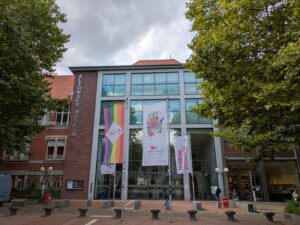
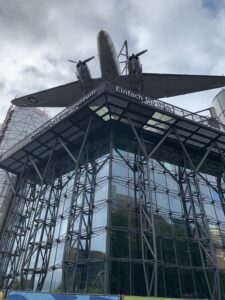
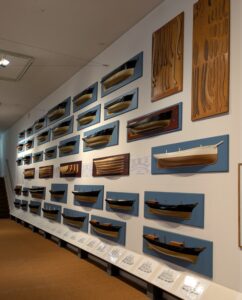
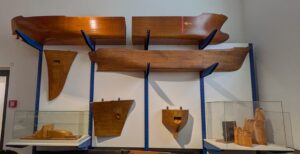
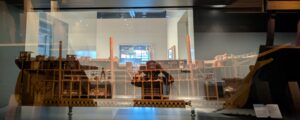
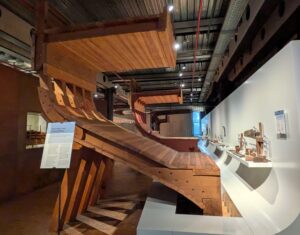
In August 2026, I stood before a wall of ship-hull models at the Altonaer Museum in Hamburg. From medieval cogs to modern container ships, the models revealed how dramatically the shape of a vessel can change. A month later, at the German Museum of Technology in Berlin, I encountered something different: exposed hull structures, curved frames, wooden planking, riveted steel and welded joints. Hamburg showed me the shapes of ships. Berlin revealed how those shapes were made possible.
Together, the two museums raised a question that had little to do with launching a ship into the water: How does a human idea become a structure capable of carrying weight, resisting the sea and travelling across it?
The Shape of a Ship Is an Engineering Decision
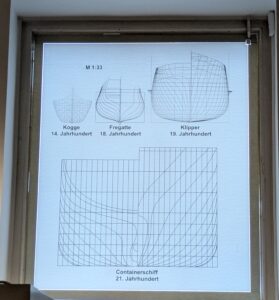
At the Altonaer Museum, four types of vessels offered four different design answers. The medieval Kogge prioritised practical cargo transport. The eighteenth-century frigate needed speed and manoeuvrability. The nineteenth-century clipper pursued fast ocean passages, while the modern container ship was designed for transporting enormous quantities of goods efficiently.
These vessels did not simply replace one another in a straight line of progress. Each responded to a different purpose. Hull shape is therefore a negotiation between competing demands: speed, cargo capacity, stability and the conditions of navigation.
The museum’s hull models also helped me understand why naval architects need more than a side view of a ship. A Linienriss, or lines plan, describes the hull through different sections and perspectives. Waterlines, longitudinal sections and transverse sections translate a three-dimensional form into something that can be measured, calculated and eventually built.
The curves of a ship are not an artist’s improvisation. They are engineering answers to the competing demands of speed, capacity and safety.
From Drawing to Structure
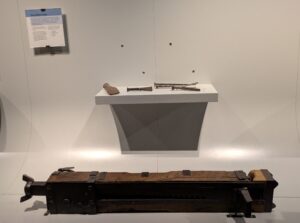
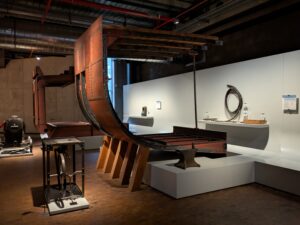
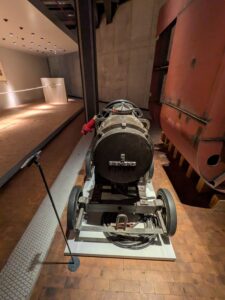
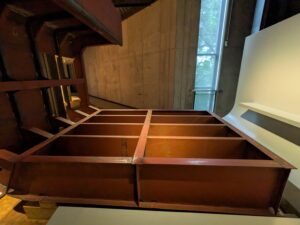
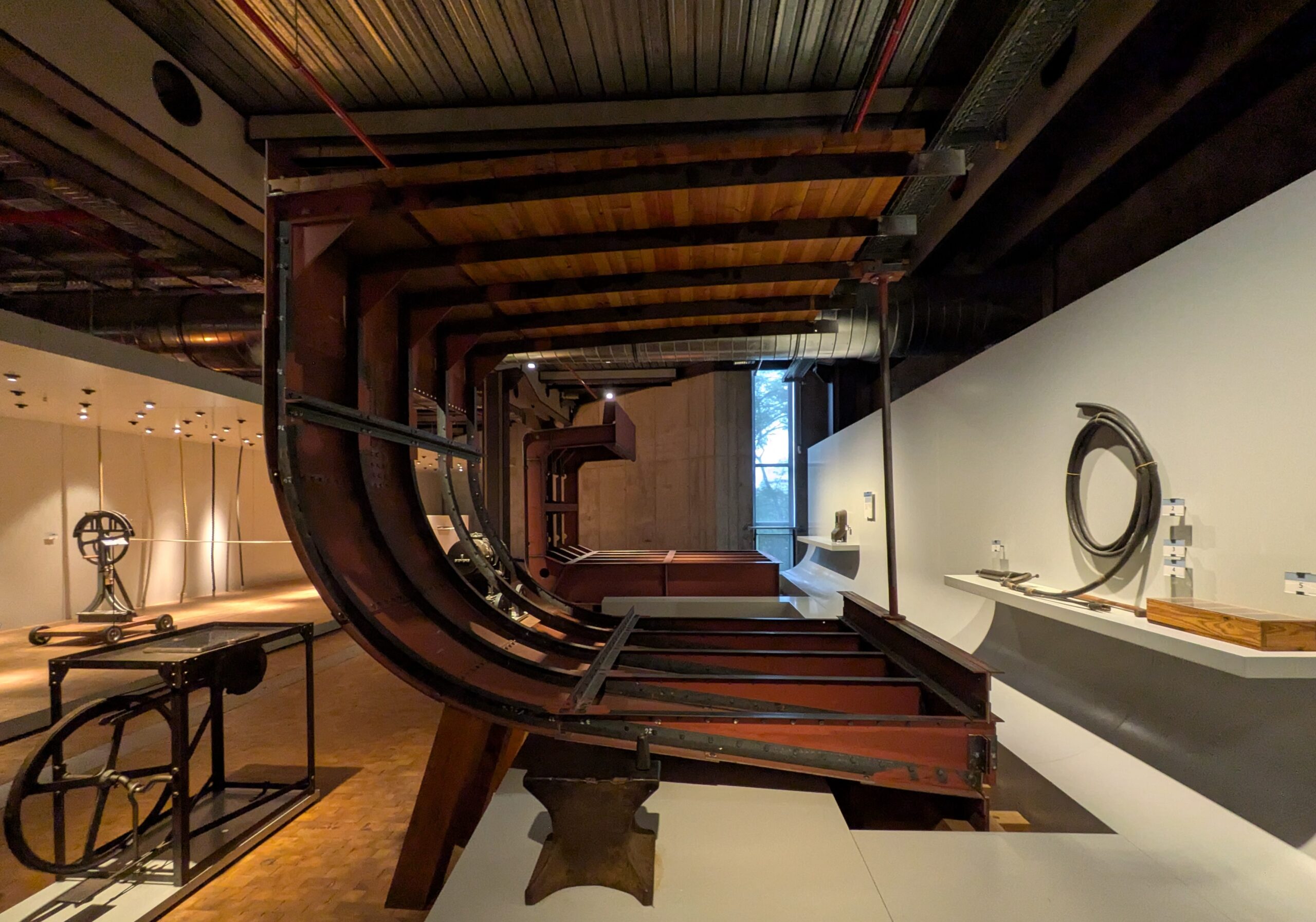
In Berlin, the hidden anatomy of a ship became visible. A wooden hull section showed how the keel forms a longitudinal foundation, how frames define the vessel’s transverse shape, and how planking encloses the structure. What appeared in Hamburg as a smooth outer contour was now revealed as an arrangement of individual components.
For centuries, timber made such structures possible. Yet wood also imposed limitations. Shipbuilders needed suitable lengths, strength and sometimes naturally curved pieces of timber. As vessels became larger and construction requirements changed, obtaining the right material became increasingly difficult.
Iron offered another possibility. In composite construction, metal frames could support a hull that still retained wooden planking. Later, iron plates and metal structural members took on a greater share of the work. The transition was not merely a change of material. It was a reorganisation of how a ship carried forces through its structure.
Technological breakthroughs often begin when the material that once made something possible can no longer meet the demands placed upon it.
When Rivets Held a Ship Together
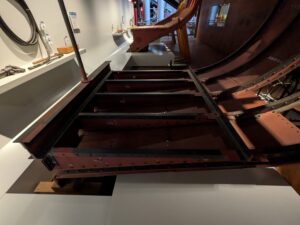
One of Berlin’s most striking exhibits was a section of riveted metal hull construction. Rows of connections showed how separate plates and structural members could become part of a larger vessel. Yet behind those apparently simple joints lay a demanding industrial process.
Rivets had to be heated, positioned and hammered into shape while still hot. Workers depended on one another’s timing and precision. The sound of riveting hammers, the heat of the forge and the physical effort involved were all part of shipbuilding. A metal ship was not assembled by materials alone; it was produced through coordinated human labour.
Rivets joined the steel plates into a ship. Human labour gave the silent metal a direction.
From Rivets to Welds
Another transformation appeared in Berlin’s welding exhibits. Instead of fastening overlapping plates with thousands of individual rivets, welding allowed metal components to be joined through heat and fusion. Electric welding gradually became increasingly important in shipbuilding during the twentieth century, although riveted and welded construction continued to coexist for many years.
Welding also changed the organisation of production. Steel components could be prepared and joined into larger structural sections, supporting new approaches to hull assembly. But the disappearance of many rivets did not eliminate engineering challenges. Weld quality, structural strength and the reliability of joints became essential considerations.
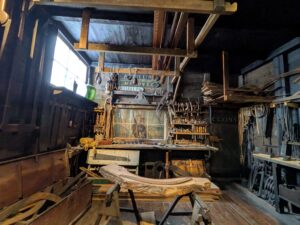
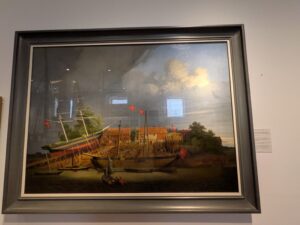
A nineteenth-century shipyard painting at the Altonaer Museum offered a historical counterpoint. The 1845 painting of the launch of ERNST LORENZ, presented by the museum as a work with the character of a family portrait rather than a literal construction record, reminded me that shipbuilding has always been both a technical and a human enterprise.
From the hammer striking a hot rivet to the heat of an electric arc, the means of joining metal have changed. The underlying question remains: How can separate parts be connected strongly enough to withstand the forces of the sea?
When the Ship Leaves the Shipyard
By the end of these two museum visits, the ship had become something different in my imagination. I no longer saw only a finished vessel moving across the water. I saw the decisions behind its curves, the frames beneath its shell, the limitations of timber, the labour of riveting and the precision demanded by welding.
Yet a completed hull is only the beginning. Once a ship leaves the shipyard, its structure must face cargo loads, waves, currents and the unpredictable conditions of navigation. The calculations made on land are tested at sea.
A ship may eventually grow old, and its materials and construction methods may belong to another age. But the human ambition behind it continues: to create structures capable of carrying us beyond the limits of where we stand.
Every ship is a love letter written by humanity to the sea. Shipbuilding is the grammar that makes the letter possible.
Across Civilizations
Wood, Iron and Human Ingenuity
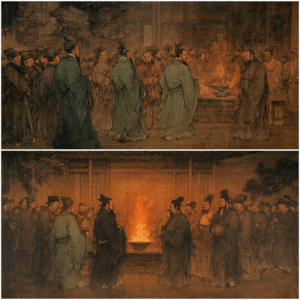
King Kaolie stood before a steel hull structure in the Berlin museum, studying its closely spaced metal components.
“Lady Lingyin,” he asked, “if you now have iron and steel, why do you still study wood?”
“There was nothing wrong with wood,” I replied. “But ships grew larger, and some demands exceeded what timber could provide. So people began looking for other materials.”
The king considered this. “Then perhaps the problem was not the wood. Perhaps your ambitions simply became too great?”
Huang Xie laughed. “Your Majesty has a point. Once people wanted to cross a river. Later, they wanted to cross an ocean. When the destination changes, the methods must change as well.”
King Kaolie looked back at the steel frames. “And when you discover something better than steel, will these ships become obsolete too?”
“Perhaps,” I answered. “No material can solve every problem, and no technology remains suitable for every purpose.”
The king thought for a moment. “Then the real skill of shipbuilding is not finding the best material, but knowing when to change.”
“Much like governing a kingdom,” Huang Xie observed. “One must remain faithful to the purpose without becoming imprisoned by the method.”
The king suddenly turned towards us. “Then if Chu wished to build a great ship, should I choose wood or iron?”
Huang Xie smiled. “Your Majesty, perhaps you should first ask where the ship is meant to go.”
The king laughed. “Of course. The destination determines the choice.”
I nodded.
More than two thousand years ago, the people of Chu worked with earth, timber and bronze, seeking structures suited to the properties and limitations of their materials. Two thousand years later, shipbuilders moved from wooden hulls towards steel construction, transforming not only the materials they used but also the ways they responded to constraints.
Materials have limits, but human ingenuity has no fixed shape. Objects grow old, yet our desire to carry people, goods and possibilities beyond existing boundaries continues to seek new ways of joining the world together.

 时间:2026年08月31日(一)与2026年09日24日(四)
 行程|汉堡 · Altonaer 博物馆与柏林 · 德意志科技博物馆航海厅