封面图说明|
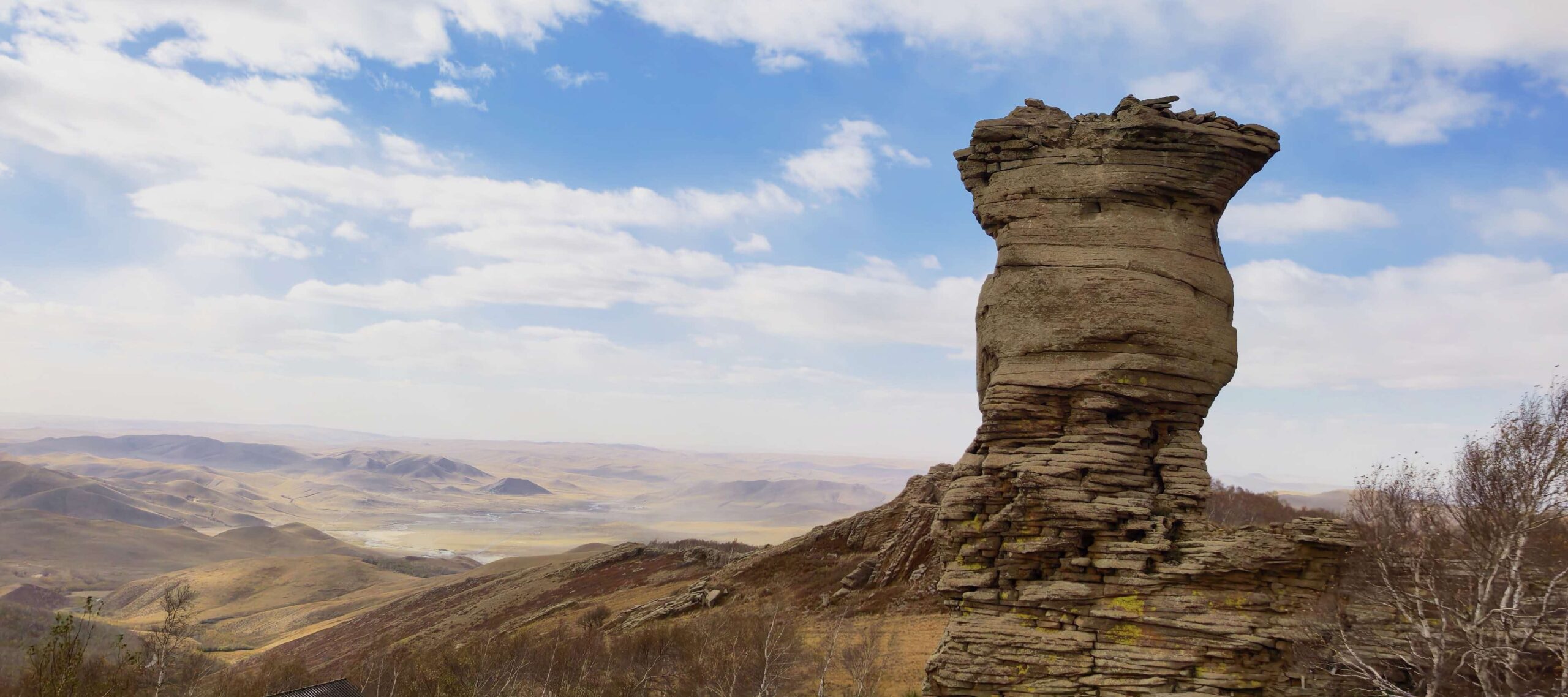
阿斯哈图石林位于内蒙古,
这里属于赤峰市克什克腾旗,
巨大的花岗岩石林散落在辽阔草原之间,
旅行从这里走进更漫长的时间。
摄影:安庆龙
拍摄:2026年秋。
全文图片感谢安庆龙提供并授权作者使用。
引文|一张不知道地点的早安卡
有些时间不是我们不知道,
而是它变化得太慢,
慢到人的一生都看不见过程,
于是,我们把变化误认成静止。
十月二十四日的早晨,
收到安庆龙寄来的一张早安卡。
照片里没有城市,也没有建筑,
只有巨大的岩石立在荒草之间,
地上似乎落了一层薄雪。
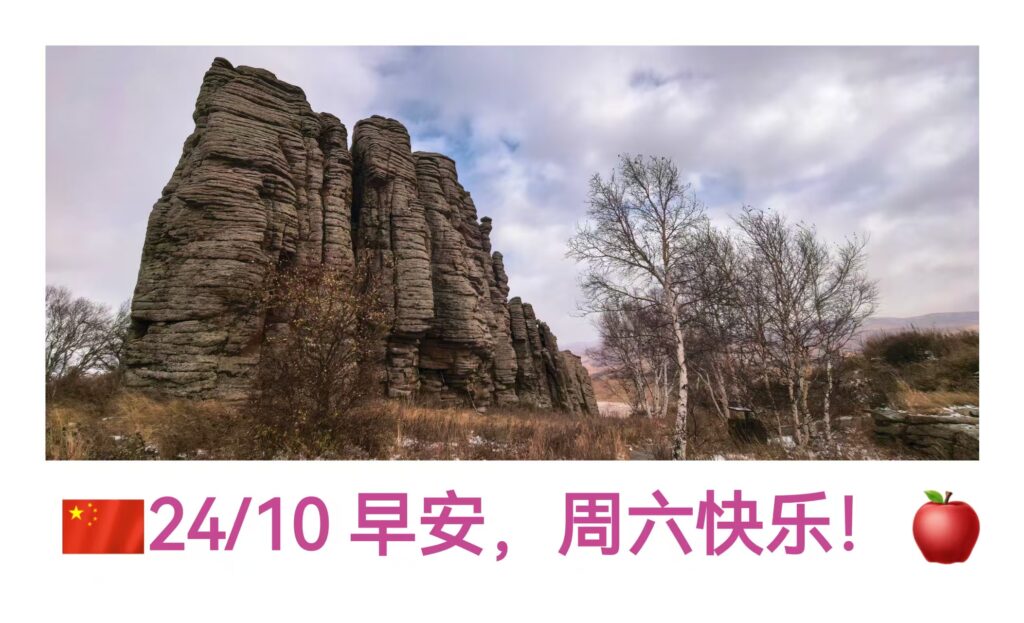 图:安庆龙的早安卡
我起初并不知道这是哪里,
只看见岩石一层一层叠起,
有些像墙,有些像巨大的柱子,
白桦从岩石之间向天空伸展。
后来才知道这里是阿斯哈图,
位于内蒙古赤峰市克什克腾旗,
大兴安岭在这里伸向草原,
花岗岩石林散落在北大山上。
那些看起来沉默不动的岩石,
其实来自极其漫长的时间。
前一篇才写完桃花潭,
一首诗把人带回一千多年前。
到了阿斯哈图,
时间却突然从千年继续向后退。
构成石林的花岗岩岩体,
形成于遥远的侏罗纪,
距今大约一点五至一点八亿年。
一个人的几十年放到这里,
几乎短得无法成为刻度。
但“一亿年的风景”并不是说,
眼前景色静止了一亿多年。
岩体形成只是漫长故事的开始,
冰川、流水、风化与冻裂,
后来仍不断改变它的形状。
同样是一次旅行,
我们面对的过去完全不同,
有些过去可以从文字里寻找,
有些过去却必须重新学习尺度。
一|旅行让人进入不同的时间尺度
旅行改变的不只是地点,
当身体进入另一片土地,
我们衡量过去的那把尺,
也会跟着改变。
城市里的时间很具体:
几点上班,几个月完成一项工作,
几年又构成一段人生。
即使回头寻找历史,
时间通常仍属于人的世界。
一座建筑可能经历几百年,
一个王朝延续数百年。
到了桃花潭,
这把尺已经拉长到千年,
李白与汪伦早已离开,
那场送别却留在诗里,
后来的人仍能循着文字抵达。
可是到了阿斯哈图,
一千年突然显得很短。
几十年可以装下一生,
千年可以承载一段文明,
面对以亿年计算的岩石,
人的生命却缩成很短的一瞬。
在文字里,
我们以千年为单位,
站到岩石面前才发现,
千年也不过是一瞬。
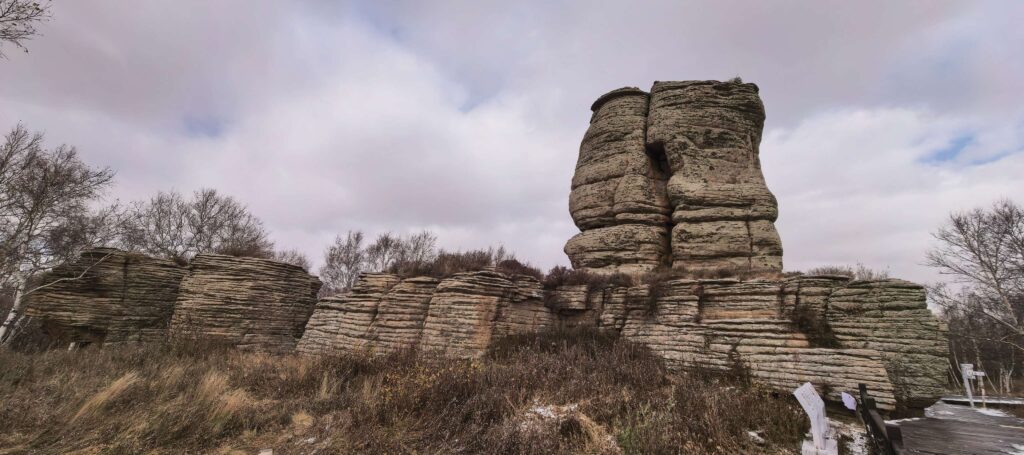
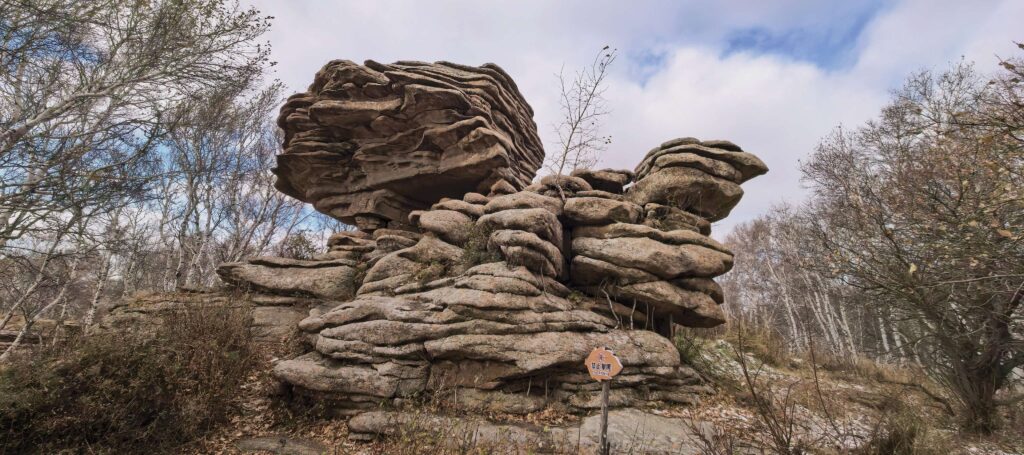
图:阿斯哈图花岗岩体,摄影:安庆龙
二|所谓「风景」,其实是过程留下来的形状
我们看见的是一块岩石,
时间留下的却是一段过程。所谓风景并不是最后的成品,
只是变化暂时停在眼前的形状。
阿斯哈图的岩石,
很容易让人产生误会,
巨大的石墙层层立在草原上,
石柱沉默,
岩壁似乎纹丝不动,
仿佛一直就是今天的样子。
可是岩石也有自己的过程。
冰川曾经从岩体表面经过,
融水沿着岩石的节理冲蚀,
寒冷让裂隙反复冻结与扩张。
这些变化,
很难被人亲眼看见,
风吹过草原,我们知道风在动,
流水经过河道,
我们也看得见流动。
可是岩石改变得实在太慢,
我们便很容易把缓慢,
当成静止。
照片里的石柱与石墙,
并不是一件完成的作品,
而是许多力量长期累积以后,
恰好被今天的旅行者看见,
留下此刻暂时的形状。
我们看见的是一块岩石,
时间留下的却是一段过程,
风景不是最后的成品,
只是变化暂时停在眼前的形状。
所谓一亿年的风景,
从来不是一亿年的静止,
而是漫长变化不断累积以后,
在今天,
与我们短暂相遇。
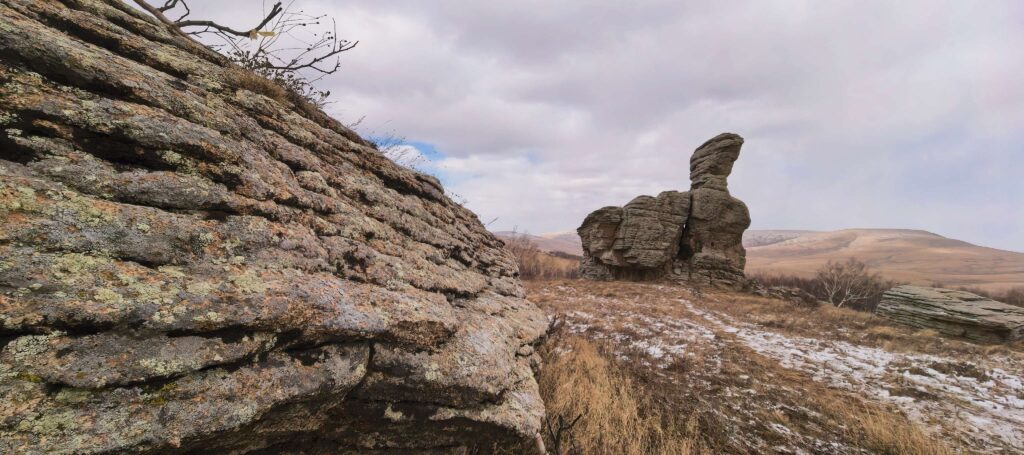
图:岩壁近景,摄影:安庆龙
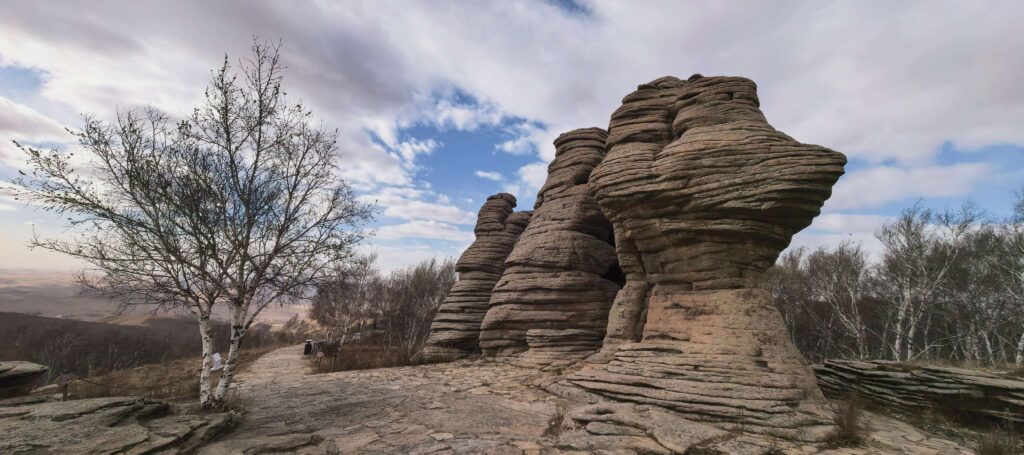
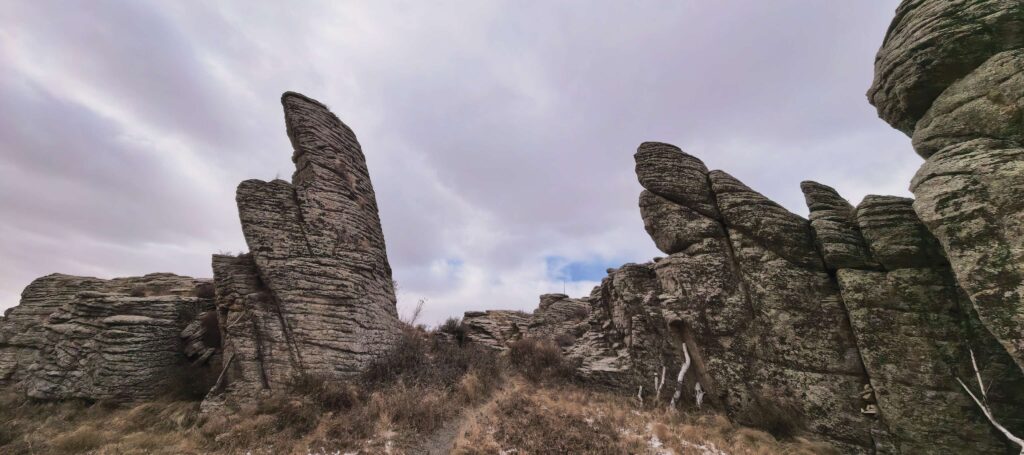
图:层层叠起的巨大石块,摄影:安庆龙
三|旅行为什么需要身体抵达
有些尺度并不是不知道,
而是没有站到它的面前。
知识始终停留在数字里,
身体还没有找到参照。
“一亿年”写在书里,
只是一个很大的数字。
我们知道它非常漫长,
却很难真正感觉它有多长。
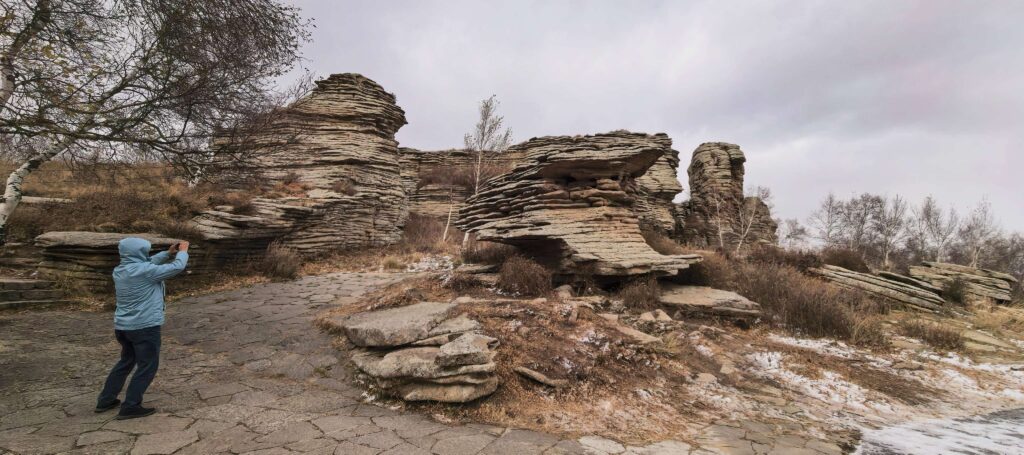
图:人与岩壁的尺度对比。摄影:安庆龙
到了岩体面前,
情况开始发生变化。
岩壁、树木与人的身体,
第一次出现在同一个画面里。
一个人站在岩壁下面,
几十年的生命并没有变短。
只是当两种尺度同时出现,
我们才突然发现,
人的时间原来只是其中一种。
这也是旅行需要身体的原因。
知识可以告诉我们一亿年,
照片也可以记录岩石的巨大,
身体却提供了自己的尺度。
这一次,我没有站在那里,
是照片里那个身影,
替我提供了一把尺度。
我无法借自己的身体丈量岩壁,
却能从人与岩石的比例之间,
看见两种时间突然相遇。
知识可以告诉你一亿年,
但只有身体站在岩壁前,
你才会知道,
一亿年到底有多重。
我们当然无法感受一亿年,
但站到这样的风景面前,
身体至少第一次意识到:
世界并不按照人的尺度运行。
身体也开始知道,
自己的几十年,
只是世界漫长时间之中,
众多尺度的一种。
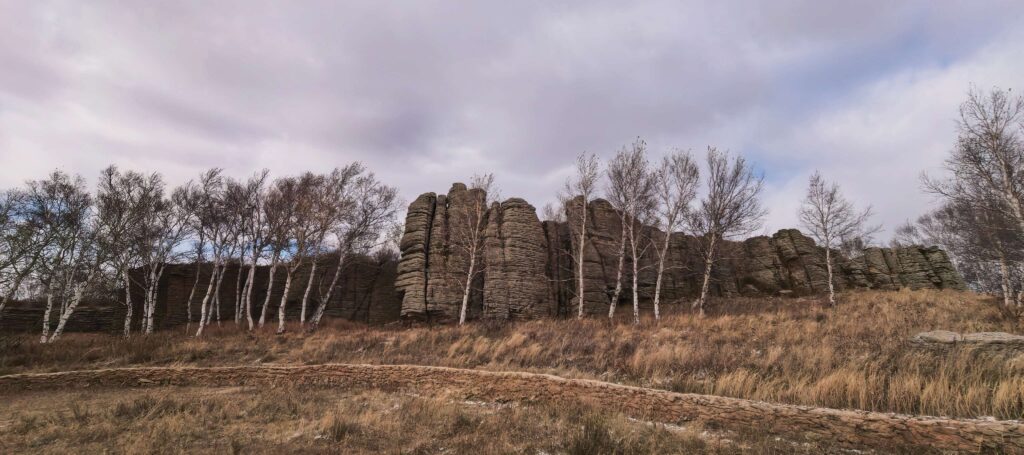
图:石林,摄影:安庆龙
尾声|旅行如何让我们看见时间
旅行带我们离开日常,
也把我们带到另一把时间尺前。
有时是千年留下的文字,
有时是亿万年留下的岩石。
桃花潭留下的是诗,
那是文明保存下来的时间。
阿斯哈图留下的是岩石,
那是地质时间获得重量的地方。
一个让文字落回土地,
一个让时间获得重量。
旅行让身体走进两种过去,
也改变我们理解世界的尺度。
旅行,
就是不断更换尺子的过程。
我们总用自己的寿命,
判断什么正在发生变化。
看得见的过程叫作变化,
慢到看不见的过程,
却很容易被误认为静止。
但世界从来不是这样运行。
风、水、岩石与人的生命,
各自拥有不同变化速度,
不必服从同一种节奏。
楚人对话后记|考烈王、黄歇与令尹夫人的观后感
人在岩石面前,是什么?
考烈王看着照片里,
那道巨大的石墙,
看了很久,
才开口:
“这石头,一亿年前就在这儿了?”
“不是。”
我把照片放大,
指着岩石的纹理:
“岩体形成于大约一点五亿年前,
但那个时候,
还不是现在这个形状。”
“冰川、流水与风化,
一点一点改变岩石,
经过漫长的过程,
才成为今天的样子。”
考烈王皱了皱眉:
“既然是一点点变的,
为什么我们在照片里,
看不出它在变?”
黄歇在一旁说:
“大王看不见树长高,
难道树就没有长?”
考烈王沉默了。
过了一会儿,
他又看向照片,
目光落到左下角,
那里有一个穿蓝色外套的人,
正举着相机,
站在巨大的岩石脚下。
考烈王指着那个人:
“他在那里做什么?”
“旅行。”
我说。
“就为了看石头?”
“也许开始是。”
考烈王问:
“后来呢?”
“后来可能会发现,
自己原来这么小。”
考烈王显然不喜欢这句话:
“为什么旅行,
非要让人发现自己小?”
黄歇慢慢说道:
“因为平常活着的时候,
人很容易把自己的尺度,
当成世界的尺度。”
一个人活几十年,
便觉得几十年就是时间,
站到岩石前才发现,
那只是众多尺度中的一种。
考烈王想了一会儿,
忽然问:
“那从楚国立国算起,
三千年的时间,
到底算长还是算短?”
黄歇笑了:
“看大王用哪把尺。”
考烈王没有立刻接话,
他低头看着照片里,
那片草原与岩石,
又抬头望向窗外的江面。
“寡人想起,
楚国有江,
有汉水,
也有云梦泽。”
“水一直在流,
我们看得见它动,
可是石头不流,
我们便以为它不动。”
水流得快,
我们看见变化,
石头变得太慢,
我们却把变化错认成永恒。
我点点头:
“楚人的文明,
其实很像水,
它流得很急,
几百年就换了人间。”
黄歇接过话:
“可是石头,
也有它的道理,
它不急着向谁证明自己在变,
只是按照自己的节奏,
慢慢成为今天的样子。”
考烈王沉默了很久,
才慢慢开口:
“所以寡人觉得三千年很短,
不是因为楚国真的短,
而是因为这石头,
实在活得太久了。”
我看着他,
想到另一件事:
“可是大王,
三千年也没有白白过去。”
考烈王抬起头:
“什么意思?”
“从楚国立国到今天,
已经走过近三千年,
文字还在,
器物还在,
歌与舞也留下痕迹,
还有人在寻找你们。”
黄歇淡淡说道:
“能被后来的人找到,
就已经没有白白经过。”
考烈王没有回答,
又低头看向照片,
草原一直铺向远处,
巨大的岩石立在其中,
那个穿蓝色外套的人,
仍在岩壁下面举着相机。
那一刻,
这张照片拍下的不只是岩石,
也拍下一个人站在岩石前,
突然重新认识自己的瞬间。
考烈王看了很久,
问我:
“这张照片,
你也会留下?”
我笑了:
“当然,
不然我写这么久做什么?”
考烈王说:
“下次,
寡人也想站到那下面看看。”
他停了一下:
“等真的站到它下面,
大概会知道一点别的。”
水流过,
人走过,
岩石仍然留在草原上,
文明也留下自己的痕迹,
等待后来的人,
再次走到它的面前。
Appendix|English Narrative Overview
Why Does Travel Change Our Sense of Time? | A Hundred Million Years in the Asihatu Stone Forest, Inner Mongolia
When Travel Changes the Measure of Time
Some landscapes take us into the past through stories. Others do it through stone.
On the morning of October 24, my friend An Qinglong sent me one of his familiar good-morning cards from his travels through China. The photograph showed no city, monument or recognisable building. There were only enormous walls of rock rising from dry grass, with birch trees growing between them and what appeared to be a light covering of snow on the ground. At first, I had no idea where he was.
The place turned out to be the Asihatu Stone Forest in Hexigten Banner, Chifeng, Inner Mongolia. Its granite formations rise across a broad grassland landscape near the Greater Khingan Mountains. They look massive, layered and almost motionless. Yet the most remarkable thing about them is not simply their size. It is the scale of time they represent.
Only hours earlier, I had finished writing about Taohuatan, the place associated with Li Bai’s famous farewell poem To Wang Lun. There, travel led back more than a thousand years into cultural memory. A poem allowed later generations to follow words back toward a landscape.
Asihatu changes the scale completely.
The granite body from which the stone forest developed formed during the Jurassic, roughly 150 to 180 million years ago. Suddenly, a thousand years seems very short. A human life of several decades becomes almost too small to function as a meaningful unit of measurement.
In texts, we measure the past in thousands of years. Standing before rock, we discover that a thousand years may be only a moment.
A Landscape Is a Process Given Shape
It is easy to look at the rocks of Asihatu and imagine permanence. Massive stone walls stand across the grassland. Pillars appear silent and immovable, as though they had always looked exactly as they do today.
But the age of the granite does not mean that the landscape has remained unchanged for more than a hundred million years. The formation of the rock was only the beginning. Glacial action, meltwater, freezing and thawing, weathering and other geological processes continued to reshape it over immense spans of time.
This distinction matters because the human eye is accustomed to recognising change when change happens quickly enough to be seen. Wind moves through grass. Water flows along a river. A ship crosses the horizon. We immediately understand these as processes because movement is visible.
Rock works on another rhythm.
Its transformations are often far too slow to be witnessed within a human lifetime. Because we cannot watch the entire process unfold, we are tempted to call the result static. Yet what appears to be stillness may simply be change taking place beyond the scale of our perception.
The pillars and walls photographed at Asihatu are therefore not finished objects. They are temporary forms produced by forces acting and accumulating over time. What the traveller encounters is not the final version of the landscape, but one moment in a process that began long before us and will continue long after us.
We see a rock. Time leaves behind a process. A landscape is not a finished object, but a temporary shape assumed by change.
This is what makes the phrase “a hundred-million-year landscape” meaningful. It does not describe a scene frozen for a hundred million years. It describes a landscape whose present form can only be understood through change occurring on timescales far beyond ordinary human experience.
Why the Body Still Needs to Arrive
“A hundred million years” can be written in a book. We can understand the number intellectually and know that it represents an immense span of time. Yet knowing the number and sensing its scale are not quite the same thing.
One of An Qinglong’s photographs makes this difference especially clear. A person in a blue jacket stands at the foot of the rock formations, holding up a camera. The human figure occupies only a small part of the image. Rock, trees, grassland and body suddenly appear within the same frame.
The body becomes a reference point.
Travel does not allow us to experience geological time directly. No one can stand before a rock and somehow feel 150 million years passing. But physical scale gives abstract knowledge a point of comparison. The rock wall is no longer simply “large,” because a human body stands beside it. In the same way, geological time is no longer merely a very large number. It begins to challenge the scale through which we normally understand our own lives.
Knowledge can tell us what a hundred million years means. But only when the body stands before the rock do we begin to sense its weight.
This is one reason travel still matters in an age when almost any place can be viewed on a screen. Some things are not unknown to us; they are simply difficult to feel until the body acquires a reference. Travel places our own physical scale beside another scale and allows the comparison to happen.
A human life does not become shorter beneath a rock wall. But it suddenly becomes visible as only one measure among many.
Travel as a Change of Measure
Taohuatan and Asihatu lead into two very different kinds of past.
At Taohuatan, words carry us across more than a thousand years. Poetry returns to landscape, and cultural memory becomes something that later travellers can physically follow.
At Asihatu, rock leads into geological time. Numbers that normally remain abstract acquire weight because the traveller encounters the traces left by processes vastly longer than a human life.
One allows words to return to the land. The other allows time to acquire scale.
Travel, in this sense, means continually changing the measure by which we understand the world.
We usually judge change through the duration of our own lives. What moves quickly enough for us to see is called change; what changes too slowly is easily mistaken for stillness. But the world has never operated at a single speed. Wind, water, rock and human life each follow different rhythms.
Perhaps understanding the world requires more than bringing everything into human time. Sometimes it requires leaving our familiar scale behind long enough to recognise rhythms that were always there, moving at speeds of their own.
Across Civilizations
What Is a Human Being Before a Rock?
King Kaolie stared for a long time at the enormous wall of rock in the photograph. “Was this already here a hundred million years ago?”
“No.” I enlarged the image and pointed to the texture of the rock. “The granite body formed roughly 150 million years ago, but it did not yet look like this. Glaciers, water and weathering gradually reshaped the rock over immense stretches of time until it became what we see today.”
The king frowned. “If it has been changing little by little, why can’t we see it changing in the photograph?”
Lord Chunshen Huang Xie answered from beside him. “Your Majesty cannot see a tree growing taller either. Does that mean the tree is not growing?”
The king fell silent.
After a while, he looked at the photograph again. His attention shifted to the lower left corner, where a person in a blue jacket stood at the foot of the enormous rocks, holding up a camera.
“What is he doing there?” the king asked.
“Travelling,” I said.
“Just to look at rocks?”
“Perhaps that is how it begins.”
“And afterwards?”
“Perhaps he discovers how small he is.”
The king clearly disliked this answer. “Why must travel make a person discover that he is small?”
Huang Xie spoke slowly. “Because in ordinary life, people easily mistake their own scale for the scale of the world.”
A person lives for several decades and begins to think of decades as time itself. Only when standing before rock shaped across geological time does that familiar measure suddenly become one among many.
The king considered this for a moment. Then he asked, “Then, counting from the founding of Chu, are nearly three thousand years a long time or a short time?”
Huang Xie smiled. “That depends on which ruler Your Majesty chooses to use.”
The king did not reply immediately. He looked down at the grassland and rocks in the photograph, then raised his eyes toward the river outside the window.
“I was just thinking,” he said. “Chu had the great rivers. We had the Han River. We had Yunmeng Marsh.”
“Water is always flowing, and we can see it move. But rock does not flow before our eyes, so we imagine that it does not move at all.”
Water moves quickly enough for us to recognise change. Rock changes so slowly that we mistake change for permanence.
I nodded. “The civilization of Chu was, in some ways, more like water. It moved quickly. Within a few centuries, the human world could be transformed.”
Huang Xie continued, “But rock has its own way of being. It does not need to prove to anyone that it is changing. It simply follows its own rhythm and slowly becomes what we see today.”
King Kaolie was silent for a long time before speaking again. “So when I suddenly feel that three thousand years is short, it is not because Chu was truly short-lived. It is because these rocks have lived for far too long.”
I looked at him and thought of something else. “But Your Majesty, those three thousand years have not simply disappeared.”
The king looked up. “What do you mean?”
“Nearly three thousand years have passed since the founding of Chu. Its writings remain. Its objects remain. Traces of its songs and dances remain. And people are still looking for you.”
Huang Xie said quietly, “If people who come later can still find you, then those years did not simply pass without leaving anything behind.”
The king said nothing. He returned his gaze to the photograph. The grassland stretched into the distance, enormous rocks rising from it, while the person in the blue jacket still stood beneath the rock wall with a camera raised in his hands.
At that moment, the photograph captured more than rock. It also captured the moment when a human being stood before it and suddenly saw himself differently.
King Kaolie studied the photograph for a long time. Then he asked me, “Will you keep this photograph too?”
I laughed. “Of course. Otherwise, why have I spent so long writing about it?”
The king looked once more at the tiny figure beneath the rocks.
“Next time,” he said, “I would like to stand down there myself.”
He paused.
“Perhaps once I am truly standing beneath it, I will understand something else.”
Water flows past. People pass through. The rocks remain on the grassland. Civilizations, too, leave traces of their presence, waiting for those who come later to walk toward them once again.
📜 参考资料:
延伸阅读:
🤖 人工智能协作声明
本文的主题选择、田野调查、资料搜集、核心观点与中文原始内容,均由作者独立完成。创作过程中,作者与人工智能模型,进行持续协作,包括多轮讨论、思路推演、节奏输出、部分翻译、英文 Narrative Overview 生成、语言检查、结构检测与文字润饰。
人工智能在此过程中,作为创作协作者,参与内容发展与语言表达,但不作为法律意义上的作者或著作权主体。所有 AI 协作产生的内容,均由作者依据田野资料、原始文献与中文母稿,进行选择、审校、修改与艺术化重构。文章的叙事方向、内容取舍、创作决策、最终表达与价值判断,均由作者决定并负责。
📜 本站所有原创作品均已完成区块链存证,确保原创凭证。部分重点作品另行提交国家版权登记,作为正式法律备案。原创声明与权利主张已公开。完整说明见:
👉 原创声明 & 节奏文明版权说明 | Originality & Rhythm Civilization Copyright Statement – NING HUANG
节奏文明存证记录
本篇博客文为原创作品,由黄甯与 AI 协作生成,于博客网页首发后上传至 ArDrive 区块链分布式存储平台进行版权存证:
- 博客首发时间:2026年10月24日
- 存证链接:4e86ad83-9b26-4883-82fd-93e7dcc6f135
- 存证平台:ArDrive(arweave.net)(已于 2026年10月24日上传)
- 原创声明编号:Rhythm_Archive_24_Oct_2026/travel-sense-of-time-asihatu-inner-mongolia
- 用途声明:本文为《节奏文明观》之〈流动文明 〉与〈节奏文明地景书写 〉篇章,亦参与构建《AI×非遗文明共构档案》与《文明节奏回声计划》,用于文明节奏实地记录、区块链存证、跨域协作与版权登记用途。
© 黄甯 Ning Huang, 2026. All Rights Reserved.
本作品受版权法保护,未经作者书面许可,禁止复制、改编、转载或商用,侵权必究。
📍若未来作品用于出版、课程、NFT或国际展览等用途,本声明与区块链记录将作为原创凭证,拥有法律效力。