When the Nineteenth Century Still Sails: Aboard a Historic Paddle Steamer in Dresden
Field visit: 25 September 2026
Route: Dresden · Elbe River · Dresden to Pillnitz
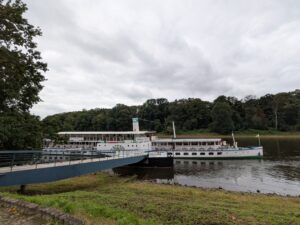
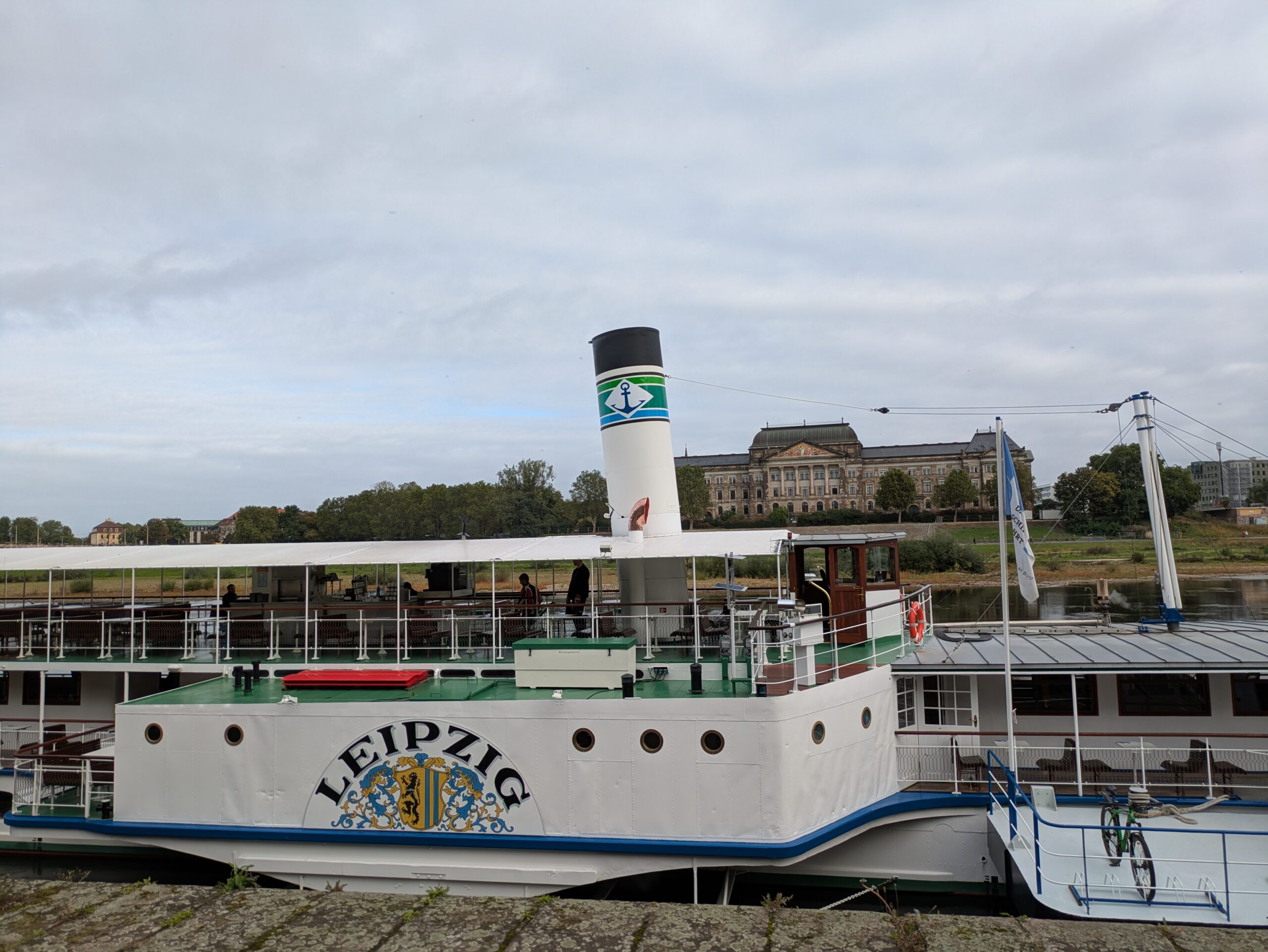
Vessel: Paddle Steamer LEIPZIG
When History Still Moves
Some history remains behind glass. Some still vibrates and turns, carrying a boat full of people upstream along the Elbe.
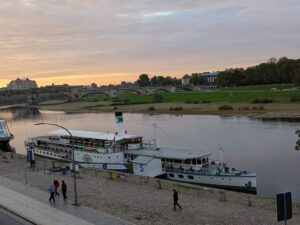
As LEIPZIG left Dresden, the city slowly receded toward both banks. Buildings unfolded along the river, and I knew that the three famous Elbe castles were on the port side of the vessel. But I did not spend much time looking at them. What kept drawing my attention instead was the paddle wheel turning beside the ship and the steady rustling rhythm of machinery beneath the deck.
On shore, history is often encountered through drawings behind glass. Aboard the ship, history became a warm vibration beneath my feet. I was sitting on an old vessel, watching Dresden pass from the water, while entering a piece of technology that was not merely preserved, but still working.
A Heart from 1929, Still Beating
What excited me most was not simply that an old ship was still sailing. It was that machinery built in 1929 was still turning steam into forward motion beneath my feet.
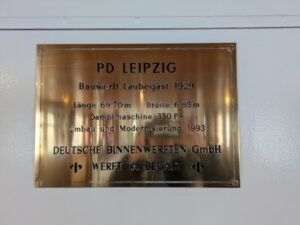
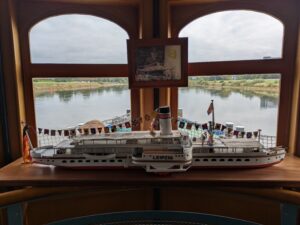
LEIPZIG was built in 1929 and still sails on the Elbe today. She belongs to Dresden’s historic paddle-steamer fleet and is both its largest and youngest historic paddle steamer.
The ship herself belongs to the twentieth century, but the technology working beneath my feet is older. Steam engines and paddle-wheel propulsion had already matured during the nineteenth century. This is the “nineteenth century” of the title: not the date of the vessel, but a technological lineage that continues to move through the present.
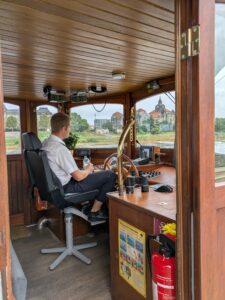
LEIPZIG is not a museum ship permanently moored to the riverbank. I bought a ticket, stepped aboard, and she actually carried us upstream. I chose a seat behind the wheelhouse, where I could watch the captain observe the river and navigate the vessel. Before long, however, the sound coming from below deck pulled me away from the scenery.
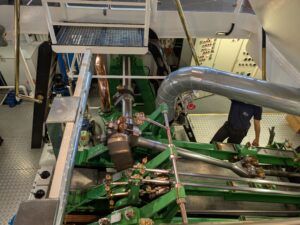
Looking down from the deck, I found an entire mechanical system in motion. This was not a model or a demonstration. Connecting rods moved back and forth, shafts rotated, and the ninety-year-old vessel was travelling under the power of her own historic machinery.
A real old ship does not need an instruction manual. Its breathing is already the best guide.
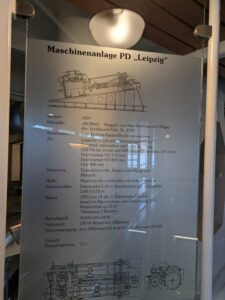
At the centre of LEIPZIG’s propulsion system is a two-cylinder compound steam engine built in 1929. Steam first enters the high-pressure cylinder and drives the piston. Instead of being exhausted immediately, it then enters the larger low-pressure cylinder, where its remaining pressure is used for further expansion. The reciprocating movement of the pistons passes through connecting rods and cranks and becomes the rotation of a shaft.
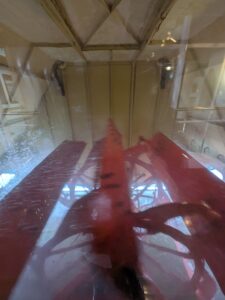
That force continues outward to the sides of the vessel, driving the red paddle wheels, each 3.20 metres in diameter and fitted with nine iron paddle blades. One blade after another enters and leaves the water, pushing it backwards and moving the ship forward.
Standing beside the machinery, I was no longer looking at separate components. I could see an entire path of energy unfolding in front of me: fuel produces heat, heat produces steam, steam produces force, and that force eventually reaches the water and moves the whole vessel.
Turning energy into motion is an old engineering problem. Keeping that motion going for more than ninety years is another kind of persistence.
Three Lives of One Ship
The age of a ship cannot be counted only from the day she was launched. War, sinking, repair and interruption become layers in her life.
When LEIPZIG entered service in 1929, she was not an antique. As the sister ship of the luxury passenger steamer DRESDEN, built in 1926, she represented advanced passenger-ship technology of her time. Her modernity extended beyond the hull itself to steering, electrical supply and equipment on board.
In 1931, LEIPZIG made her first voyage beyond Germany to Aussig, today Ústí nad Labem in the Czech Republic. She also operated musical excursion cruises to Herrnskretschen, today Hřensko. At that time, LEIPZIG had none of the historical aura she carries today. She was simply a young working vessel on the Elbe.
War transformed the meaning of her voyages.
During the summer of 1942, LEIPZIG regularly carried convalescent soldiers on excursions to Stadt Wehlen. In 1944, she was officially converted into a hospital ship, marked with red crosses and stationed near Kleinzschachwitz.
On the morning of 14 February 1945, after the devastating bombing of Dresden, LEIPZIG entered the city as a hospital ship. She took injured civilians aboard and carried them upstream. The vessel that had once carried excursion passengers was now transporting people away from a devastated city.
On 2 March 1945, LEIPZIG was hit during another air raid and sank near Kleinzschachwitz. Yet her story did not end on the riverbed. The first attempt to salvage her began on 15 March, while the war was still continuing. The temporary repair at the stern failed, and the first recovery attempt had to be abandoned.
It was not until Christmas 1945 that LEIPZIG was finally raised. On 24–25 December, she was recovered and taken to Laubegast, where a long process of repair began.
On 7 June 1947, LEIPZIG returned to passenger service. The historical invitation for the occasion called it her “second maiden voyage.” The ship was moving again, but the Germany into which she returned was no longer the Germany of 1929.
History interrupted her once more at the end of 1988, when LEIPZIG entered the shipyard for a major overhaul. Once the vessel had been dismantled, the world outside changed dramatically. Funding disappeared during the political and economic transformation surrounding the end of East Germany, and work stopped in 1990.
After Conti took over the shipping company in November 1992, reconstruction resumed. On 11 July 1993, LEIPZIG undertook her first trial run. She returned to service and has continued sailing on the Elbe.
A ship reaches such an age not because she has never been wounded, but because after every serious interruption, someone has been willing to return her to the water.
Who Keeps a Century-Old Machine Sailing?
A machine can propel a ship, but it cannot carry that ship through a century on its own. The people working behind the machinery are the ones who repeatedly return history to the river.
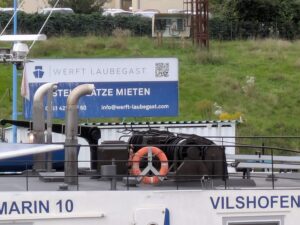
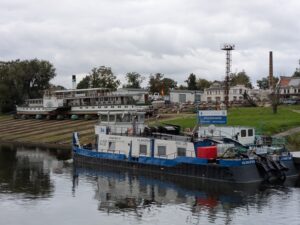
As LEIPZIG continued toward Pillnitz, we passed the shipyard at Laubegast. By then, I had already read the vessel’s history, and the place suddenly meant something different. Again and again, LEIPZIG’s life had returned here. Construction, repair, major overhauls and long-term maintenance connected the ship to this place.
Building a ship may require one launch ceremony. Keeping one alive requires the everyday work of generations.
Until then, my attention had remained very close to the vessel itself: the wheelhouse, the steam engine and the connecting rods. Passing the shipyard widened the frame. LEIPZIG does not exist alone. She belongs to a historic fleet.
For these old vessels to continue carrying passengers, machinery alone is not enough. They need crews who understand modern safety requirements, craftspeople familiar with historic structures, specialists capable of maintaining boilers and machinery, and shipyards that retain the ability to work with technologies from another age.
Technology can be recorded in drawings. Craft knowledge also survives in human hands. The fact that these historic ships still sail therefore preserves more than industrial artefacts. It preserves a living relationship between people, knowledge and machines.
LEIPZIG’s technical life also extends beyond Laubegast. Her 1929 steam engine was built in Dresden-Übigau. Decades later, her replacement boiler also came from Übigau, and during the winter of 2021–22 that boiler returned there for another major overhaul.
A ship can continue sailing only because an entire network survives around it: places, workshops, machines, skills and people. The network may change over time, but it has never completely broken.
After Leaving the Ship, I Was Still Looking at Ships
Every voyage ends, and eventually the sound of the machinery remains behind. But what a ship truly leaves is also the trace of the people who have lived and worked around it.
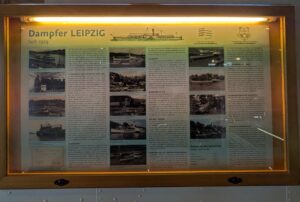
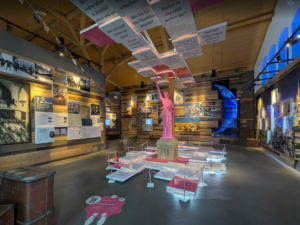
The day after leaving LEIPZIG, I visited the shipping company’s premises. There, a series of display cases preserved objects from the working life of the fleet: a speaking tube, ropes, tools and old account books.
Aboard LEIPZIG, I had watched machinery move a ship. In front of these glass cases, I encountered something quieter: the everyday life surrounding that machinery.
Someone navigated. Someone repaired. Someone kept the accounts.
The history of a fleet is not contained only in engines and hulls. It also survives in small, ordinary objects that once passed through human hands.
An old ship is moving not only because it shows us what technology of the past could achieve, but because it also shows that people in the present are still willing to care for it.
Across Civilizations
When Does an Old Technology Become Old?
King Kaolie watched the paddle wheel enter the water again and again.
“That wheel has not been the most advanced technology for a long time, has it?”
“No,” I said. “Propellers came later. They are faster and more efficient.”
He looked puzzled. “Then why is something that has already ‘lost’ still working on the river?”
I looked at LEIPZIG and, for a moment, did not know how to answer.
Huang Xie smiled. “The people of Chu made lacquerware layer by layer. More than two thousand years later, people still work with lacquer. Is it more efficient than iron or porcelain? Not necessarily. But it still has its place.”
King Kaolie looked back at the paddle wheel. “Then tell me: when does a technology truly become old?”
“Perhaps when it is no longer useful,” Huang Xie suggested.
I turned again toward LEIPZIG. The steam engine was still running, and she was carrying a boat full of passengers toward Pillnitz.
Huang Xie shook his head. “It is not that old technologies never die. Some survive only in museums, and sometimes no one even remembers how to make them anymore. So the interesting question is not why old technology refuses to die, but why this one remained.”
This time, I did not answer.
The answer had already been hidden within the journey itself. A technology may survive not because it remains at the technological frontier, but because people continue to use it, because someone still knows how to care for it, and because the human knowledge surrounding the machine has not been broken.
More than two thousand years separate the world of Chu from the Elbe today, yet both lead toward the same question:
Objects inevitably grow old. But as long as someone is willing to take up the tools, civilization can continue to sail.

 时间:2026年09月25日 (五)
 行程|德勒斯登 · 易北河上游船