How Do You Wake a Steamship from 1908? | The Three-Step Life Cycle of SCHAARHÖRN
Acknowledgement|My thanks to Stiftung Hamburg Maritim for providing a complimentary ticket for the planned SCHAARHÖRN voyage. Due to strong winds, the voyage was cancelled and the visit took place aboard the vessel at the quay instead.
The Voyage That Never Began
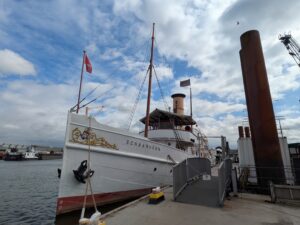
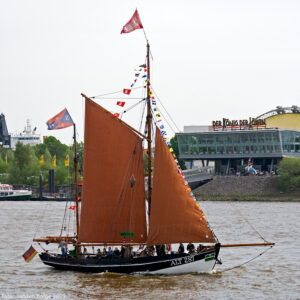
Built in Hamburg in 1908, SCHAARHÖRN is a coal-fired twin-screw steamship. Originally commissioned as a survey vessel, she was given unusually elegant fittings because Hamburg also intended to use her to carry Kaiser Wilhelm II through the port — a voyage that never took place. For decades, she later served in hydrographic survey work around the Elbe estuary.
On 30 August 2026, I went to Hamburg expecting to spend three and a half hours aboard SCHAARHÖRN. The plan was to leave the harbour with her and experience how a steamship built in 1908 still sails today. But the wind had reached Beaufort force seven to eight, above the vessel’s operating limit of force five. The voyage was cancelled, and SCHAARHÖRN remained tied to the quay.
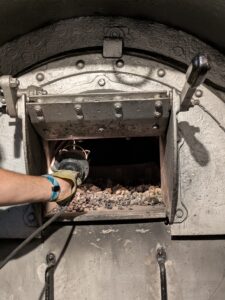
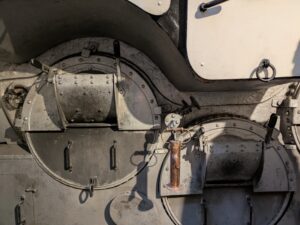
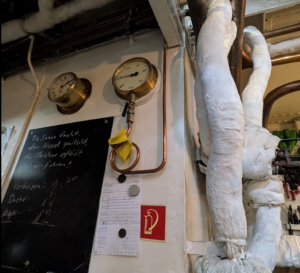
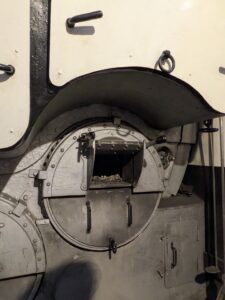
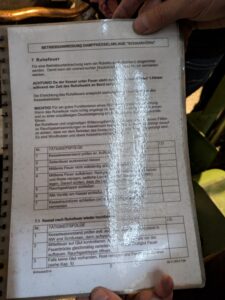
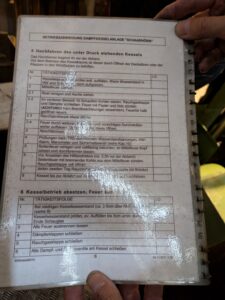
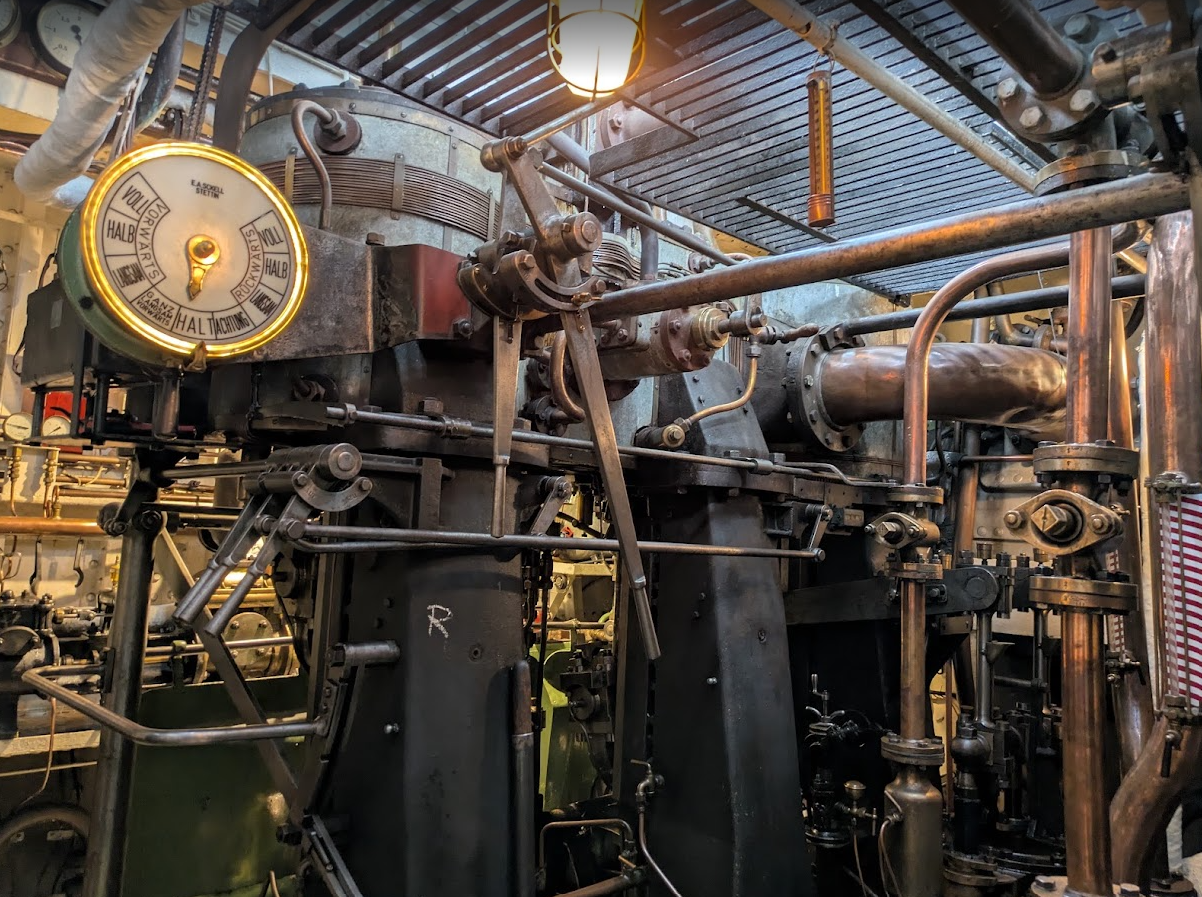
Instead, I went below deck. There I found pressure gauges, copper pipes, valves, furnaces and machinery — and a laminated operating manual for the ship’s boiler system. I had come to watch an old steamship sail. Instead, I began asking a different question: What has to happen before a steamship can sail at all?
A Voyage Begins Long Before Departure
A steamship does not wake when the whistle sounds or when the propeller begins to turn. According to SCHAARHÖRN’s operating procedures, preparing a cold boiler begins about 36 hours before departure. In practice, the preparations reach back almost two days.
Before fire comes water. The crew checks the boiler water level, the low-water alarm and the feedwater system. Only then are the grates cleaned, coal placed in the furnace and the first fire established.
From there, the transformation begins: coal → fire → heat → water → steam → pressure. Yet the striking thing is how slowly it must happen. The instructions limit the rise in boiler-water temperature to roughly seven degrees Celsius per hour and the increase in pressure to no more than one bar per hour. More fire is not automatically better. The entire system needs time to move from cold to hot.
The Difficult Part Is Keeping Her Running
Once pressure has been established, the machinery can work. But nothing inside the boiler remains still. Fire continues to burn, water becomes steam, steam is consumed, and both water level and pressure continue to change.
The crew is therefore not guarding a single correct number. They are watching a moving relationship between fire, water, steam and pressure. The water-level glass must be cleaned and checked, the low-water alarm tested, the pressure gauge verified and the safety valve kept functional. Even an instrument that displays a number cannot simply be trusted without verification.
The operating logic can be reduced to a repeating sequence: observe → judge → adjust → observe again. This is perhaps the most important difference between starting a machine and keeping it alive.
Water Goes In, Water Comes Out
Steam leaves the boiler, so water has to return. SCHAARHÖRN’s instructions describe several ways of feeding water back into the system, including feed pumps, a duplex pump, an injector and an auxiliary feed pump.
But supplying water is only half the story. Deposits at the bottom of the boiler must be removed through blowdown, while foam and impurities at the surface require separate treatment. Water enters, water leaves, and the crew checks again. What looks from outside like steady operation is, from inside, a process of continuous correction.
Upstairs and Downstairs
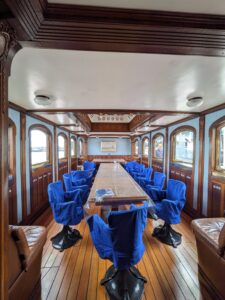
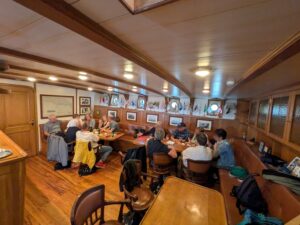
Above the machinery spaces, SCHAARHÖRN presents a completely different world. Her wooden saloon, long table and blue-covered chairs create a calm passenger space. No one sitting there needs to know when boiler water must be replenished or when a pressure gauge needs attention.
Below deck, however, coal continues to burn, water becomes steam and pressure changes. Someone watches, judges, adjusts and looks again. The calm experienced upstairs is therefore not the absence of activity. It is produced by continuous work downstairs.
A Steamship Does Not Have an OFF Button
Stopping the ship is also a process. When a voyage ends, the boiler is still hot, pressure remains in the system and the furnace still contains stored heat. Energy accumulated over many hours cannot disappear at the moment the passengers step ashore.
The fire must be reduced, the boiler water level checked and the steam and flue-gas systems brought out of operation in sequence. But SCHAARHÖRN also has another state: Ruhefeuer, a banked or resting fire. The boiler is no longer operating normally, yet the fire is not allowed to disappear completely. The system waits in a condition from which it can later be brought back toward operation.
This was the moment when the machine stopped looking binary to me. It was not simply ON or OFF. It could be cold, warming, operating, resting, restarting or shutting down.
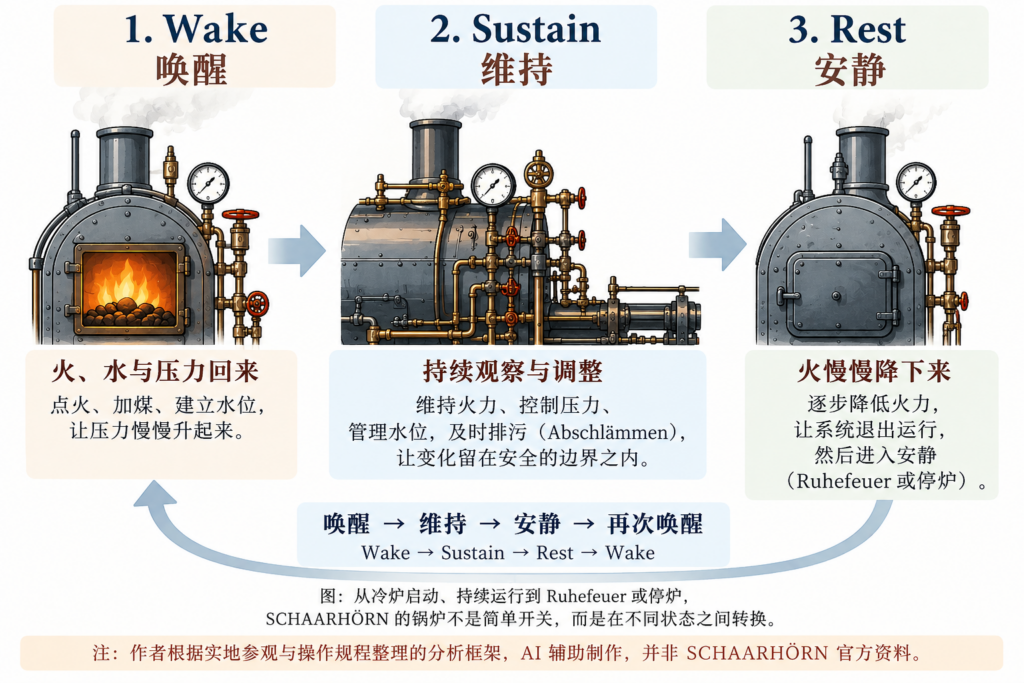
Wake, Sustain, Rest
The dense operating instructions gradually resolved themselves into a much simpler pattern. First, the system must be awakened. Then it must be sustained through constant observation and adjustment. Finally, it must be brought toward rest — sometimes only temporarily, before another awakening.
Wake → Sustain → Rest → Wake again.
This is my own analytical framework based on the visit and the operating instructions, not an official SCHAARHÖRN model. But it helped me understand the machinery in a new way. A steamship does not simply switch between two states. It moves through a cycle.
What Does It Mean to Preserve a Working Ship?
A historic steamship can be preserved as an object. Hull plates can be repaired, timber replaced, brass polished and machinery maintained. But a working historic ship requires something more.
The operating procedures preserve knowledge. The crew turns that knowledge into action. Only when the physical vessel, the knowledge of how it works and people capable of applying that knowledge remain connected can the preserved machine become a working ship again.
That is what makes SCHAARHÖRN living maritime heritage. I had travelled to Hamburg hoping to see her move, but the wind kept her at the quay. Instead, I discovered something I might otherwise have missed.
A ship built in 1908 does not continue to sail simply because its machinery survived. It continues to sail because, in 2026, someone still knows how to wake it.
Across Civilizations
King Kaolie stood in front of the boiler and watched the fire. “The fire is already burning. Why can’t the ship leave?”
“Because having fire does not mean having usable power,” I said. “The water must warm slowly, and the pressure must rise slowly too.”
The king frowned. “You have fire, but you cannot burn it harder. You have power, but you cannot use it immediately. You people two thousand years later make everything complicated.”
Lord Chunshen Huang Xie smiled. “Your Majesty, it was no different two thousand years ago. Chu had soldiers. Did that mean we sent them into battle every day? We had grain. Did that mean we ate all of it at once?”
“Of course not.”
“Then perhaps power itself is not the difficult part,” Huang Xie said. “The difficult part is allowing power to exist without letting it destroy the order around it.”
King Kaolie looked back at the machinery. “So the crew is not trying to make the fire bigger?”
“No.”
“Or make the ship faster?”
“No.”
“Then what are they doing?”
“Making sure every force remains where it belongs.”
We climbed back onto the deck. The wind across Hamburg harbour was still strong, and SCHAARHÖRN remained tied to the quay.
The king looked at the mooring lines. “I understand now. The wind is too strong, so the ship does not sail. Pressure cannot be rushed, so you do not force the boiler. Having power does not mean that power must always be used.”
Huang Xie smiled. “Your Majesty has finally understood.”
“I understood from the beginning.”
I looked at him. “So, can Your Majesty operate the steamship now?”
He was silent for a moment. “No. Can you?”
“No.”
The king nodded with satisfaction. “Excellent. Then none of us should touch anything.”
The challenge is not simply to create power, but to bring power into order.

 时间:2026年08月30日 (日)
 行程|汉堡 · Schaarhörn 登船