封面图说明|
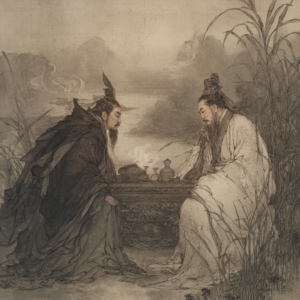
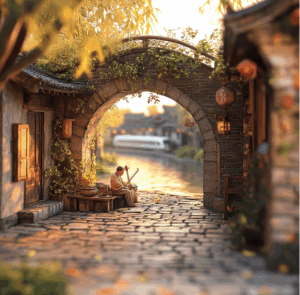
青衣临水,怀瑾握瑜,孤影沉思。
骏马隐于烟波,贤才难遇伯乐。
江水无言,唯有美玉映照初心。
图片:原创数字插画。
引文|怀瑾握瑜,为何无人识?
怀抱美玉的人,
最深的悲哀不是无人赞赏,
而是世人早已失去辨认美玉的眼睛。
战国后期,
楚国的孟夏时节,
草木繁盛,
江河奔流不息。
然而,
在这片充满生机的土地上,
一位远离朝廷的诗人正独自南行。
《怀沙》所呈现的困境,
不只是忠臣遭到放逐的政治悲剧;
它更揭示了一个艰难的选择:
当解释与申辩都失去了作用,
一个人还能如何守住自己的原则?
一|怀玉之人:当世界颠倒了黑白
当凤凰被囚,鸡鹜翔舞,
当美玉与顽石被混为一谈,
一个坚守原则的人,
该如何面对失去判断标准的世界?
1. 孟夏南行:草木繁盛,诗人独哀
「滔滔孟夏兮,草木莽莽。
伤怀永哀兮,汩徂南土。」
「草木莽莽」描绘生命的繁盛,
「伤怀永哀」却揭示内心的悲痛。
自然依照季节不断生长,
诗人的政治理想却陷入困境;
外在世界的繁盛与个人的命运,
并不会按照同一种方向发展。
2. 黑白颠倒:当凤凰被关进竹笼
「变白以为黑兮,倒上以为下。」
「凤皇在笯兮,鸡鹜翔舞。」
白色被说成黑色,上方被说成下方,
原本应当受到尊重的凤凰,
竟然被关进狭小的竹笼。
当贤者受到限制,
庸者反而得势,
政治秩序便失去了应有的标准;
这不是一只鸟的遭遇,
是一个时代失去了辨认的能力。
「同糅玉石兮,一概而相量。」
珍贵的美玉与普通石头,
被混杂在同一个地方。
判断者不再区分两者的品质,
反而使用相同的尺度加以衡量。
美玉没有因此失去自身的价值,
但它已难以获得应有的认识;
问题不在玉,
在眼睛。
3. 怀瑾握瑜:美玉为何无人识?
「怀瑾握瑜兮,穷不知所示。」
「伯乐既没,骥焉程兮。」
一个人拥有怎样的德行与才能,
与他是否得到社会认可,
原本就是两个不同的问题;
但在政治生活中,
如果缺乏辨认贤才的能力,
个人的价值便难以转化为实际贡献。
「邑犬群吠兮,吠所怪也。」
「非俊疑杰兮,固庸态也。」
人们容易相信熟悉的判断,
也容易排斥不符合习惯的事物;
当群体的意见成为衡量标准,
独立而不同的声音,
便可能被误认为错误。
4. 定心广志:当生命走向最后的抉择
「离闵而不迁兮,愿志之有像。」
「定心广志,余何畏惧兮!」
「知死不可让,愿勿爱兮。」
《橘颂》赞美坚定的人格,
《怀沙》则将坚定推向悲剧的边缘;
同样是不迁其志,
一个还留在人间,
一个已经走到了江边。
从现代人的立场阅读《怀沙》,
我们可以理解诗人的悲愤与坚持,
也能尊重他对人格原则的重视。
但理解古代的死亡抉择,
并不意味着必须赞同这样的方式。
生命同样具有不可替代的价值,
坚持理想也不必以死亡证明;
《怀沙》真正令人悲伤的,
不只是诗人最终面对的命运,
而是一个曾经希望改变国家的人,
在经历政治排斥与流放之后,
仍然无法放下自己的理想。
二|当《怀沙》成为歌:两千三百年后的精神回声
江水带走了楚人的身影,
却未能带走诗人的声音。
两千三百多年后,
古老的辞章再次化为旋律。
2025年7月31日前后,
《怀沙》的AI音乐创作逐渐完成。
从古辞原文的拼音标注开始,
到古琴、箫声与低回人声的构想,
创作者尝试以缓慢而沉重的旋律,
呈现诗人从悲愤走向决绝的心境。
然而,真正意外的发现发生在谱曲之后。
「谱完《怀沙》的曲,
骤然发现自己就是怀沙,
傲娇、龟毛,又有洁癖。」
这并非将自己的命运与屈原相提并论,
而是在反复阅读与创作的过程中,
发现自己在生活与创作中,
对原则与品质的某些坚持,
竟与古老辞章中的情感产生共鸣。
我们究竟是在理解屈原,
还是通过屈原,
重新认识自己?
《楚辞·九章·怀沙》|AI 谱曲作品
尾声|江水东流,美玉仍在
江水带走了诗人的生命,
却未能带走他坚守的信念。
美玉沉入历史的深处,
仍在后人的目光中闪耀。
屈原未能改变自己的政治命运,
却让后世看见了理想与现实的冲突。
他的选择属于那个遥远的时代,
而今天的人们拥有不同的生活条件。
我们可以珍惜他对原则的坚守,
却不必重复他以生命作出的抉择;
如果坚守原则不必以生命为代价,
那么今天的我们,
又该如何守护心中的美玉?
美玉不必沉江,
才能证明珍贵;
志向不必殉身,
才能证明坚定;
真正值得守护的,
不仅是心中的美玉,
还有那个怀抱美玉的人。
楚人对话后记|考烈王、黄歇与令尹夫人的观后感
美玉该如何留在人间?
《怀沙》的最后一句渐渐消散。
「明告君子,吾将以为类兮。」
考烈王问黄歇:
「春申君,屈大夫既然怀有治国之才,
为何宁愿赴死,也不另寻出路?」
黄歇放下茶盏:
「大王,屈大夫并非不知变通;
而是不愿改变自己的原则。
只是臣以为,坚守志向,
未必一定要付出生命的代价。」
考烈王摇了摇头:
「春申君,朝堂上的事情,
从来不是只有黑白两种颜色。
若人人都坚持自己的判断,
君王又该如何治理国家?」
黄歇拱手回答:
「大王,治国需要权衡利害;
但妥协也应当有所界限。
若为了保住官位而颠倒是非,
便不是变通,而是失去原则。」
我坐在一旁,忍不住问:
「可是若无人识玉,
难道就要让美玉沉入江水?
屈原为什么不能继续活着,
等待真正理解他的人?」
黄歇沉思片刻:
「夫人,伯乐不在,
千里马仍然能够奔跑。
世人不识美玉,
也不意味着美玉失去价值。
只是屈大夫身在困境之中,
或许已经看不见其他道路。」
我忽然笑了起来:
「其实谱完《怀沙》的曲,
我发现自己就是《怀沙》!
傲娇、龟毛,又有洁癖!
不过,我可不打算投江,
我还要继续写文章、谱曲呢!」
考烈王听完哈哈大笑:
「令尹夫人,寡人倒觉得,
你比屈大夫想得开一些。
既然怀抱美玉,
何不留在人间慢慢展示?」
黄歇望着考烈王,微微一笑:
「大王,两千三百多年过去,
仍然有人为屈大夫谱曲。
这不正说明,当年无人识得的美玉,
终究还是等到了后人?」
考烈王沉默片刻,忽然说道:
「春申君,寡人倒想提醒你:
你自己也是身居高位之人。
劝别人留在人间容易;
可别忘了为自己留下退路。」
黄歇闻言,微微一怔。
他望着考烈王,没有立即回答。
云梦泽上,夜色渐渐深沉,
只有江水依旧缓缓东流。
有些人守住了理想,
却未能守住自己的生命;
有些人深谙权力的规则,
最终也未能走出权力的困局。
说明:本篇为依据《楚辞·九章·怀沙》及楚国历史人物创作的跨时空文学想象,并非真实历史对话。
Appendix|English Narrative Overview
Holding Jade Within, the River Remains Silent
Chu Ci · Jiu Zhang · Huai Sha
When the World Can No Longer Recognize Jade
Summer has arrived in the ancient state of Chu. Trees and grasses flourish, and the rivers continue their endless journey across the southern landscape. Yet a solitary poet travels through this world of abundance with a heavy heart. Qu Yuan, once devoted to serving his country, has been driven away from the political life to which he gave his loyalty.
In Huai Sha, his sorrow extends beyond personal exile. He sees a society in which the distinction between right and wrong has become increasingly uncertain. Those he considers worthy are neglected, while others gain influence. The ideals that once guided his public life seem to have lost their place in the world around him.
The poem raises a painful question. What happens when a person remains faithful to his principles, but the society he hopes to serve can no longer recognize their value?
I. Holding Jade | When the World Loses Its Judgment
Qu Yuan begins his journey in the flourishing summer landscape of Chu. Nature continues to grow according to its seasons, indifferent to the political troubles of human beings. For the poet, however, the journey south is marked by grief. His surroundings are full of life, while the future he once imagined for his country appears increasingly distant.
As the poem unfolds, he describes a world turned upside down. A phoenix is confined while ordinary birds move freely. White is mistaken for black, and what should stand above is placed below. These images express more than disappointment with individual officials. They suggest a political order that has lost the ability to distinguish genuine ability from undeserved influence.
The image of jade gives this criticism a more personal meaning. Qu Yuan carries precious jade within himself, yet has no one to whom he can reveal it. The jade represents integrity and moral character, qualities that do not disappear simply because others fail to appreciate them. But in political life, unrecognized ability may never become an opportunity to serve.
He then recalls Bo Le, the legendary judge of exceptional horses. Without someone capable of recognizing a fine horse, how can its abilities be properly measured? The same problem confronts a talented person whose society has lost its standards of judgment. The tragedy is not that the jade has become worthless, but that those who should recognize it no longer know how to look.
Qu Yuan also observes how people distrust what they do not understand. Dogs bark at unfamiliar things, just as ordinary opinion may turn against those who think or act differently. Once conformity becomes the measure of correctness, an independent voice can easily be mistaken for a dangerous one.
In the final movement of the poem, the poet resolves not to abandon his convictions. His determination brings Huai Sha close to the tragedy traditionally associated with his death. Yet understanding his choice does not require us to regard death as the necessary proof of integrity.
This creates a striking contrast with Ju Song, the Ode to the Orange Tree. Both poems admire a character that remains steadfast. But while the orange tree continues to stand firmly rooted in its native soil, the poet of Huai Sha approaches the edge of the river. The same ideal of constancy has reached a very different human conclusion.
II. Giving Huai Sha a New Voice | An AI Musical Experiment
Around July 31, 2025, I returned to Huai Sha through music. I began by preparing the pronunciation of the classical Chinese text, then explored how its sorrow and determination might be expressed through an AI-generated composition. The musical concept drew on the restrained sounds of the guqin and xiao, with a slow, mournful atmosphere intended to give the ancient words space to unfold.
The process was not simply about transforming poetry into a song. It required thinking about how the rhythm of classical Chinese might survive in a modern musical setting. The recurring particle xi (兮), so characteristic of Chu Ci, offered natural moments of suspension and emotional emphasis.
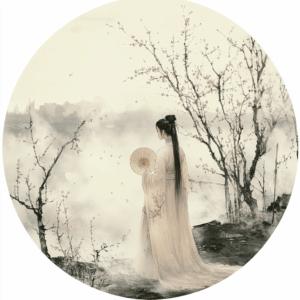
The accompanying artwork developed another interpretation of the poem. A woman dressed in dark robes stands beside the river, holding luminous green jade. Distant horses emerge through the mist, recalling the story of Bo Le and the unrecognized steed. The female figure is not intended as a historical portrait of Qu Yuan, but as a contemporary artistic expression of the poem’s inner world.
Something unexpected happened after I completed the composition. I wrote, half jokingly, that I had suddenly discovered I was Huai Sha myself: proud, particular about details, and almost obsessively concerned with standards.
I was not comparing my life with Qu Yuan’s suffering. Rather, the creative process had revealed something familiar in his insistence on principles. What began as an attempt to understand an ancient poet had become an opportunity to recognize aspects of my own character.
Was I discovering Qu Yuan through his poetry, or discovering something about myself through Qu Yuan?
Epilogue | The River Flows East, the Jade Remains
More than two thousand years have passed. The political struggles of ancient Chu have disappeared into history, but Qu Yuan’s poetry continues to be read, interpreted, and sung. The jade he carried has outlived the world that failed to recognize it.
His determination deserves respect, yet his tragic fate also invites a different question. Must a person sacrifice life itself to demonstrate the strength of a conviction? The value of integrity does not depend upon such a sacrifice.
We can admire the principles Qu Yuan refused to surrender without believing that we must follow his final path. Perhaps the greater challenge for people living today is to preserve both our convictions and the possibility of continuing to live by them.
The river continues flowing eastwards. The jade remains precious, but so does the person who carries it.
Across Civilizations
King Kaolie, Huang Xie, and Lady Lingyin | How Can Jade Remain in the Human World?
The final words of Huai Sha faded from the screen. King Kaolie turned towards Huang Xie, Lord Chunshen, as the image of the river slowly disappeared.
“Qu Yuan possessed the ability to serve his country,” the king observed. “Why did he choose death rather than search for another path?”
Huang Xie set down his teacup. “Your Majesty, he was unwilling to abandon his principles. But remaining faithful to one’s convictions does not necessarily require surrendering one’s life.”
The king shook his head. “You know as well as I do that governing a country is rarely a matter of simple right and wrong. If every official insists that his judgment is correct, how can a ruler govern?”
“Government requires compromise,” Huang Xie replied. “But compromise must have limits. When someone abandons the distinction between right and wrong merely to preserve his position, adaptability becomes something else.”
I had been listening quietly. “But if no one recognizes the jade, must it be carried into the river? Why could Qu Yuan not remain alive and wait for someone who might understand him?”
Huang Xie considered the question. “Even without Bo Le, an exceptional horse can still run. Jade does not lose its value because others fail to recognize it. Perhaps Qu Yuan had simply reached a point where he could no longer see another road.”
I laughed. “After composing Huai Sha, I suddenly recognized myself in it. Proud, terribly particular, and obsessed with getting things right! But I have no intention of jumping into a river. I still have articles to write and music to compose.”
King Kaolie burst into laughter. “Lady Lingyin, perhaps you have found a more practical way to carry your jade. Why not remain in the world and give others time to recognize it?”
Huang Xie smiled. “And after more than two thousand years, someone is still composing music for Qu Yuan. Does that not suggest that the jade he carried eventually found people capable of appreciating it?”
The king fell silent before turning towards his minister again.
“Lord Chunshen, there is something I should remind you of. You, too, occupy a position of great power. It is easy to advise another man to preserve his life. Do not forget to leave yourself a way out.”
For a moment, Huang Xie had no answer.
Night settled over Yunmeng Marsh, and the river continued its journey eastwards. Qu Yuan had remained faithful to his ideals, while Huang Xie had learned to navigate the complexities of political power. Yet history would not spare Huang Xie a tragic ending of his own.
Their different lives leave us with a question that reaches far beyond ancient Chu: how can we protect what we believe in without losing ourselves in the struggle?
The jade is worth preserving. So is the life of the person who holds it.
Historical and literary note: This dialogue is a fictional encounter across time, inspired by Chu Ci · Jiu Zhang · Huai Sha and the history of ancient Chu. King Kaolie and Huang Xie, Lord Chunshen, belonged to a later historical generation than Qu Yuan. Their conversation with Lady Lingyin is a literary creation, not a historical record. The traditional association between Huai Sha and Qu Yuan’s death is also subject to questions of dating and interpretation.
🤖 人工智能协作声明
本文的主题选择、田野调查、资料搜集、核心观点与中文原始内容,均由作者独立完成。创作过程中,作者与人工智能模型,进行持续协作,包括多轮讨论、思路推演、叙事节奏调整、部分翻译、英文 Narrative Overview 生成、语言检查、结构检测与文字润饰。
人工智能在此过程中,作为创作协作者,参与内容发展与语言表达,但不作为法律意义上的作者或著作权主体。所有 AI 协作产生的内容,均由作者依据田野资料、原始文献与中文母稿,进行选择、审校、修改与艺术化重构。文章的叙事方向、内容取舍、创作决策、最终表达与价值判断,均由作者决定并负责。
📜 本站所有原创作品均已完成区块链存证,确保原创凭证。部分重点作品另行提交国家版权登记,作为正式法律备案。原创声明与权利主张已公开。完整说明见:
👉 原创声明 & 节奏文明版权说明 | Originality & Rhythm Civilization Copyright Statement – NING HUANG
节奏文明存证记录
本篇博客文为原创作品,由黄甯与 AI 协作生成,于博客网页首发后上传至 ArDrive 区块链分布式存储平台进行版权存证:
- 博客首发时间:2026年11月21日
- 存证链接:ae49a53f-3d13-498d-9a81-5b758f7e4a84 (arweave.net)(已于 2026年11月17日上传)
- 原创声明编号:Rhythm_Archive_21_Nov_2026/chu-ci-jiu-zhang-huai-sha-embracing-sand
- 用途声明:本文为《节奏文明观》之篇章,亦参与构建《AI×非遗文明共构档案》与《文明节奏回声计划》,用于文明节奏实地记录、区块链存证、跨域协作与版权登记用途。
© 黄甯 Ning Huang, 2026. All Rights Reserved.
本作品受版权法保护,未经作者书面许可,禁止复制、改编、转载或商用,侵权必究。
📍若未来作品用于出版、课程、NFT或国际展览等用途,本声明与区块链记录可作为创作时间及原创性的佐证。