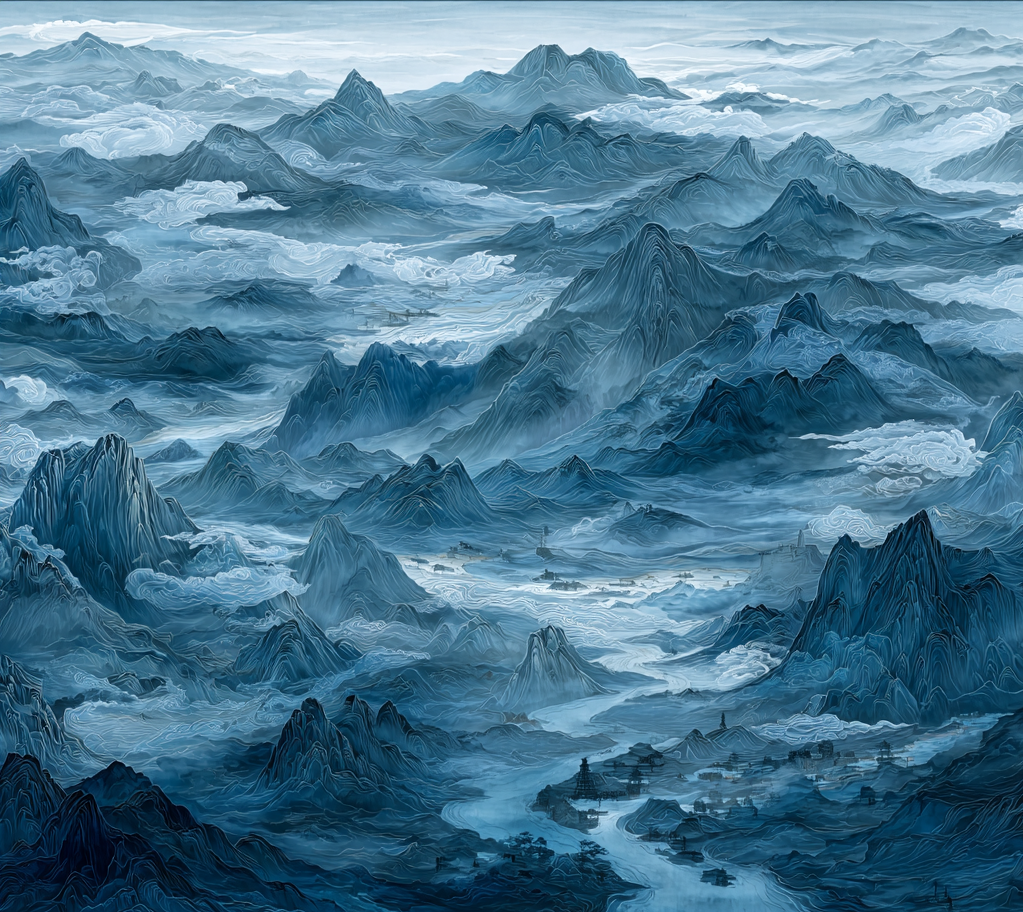
封面图说明|
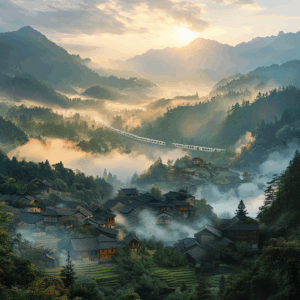
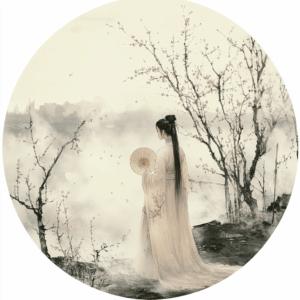
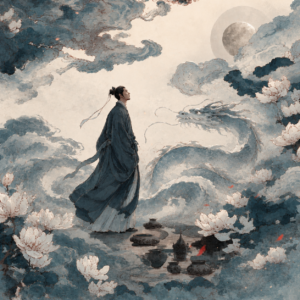
群山连绵,云海翻涌于天地之间。
千峰隐现,仿佛通往远古神界。
山河无尽,灵魂向宇宙太初远游。
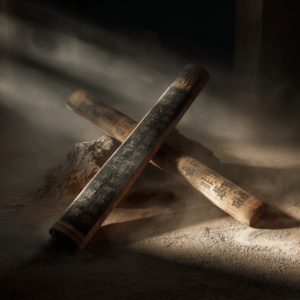
图片:原创数字插画。
引文|当人间已无归处,灵魂还能去哪里?
当现实无法容纳理想,
远游便不再只是逃离,
而是一场寻找生命本源的精神远行。
从人间的困顿出发,
到宇宙太初的无垠之境,
《远游》展开了一场超越天地的精神旅程。
然而,远游并未止于神仙世界。
当他穿越四荒八漠,
抵达天地难以辨认的尽头,
终于走向无为至清之境。
可是,在这场壮阔的远行中,
诗人曾回望故乡,长叹落泪。
即使能够超越天地的边界,
心中的眷恋仍未完全消散;
走得再远,
人未必真能放下自己出发的地方。
一|从人间到太初:一场超越天地的精神远行
当人间无法容纳理想,
诗人便将目光投向天地之外。
然而,真正的远游并非逃往另一处仙境,
而是追问生命能否超越现实的边界。
1. 人间为何令人无法停留?
「悲时俗之迫阨兮,愿轻举而远游。」
《远游》开篇没有描绘壮丽的仙境,
而是从现实世界的压抑与悲伤写起。
《楚辞》一直在绕着“悲”转,
因为屈原悲的不是失宠,
而是他所坚信的那套价值,
已经不再被这个世界认可。
「夜耿耿而不寐兮,魂茕茕而至曙。」
漫长的黑夜里,
诗人辗转难眠,直到天色渐明。
身体仍然停留在人间,
思绪却已经开始向远方飘荡。
「内惟省以端操兮,求正气之所由。」
然而,诗人并未立即逃离现实,
而是先将目光转向自己的内心。
远游的第一步,
不是身体离开人间,
而是精神开始重新寻找自己的位置。
2. 从赤松子到王子乔:楚人如何想象超越生命?
「闻赤松之清尘兮,愿承风乎遗则。」
赤松子是传说中的仙人,
象征着远离尘俗、自由自在的生命境界。
「见王子而宿之兮,审壹气之和德。」
诗人随后遇见传说中的王子乔,
向他请教关于道与生命的奥秘。
「道可受兮,不可传。
其小无内兮,其大无垠。」
道可以通过亲身体验而领悟,
却无法仅凭语言完整传授。
从赤松子的仙逸到王子乔的论道,
《远游》逐渐由求仙走向求道;
超越生命未必意味着永远活着,
也可能意味着改变自己认识世界的方式。
3. 八龙御天:楚人的宇宙究竟有多大?
「驾八龙之婉婉兮,载云旗之逶蛇。」
八条神龙牵引着华丽的车驾,
长长的云旗在天空中飘扬。
「揽慧星以为旍兮,举斗柄以为麾。」
彗星可以成为飘扬的旗帜,
北斗的斗柄可以成为指挥的标志。
在这样的宇宙想象中,
天地不是不可逾越的边界,
而是精神能够自由穿行的世界。
4. 当天地消失:远游为何以「太初」结束?
「下峥嵘而无地兮,上寥廓而无天。」
向下望去,已经没有可以立足的大地。
向上仰望,也不再看见熟悉的天空。
「视倏忽而无见兮,听惝恍而无闻。」
视觉与听觉失去了平日的作用,
人类依赖感官认识世界的方式,
似乎已经无法继续解释眼前的一切。
「超无为以至清兮,与泰初而为邻。」
诗人没有找到一座永恒的宫殿,
他所抵达的,是与万物初始状态相邻的境界。
《远游》的终点,
不是找到一个更美好的世界,
而是尝试超越人类理解世界的原有边界。
二|当古老的神游成为音乐:四章《远游》的AI创作实验
古老的楚辞可以交给AI吟唱,
但文字的准确与作品的完整,
仍然需要创作者一次次把关。
四首歌曲依照原文顺序展开:
从人间的沉郁出发,
经过寻仙与论道,
进入八龙御天的神界乐舞,
最后抵达无地无天的太初之境。
最常遇到的问题是古字发音不准,
尤其第一句经常出现错音。
SUNO 有时唱不到结尾,
有时重复诗句,甚至自行增加内容。
AI 擅长提供声音与旋律的可能,
却不能代替人理解古典文本;
从分段、标注拼音到选择最终版本,
每一步都需要人的判断。
尾声|远游之后,人是否仍要返回人间?
身体可以远离故土,
精神可以穿越天地,
唯有心中的眷恋,
未必能够随风而去。
「忽临睨夫旧乡。」
「仆夫怀余心悲兮,边马顾而不行。」
在壮丽的天界远游中,
诗人忽然回望遥远的故乡。
即使已经乘龙御风,
穿越日月与星辰,
他仍然无法忘记人间。
「思旧故以想象兮,长太息而掩涕。」
他可以离开令人失望的现实,
却无法轻易割断与故土的联系;
人可以在想象中超越天地,
却未必能够在情感上离开人间。
《远游》并非一首彻底告别人间的诗歌。
诗歌最终抵达「与泰初而为邻」的境界,
却没有明确回答诗人是否真正获得解脱。
当现实无法容纳所有理想,
人便会向远方寻找可能;
而远游最动人的地方,
或许不是终于抵达天地尽头,
而是走得再远,
仍然记得人间。
《楚辞》的“悲”,
不是屈原走不出来,
而是“一个人与时代不同步”这件事,
本来就没有出口;
但《远游》告诉我们:
就算没有出口,
人还可以往宇宙深处走一趟。
楚人对话后记|考烈王、黄歇与令尹夫人的观后感
当屈原走到天地尽头,自由究竟在哪里?
《远游》的最后一曲渐渐结束。
云梦泽上,暮色沉沉。
考烈王望着屏幕,问黄歇:
「春申君,屈大夫已经走到天地尽头,
为何仍然回望故乡,长叹落泪?」
黄歇沉思片刻:
「大王,人可以离开一片土地,
却未必能够离开自己的记忆。
故乡不只是山川城郭,
还有一个人曾经相信的理想。」
考烈王又问:
「那么,他远游天地之外,
究竟是为了寻找自由,
还是为了逃避人间?」
我正想回答,
云梦泽的水雾忽然散开。
一位身着楚衣的诗人缓缓走来。
屈原向黄歇与考烈王微微点头,
然后轻声问了一句:
「你们说,我走了那么远,
最后为什么还是回头?」
不是他困住了自己,
是“理想”这东西,
一旦认真起来,
就没有那么容易放下。
走到天地尽头,
才发现最放不下的,
不是君王,不是故国,
是自己曾经相信过的那个世界。
云梦泽上,暮色更深了。
江水继续向东,
没有人再问下去。
说明:本篇对话为作者依据《楚辞·远游》创作的跨越时空文学想象,并非真实历史对话。
Appendix|English Narrative Overview
When the Human World Cannot Hold Our Ideals, the Soul Returns to the Primordial Cosmos
Chu Ci · Yuan You (The Far Journey)
When the Human World Offers No Way Forward
Night has fallen over the ancient kingdom of Chu, but the poet cannot sleep. His thoughts return again and again to a world that no longer seems to recognize the values he has spent his life defending. He questions his own conduct, searches for the source of moral integrity, and waits for the darkness to pass. By dawn, nothing around him has changed. Yet somewhere within that sleepless night, a journey has already begun.
In Yuan You (远游, The Far Journey), traditionally attributed to Qu Yuan, the poet’s sorrow opens the way to an extraordinary adventure. Rather than continuing to struggle within the boundaries of human society, he turns towards the immortals and the distant heavens. His imagination carries him beyond mountains, rivers, and the familiar order of the world, towards the mysterious beginnings of the universe.
But this is not simply a story about escaping suffering. The poet will cross the heavens, encounter legendary beings, and travel beyond the limits of sight and sound. Along the way, he will discover that leaving the human world is far easier than leaving behind everything it once meant to him.
I. Beyond the Human World | A Journey to the Beginning of the Cosmos
The poet begins his journey in sorrow. The customs of his age have become oppressive, and the ideals that once gave direction to his life seem to have no place in the world around him. Yet before seeking another realm, he examines himself. His first departure is therefore not from the earth beneath his feet, but from the assumption that the human world must contain every possible answer.
He looks towards the legendary immortals. Red Pine Master, remembered for his freedom from worldly constraints, offers a vision of existence beyond ordinary human limitations. Later, the poet encounters Wangzi Qiao, who speaks of the mysterious Way that cannot be fully conveyed through words. Their meeting changes the meaning of the journey. What began as a longing to escape the world becomes a search for another way of understanding life itself.
Soon the landscape expands beyond anything a mortal traveller could recognize. Eight dragons draw a celestial chariot across the heavens, their movements unfolding beneath streaming cloud banners. Comets become standards, and the Northern Dipper provides a symbol of command. The poet moves through a universe filled with divine presences, extraordinary processions, and celestial music. The heavens of ancient Chu imagination are not empty distances between stars, but a vast world alive with movement.
The journey grows increasingly magnificent, yet its destination remains uncertain. The poet passes through realms where the familiar boundaries between human beings, spirits, and the cosmos seem to dissolve. He has travelled far beyond the society that once confined him, but he continues onward. Even the splendour of the divine world is not the answer he seeks.
Eventually, the heavens themselves begin to disappear. Looking down, the traveller can no longer distinguish the earth; looking up, he finds no recognizable sky. Sight and hearing lose their familiar meaning, and the universe no longer offers the landmarks by which human beings ordinarily understand existence. The celestial procession has carried him to a place where even the distinction between above and below has ceased to matter.
Here, at the end of the journey, the poet approaches Taichu, the primordial state associated with the beginning of all things. There is no palace waiting for him, no ruler offering recognition, and no earthly destination to claim as his own. He has travelled beyond the world he knew, only to arrive at a realm where the very idea of a destination begins to dissolve.
II. Giving Yuan You a New Voice | Four AI Musical Interpretations
More than two thousand years later, I returned to this extraordinary journey through music. During the summer of 2025, I worked with SUNO AI to give Yuan You a new musical form, using the original classical Chinese text rather than a modern adaptation. The poem was too long and complex to become a single satisfactory composition, so I divided it into four consecutive pieces.
The first composition, Leaving the Mortal World, Longing for a Spiritual Journey (5:52), begins with the poet’s sorrow and his desire to depart. The second, Riding Dragons and Seeking the Divine (5:12), continues his encounters with the world beyond ordinary human experience. The third, Washing in Tang Valley, Drying Beneath the Nine Suns (7:46), carries the journey into its most elaborate celestial landscapes. The final piece, Entering the Primordial Realm (3:00), brings the traveller towards the mysterious stillness beyond earth and sky.
The musical journey was not as straightforward as the titles might suggest. Classical Chinese repeatedly challenged the AI singing system, especially when uncommon characters appeared at the beginning of a passage. Sometimes SUNO repeated verses, sometimes it failed to reach the ending, and occasionally it introduced words that had never appeared in the poem. Each new generation offered possibilities, but also new problems.
I experimented with descriptions of bronze bells, ceremonial drums, spacious vocal textures, and the mysterious atmosphere of ancient Chu ritual imagination. Yet the results could not be controlled with the precision of a conventional musical score. Dividing the poem into four compositions also meant accepting differences in sound and interpretation between the pieces.
The purpose was never to claim that these recordings reproduced the music heard in ancient Chu. They were a modern encounter between a surviving literary tradition and an unpredictable creative technology. SUNO could generate melodies and voices, but preserving the text required decisions about pronunciation, sequence, completeness, and which imperfections could be accepted. The ancient poem supplied the journey; AI offered new ways to hear it.
Epilogue | The World He Could Never Leave Behind
Before reaching the primordial cosmos, the poet experiences a moment that changes the meaning of his entire journey. From the heights of the celestial world, he suddenly looks back towards his homeland. His heart fills with sorrow, and tears follow. Even the creatures accompanying his journey seem unwilling to continue.
He has travelled beyond the reach of earthly rulers and the disappointments of political life. He has encountered immortals, crossed the heavens, and entered a universe far greater than anything he once knew. Yet a single glance towards home brings back everything he had hoped to leave behind.
The homeland he remembers is more than a place on a map. It is the world in which his ideals once seemed possible, where his convictions acquired their meaning, and where he imagined that a different future might still be achieved. Leaving that world behind would mean more than departing from its rivers and cities. It would mean accepting that something he once believed in might never come into existence.
This is why the sorrow of Chu Ci cannot be reduced to a poet’s inability to move on. Its deeper tragedy lies in the experience of living according to values that one’s own age no longer seems willing to recognize. Such a conflict may offer no clear resolution, no matter how sincerely a person searches for one.
Yuan You does not promise that the poet will finally be free of his sorrow. Instead, it allows him to imagine a journey beyond the boundaries of the world that has disappointed him. Even when reality offers no way forward, the imagination can still travel towards the farthest reaches of the universe.
And perhaps the most moving part of that journey is not his arrival near the primordial beginning of existence. It is the moment when, after travelling so far, he still remembers the human world.
Across Civilizations
King Kaolie, Huang Xie, and Lady Lingyin | Why Did Qu Yuan Look Back?
The final notes of Yuan You faded into silence. Evening mist settled over Yunmeng Marsh, and the distant water reflected the last traces of daylight. King Kaolie had watched the poet travel beyond the heavens, past the boundaries of earth and sky, towards the beginning of the cosmos. Yet one moment continued to trouble him.
He turned towards Huang Xie, Lord Chunshen. “Qu Yuan has travelled to the very limits of the universe. Why did he still look back towards his homeland and weep?”
Huang Xie remained silent for a moment. “Your Majesty, a man may leave a country without leaving his memories behind. A homeland is not merely its mountains, rivers, and cities. It is also the place where he once believed his ideals could become reality.”
The king considered this answer, then asked another question. “If that is so, was he searching for freedom beyond the heavens, or was he merely trying to escape the human world?”
I was about to speak when the mist over Yunmeng Marsh began to part. Through the pale evening light, a figure in the robes of ancient Chu slowly approached. It was Qu Yuan himself, appearing as though he had just returned from the farthest reaches of his imagined universe.
He acknowledged the king and Huang Xie, then asked quietly, “I travelled so far. Why do you think I still turned around?”
For a moment, none of us answered. I looked at the poet and wondered whether the question had been misunderstood from the beginning. Perhaps he was not trapped by his sorrow. Perhaps ideals, once sincerely embraced, were simply not things that could be abandoned whenever the world became disappointing.
Huang Xie looked towards the river. The poet had travelled beyond the reach of kings, beyond the splendour of the celestial realm, and beyond the familiar boundaries of existence. Yet what he could not leave behind was neither a ruler nor even a kingdom. It was the world he had once believed could exist.
The evening grew darker over Yunmeng Marsh. The river continued flowing eastwards, and no one asked another question. Somewhere beyond the fading light lay the limitless universe of Yuan You. But the poet’s final glance remained directed towards the human world.
Historical and literary note: This dialogue is a fictional encounter across time, inspired by Chu Ci · Yuan You and the history of ancient Chu. The poem is traditionally attributed to Qu Yuan, although its authorship remains debated. King Kaolie and Huang Xie, Lord Chunshen, belonged to a later generation. Their meeting with Qu Yuan and Lady Lingyin is a literary reflection, not a historical record.
🤖 人工智能协作声明
本文的主题选择、田野调查、资料搜集、核心观点与中文原始内容,均由作者独立完成。创作过程中,作者与人工智能模型,进行持续协作,包括多轮讨论、思路推演、叙事节奏调整、部分翻译、英文 Narrative Overview 生成、语言检查、结构检测与文字润饰。
人工智能在此过程中,作为创作协作者,参与内容发展与语言表达,但不作为法律意义上的作者或著作权主体。所有 AI 协作产生的内容,均由作者依据田野资料、原始文献与中文母稿,进行选择、审校、修改与艺术化重构。文章的叙事方向、内容取舍、创作决策、最终表达与价值判断,均由作者决定并负责。
📜 本站所有原创作品均已完成区块链存证,确保原创凭证。部分重点作品另行提交国家版权登记,作为正式法律备案。原创声明与权利主张已公开。完整说明见:
👉 原创声明 & 节奏文明版权说明 | Originality & Rhythm Civilization Copyright Statement – NING HUANG
节奏文明存证记录
本篇博客文为原创作品,由黄甯与 AI 协作生成,于博客网页首发后上传至 ArDrive 区块链分布式存储平台进行版权存证:
- 博客首发时间:2026年11月17日
- 存证链接:52685242-684d-4158-8519-a83cdaea94b0 (arweave.net)(已于 2026年11月17日上传)
- 原创声明编号:Rhythm_Archive_17_Nov_2026/chu-ci-yuan-you-return-to-primordial-cosmos
- 用途声明:本文为《节奏文明观》之篇章,亦参与构建《AI×非遗文明共构档案》与《文明节奏回声计划》,用于文明节奏实地记录、区块链存证、跨域协作与版权登记用途。
© 黄甯 Ning Huang, 2026. All Rights Reserved.
本作品受版权法保护,未经作者书面许可,禁止复制、改编、转载或商用,侵权必究。
📍若未来作品用于出版、课程、NFT或国际展览等用途,本声明与区块链记录可作为创作时间及原创性的佐证。