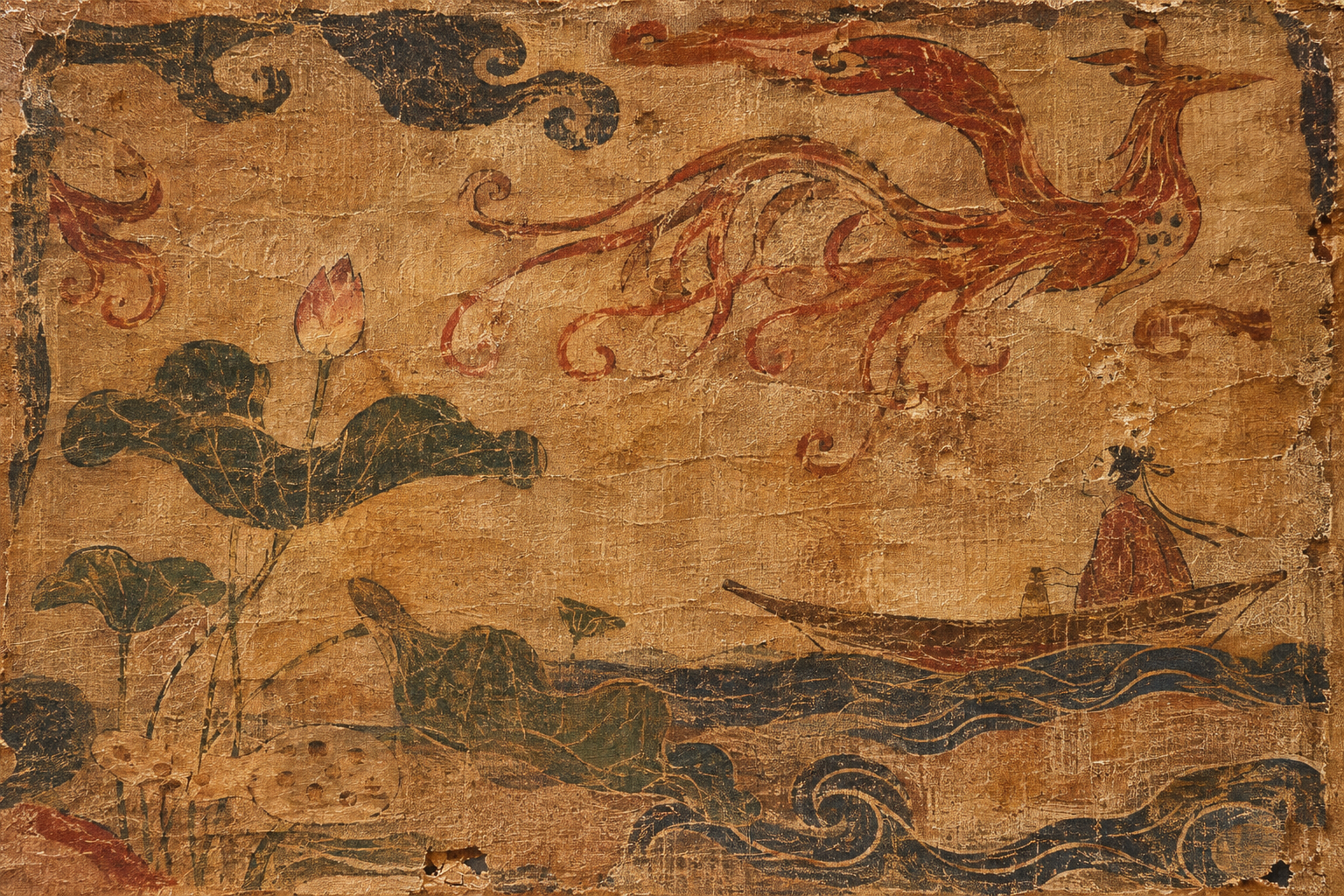
封面图说明|
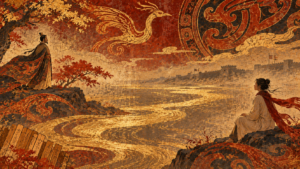
楚地帛画风格的画面上,
莲花、凤凰与河流交织,
一叶小舟穿过岁月的波纹,
驶向尚未抵达的远方。
图片:原创数字插画,借鉴战国楚地帛画艺术风格,非出土文物复原。
引文|一节莲藕,一只金凤凰,一卷古地图
人与人之间的距离,
有时不在于相隔多远,
而在于相同的语言与物品,
始终未能建立共同的意义。
春天的北京,
有人想吃莲藕,
得到的回答却是荷花还没开。
一只金凤凰曾经出现在消息里,
却始终无法确认它为谁而来。
几个月后,
一卷关于出生地的古地图,
从一个人的手中转向另一个人。
最初被称为一份材料,
再次出现时,却成了一份礼品。
三个看似平常的生活片段,
涉及语言、赠与和物品的流转。
当期待与回应无法彼此对应,
人与人又该如何建立共同的尺度?
一|荷花未开:当语言错过了需求
语言可以传递信息,
却未必能够抵达理解;
真正的沟通,
不只是听见对方说了什么,
而是理解对方为什么这样说。
四月的北京,
有人忽然想吃莲藕,
于是向一位熟人询问,
哪里可以找到一家湖北餐厅。
对方没有推荐餐厅,
却回答说荷花还没有开放。
一个人询问的是眼前的食物,
得到的回答却涉及植物的花期。
从植物学来看,
莲藕是莲生长于泥中的地下茎,
荷花则是水面上开放的花朵。
莲藕是否能够端上餐桌,
并不取决于荷花此刻是否开放。
市场上的莲藕可以经过储藏与运输,
不必等待眼前池塘的花期。
这段简短的对话,
至今仍留下一个疑问,
为什么关于餐厅的询问,
最终得到的却是花期的回答?
一场对话的错位,
未必因为有人听不懂词,
而是双方没有确认,
对方真正想表达的需求。
当回应偏离原来的需求,
沟通便可能出现细微的错位,
一句话究竟为何这样回答,
也许只有说话者自己知道。
人类创造了复杂的语言系统,
却仍然无法保证每一次交谈,
都能让两个独立的意识真正相遇。
二|金凤凰未至:当象征无法代替行动
礼物可以承载善意,
却无法代替真实的行动,
当象征与回应失去联系,
再珍贵的物品也难以建立共同的意义。
曾经有一只金凤凰模型,
出现在一次活动的礼品安排中。
有人记得一位熟人喜欢收藏,
也知道她的收藏中还缺少这一款。
由于原来的型号已经停产,
工作人员选择了仍在生产的模型。
一位工作人员曾询问收藏者,
何时返回所在的城市,
并表示留了一份伴手礼,
却没有说明究竟是什么。
更耐人寻味的是,
活动行程经过收藏者所在的城市,
双方却没有提前约定见面,
收藏者也未事先得知这一行程。
直到后来的一次联系,
收藏者才知道那份伴手礼,
原来是一只金凤凰模型。
然而,这只金凤凰,
究竟是专门准备的,
还是活动中顺手留下的,
始终没有得到明确确认。
一件原本可能成为礼物的物品,
就这样停留在赠与意图尚未明确的状态中。
在文化人类学中,
法国社会学家马塞尔·莫斯
曾在《礼物》中讨论赠与的社会义务。
赠与、接受与回赠,
构成许多社会关系中的互动机制。
在人类的赠与文化中,
礼物常被视为关系延续的媒介。
一次馈赠可能引出下一次回应,
使人与人形成持续的互动循环。
然而,并非所有赠与行为,
都必须等待对等的回报。
莫斯所讨论的互惠关系,
揭示了赠与背后的社会机制,
但理解这种互动的存在,
不等于每个人都必须无限等待。
当感谢与馈赠持续近两年,
一次次心意逐渐累积,
赠送者也可能在某个时刻意识到,
自己想表达的感谢已经完成。
真正的赠与,
不在于对方是否回赠,
而在于送出的时候,
心已经完整地到达了。
当一次次赠与累积到某个时刻,
心意已经充分表达,
便不必再用更多礼物证明什么,
因为善意也有完成的时辰。
但现代社会中的礼物,
并不总是具有相同的文化含义。
一件物品可以事先准备,
却不一定意味着私人关系的承诺。
当物品所暗示的意义不够明确,
而沟通与行动又没有及时衔接,
人们便容易产生不同的理解。
金凤凰原本象征着吉祥,
但象征本身无法替人表达意图,
更无法替代现实中的沟通与行动。
象征可以表达意义,
但只有沟通与行动,
才能帮助人们确认彼此的期待。
三|古地图远行:物品如何承载不同的关系?
物品可以在人与人之间流转,
记忆却未必能够随之传递,
当一份礼物拥有不同的名称,
它的意义也在不同关系中重新生成。
一幅描绘古老地域的地图,
可能只是研究者眼中的历史资料,
也可能是某个人珍藏的记忆,
承载着出生地与生命起点的联系。
曾经有一幅关于出生地的古地图,
被赠送给一位相识的人。
接收者当时称它为「材料」,
仿佛将它归入资料与研究的范畴。
几个月后,双方已不再联系,
这幅地图却继续在人际间流转,
它被转赠给另一位接收者,
而对方称它为一份「礼品」。
地图可以转手,
故乡却不能一起转赠;
别人如何称呼一幅地图,
早已不是赠送者能决定的。
同一幅地图,没有改变内容,
却在两次不同的接收过程中,
获得了「材料」与「礼品」的名称,
也进入了不同的社会关系。
在日常语言中,「材料」
通常强调物品的信息与实用价值。
而「礼品」则更容易让人联想到,
馈赠行为中的礼仪与人际联系。
但名称的不同并不必然意味着,
某个人更加珍惜或尊重这幅地图。
从文化人类学的角度来看,
物品并非始终拥有固定的社会意义。
人类学家阿尔君·阿帕杜莱
曾提出从社会生活理解物品的视角。
在他主编的研究文集中,
伊戈尔·科皮托夫进一步讨论,
物品如何拥有自己的文化生命史,
并在不同情境中改变社会身份。
因此,一幅古地图的远行,
不仅是所有权或持有者的变化,
也是它从个人记忆的载体,
进入其他社会关系的过程。
物品的意义,
并非由某一个人永久决定,
而是在赠与、使用与流转中,
随着不同的关系不断被重新解释。
或许,赠与最值得思考的地方,
不在于物品最终停留在谁手中,
而在于当它离开最初的赠送者,
人们是否仍愿意理解它的来历。
尾声|人类如何建立共同意义?
市场需要共同的尺度,
航行需要共同的坐标,
而人与人之间的关系,
需要彼此尊重、理解与回应的能力。
回望这三个平凡的故事,
一节莲藕、一只金凤凰,
以及一幅不断远行的古地图,
呈现出人际交流中的不同错位。
荷花尚未开放的回答,
揭示了语言与需求之间的距离,
金凤凰未能确认的赠与,
则呈现出期待与行动的不同步。
一幅关于出生地的古地图,
从研究材料变成另一份礼品,
物品本身并没有发生改变,
它的社会意义却随着关系而转换。
人类文明不只是技术与建筑,
也不只是文字与制度的积累,
文明还包括建立共同理解的能力,
让不同的人能够协调彼此的行动。
当一种关系难以持续协调,
双方又无法建立有效的回应,
即使彼此并无明确的恶意,
共同的节奏也可能逐渐消失。
所谓关系的错位,
往往不是谁做错了什么,
而是两个人对“什么时候该发生什么”,
拥有完全不同的时钟。
人与人之间的节奏错位,
也让人想到个体与时代的关系,
当个人的生命节奏与社会期待不同,
是否就意味着必须改变自己的方向?
人无法要求每一朵花同时开放,
也无法决定每一件礼物的命运,
更不能让所有人的生命时钟,
都按照自己的期待运行。
能够选择的或许是另一件事:
不再无限等待某个人的回应,
也不把生命的价值完全交给,
某个时代或某种制度来判断。
当两个人无法建立共同尺度,
离开未必意味着谁对谁错,
也可能只是承认彼此的差异,
已经无法通过协调继续弥合。
河流不会因为船只离开就停止流动,
船也不必永远停在原来的渡口,
等待一条无法确认的共同航线。
真正成熟的文明,
不仅体现在人如何走向彼此,
也体现在无法继续同行的时候,
仍然允许各自走向不同的远方。
楚人对话后记|考烈王、黄歇与令尹夫人的观后感
寡人问的是吃藕,怎么扯到花期了?
考烈王读完三个故事,
把竹简往案上一放,
抬头问黄歇:
「春申君,后世的人都这样说话?」
黄歇忍着笑:
「大王,有人想吃莲藕,
有人回答荷花还没开,
至于这话究竟是什么意思,
臣也不敢替他说清楚。」
考烈王摇头:
「寡人若问今晚吃什么,
有人回答荷花还没开,
那寡人岂不是得饿着,
一直等到夏天?」
我拿出金凤凰的照片,
考烈王看了半天:
「令尹夫人,这凤凰倒漂亮。
可它究竟要飞到哪里?」
我笑着回答:
「大王,这正是问题所在。
没人能确认它为谁而来,
更不知道原本是否要送人。」
考烈王把照片还给我:
「既然没人说清楚,
寡人便不替凤凰猜心思,
想送便送,不送便罢,
怎么绕这么多弯?」
黄歇展开一幅古地图。
考烈王看见陌生的山川地名,
又听说地图后来被转赠,
忍不住问:
「春申君,地图也会改名字?」
黄歇笑道:
「大王,最初叫作材料,
到了另一人手中叫礼品。
地图还是原来的地图,
只是看地图的人不同。」
考烈王想了想:
「若有人送寡人故乡地图,
寡人自然知道那是心意。
可若寡人再送给别人,
那份心意还能跟着走吗?」
我轻轻回答:
「大王,地图可以转手,
故乡却不能一起转赠。
别人如何称呼与处理那幅地图,
已经不是赠送者能决定的。」
考烈王忽然想起什么:
「春申君,令尹夫人送了两年礼,
如今又研究河流与船舶。
她是不是早就不等凤凰了?」
黄歇笑着回答:
「大王,她如今忙得很。
一会儿研究德国的链条拖船,
一会儿又去博物馆找古船。
再说了,她连那只凤凰,
究竟是特地准备送给她的,
还是活动中顺手留下的,
都没弄明白,
哪还有时间替凤凰排航期?」
我忍不住笑了:
「大王,凤凰有凤凰的去处,
古地图有古地图的旅程。
我还有自己的河流要走,
何必让所有故事停在原地?」
考烈王拍案大笑:
「好!寡人终于明白了。
想吃藕便去找餐厅,
想看船便去看船。
不必等荷花开,更不必等凤凰来!」
人与人各有自己的时辰,
未必都能走在同一条航线上;
真正重要的不是等待谁来,
而是别忘了自己要去哪里。
花不开,
不是花不努力;
船走了,
不是船无情;
只是它们各自遵循着不同的节奏。
楚宫的竹简缓缓合上,
考烈王吩咐膳房准备莲藕,
黄歇笑着收起那幅古地图,
令尹夫人的船早已驶向远方。
Appendix|English Narrative Overview
The Lotus Has Yet to Bloom, the Golden Phoenix Has Yet to Arrive | When People Lose Their Common Measure
Three Objects, Three Misunderstandings
Sometimes, the distance between two people has little to do with geography. They may speak the same language, exchange gifts, and share familiar objects, yet never quite agree on what those words and objects mean.
In Beijing one spring, someone wanted to eat lotus root and received an unexpected reply: the lotus flowers had not yet bloomed. Elsewhere, a golden phoenix model appeared in the arrangements for an event, but its intended recipient remained uncertain. Months later, an old map of someone’s birthplace passed from one person to another. What had first been described as “material” was subsequently called a “gift.”
Three ordinary episodes, three objects, and three different kinds of misunderstanding. Together, they raise a question that extends beyond any particular relationship: How do people establish a common measure when their expectations, actions, and interpretations no longer coincide?
When a Lotus Root Becomes a Question About Flowers
In April, in Beijing, someone suddenly felt like eating lotus root. Hoping to find a restaurant serving Hubei cuisine, she asked an acquaintance for a recommendation. Instead of suggesting a restaurant, the acquaintance replied that the lotus flowers had not yet bloomed.
The question concerned food. The answer concerned the flowering season of a plant. Botanically, the lotus root is the underground stem of the lotus, while its flowers bloom above the water. Lotus roots sold in markets may have been harvested, stored, and transported long before the flowers in a nearby pond begin to open. Whether lotus root can be served at a restaurant does not depend on whether lotus flowers are currently in bloom.
What makes this brief exchange interesting is not simply its unexpected answer. It is the uncertainty that remains. Why did a question about a restaurant receive a response about the flowering season? Was the remark intended as a literal observation, a conversational diversion, or something else entirely? Without further clarification, its meaning cannot be established.
A misunderstanding does not necessarily occur because someone fails to understand individual words. It may arise because the people involved never establish what the question is really asking. One person seeks practical information, while the response moves in another direction. The words are understandable, yet the intended connection between them is missing.
Human beings have developed extraordinarily complex systems of language. Nevertheless, language alone cannot guarantee understanding. Communication requires more than producing a response; it requires recognising the purpose behind a question and, when necessary, asking for clarification.
Two people may understand every word in a conversation and still fail to understand what the other person needs.
The Golden Phoenix: When Symbols Cannot Replace Actions
The second story concerns a golden phoenix model that appeared among the gifts arranged for an event. Someone remembered that an acquaintance enjoyed collecting such models and that one particular model was missing from her collection. Because the original version was no longer in production, staff selected a model that was still available.
Yet an important question remained unresolved. Although the model was connected with the event’s gift arrangements, there was no direct confirmation that it was intended as a personal gift. Nor was there a clear explanation of any particular intention behind its possible presentation.
The event itinerary also passed through the collector’s city. No meeting had been arranged in advance, and she had not been informed beforehand that the journey would bring the participants there. The golden phoenix therefore remained an object surrounded by possibilities rather than a clearly communicated act of giving.
In cultural anthropology, gifts are rarely understood as merely physical objects. In his influential work The Gift, the French sociologist and anthropologist Marcel Mauss examined the social obligations associated with giving, receiving, and reciprocating. Across different societies, gifts can help create and sustain relationships. An act of giving may invite a response, and that response may become part of an ongoing social exchange.
Yet recognising the importance of reciprocity does not mean that every individual must continue giving indefinitely or wait endlessly for a corresponding gesture. Mauss helps explain the social mechanisms of exchange; he does not determine how long any particular person must remain within an uncertain relationship.
When expressions of gratitude and acts of giving continue for nearly two years, a giver may eventually reach a different understanding. The purpose of those gestures may already have been fulfilled. Gratitude has been expressed, goodwill has been offered, and no further gift is necessary to prove the sincerity of the original intention.
The value of a gift does not depend entirely on whether another gift is returned. Sometimes, the act of giving is complete because the intention behind it has already been fully expressed.
Modern gifts, however, do not always carry the same meaning. An object prepared for an event may be part of an organisational arrangement rather than a personal commitment. A symbol may suggest goodwill without establishing what someone actually intends to do.
The phoenix has long been associated with auspiciousness in Chinese cultural traditions. But even a beautiful symbol cannot communicate an intention that has never been clearly expressed. It cannot arrange a meeting, confirm a promise, or explain an uncertain relationship.
Symbols can carry meaning, but communication and action are what allow people to understand one another’s expectations.
The Journey of an Old Map: How Objects Acquire New Meanings
The third story begins with an old map depicting the region where someone was born. To a historian, such a map might be a source of geographical information. To the person whose birthplace it represents, however, it may also carry memories of home, identity, and the beginning of a life.
The map was given to an acquaintance, who described it as “material.” The word suggested something useful for reference, documentation, or research. Months later, after the two people were no longer in contact, the map continued its journey. It was passed on to another recipient, who described it as a “gift.”
The map itself had not changed. Its geographical information, historical appearance, and physical form remained the same. Yet it had entered a different relationship and acquired a different description.
In everyday language, “material” often emphasises an object’s informational or practical value. “Gift,” by contrast, draws attention to the social act of giving and receiving. Neither word necessarily proves that one recipient respected or appreciated the object more than the other. They simply place the same object within different frames of meaning.
This distinction connects with an important approach in cultural anthropology. In The Social Life of Things, edited by Arjun Appadurai, objects are examined through the social contexts in which they circulate and acquire value. In the same volume, Igor Kopytoff developed the idea of the cultural biography of things, exploring how objects can pass through different social categories and acquire changing identities over time.
An old map can therefore have more than one social life. It may begin as an object connected to personal memory, become reference material in another person’s possession, and later enter a new relationship as a gift. Its journey involves more than a change of ownership or possession. It also involves changes in the ways people classify, use, and understand it.
A map can be passed from hand to hand, but a homeland cannot be transferred along with it. Once an object has been given away, the original giver can no longer determine how every future recipient will describe or interpret it.
Perhaps the most interesting question is not where a gift eventually comes to rest, but what happens to its history after it leaves the person who first gave it. Does its earlier meaning remain visible? Does the new recipient know where it came from? And how much of an object’s personal significance can survive when it moves into a different social world?
Objects travel. Their meanings travel too, but not always together.
Epilogue: How Do Human Beings Establish a Common Measure?
A marketplace needs common standards of measurement. Navigation requires shared coordinates. Human relationships, although less easily measured, also depend on mutual understanding, respect, and the ability to respond to one another.
The lotus root, the golden phoenix, and the old map illustrate three different forms of misalignment. In the first story, language fails to connect a question with the information being sought. In the second, a possible gift remains separated from any clearly confirmed intention or action. In the third, an object moves between people and acquires different meanings along the way.
Civilisation is not built solely through technology, architecture, writing, or institutions. It also depends on the ability of individuals to establish shared understandings and coordinate their actions. Without that capacity, even familiar words and ordinary objects can become sources of uncertainty.
Yet not every difference can be resolved. When two people repeatedly fail to establish an effective way of communicating, a shared rhythm may gradually disappear, even when neither person has any clearly identifiable intention to cause harm.
Perhaps the difficulty is not always that someone has done something wrong. Sometimes, two people simply carry different clocks. They have different expectations about what should happen, when it should happen, and what a particular gesture is supposed to mean.
This question also reaches beyond private relationships. Individuals and societies do not always develop according to the same rhythm. A person’s experiences, interests, or abilities may not correspond neatly to prevailing expectations. But does a difference in timing necessarily mean that the individual must abandon their own direction?
No one can demand that every flower bloom at the same moment. No one can control the future of every gift once it has been given. And no one can make every human life follow the same clock.
What remains possible is a different choice: to stop waiting indefinitely for a response that may never arrive, without allowing the judgment of another person, an institution, or an entire era to determine the value of one’s life.
When two people cannot establish a common measure, parting does not necessarily mean that one was right and the other wrong. It may simply mean acknowledging that their differences can no longer be reconciled through further attempts at coordination.
A river does not stop flowing because a boat has departed. Nor must a boat remain forever at the same landing place, waiting for a shared route that has never been confirmed.
A mature civilisation is reflected not only in the ways people learn to approach one another, but also in their ability to accept that some journeys must continue in different directions.
Across Civilizations
King Kaolie of Chu Asks: “I Wanted Lotus Root. Why Are We Talking About Flowers?”
King Kaolie of Chu finished reading the three stories, placed the bamboo slips on his desk, and turned towards Huang Xie, Lord Chunshen.
“Lord Chunshen, is this how people speak to one another in later generations?”
Huang Xie struggled to suppress a smile. “Your Majesty, someone wanted to eat lotus root, and someone else replied that the lotus flowers had not yet bloomed. As for what that answer was supposed to mean, even I would hesitate to explain it.”
The king shook his head. “If I asked what we were having for dinner tonight and someone told me the lotus flowers had not yet bloomed, would I have to remain hungry until summer?”
I took out a photograph of the golden phoenix model. King Kaolie studied it carefully.
“Lady Lingyin, this phoenix is rather beautiful. But where exactly is it supposed to fly?”
I smiled. “Your Majesty, that is precisely the problem. Nobody could confirm whom it was intended for, or whether it was originally meant to be given as a personal gift.”
The king handed back the photograph. “If nobody has explained it clearly, I shall not attempt to read the phoenix’s mind. If someone wishes to give it, let them give it. If not, let it be. Why make such a simple matter so complicated?”
Huang Xie then unfolded an old map. King Kaolie examined the unfamiliar mountains, rivers, and place names. When he heard that the map had subsequently been passed on to another person, he raised his eyebrows.
“Lord Chunshen, can a map change its name too?”
Huang Xie laughed. “Your Majesty, one person called it material, while the next called it a gift. The map remained exactly the same. Only the people looking at it had changed.”
The king considered this carefully. “Suppose someone gave me a map of my homeland. Naturally, I would recognise the sentiment behind it. But if I passed that map to someone else, would the original sentiment travel with it?”
I answered softly. “Your Majesty, a map can change hands, but a homeland cannot be passed along with it. Once the map has left the original giver, how others describe or handle it is no longer entirely within that person’s control.”
Suddenly, King Kaolie remembered something else.
“Lord Chunshen, Lady Lingyin spent two years giving gifts, and now she spends her time studying rivers and ships. Has she already stopped waiting for the phoenix?”
Huang Xie burst into laughter. “Your Majesty, she is far too busy! One day she is studying German chain-towing vessels, and the next she is searching museums for historical ships. When would she possibly find the time to arrange a sailing schedule for a phoenix?”
I could not help laughing too. “Your Majesty, the phoenix has its own destination, and the old map has its own journey. I have rivers of my own to explore. Why should every story remain anchored in the same place?”
King Kaolie slapped the desk and laughed.
“Excellent! Now I finally understand. If you want lotus root, find a restaurant. If you want to see ships, go and see ships. There is no need to wait for the lotus flowers to bloom, and certainly no need to wait for a golden phoenix to arrive!”
Every person follows a different rhythm, and not everyone can travel along the same waterway. What matters is not endlessly waiting for someone else to appear, but remembering where one’s own journey is meant to lead.
A flower that has not bloomed is not necessarily failing. A boat that has departed is not necessarily unkind. They may simply be following different rhythms.
The bamboo slips were slowly closed in the royal palace of Chu. King Kaolie ordered lotus root to be prepared in the kitchen. Huang Xie rolled up the old map with a smile.
And Lady Lingyin’s boat was already sailing towards a distant horizon.
Historical and literary note: The conversations in “Across Civilizations” are fictional literary dialogues featuring King Kaolie of Chu, Huang Xie (Lord Chunshen), and Lady Lingyin. They are imaginative reflections on the themes of this essay, not historical accounts of actual conversations.
🤖 人工智能协作声明
本文的主题选择、田野调查、资料搜集、核心观点与中文原始内容,均由作者独立完成。创作过程中,作者与人工智能模型,进行持续协作,包括多轮讨论、思路推演、叙事节奏调整、部分翻译、英文 Narrative Overview 生成、语言检查、结构检测与文字润饰。
人工智能在此过程中,作为创作协作者,参与内容发展与语言表达,但不作为法律意义上的作者或著作权主体。所有 AI 协作产生的内容,均由作者依据田野资料、原始文献与中文母稿,进行选择、审校、修改与艺术化重构。文章的叙事方向、内容取舍、创作决策、最终表达与价值判断,均由作者决定并负责。
📜 本站所有原创作品均已完成区块链存证,确保原创凭证。部分重点作品另行提交国家版权登记,作为正式法律备案。原创声明与权利主张已公开。完整说明见:
👉 原创声明 & 节奏文明版权说明 | Originality & Rhythm Civilization Copyright Statement – NING HUANG
节奏文明存证记录
本篇博客文为原创作品,由黄甯与 AI 协作生成,于博客网页首发后上传至 ArDrive 区块链分布式存储平台进行版权存证:
- 博客首发时间:2026年11月08日
- 存证链接:3ec8a5a7-b731-4058-9475-8812332646de
- 存证平台:ArDrive(arweave.net)(已于 2026年11月08日上传)
- 原创声明编号:Rhythm_Archive_08_Nov_2026/lotus-golden-phoenix-rhythm-of-life
- 用途声明:本文为《节奏文明观》之篇章,亦参与构建《AI×非遗文明共构档案》与《文明节奏回声计划》,用于文明节奏实地记录、区块链存证、跨域协作与版权登记用途。
© 黄甯 Ning Huang, 2026. All Rights Reserved.
本作品受版权法保护,未经作者书面许可,禁止复制、改编、转载或商用,侵权必究。
📍若未来作品用于出版、课程、NFT或国际展览等用途,本声明与区块链记录可作为创作时间及原创性的佐证。