When AI Enters the Railway | From CRRC VELLINK to the InnoTrans 2026 AI Tour
When AI Enters the Railway
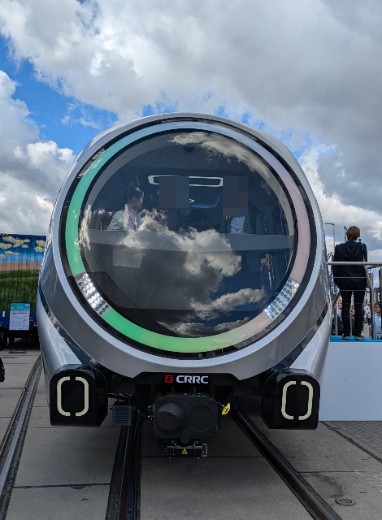
A huge circular window framed the exhibition grounds outside. People moved constantly between the trains, while screens inside the cab kept changing. Standing inside CRRC’s VELLINK at InnoTrans 2026, I began with something very concrete: one train, one cab, one view onto the railway world outside.
Then I followed the InnoTrans AI Tour. Nine companies appeared one after another, and the scale of the observation gradually expanded. A train needed to know where it was. Machines were learning to recognise tracks and infrastructure. Cameras were beginning to detect unusual situations in stations. AI systems were searching for faults, supporting maintenance, examining engineering requirements and navigating technical knowledge. Some AI even travelled directly onboard the train.
What began with a single vehicle therefore became a much larger question. AI was not entering the railway at one particular point. It was appearing in different places, performing different kinds of observation and assisting different forms of judgement.
Once machines begin to “see” the world, the question for humans is no longer simply what machines can do, but what remains ours to do.
When a Train Begins to Sense Itself
CRRC’s brochures offered the first clue. VELLINK appeared among its urban rail products, but the emphasis was no longer only on speed, capacity or physical performance. Intelligence had become part of the language used to describe the railway vehicle.
In practical terms, this intelligence begins with something quite simple: a train continuously produces information about itself. Doors, components and operating systems change state as the vehicle runs. Those changes can become signals. Instead of waiting until a component has already failed, digital systems can search for unusual patterns earlier and give maintenance teams more time to understand what is happening.
CRRC places several of these capabilities within its AIZOR industrial AI system. AI can assist with fault detection and localisation, organise information for vehicle diagnosis, and even inspect whether engineering drawings, models, standards and specifications remain consistent. In its digital lifecycle approach, the logic of maintenance also begins to shift—from fixed schedules and post-failure intervention towards earlier warning and condition-based maintenance.
The train has not become a thinking creature. But it has begun to leave a readable trail of its own condition, allowing machines and people to notice changes that might previously have remained invisible until something went wrong.
Machines once waited to be repaired after they failed. Now, before they fail, they are learning how to sigh.
When AI Begins to See the Railway
The nine companies on the AI Tour showed how quickly that field of perception expands beyond the vehicle itself.
OSTRION began with one of the oldest transport questions imaginable: where am I? Its display showed why modern railway positioning is inherently multi-source. GNSS, inertial sensing, vision and landmarks, odometry, and infrastructure references each contribute different kinds of information. On the same screen, SPOT002 and SPOT004 demonstrated optical positioning in operation. The point was not that one technology suddenly knows everything, but that different sources can complement one another.
At SIGNON, the machine’s gaze moved outward. Railway infrastructure, vegetation and trackside equipment became objects that AI could identify from recorded data. At A&R Tech, the same idea entered the station: cameras were no longer useful only for recording what had already happened; intelligent processing could help staff notice potentially dangerous or unusual situations as they developed.
Seeing, however, is only the beginning. Downer Rail’s TrainDNA confronts a different problem: the sheer volume of information generated by a train. Its presentation described more than 100,000 alerts per train per day, with AI helping determine what should count as an alert, filter information by importance and support the appropriate response.
Vossloh shifted the focus from the vehicle to the track. Its Trackstability system used temperature and track conditions to assess stability and indicate whether conditions remained within a desired safety range.
Eviden, meanwhile, brought images and data together, using AI to detect anomalies and identify changes that may appear before a failure becomes visible. Together, these approaches showed how AI could support earlier intervention—not only by diagnosing what had already gone wrong, but by recognising signs of what might happen next.
Across these examples, the objects differ—a vehicle, a track, an image, a station—but the underlying question is similar: what is changing, and where might something be wrong?
From Steel to Code
At Developair, the railway almost disappeared from view. There were no tracks or trains on the screen. Instead, NOVA showed requirements, test cases and test scripts connected through a traceability structure.
A train door, for example, may only be allowed to open under defined operating conditions, while other requirements specify how the system should respond when an obstacle is detected. Those requirements must then be connected to test cases and test scripts that demonstrate whether they have actually been verified. AI can assist engineers in following that chain and finding gaps that might otherwise remain buried inside a complex development process.
Developair’s display also explicitly referred to “Human-in-the-Loop Governance”—a useful reminder that AI assistance does not remove people from the engineering and verification process.
At Alstom, the problem shifted again—from engineering traceability to railway knowledge. Talk To My Train, presented under the phrase “Turning railway knowledge into operational action,” went beyond simply retrieving information. The examples on screen showed railway knowledge being used to investigate failures, examine fleet conditions, generate reports and create real-time operational views.
AI was therefore not only helping people find an answer. It was beginning to help turn knowledge into something that could be acted upon.
Nomad Digital added yet another dimension: AI does not necessarily have to remain somewhere in a distant cloud. Some processing can take place onboard the train itself, allowing intelligence to travel with the vehicle and respond locally.
By this point, the AI Tour was no longer about one kind of technology. Positioning, computer vision, anomaly detection, predictive maintenance, engineering verification, knowledge retrieval and onboard processing belonged to different technical worlds, yet together they revealed a broader transformation.
AI’s reach has extended from steel into code. It is no longer only looking at machines; it is beginning to work with the words, rules and logic that humans have written around them.
Where, Then, Is the Intelligence?
After visiting the nine companies, I returned to CRRC’s brochures. This time, the diagrams looked different to me. The train was no longer an isolated object.
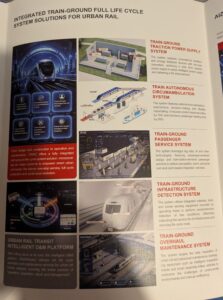
CRRC’s Integrated Train-Ground Full Life Cycle System Solutions for Urban Rail placed the vehicle within a much wider system connecting traction power supply, autonomous operation, passenger services, infrastructure detection, overhaul and maintenance, and intelligent operation and maintenance.
This offers a useful way to understand what I had seen across the AI Tour. Intelligence does not have to reside in one central machine. It can be distributed across vehicles, tracks, stations, maintenance systems and engineering workflows. Data and communication allow these separate forms of perception to interact, while systems such as AIZOR extend AI further into design, diagnosis and maintenance.
The important question therefore changes again. It is no longer simply whether AI can detect something, calculate something or find something. In a safety-critical system such as a railway, we also have to ask how far machine judgement should go, when human verification becomes necessary, and where responsibility ultimately remains.
A machine may notice an anomaly first. A human may then examine its significance and decide what action is required. The result of that action becomes new information, beginning another cycle of observation, feedback, judgement and correction.
Data shortens the distance to a problem, and machines expand the range of what can be seen. But when safety and responsibility are at stake, the final move still belongs to a human being.
When the Train Appears Again
At the end, I return to the same circular window.
It is still there. Outside, people continue walking between the trains at InnoTrans, and VELLINK remains where the observation began. Yet after moving through positioning, infrastructure, stations, maintenance, engineering and knowledge systems, it has become difficult to see that train as an isolated machine.
The journey of this article began with one vehicle and gradually moved outward into the railway around it. When it finally returns to VELLINK, the train itself has not changed. What has changed is the network of relationships that has become visible around it.
When AI enters the railway, it is not one particular component that becomes intelligent. What changes is the way a train and the entire railway world sense and connect with one another.
Across Civilizations
When Objects Learn to See
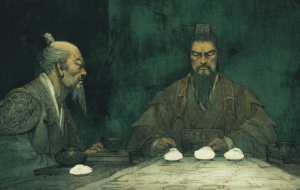
King Kaolie, Huang Xie and I stood in the Outdoor Display at InnoTrans, surrounded by trains from different countries. Tracks stretched through the exhibition grounds, and before us was VELLINK again, with its enormous circular window.
King Kaolie stared at the screen for a while, then looked at the tracks around us. “Lady Lingyin,” he finally asked, “have you given the train eyes?”
“More than eyes,” I replied. “It also needs to know where it is, where something is going wrong, and sometimes notice a change before the problem becomes serious.”
The king looked puzzled. “A train needs to know where it is? Does it not simply follow the tracks? How could it possibly get lost?”
Huang Xie laughed. “Your Majesty, even a person travelling along a road must know the direction and observe the way ahead. A train moves far faster than a person. Surely it cannot afford to be confused.”
King Kaolie considered this. “Then does it think for itself? If it can see, search and judge, perhaps one day there will be no need for people to interfere at all.”
I shook my head. “It can calculate, search and compare large amounts of information. It can detect anomalies and alert people. But many decisions still have to be made—and carried—by humans.”
The king fell silent. “Then you are not teaching trains to become human, and you are not handing everything over to machines. What exactly are you teaching them?”
Huang Xie looked along the tracks. “Your Majesty, they are giving objects another pair of eyes. They are teaching them to notice change earlier.”
King Kaolie looked again at the silver train, as though something had finally fallen into place. “I understand. You have not built a machine that never makes mistakes. You have built something that can help you discover mistakes earlier.”
I nodded.
Huang Xie smiled. “Your Majesty, it is rather like the people of Chu observing the stars. The stars cannot govern the kingdom for us. But they may tell us that the season has changed.”
The king looked down the tracks disappearing into the distance. “Very well. Let them keep watching. But where we go—that is still for us to decide.”
Two thousand years ago, the people of Chu observed rhythms in the heavens, the body, sound and the changing world around them, seeking ways to recognise change and respond to it. Two thousand years later, sensors, data and AI are being distributed across railways so that trains, tracks, stations and maintenance systems can perceive one another.
The technologies belong to entirely different worlds, but the human question has remained remarkably persistent: How do we notice change? How do we turn signs into judgement? And once we know that something has changed, who decides what should happen next?
When objects acquire eyes, human beings do not disappear. They return to the place that remains theirs: the place of judgement, responsibility and direction.

 时间:2026年09月22–23日(二–三)
 行程|柏林 · InnoTrans
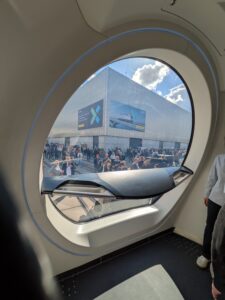
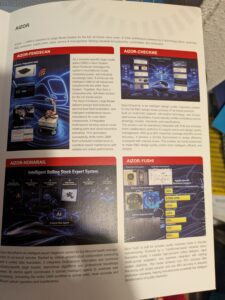
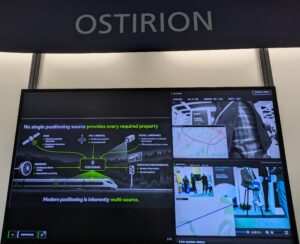
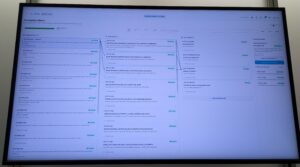
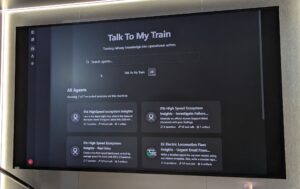
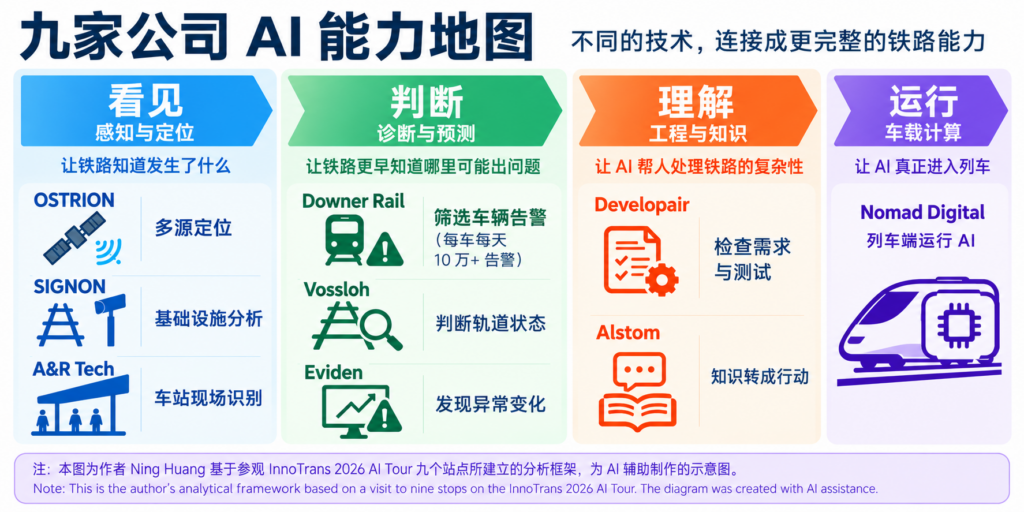 图:九家公司能力地图