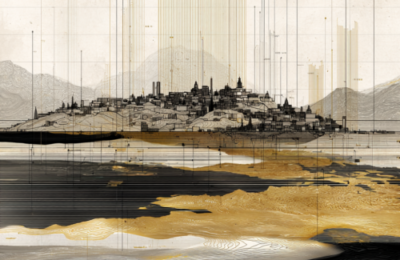
长江文明中的建构逻辑:楚式营建学揭示楚人如何以土地、水脉与地景构筑世界。

楚式营建学研究楚文明如何以土地、水脉与地景为基础,发展出早期的地基技术、治水方法与城市营造体系,形成独特的地—水—城一体化建构逻辑。

Chu Yingjian Studies explores how the Chu civilization shaped land, water, and settlements through early geotechnical knowledge and landscape engineering.

Chu Yingjian Studies · Extra I|Civilizational Echo: Structural Parallels between Chu Yingjian and High-Speed Rail Thinking

This essay compares the structural logic of Chu Yingjian—an ancient generative construction system from Chu civilization—with the systemic thinking behind modern Chinese high-speed rail. By examining ritual systems, musical structures, and urban formation in Chu culture alongside contemporary infrastructure engineering, the article reveals how different civilizations independently develop similar methods for organizing large-scale complexity.

WeiterlesenChu Yingjian Studies · Extra I|Civilizational Echo: Structural Parallels between Chu Yingjian and High-Speed Rail Thinking

Chu Yingjian Studies III: Landscape as Generative System in Chu Civilization

In the Chu heartland, space was not engineered into place—it emerged from the rhythms of wetlands. This chapter examines three archaeological cases—Mopan Mountain City, the Jushui–Daoshui–Sheshui mound systems, and the Jiajiahu Chu City—to illuminate the “growth-based” logic behind Chu urban construction; and draws on the Tianxingguan and Jiudian bamboo texts, together with the spatial order of Jinan City, to show how every act of building required divination, ritual, site-reading, and the consent of the land. Chu architecture was not imposed on terrain; it grew from water, earth, and time.

WeiterlesenChu Yingjian Studies III: Landscape as Generative System in Chu Civilization

Chu Yingjian Studies VIII: How Cities Grow — The Five Forces Model of Urban Generation in Chu Civilization

This chapter argues that a Chu city was not “designed” but generated through the interaction of five forces: landscape, time, materials, movement, and institutions. Drawing on archaeological and geomorphological evidence, it shows how landscape determined the city’s point of emergence, how temporal rhythms pushed construction outward layer by layer, how materials shaped structural form, how bodily movement carved circulation routes, and how institutions anchored the city’s center and periphery. The chapter concludes that: A Chu city = Landscape × Time × Materials × Movement × Institutions. Its form was not imposed from above but emerged naturally through the coordinated action of these forces.

WeiterlesenChu Yingjian Studies VIII: How Cities Grow — The Five Forces Model of Urban Generation in Chu Civilization

《Chu Yingjian Studies · Overview》|A Structural Guide to a Civilizational Operating System

Chu Yingjian Studies presents a civilizational operating system derived from wetland dynamics, temporal rhythms, material logic, and systemic coordination. This master navigation outlines the nine core chapters and two extended dialogues, showing how Chu cities and their world were not built but generated. Yingjian is not engineering—it is the civilizational capacity that allows forms, systems, and worlds to continue emerging.

Weiterlesen《Chu Yingjian Studies · Overview》|A Structural Guide to a Civilizational Operating System

《楚式营建学·全系列导航》|文明操作系统的结构说明

《楚式营建学》是一套从湿地、时间、材料到系统算法的文明操作系统。 本导航汇整九篇正传与两篇外传,展示楚人如何让城市与文明“被生成”—— 空间由湿地读出,结构由节律推动,秩序由系统达成。 Yingjian(营建)不是工程,而是让世界继续成形的文明能力。 Chu Yingjian Studies presents a civilizational operating system derived from wetland dynamics, temporal rhythms, material logic, and systemic coordination. This master navigation outlines the nine core chapters and two extended dialogues, showing how Chu cities and their world were not built but generated. Yingjian is not engineering—it is the civilizational capacity that allows forms, systems, and worlds to continue emerging.

Weiterlesen《楚式营建学·全系列导航》|文明操作系统的结构说明

《楚式营建学 · 外传二|楚辞 × 考工记的地下恋爱》

《楚式营建学 · 外传二》是一场关于“结构与诗性如何在地下相遇”的实验性写作。 《考工记》代表北方的秩序与尺度,《楚辞》代表南方的气息与生成。 两者原本不相交,却因同被封入墓室而在黑暗中开始对读。 本文以拟人化方式,重建两千三百年前两种世界观的交汇: 他们彼此质疑、彼此偷学,最终生出一个孩子—— 楚式营建学:一种由地景、时间、材料、身体、制度共同驱动的文明建构心智。 这是楚文明底层逻辑的再现,不是爱情故事。 那是两部古书在黑暗中点亮彼此的时刻。 “Chu Yingjian · Extra II” is an experimental narrative about how structure and breath meet underground. The Kaogongji stands for northern order—measure, alignment, systemic clarity. The Chuci carries southern sensibility—water, wind, emergence, and the pulse of living forms. Placed together in a tomb 2,300 years ago, the two texts begin to read each other in the dark. This chapter personifies their dialogue and traces how two worldviews slowly interweave— questioning, borrowing, transforming—until they generate a single child: Chu Yingjian:a civilizational building-mind shaped by landscape, time, materials, the body, and systemic order. It is not a love story. It is the moment two ancient grammars discover they share the same world.

Weiterlesen《楚式营建学 · 外传二|楚辞 × 考工记的地下恋爱》

《楚式营建学 · 外传一|文明回声:楚式营建与高铁思维的结构对应》

《文明回声》不是在寻找“影响链”, 而是在描述一种更深的结构事实—— 当文明必须处理高度复杂的系统时, 会独立长出相似的组织方式。 楚式营建并未影响现代高铁, 高铁也没有继承古代楚城的任何技术或形式。 但两者都在面对各自时代的巨大复杂性: 湿地、湖泽、礼制、材料、节律、战争、迁徙; 速度、网络、调度、节点、精度、迭代、共生。 它们之间的相似, 不是传承, 不是源流, 而是 结构的趋同。 古代楚文明留下的礼器系统、编钟系统、城址系统、 与现代高铁的规模、系统、技术、迭代、精度、共生六大思维, 在结构上相互映照—— 显示出文明在面对复杂世界时 都会发展出一套“让系统能够成立”的心智。 本篇是一次跨越两千年的 结构层级的对照实验: 不求证明,不作推演, 只展示文明在深处 如何自然地长成类似的形状。 Civilizational Echoes is not a search for historical influence. It is an attempt to describe a deeper structural fact: when a society must organize a highly complex system, it tends to grow similar forms of thinking—independently. Chu engineering did not shape China’s modern high-speed rail, nor did high-speed rail inherit anything from ancient Chu cities. Yet both faced the full weight of complexity in their own eras: wetlands, water systems, ritual structures, materials, rhythms, migration; speed, networks, dispatching, nodes, precision, iteration, coexistence. Their resemblance is not lineage, not transmission, but structural convergence. The ritual vessels, bell systems, and cityscapes of ancient Chu mirror—in structure rather than origin— the six paradigms of the modern high-speed rail system: scale, systems, technology, iteration, precision, coexistence. This chapter is a cross-epoch structural experiment, showing how civilizations, when confronted with complexity, naturally grow toward similar organizational logics— without contact, without inheritance, purely through the demands of the world they must sustain.

Weiterlesen《楚式营建学 · 外传一|文明回声:楚式营建与高铁思维的结构对应》

《楚式营建学之九|营建世界的方式:楚文明的生态系统设计》

本篇作为《楚式营建学》的世界观封顶章,从“城市如何长成”提升到“世界为何能被生成”的层级。楚人以时间为节律、以湿地为形势、以材料为结构语言、以身体为路径生成、以制度为安定核心,使营建成为一套协同系统。本文进一步提出楚文明的三层同构模型:宇宙的反辅、社会的差异互成、城市的自然生长,并指出楚文明的核心不是建造物,而是一种让世界得以持续生成与维持的操作方式。 As the conceptual capstone of Chu Yingjian Studies, this chapter elevates the discussion from “how cities grow” to “why a world can emerge at all.” The Chu viewed time as rhythm, wetlands as spatial logic, materials as structural language, the human body as path-maker, and institutions as stabilizing centers—forming a coherent generative system. This essay presents the Chu model of reciprocal formation across three scales—cosmos, society, and city—and argues that Chu civilization is fundamentally a life-system operating system, rather than an architectural tradition.

Weiterlesen《楚式营建学之九|营建世界的方式:楚文明的生态系统设计》

《楚式营建学之八|楚人如何让城市长出来》

本篇从楚地的湿地地景出发,提出“城市不是被建成的,而是被五种力量共同生成”的核心模型。 透过考古与地形证据,本篇说明楚人如何以地景力决定城市落点,以时间力推进城体成长,以材料力写出结构语法,以身体力踏出动线网络,并由制度力锚定核心与外缘。 This chapter argues that a Chu city was not “designed” but generated through the interaction of five forces: landscape, time, materials, movement, and institutions. Drawing on archaeological and geomorphological evidence, it shows how landscape determined the city’s point of emergence, how temporal rhythms pushed construction outward layer by layer, how materials shaped structural form, how bodily movement carved circulation routes, and how institutions anchored the city’s center and periphery. The chapter concludes that: A Chu city = Landscape × Time × Materials × Movement × Institutions. Its form was not imposed from above but emerged naturally through the coordinated action of these forces.

Weiterlesen《楚式营建学之八|楚人如何让城市长出来》

《楚式营建学之七|材料之书:土、木、铜的三重结构语言》

本篇从工程逻辑切入,解析楚人如何以三种核心材料——夯土、木作、青铜——建构时间、空间与制度三重结构。夯土以“节律压法”把时间压进台基;木构以“呼吸性结构”形塑湿地上的生命空间;青铜以“模与范”固化礼制秩序,形成可复制的结构系统。本篇统整前六篇内容,展示楚式营建如何以材料为语言,让城市与文明“长成它应有的样子”。 This chapter examines how Chu civilization used three fundamental materials—rammed earth, timber, and bronze—to construct three structural dimensions of its urban system: time, space, and order. Rammed earth encodes temporal rhythm into layered foundations; timber forms a “breathing structure” suited to wetland environments; bronze, through molds and standardized patterns, stabilizes ritual hierarchy and reproducible institutional forms. Integrating insights from the previous chapters, this piece reveals how Chu cities “grew” through material logic rather than architectural design.

Weiterlesen《楚式营建学之七|材料之书:土、木、铜的三重结构语言》