Berlin, Built by Barges | Seven Centuries of an Inland Port | Berlin Historic Harbour
A City Has Weight
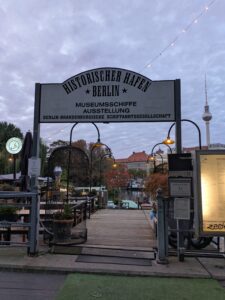
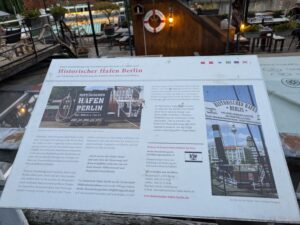
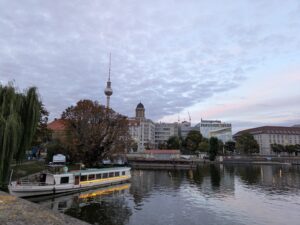
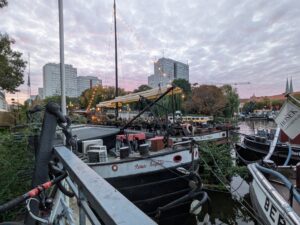
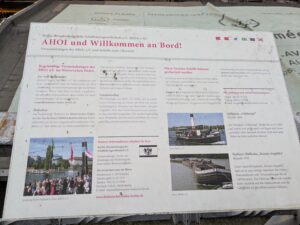
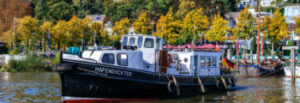
I had spent the day at InnoTrans looking at technologies designed to move the future: artificial intelligence, railway systems, and new forms of mobility. That evening, walking along the Spree, I encountered a very different transport system. Several old vessels lay quietly at Märkisches Ufer, with the Berlin TV Tower rising behind them. Then an exhibition panel offered a sentence that changed the scale of the entire scene: “Berlin ist aus dem Kahn gebaut.” Berlin was built by barges.
The claim was more literal than it first appeared. Cities are usually described through architecture, population, politics, or economic growth. But a city also has weight. Before a wall can stand, its bricks must arrive. Before a roof can be built, timber has to be moved. Before factories and households can function, fuel and food must enter the city. For centuries, much of that weight reached Berlin by water.
The physical body of a city does not grow out of nothing. Its bricks and steel all have a point of departure.
Berlin is not a seaport, yet its harbour history stretches back more than seven centuries. That apparent contradiction became the question I carried with me along the river: how could an inland city be built by barges?
When Movement Has to Stop
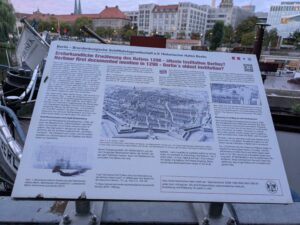
Around the turn of the twelfth and thirteenth centuries, Berlin and Cölln were gradually taking shape on opposite sides of the Spree. Boats travelled along the river, but at the Mühlendamm they encountered a problem. The dam used the difference in water level to power mills, while at the same time interrupting navigation. Boats could not simply continue.
That obstruction produced consequences. Cargo had to be unloaded, transferred to another vessel, or moved onto land. Timber and other goods accumulated along the riverbank. Merchants stopped because their goods had stopped. People were needed to unload, transport, trade, and regulate what was moving through the area. By 1298, documents were already recording rights connected with the storage and trade of goods, as well as duties on timber and vessels.
What interests me is the reversal hidden in this history. The Mühlendamm obstructed movement, yet the obstruction itself helped create a transport node. Water routes met roads. Cargo met markets. Boats met people who could move their loads onward. A place where movement had to stop gradually became a place through which movement could be reorganized.
Cities exist through movement. Yet it is through pauses in that movement that a place becomes a real space.
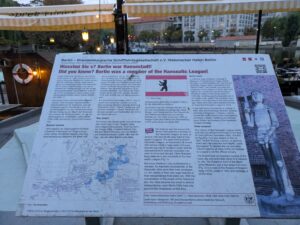
By the middle of the fourteenth century, Berlin-Cölln had entered the Hanseatic trading network and become connected to a much wider geography of exchange. The harbour was therefore not simply something added to an already existing city. Long before Berlin became a capital, the movement and interruption of goods along the Spree were already helping to give the city structure.
How Much Does a City Weigh?
By the nineteenth century, the question had changed. Berlin was no longer simply a settlement growing around a river crossing and a place of transshipment. It was becoming a large industrial city, and every stage of that growth required material.
More people meant more houses. More houses meant more bricks, lime, timber, and gypsum. Factories needed coal. Residents needed grain and fuel. Bricks arrived from Brandenburg; coal came from Lusatia and Silesia. The city could expand across land only because enormous quantities of material were continuously being brought in from somewhere else.
We normally encounter a city after this work has already been completed. We see the wall, not the bricks travelling toward it; the roof, not the timber on the barge; the factory, not the coal moving along the river. But before a city can rise, someone has to move its weight.
This is where the ordinary barge becomes important. Ocean-going ships may carry international trade across great distances, but barges carried something more mundane and, in another sense, more fundamental. They carried the materials from which everyday urban life was made. A brick is insignificant until thousands of bricks become houses. Coal is ordinary until factories and homes depend on it. Timber becomes roofs; grain becomes meals.
Large ships carry trade. Barges carry the everyday life of a city. The most ordinary things often support the heaviest parts of human existence.
Yet carrying more did not simply mean building a larger vessel. A barge still had to fit the physical system through which it moved. It had to pass beneath bridges, through waterways, and into locks and harbours. The Finowmaß, at roughly forty metres long and 4.6 metres wide, and the later, wider Berliner Maßkahn reveal something larger than the dimensions of individual vessels.
The word Maß—measure—describes a relationship. A vessel can only move if its dimensions remain compatible with the waterway, the lock, the bridge, and the harbour. Transport capacity therefore does not belong to the ship alone. It is produced by an entire system whose parts have to fit together.
By the late nineteenth century, around four hundred cargo vessels were arriving in Berlin each day. The number is striking, but what matters is what stood behind it: waterways, locks, harbours, roads, crews, loading operations, and countless coordinated movements that kept the city supplied.
Four hundred vessels a day, each carrying the appetite and survival of the city. When they lined the waterways, Berlin was acquiring its physical body.
At that point, “Berlin ist aus dem Kahn gebaut” no longer sounded metaphorical. Brick became wall. Timber became roof. Fuel kept factories and households running. Berlin was not merely expanding beside the water. Its physical body was being assembled through transport.
When a Barge No Longer Carries Cargo
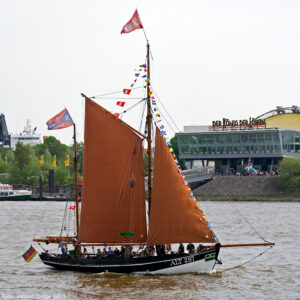
The historic harbour today is quiet for a different reason. Cargo vessels no longer queue there to unload the daily needs of a growing industrial city. Yet the old ships have not necessarily stopped working. What they carry has changed.
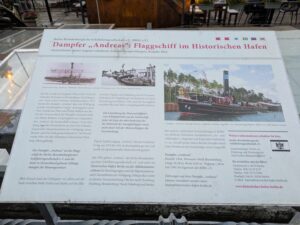
ANDREAS is still an operational steam tug. Its machinery requires maintenance, and people still need to know how to make it work. When I visited, a notice announced another voyage from Berlin to Potsdam. The vessel would once again leave the harbour, encounter real water, and move under its own machinery.
That matters because an operational historic vessel preserves something that a static object cannot. A machine that still works requires knowledge. Someone must know how to repair it, operate it, and respond to the conditions of actual navigation. The technology is not merely displayed; it is performed.
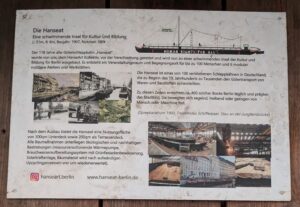
Other vessels have undergone a different transformation. Renate-Angelika, once a Berliner Maßkahn, now serves as a floating exhibition space. The century-old cargo vessel Hanseat, once threatened with dismantling, is being transformed for cultural and educational use. The holds that once received cargo can now receive visitors.
Once, the hold carried heavy cargo. Today, it carries memory. The vessel has not stopped transporting things; what it transports has changed.
This raises a larger question about maritime heritage. What exactly survives when a ship is preserved? Steel can survive. Rivets can survive. Machinery can survive. But if nobody knows how to repair the engine, operate the steam system, or handle the vessel on water, then part of the ship has already disappeared.
The distinction is between preserving a Schiff and preserving Schifffahrt: between keeping a ship and keeping alive the practice of navigation. The latter includes machinery, labour, operating knowledge, and the experience accumulated by people who work on water. Material objects can remain in place. Practical knowledge survives only when someone continues to learn it.
Once, boats carried materials into the city. Today, people keep knowledge aboard the boats. The cargo has changed, but the relationship between people and vessels still has to be carried forward.
Different Clocks on the Same River
Near the harbour stands an old chestnut tree, more than two centuries old. A nineteenth-century map shows five trees in this area; today, only this one remains. It has watched barges come and go, the harbour change, war damage the surrounding city, and Berlin rise again.
The tree introduced another kind of measure into the harbour. Ships measure time in voyages. Ports change according to economic needs. Technologies are replaced. Cities can be destroyed and rebuilt. A tree follows another rhythm. It simply continues to grow, adding another ring year after year.
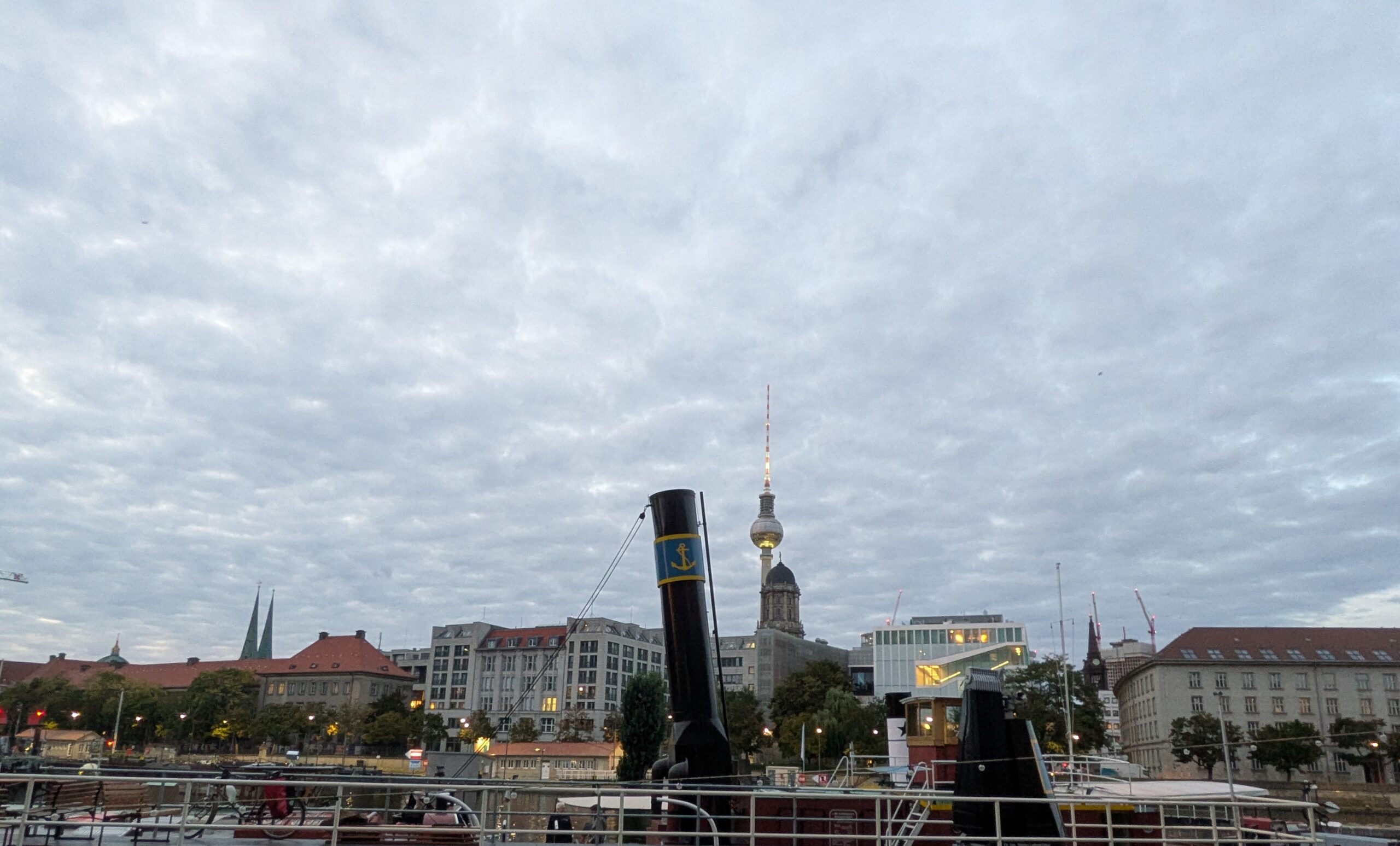
That evening, the different scales of time were visible in a single frame. The black smokestack of ANDREAS stood nearby. The Berlin TV Tower rose in the distance. Between them flowed the Spree. An old tree, a historic vessel that could still sail, a modern skyline, and a river occupied the same space, yet each belonged to a different tempo of change.
The city repeatedly tears down and rebuilds. The river continues to flow. The old tree quietly adds another ring. On the same stretch of water, time has different scales.
I had only happened to pass by the harbour that evening, expecting to look at a few old ships. Instead, following the exhibition panels along the river had changed the way I understood the sentence that first stopped me.
Berlin had once been carried in, boat by boat.
Across Civilizations
How Many Boats Could Enter Yingdu, the Capital of Chu, in a Day?
One number from Berlin refused to leave me: by the late nineteenth century, around four hundred cargo vessels were arriving in the city every day. It was exactly the sort of number that would make King Kaolie competitive.
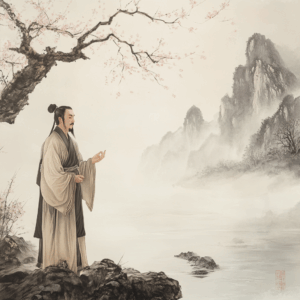
“Four hundred vessels entered Berlin every day?” he asked. “Then what about Yingdu? How many boats could we receive in a day?”
I looked at him. “Your Majesty, must this be a competition too?”
“Of course. Berlin had the Spree. Did Yingdu have no water?”
Huang Xie intervened. “Your Majesty, you are comparing nineteenth-century Berlin with Yingdu more than two thousand years ago. We may be at a slight disadvantage.”
King Kaolie was not persuaded. “Yingdu had water gates. Boats could enter the city.”
Huang Xie looked at him. “Your Majesty, the water gates at Jinan City, the site of the former Chu capital, belonged to the time of your ancestors. I never served there as Chief Minister.”
The king paused.
“It was still Chu.”
I laughed.
But the joke left behind a serious question. Before Berlin, I might have looked at a water gate in an ancient city and simply asked what kind of structure it was. Now I wanted to know what moved through it.
What did the boats carry into Yingdu—grain, timber, stone? Where was the cargo unloaded after entering the city? Was there a quay inside the water gate? How did the waterways connect with the streets and the everyday life of the city?
Huang Xie looked at me. “I don’t know. More than two thousand years have passed. I cannot answer those questions for you.”
King Kaolie turned to him. “Weren’t you the Chief Minister?”
Huang Xie looked back at him. “Your Majesty, I just told you. I was never Chief Minister there.”
This time I really laughed.
Yet the questions remained. Berlin had made me realize something very concrete: an ancient city, too, could be studied through its weight.
People inside the city had to eat every day. Houses required timber and other materials. Fuel had to keep entering the city. These heavy, ordinary things could not simply appear inside the city walls.
The water gates of Jinan City therefore began to look different to me. They were no longer merely openings in a city wall. They might also have connected the waterways outside the city with everyday life within it.
Which water gate did the boats enter through? What exactly did they carry? Where did they stop and unload?
I do not yet know the answers, and I do not want to invent them on behalf of the people of Chu.
King Kaolie looked at the questions I had written down. “So what are you going to do with all of these?”
Before I could answer, Huang Xie answered for me.
“Isn’t she planning to return to Chu? If she wants to know so badly, she can go to Jinan City and look for herself.”
I thought for a moment.
“All right. Then I’ll find the answers myself.”
Two thousand years ago, the barges of Chu carried the weight of Yingdu. Two thousand years later, the barges of Berlin made me reconsider how a city is “carried” into existence.
The answer is not in books. It lies between the water gate and the quay.
I had only happened to pass by the Historischer Hafen Berlin that evening, expecting to look at a few old ships. In the end, I carried away something else: not a conclusion about Berlin, but a set of questions to take back to Chu and use to look at an ancient city again.

 时间:2026年09月23日 (三)
 行程|柏林 · 马尔基施河岸与历史港