Some Knowledge Can Only Be Generated Through Travel and Experience | “Why We Travel” at the Dresden Transport Museum
Field experience: 25 September 2026
Location: Dresden · Dresden Transport Museum
Why Do We Have to Leave at All?
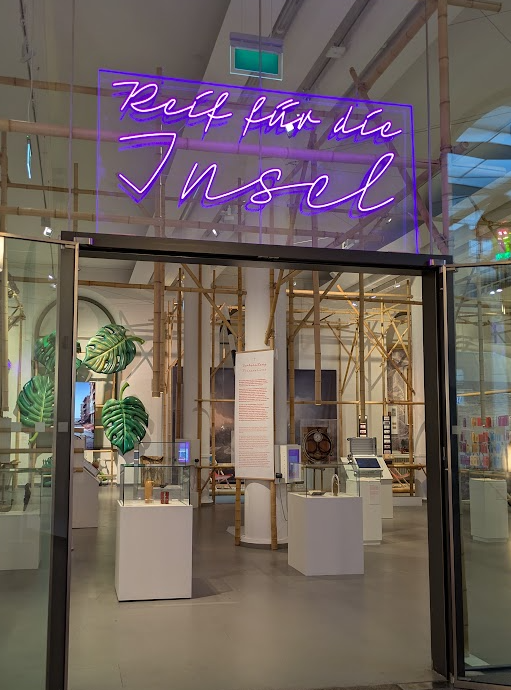
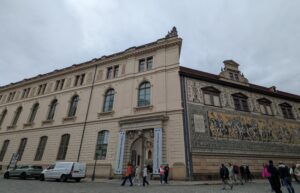
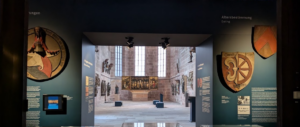
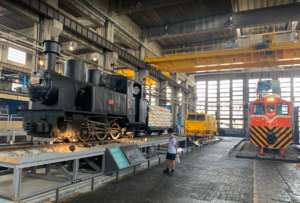
At the end of September, I entered the Dresden Transport Museum intending simply to continue my fieldwork on transport. Instead, I stopped at a temporary exhibition with a deceptively simple subtitle: Warum wir reisen — Why do we travel?
The exhibition does not begin with holidays. It goes further back, to a time when people usually left home because something had to be done. Merchants travelled to exchange goods. Armies crossed territories. Pilgrims followed routes towards sacred places. Researchers entered unfamiliar environments to observe, collect and bring knowledge home.
As I moved through the exhibition, however, the meaning of travel gradually changed. Landscapes became something worth seeing in their own right. Transport made distant places increasingly accessible. Hotels made it possible to remain away from home. Organised travel reduced uncertainty. Paid holidays eventually gave ordinary workers something just as important as transport: time.
Yet somewhere along this historical journey, another question began to interest me more than the history of tourism itself: Why do we have to leave our original place at all?
Today, if the purpose of travel were simply to acquire information, we would hardly need to go anywhere. Maps, photographs, videos and texts can bring distant places directly onto our screens. My own fieldwork has taught me something different.
Knowing a place and physically entering it are not the same thing. Once the body changes position, relationships that were invisible from a distance begin to change as well. Distances become footsteps. Scale becomes physical. A harbour that looked compact on a map suddenly takes an hour to cross. A ship that appeared manageable in a photograph becomes a spatial system once I climb aboard. Questions I had never thought to ask often emerge only while walking, boarding, looking, turning and comparing.
That is why the exhibition gradually became, for me, more than a history of travel. It became a question about knowledge itself:
If some forms of understanding can only arise after the body has actually arrived, can travel itself become a way of generating knowledge?
Before There Were Tourists, People Were Already Moving
Human beings travelled long before they became tourists.
Trade, warfare, pilgrimage and research all produced movement, but movement was largely a means towards another end. Goods had to reach markets. Territories had to be crossed. Sacred destinations had to be reached. Plants, animals and observations had to be collected.
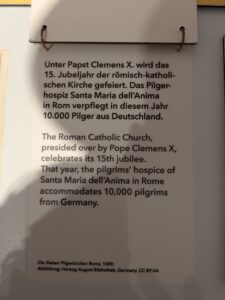
The exhibition shows, for example, how pilgrimage already required routes, accommodation and forms of organisation. During the Roman Jubilee of 1675, Santa Maria dell’Anima alone accommodated around 10,000 pilgrims from German-speaking lands. In the nineteenth century, the German naturalist Amalie Dietrich travelled to Australia, where she spent ten years collecting botanical and zoological specimens that were sent back to Hamburg.
In cases like these, the question “Why travel?” had a relatively clear answer.
Then something began to change.
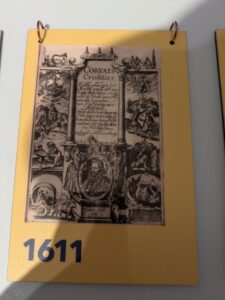
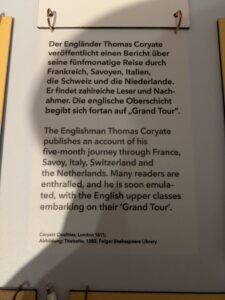
In 1611, the English traveller Thomas Coryate published an account of his five-month journey through continental Europe. His writing attracted readers and imitators and became part of the culture from which the Grand Tour developed. Travel still had educational purposes: young members of the European elite studied languages, art, society and classical civilisation. But leaving home was no longer merely a practical necessity. The journey itself increasingly became part of education.
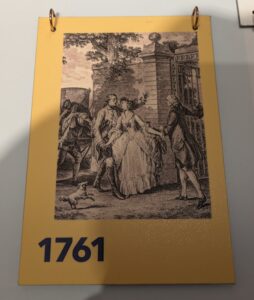
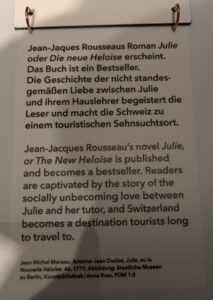
Literature also taught people to look differently at landscape. Rousseau’s Julie, or the New Heloise, published in 1761, helped transform Switzerland into an imagined destination. Writing about the Alps contributed to another subtle shift: mountains were no longer merely obstacles to be crossed. The scenery itself became worth travelling for.
Previously, one might pass through a landscape because of a destination. Increasingly, the landscape could become the reason for the journey.
The destination was no longer the only purpose, and movement was no longer merely a means. The road travelled by the body was becoming part of the experience itself.
Standing inside this European history of travel, however, I found myself thinking about a Chinese word: you — 游.
It cannot simply be translated as modern tourism. In Chinese cultural history, you may refer to roaming, extended journeys, visiting friends, seeking office, travelling through landscapes or moving through the world for reasons that do not fit neatly into a modern distinction between purpose and leisure.
Li Bai left Sichuan when he was young and travelled widely. Mountains, friendships, ambitions and encounters entered his journeys and later his poetry. Su Shi’s movements were different. Many were connected to official appointments and political exile. Yet places into which he had not freely chosen to move still became landscapes he observed, local lives he encountered, foods he tasted and experiences he transformed into writing.
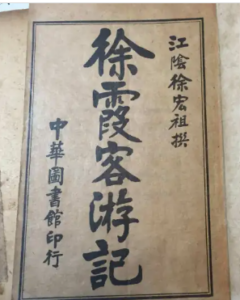
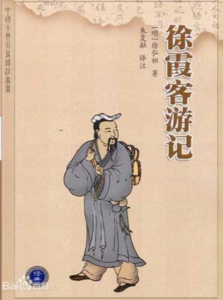
The figure I thought of most strongly, however, was Xu Xiake. Living at almost the same time as Thomas Coryate but within a very different cultural tradition, Xu travelled extensively through mountains and waterways. He observed terrain, compared water systems, recorded routes and local conditions, and gradually transformed what his body had encountered into written knowledge.
The point is not to decide which civilisation “invented” travel first. The more interesting question is when movement itself began to be understood as a source of experience.
European travel history and the Chinese tradition of you arrive there by different routes. Both suggest that people do not always possess knowledge first and then decide to travel. Sometimes knowledge begins because they leave.
Some Things Cannot Be Seen from Where We Stand
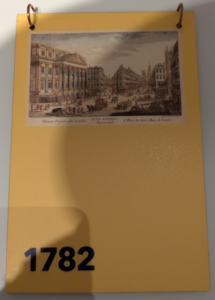
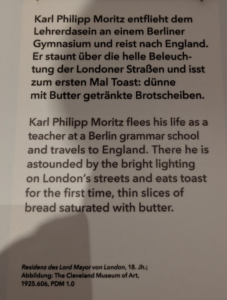
In 1782, the German writer Karl Philipp Moritz left his teaching life in Berlin and travelled alone to England. What surprised him in London was not always monumental. He noticed brightly illuminated streets at night. He encountered toast — thin slices of bread soaked with melted butter — and recorded even this ordinary food in his travel writing.
Streetlights and toast hardly sound like great discoveries. That is precisely why they matter.
At home, we pass through the same streets, eat familiar food and follow routines that no longer require explanation. Familiarity makes much of everyday life invisible. Enter another environment, however, and comparison begins almost automatically.
Strangeness reveals difference, and difference makes everyday life observable again. Sometimes the most powerful thing about travel is not seeing something extraordinary, but finally seeing one’s ordinary life clearly.
This is also why Xu Xiake’s journeys cannot be reduced to a list of mountains and roads. A map presents space after it has already been organised. Once the body enters a valley, however, slope, direction, distance and water appear together. A wrong path, an unexpected cave or a stream flowing in a different direction may force an earlier understanding to be reconsidered.
A map tells us about space that has already been organised. Only when the body enters it do slope, distance and water begin asking questions again.
I have repeatedly experienced the same difference in my own fieldwork. I can study a harbour on a map and learn the position of the river, the docks, the navigation channels and the flow of cargo. All of that information matters. But it cannot replace walking slowly around a harbour basin until distance becomes footsteps and map scale becomes bodily scale.
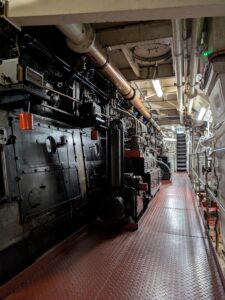
The same thing happens when I board a ship, descend into an engine room or move through a museum. I often return not with confirmation of what I already knew, but with a question I did not know existed before I arrived.
Why is this structure designed this way? Why do people move through this space in this particular manner? Why is this vessel moored here? Why does a distance that looks short on a map feel so long on foot?
This is where my fieldwork connects with a theoretical framework I have been developing through Body Force and Embodied Generative Intelligence.
The body is not simply carrying out commands issued by the brain. It continuously receives changes in the environment and adjusts through action. A slope changes and the body shifts its balance. A passage narrows and movement changes. Direction becomes uncertain and the body searches again for orientation.
When the body changes position, its environment changes with it. And when the environment changes, the relationship between person and world is rearranged.
Fieldwork, then, is not simply a method for carrying known answers into the world and looking for evidence.
Fieldwork does not take answers into the field. It allows the body to enter the field so that questions can arise which did not exist before.
This is why some knowledge cannot be obtained through reading alone, and some forms of understanding cannot be gained from images alone. We may not even know what we are missing before we leave.
Because what changes is not only the landscape before our eyes.
When the position of the body changes, the position from which we see the world changes with it.
Further reading: Body-Force · Season One · Navigation Map|How the Human Body Generates a Logic of Civilization
A Distant Place Is Not Enough. We Must Be Able to Reach It.
There is, however, another side to this story. The distant world may exist, but that does not mean everyone can reach it.
Travel first has to become materially possible.
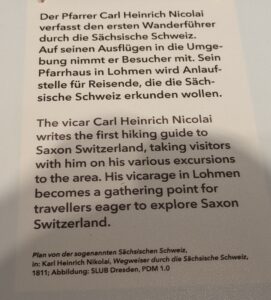
In 1801, Carl Heinrich Nicolai published an early walking guide to Saxon Switzerland. A guidebook does something deceptively important: it turns an unknown landscape into a route that can be followed.
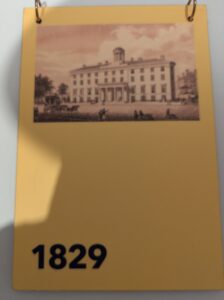
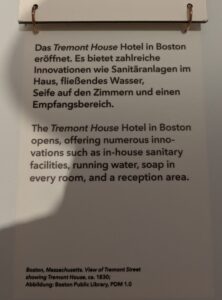
Accommodation solves another problem. When the Tremont House opened in Boston in 1829, it represented a new scale of hotel infrastructure. Leaving home becomes easier when a traveller can know in advance where the night will be spent. Transport allows the body to leave home; accommodation allows the body to remain somewhere else.
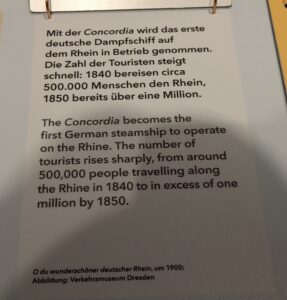
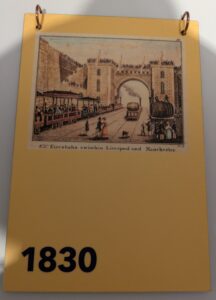
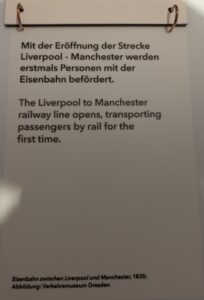
Transport then began to transform distance itself. In 1827, the steamship Concordia began operating on the Rhine. Around 1840, roughly half a million people were already visiting the Rhine; by 1850, the number had risen beyond one million. Railways accelerated the same transformation. Distance increasingly became something that could be calculated in timetables rather than endured as uncertainty.
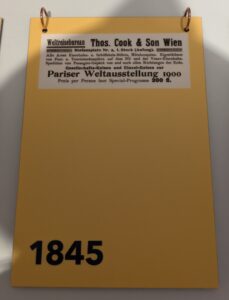
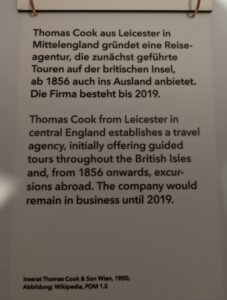
Then Thomas Cook helped organise the separate pieces of travel into a service. Routes could be planned, transport connected, accommodation arranged and prices calculated in advance. The complexity of travelling was increasingly something one could buy help with.
At this point, modern tourism appears almost complete.
But one problem remains: Who has the time to leave?
For much of modern history, leisure travel remained the privilege of a minority not because ordinary people did not know where distant places were, nor because railway lines failed to reach them, but because time and income were scarce.
From around the 1870s, institutionalised holiday arrangements gradually appeared for civil servants. Workers fought much longer for paid leave. By 1929, holiday provisions could be found in most collective agreements represented in the exhibition.
Travel history therefore intersects with labour history.
A railway ticket does not mean that a person can travel. A holiday does not necessarily mean that a person can leave. Spatial accessibility must meet freedom in time before the distant world can truly open to ordinary people.
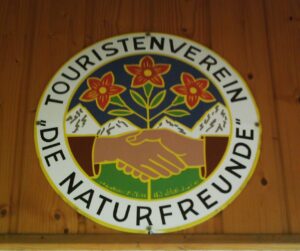
This is also where I thought of the NaturFreunde movement, founded at the end of the nineteenth century. Its history addresses a question different from that of Thomas Cook. Cook helped make complicated journeys purchasable and organised. NaturFreunde was concerned with access: why should nature, recreation and the possibility of leaving the city belong primarily to those with money?
Walking, collective activities and affordable accommodation helped make nature accessible to broader sections of society. These histories eventually converge in a larger transformation.
From the Grand Tour to Urlaub — what changed was not only the way people travelled, but who was able to stand in a distant place.
Roads, ships, railways and hotels created spatial access. Income, working time and paid leave created social access. Only when the two met could travel become a mass possibility.
And once that happened, the question changed again:
What happens when everyone begins to travel?
When More and More Bodies Can Leave
The democratisation of travel was a social achievement. Railways shortened distance. Hotels provided places to stay. Travel agencies organised journeys. Paid leave released time. Places once accessible mainly to elites increasingly opened to ordinary people.
But if millions of people gain the right and ability to travel, a destination must absorb millions of arrivals.
One person’s journey is an experience. Millions of journeys become a system.
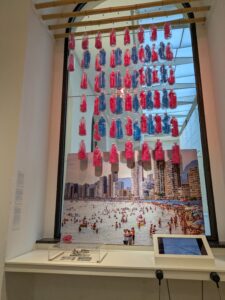
The exhibition makes this visible through Benidorm, the Spanish resort city. Tourists arriving for sun and sea also require showers, laundry, swimming pools and reliable drinking water. Water consumption therefore reveals something that a postcard does not: every travelling body remains a material body.
The traveller does not merely look at a place. The traveller eats, drinks, sleeps, washes, moves and consumes resources there.
This reverses the perspective developed earlier in the exhibition. At first, I had been asking what happens when the environment acts upon the traveller. Now the question becomes what happens when travellers act upon the environment.
The relationship runs both ways.
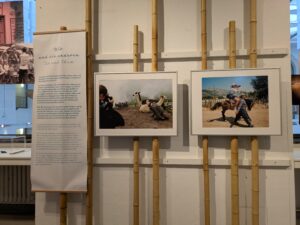
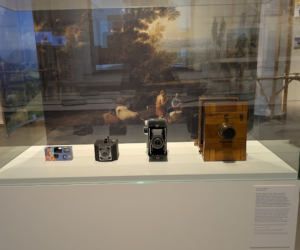
Photography makes this especially visible. A camera allows travellers not only to take landscapes home, but also to decide what deserves to be seen. Frames are selected. Views become iconic. Certain images are repeated until they begin to shape expectations of a place.
But looking is never one-directional. Tourists observe local people. Local people also observe the stream of strangers continually entering their living space.
Do tourists experience a place, or does the place gradually learn how to be experienced by tourists?
Food changes. Souvenirs change. Clothing and craft traditions may be adapted for visitors. The exhibition uses examples such as the Hawaiian shirt and Zuni carvings to show that what appears “local” may itself be the result of long cultural exchange, adaptation and tourist demand.
This does not mean that tourism simply destroys authenticity. The relationship is more complicated. Tourism can create income, sustain crafts and connect cultures. It can also reshape traditions according to what visitors expect to buy, photograph or recognise.
The destination is not a passive stage on which the traveller has an experience. It responds.
And sometimes it resists.
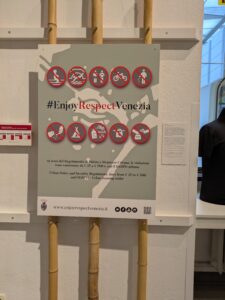
In places affected by overtourism, residents increasingly ask where the boundary lies between a visitor’s freedom and the everyday life of those who live there. Housing, water, public space, noise and infrastructure turn tourism into a negotiation over shared space.
When one person’s freedom enters another person’s living space, both sides must renegotiate the boundary.
This does not cancel the achievement of making travel accessible to more people. It completes the question.
Travel is not only about whether I am free to leave. It is also about what my arrival asks of the place that receives me.
When the Journey Comes Home
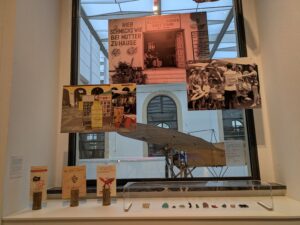
At the end of the exhibition, the traveller returns home: Wieder zu Hause.
Photographs, souvenirs and memories come back with us. The same crowded beach may be remembered by one person as freedom and by another as noise. The exhibition therefore leaves visitors with another unresolved question: how deeply must we experience a place before we can say that we know it?
My own answer begins after I return.
I also come home with photographs — sometimes hundreds of them. But when I begin sorting them, I often discover things I did not notice in the field: a sign, a vessel, a date, a sentence I did not understand at the time.
Then the journey starts again in another form. I search. I compare. I verify. One museum connects to another city. One river connects to another river. A question that remained unanswered during one journey becomes the reason for the next.
My fieldwork therefore does not end when the train arrives back in Stuttgart.
Travel leaves behind more than photographs and souvenirs. It leaves behind a relationship that actually occurred between a person and an environment.
The body reaches the world first. Writing catches up later.
This is the second connection I now see between fieldwork and Embodied Generative Intelligence.
Fieldwork allows the body to generate experience. Writing allows experience to generate knowledge.
The body enters the world. Perception generates questions through action. Questions return through memory, comparison and research. And through writing, they gradually become knowledge.
That is why I leave again and again. And why, again and again, I write the journey down.
Across Civilizations
Why Must We Leave the Place Where We Stand?
After looking through my photographs from Dresden, King Kaolie asked me a question. “I still do not understand. Why must people go somewhere far away?”
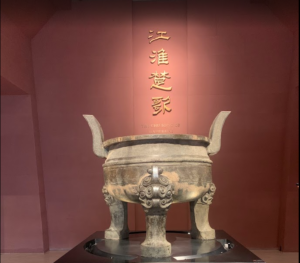
Huang Xie answered before I could. “The people of Chu were always moving too. Down the rivers, upstream against them, away from Ying and towards places farther beyond.”
“For what?” the king asked.
“Sometimes on missions. Sometimes in exile. And sometimes because the place where one stands can no longer contain the questions one needs to ask.”
The king looked at him. “Is that why people speak of travelling far?”
“Perhaps,” Huang Xie replied. “A distant place is never merely another place. When people leave what is familiar, they see a larger world. They also begin to see more clearly where they themselves are standing.”
Then he smiled. “When people of Chu went out, they often knew what they hoped to bring back. My Lady travels without even knowing what she will return with.”
More than two thousand years later, I still take these two men with me. Not because the distant world necessarily contains an answer, but because some questions only appear after we have left the position from which we were originally looking.
King Kaolie was silent for a moment. “So however far the road goes, in the end we are still searching for an answer?”
Huang Xie shook his head. “Not necessarily. Some roads matter not because they finally give us an answer, but because after travelling them, we are able to ask a question we could not ask before.”
More than two thousand years ago, the people of Chu placed such searching among rivers, mountains and the vastness of heaven and earth. Today we board trains and aircraft and carry cameras into distant places. The tools have changed. The roads have changed. The people who are able to travel have changed.
Yet one civilizational question remains remarkably persistent: Why must human beings sometimes leave the place where they already stand?
Perhaps because civilizations do not develop only by preserving the world they already know. They also need people willing to depart, cross familiar boundaries and place their bodies inside what they do not yet understand. Only then can new relationships become visible, new questions be brought home, and the familiar world be understood again.
More than two thousand years ago, Qu Yuan wrote in the Li Sao: “The road is long and far; I shall search above and below.”
His searching crossed the landscapes of his world. Mine takes my body into harbours, ships and museums. The roads have changed. The ways of travelling have changed. But the impulse behind them has not:
Sometimes we have to go out into the world before we can know what the world looks like — and before we can discover what we still do not know.