A Boat That Lets Everyone Come Aboard | Ulmer Spatz, Ulm
Some Boats Take People Somewhere. Some Boats Make It Possible to Depart.
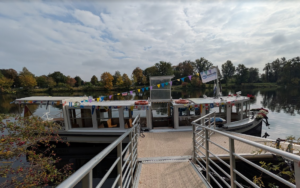
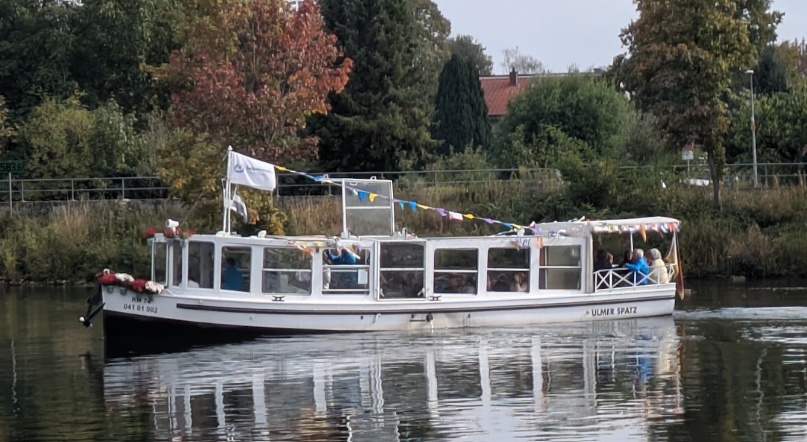
I came to Ulm expecting to spend an hour on the Danube. I wanted to watch the river pass through the city and to see how Ulm presents itself from the water. Once aboard, however, I gradually realised that the most important story of the Ulmer Spatz was not simply the route she travelled.
There were spaces for wheelchair users and systems that changed how people could enter the passenger cabin. People with different abilities worked aboard the vessel and helped keep her operating. This was also an old ship that had once needed restoration. People had repaired her, brought her back to the Danube and made inclusion part of the vessel itself.
Boarding therefore began to mean more than becoming a passenger. Some people came aboard to travel. Some came aboard to work. Others had helped make it possible for the ship to sail again. The story of the Ulmer Spatz became a question: Who can become part of the life of a ship?
Who Can Become Part of a Ship?
The story begins with restoration. In 2013, Lebenshilfe took over the ageing vessel, which required extensive work. The restoration became part of the organisation’s workshop activities: old components were removed, the hull and passenger spaces were refurbished, professional staff worked together with workshop employees, and accessibility was incorporated into the reconstruction. The process took around two years before the vessel returned to the Danube.
But the story did not end when the repairs were finished. People with different abilities continued to participate in the everyday work of the ship. They prepared spaces, assisted passengers and took part in the routines that allow the vessel to operate. Inclusion therefore moved from the workshop into the working life of the vessel, and from there to the passengers.
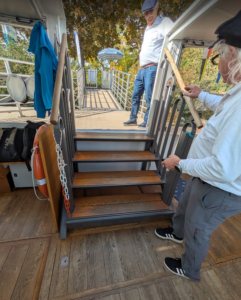
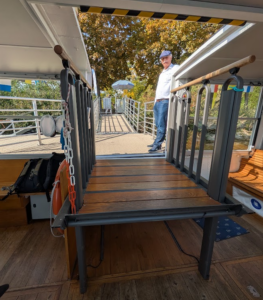
I saw this most clearly at the entrance to the cabin. At first, several steps stood in the way. Then the captain folded the steps away, and a flat platform appeared. The movement was simple, but what it changed was fundamental: the way a person could enter the ship. The Ulmer Spatz provides thirty-two passenger seats and two spaces for wheelchair users.
The point is not simply that the ship contains accessible equipment. Someone repairs the ship. Someone works aboard her. Someone enters through an adapted access system. Their forms of participation are different, yet all of them can become part of the same voyage.
How Does a Ship Built in 1933 Keep Sailing?
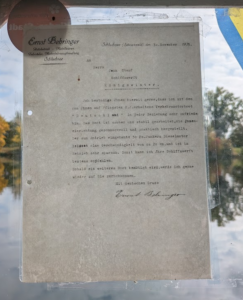
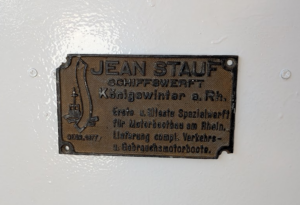
The Ulmer Spatz also carries another story: the survival of the ship herself. A historic document aboard records her earlier identity. She was once called Deutschland. According to the 1933 document, the vessel was equipped with a Junkers diesel engine producing thirty horsepower and could reach approximately twenty kilometres per hour.
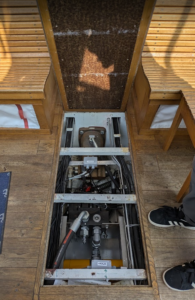
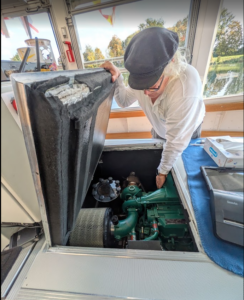
More than ninety years later, the hull is still on the water, but the machinery inside it is no longer the machinery of 1933. After the cruise, the captain opened sections of the cabin floor. Pipes, cables and mechanical systems appeared beneath the wooden interior. It felt as though another ship had suddenly been opened underneath the one I had been travelling on.
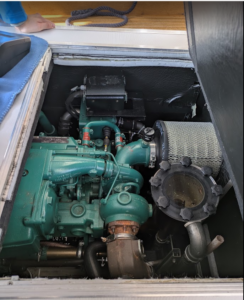
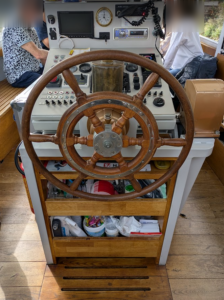
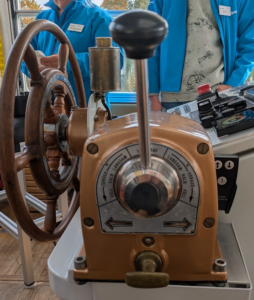
The old document mentions a Junkers diesel engine. Today, a Volvo Penta engine sits inside the old hull. The wheelhouse tells the same story in another way: a wooden wheel remains at its centre, older controls survive beside it, and modern electronic instruments have been added around them. Several technological periods now occupy the same working space.
The Ulmer Spatz has therefore not survived by remaining unchanged. Parts have been preserved, other parts have been replaced, and new systems have entered an old hull. The result is not a ship frozen in 1933. It is a ship from 1933 that can still work today.
Three Minutes at the Wheel
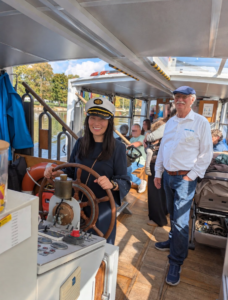
Then the captain brought me to the wooden wheel and let me steer for three minutes. The helmsman told me not to stare at my hands but to look ahead. A green marking on the bridge in front of us became my reference point. I had to keep the vessel aligned toward it and watch whether the bow began to drift away from the intended course.
I turned the wheel, but the ship did not answer immediately. That was when I noticed something I had never experienced in a car: there was a delay between my movement and the response of the vessel. I had to look, judge, make a correction and then wait. Only after waiting could I see what the ship had done.
For three short minutes, steering became a sequence: observe, judge, correct, wait. Then the helmsman took the wheel back, and the Ulmer Spatz continued along the Danube. I had learned something through my own hands: a ship does not simply obey a movement. The person steering has to learn how to read the vessel’s response.
Perhaps this is another way to understand the preservation of a working ship. Preservation does not always mean stopping time. Sometimes it means repairing, replacing and adapting enough that an old vessel can return to the work for which a ship exists: to sail.
Ulm Reappears from the River
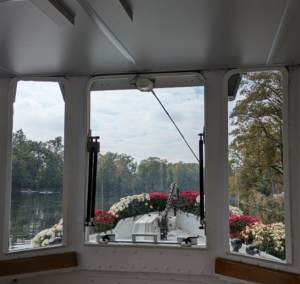
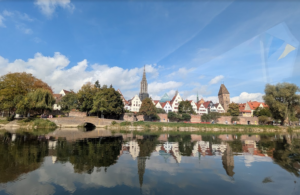
Once the Ulmer Spatz left Friedrichsau, the city began to rearrange itself. From the street, Ulm is connected by roads, squares and buildings. From the river, those connections disappear. Streets retreat behind the houses, the church spire rises above the roofs, the city wall stretches along the Danube, and the water reflects the whole city once again.
From the ship, Ulm is no longer organised primarily by streets. It is organised by water.
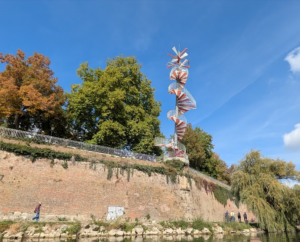
The walls along the river tell another story. In the nineteenth century, Ulm became part of an extensive federal fortress system surrounding Ulm and Neu-Ulm. What appears today as a quiet riverbank once belonged to a landscape of defence. The defensive function has receded, but the walls remain. A former defensive edge has become part of the view from the river.
Then a red-and-white spiral structure appeared above the wall: the Berblinger Tower. The site recalls the attempt made in 1811 by Albrecht Ludwig Berblinger, the famous “Tailor of Ulm”, to fly across the Danube from the city fortifications. The attempt failed, but the story remained. More than two centuries later, I passed the place from below. Berblinger had once looked across the river and imagined flying over it; I sat on a boat and looked back toward the place from which he had tried to leave the ground.
The location was the same. The perspective had changed. And with a different perspective came a different story.
Another Ulm Appears on the Water
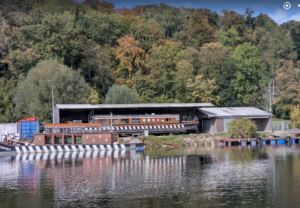
Farther along the route, another kind of vessel appeared on the bank. Its long, low, black-and-white form recalled the Ulmer Schachtel. These traditional boats once travelled downstream along the Danube, carrying goods and people toward distant destinations. Many of those journeys were one-way voyages.
I was travelling aboard the Ulmer Spatz, while in front of me was an Ulmer Schachtel. One belonged to the river as I was experiencing it that day. The other carried the memory of a much older Danube world.
Even the name Ulmer Spatz carries the city’s memory. According to the familiar Ulm legend, a sparrow carrying a twig lengthwise showed townspeople how long timber could be turned and taken through a narrow city gate.
A sparrow changed the direction of a piece of wood. A ship named after that sparrow changed my direction of looking. From the river, I saw Ulm again.
Who Is Able to Come Aboard?
An hour later, the Ulmer Spatz returned to Friedrichsau. I had seen the old city from the water, passed its walls, looked up at the Berblinger Tower and encountered traces of older Danube navigation. Yet after leaving the ship, those were not the things that stayed with me most strongly.
What remained was a simpler question: Who is able to become part of a voyage?
Some people participated in restoring the ship. Some work aboard her today. Some enter the cabin through an access system designed around bodies that cannot all use the same stairs. Different people arrive at the same river in different ways.
How many people a vessel can carry is a question of capacity and technology. For whom a vessel makes room is a different kind of decision.
A ship that truly belongs to a city should allow more of its people not only to reach the riverbank, but to reach the water itself.
Across Civilizations
King Kaolie stood inside the cabin and looked back at the movable steps, then toward the floor panels that had just been opened. “This ship is already so old,” he said. “Why do they still make it sail?”
Lord Chunshen Huang Xie placed his hand on the wooden wheel. “Because people repair it,” he replied. “People take care of it, and people make it possible for an old hull to continue working with the machines of today.”
“So preserving the ship means preserving the past?” the king asked.
I shook my head. “It has not been left on the bank, and it has not been placed inside a museum. People still work here. Passengers still depart from here.”
Huang Xie turned toward the entrance. “But those steps,” he said. “Why did they suddenly disappear and become a flat platform?”
“Because not everyone can enter a ship in the same way,” I replied. “Some people can climb the steps. Others need another route.”
King Kaolie thought for a moment. “So building another way in is what you call inclusion?”
Huang Xie shook his head. “I suspect it goes further than that. If all that changed were the entrance, then only the entrance would have changed. The ship itself would remain the same.”
I looked at them. “When this vessel was restored, people with different abilities took part in the work. After the ship returned to the river, they continued to participate in its working life.”
The king looked up. “So some people repair the ship, some work aboard it, and because of these changes, others can finally become passengers.”
Huang Xie smiled. “They appear to be three different things. But perhaps they are all asking the same question: Whom can the life of a ship include?”
I remembered my three minutes at the wheel. My own hands had held the wooden wheel. The vessel had not immediately obeyed me, yet for a brief moment, I too had entered its working movement.
“So after everything you saw today,” King Kaolie asked, “what will you remember? Not Ulm? Not the city walls?”
“I will remember those too,” I said. “And the spiral tower. But what stays with me most is how this ship continues to live.”
Huang Xie looked toward the bow as the vessel approached the landing stage. “An old ship does not remain alive through machinery alone. Someone must be willing to repair it. Someone must be willing to work aboard it. And someone must be willing to change it.”
The king asked one final question. “Then who truly counts as part of this ship?”
The Ulmer Spatz had returned to Friedrichsau. Someone prepared the ropes, passengers waited to disembark, and another group stood on the bank.
I looked toward the entrance as it opened again. “Perhaps the answer is here. People do not have to participate in the same way. But every place deliberately made for another person gives this ship another way to remain alive.”
Some people restore a ship. Some keep her working. Some are finally able to come aboard. All of them participate in her life.
Inclusion is more than opening an entrance. It changes who is able to become part of the life of a ship.

 时间:2026年10月03日 (六)
 行程|乌尔姆 · 多瑙河游船