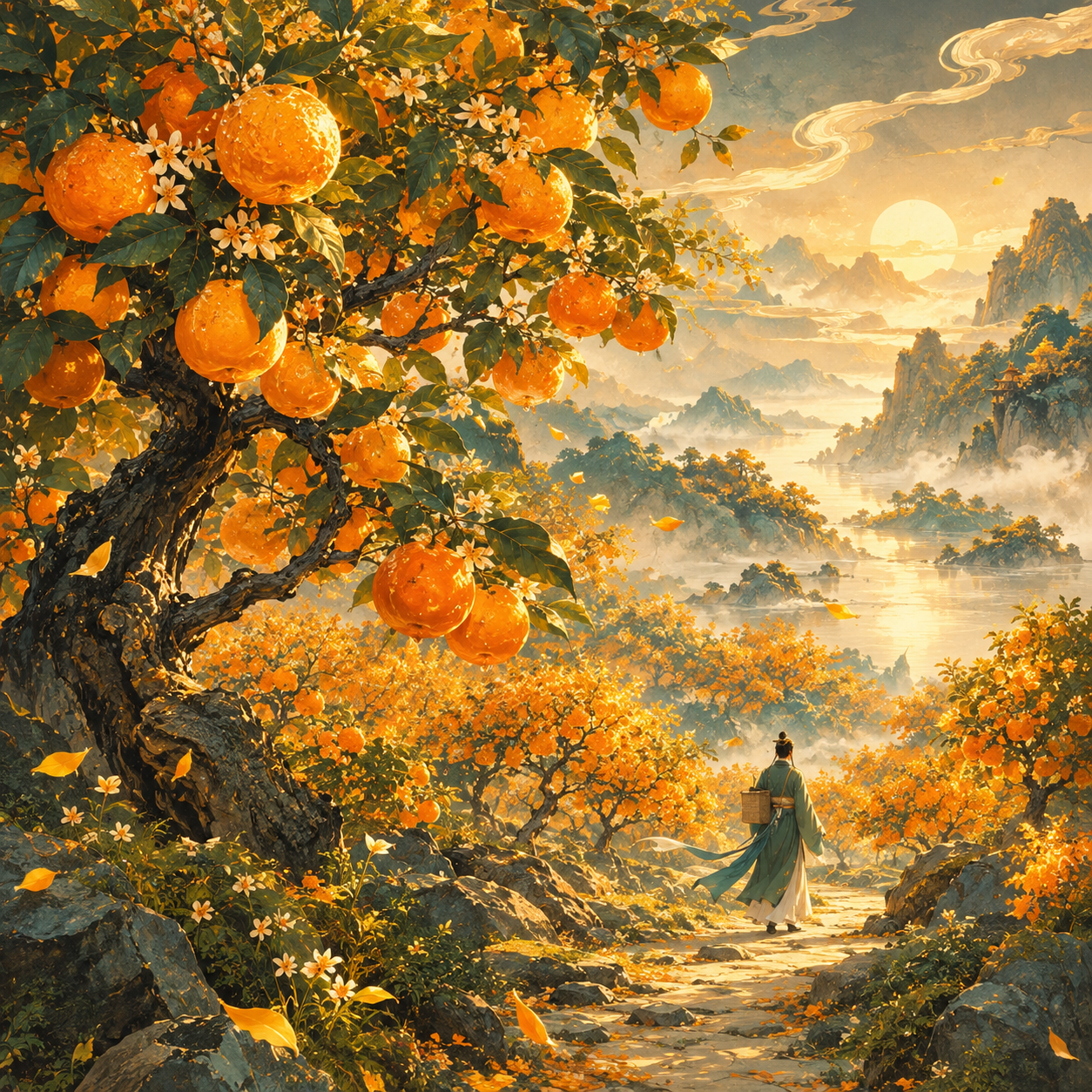
封面图说明|
南国嘉树,扎根故土而不迁,
橘林生辉,历经风霜而不改志。
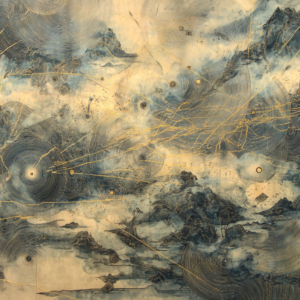
图片:原创数字插画。
引文|一棵橘树,为何值得屈原歌颂?
一棵树可以扎根于土地,
一个人能否坚守自己的志向?
“后皇嘉树,橘徕服兮。”
两千多年前的楚国南方,
一棵橘树静静生长于故土。
它不曾远行,却有自己的方向;
它不以繁华争艳,却深植于土地。
屈原在《橘颂》中,
以橘树为镜,寄托人格理想。
2025 年夏天,
我重新走近《楚辞》,
尝试以人工智能重构古老诗声。
当两千多年前的诗句再次响起,
橘树依然扎根于南国的土地。
一|受命不迁:从南国嘉树到理想人格
橘树以根守住南国的土地,
屈原以志守住内心的方向。
当天地四时不断更替,
什么才是生命不可迁移的根?
1. 后皇嘉树:橘为何生于南国?
「受命不迁,生南国兮。」
长江流域温暖湿润,
为柑橘生长提供了条件。
古人对柑橘的认识,
也包含鲜明的地域经验。
《晏子春秋》记载:
「橘生淮南则为橘。」
这并非严格的植物学定律,
却反映古人对水土的观察。
然而,屈原歌颂的橘树,
并不只是枝繁叶茂的果树。
当他写下「受命不迁」,
自然特性已开始转向人格象征。
树扎根于土,
是被命运安排的;
人守住志向,
是自己在命运面前做出的选择。
2. 独立不迁:橘树如何成为人格的象征?
「独立不迁,岂不可喜兮。」
诗人的目光由枝叶转向品格。
「深固难徙,更壹志兮。」
根系深固,难以迁移,
成为意志专一的象征。
「苏世独立,横而不流兮。」
这里的「独立」并非孤立,
也不是拒绝与世界往来。
它强调的是面对外部变化,
仍然保有自身的判断与原则。
不迁,
不是不肯移动,
而是移动之后,
仍然知道自己从哪里来。
3. 愿岁并谢:屈原为何愿与橘树为友?
「愿岁并谢,与长友兮。」
诗人不再只是远远欣赏,
而是希望与橘树相伴,
共同经历岁月的流逝。
这里出现了有趣的倒转:
通常是年长者教导年轻者,
如今诗人却向一棵树学习。
「行比伯夷,置以为像兮。」
伯夷是古代守节人物的典范。
橘树由此获得更深的意义:
它不只是南国的美好植物,
而成为值得效法的人格榜样。
屈原向一棵树学习做人,
因为树比人更早懂得:
有些根,
一旦扎下,
便不愿轻易拔起。
二|橘林苏醒:从楚辞文字到AI声音重构
橘树以根系记录土地的时间,
诗人以文字守护不迁的志向。当古老诗句进入数字声场,
谁又能预知声音苏醒的时刻?
1. 当《橘颂》重新被唱出来
2025 年 6 月 21 日的夜晚,
我用AI工具制作《楚辞·九章·橘颂》。
这次创作保留《橘颂》原典,
以 SUNO AI 生成歌曲。
古代汉语与现代普通话之间,
存在漫长的语音演变历史。
因此这次创作并不追求复原古乐,
而是以当代声音重新诠释经典。
尤其《楚辞》包含不少古语,
现代语音模型面对这些文字,
仍可能出现发音与断句偏差。
AI 能重新组织音符,
却无法还原诗人的心境;
它给出的不是古音,
而是今人对古人的一次回应。
2. 两分钟的等待:橘林在静默中苏醒
这首《橘颂》有个特别的现象。
音乐开始之后,主唱并未出现,
前奏持续铺展了约两分钟。
这并不是我预先设计的结构,
生成系统自行形成了这样的安排。
起初,听见的是流动的音场,
而不是清晰可辨的诗句。
如果将这段音乐视为橘林,
它便像一个尚未苏醒的世界。
直到约两分钟之后,
主唱终于进入音乐之中。
这一刻仿佛晨雾渐渐散去,
橘林终于显露出自己的形貌。
那两分钟不是空白,
是橘林在等天亮;
有些声音必须先沉默,
才能被听见。
如果用四个阶段加以理解:
等待、萌生、苏醒与发声。
这不是 AI 预设的创作意图,
而是我在聆听后的个人诠释。
AI 没有想过要“等待”,
是我的耳朵,
替这段前奏听出了意义。
3. 节奏文明观:根性、时间与不迁之志
「受命不迁,生南国兮。」
在自然世界里,树木扎根生长,
必须适应气候与季节的变化。
橘树不断经历生命的变化,
却始终依靠根系维持生存。
屈原从这种自然现象出发,
将橘树转化为人格的象征。
橘树的“不迁”,
是生物学;
屈原的“不迁”,
是伦理学;
两者之间,
隔着一个诗人对世界的理解。
2025 年的这次 AI 创作,
可以为讨论增加新的层次。
文字与声音经历不同的时间:
原典来自两千多年前的楚地,
数字旋律诞生于当代技术环境。
诗歌的文字可以长久流传,
每一次演唱却发生于当下。
同一棵橘树,
在屈原笔下是志向,
在 AI 的旋律里是等待;
文字没变,
听它的人变了。
尾声|橘树仍在南国
楚国的山河历经千年变迁,
橘树的根却仍在诗中生长。
「受命不迁,生南国兮。」
两千多年前,屈原写下这句诗,
将一棵生长于南国的橘树,
留在了楚文明的文学记忆之中。
此后,楚国的政治版图消失,
江河依然流淌,四季不断轮回,
而《橘颂》仍在文字中流传。
橘树并不知道王朝的兴亡。
它只是依循自然的生长节律,
在适宜的土地上开花结果。
2025 年夏天,我为《橘颂》作曲。
那两分钟没有立即响起歌声,
却让音乐拥有了等待的时间。
当世界不断改变自身的节奏,
人又该如何理解不迁之志?
是始终停留在原来的土地,
还是在变化中守住内心的方向?
橘树没有离开南国,
却在诗歌中跨越了两千多年;
人离开了故乡,
也未必就失去了根。
树不迁,是命;
人不迁,是志。
楚人对话后记|考烈王、黄歇与令尹夫人的观后感
橘树不迁,令尹夫人为何远行?
考烈王望向我:
「令尹夫人,你出生台湾,
如今却在遥远的德国生活。
依照屈大夫的说法,
你岂不是早已离开南国?」
我忍不住反问:
「大王,难道人离开故乡,
就不能保有自己的志向?
橘树需要扎根于土地,
人却可以带着文化远行。」
考烈王显然还不满意:
「可是屈大夫说得清楚,
受命不迁,生南国兮。
既然不迁才值得歌颂,
夫人为何偏偏选择远行?」
黄歇轻轻放下竹简:
「大王,橘树有橘树的天性,
人也有人自己的道路。
若把不迁理解为不得远行,
岂不是误解了屈大夫?」
我笑着补充:
「我只是从台湾走到德国,
也曾在中国大陆探访历史。
看过古老的城邑与江河,
也在德国寻找船舶的故事。」
考烈王忽然好奇起来:
「等等,令尹夫人!
寡人正在与你讨论橘树,
怎么又说到你的船去了?」
黄歇终于忍不住大笑:
「大王,您有所不知。
夫人如今在德国研究水路,
连古老的链条拖船都不放过!」
我笑着回答:
「是啊,还有好多水路没去,
好多古老的船没有看。
我的田野研究还没结束呢!」
考烈王摇头叹息:
「寡人总算明白了。
屈大夫喜欢南国的橘树,
令尹夫人却喜欢欧洲的历史船!」
黄歇望着屏幕上的橘林:
「大王,这两者未必矛盾。
橘树以根系维持生命,
夫人则以行走拓展见闻。」
考烈王想了想,忽然问:
「那寡人倒要问一句:
橘树不迁,是它的根;
令尹夫人远行,是她的路。
这两件事,到底哪一件更难?」
橘树守住根,
靠的是天性;
人守住志向,
靠的是一次又一次选择。
树不迁,是命;
人不迁,是志;
而志,比命更难守。
江风吹过橘林,
橘树仍在南国的诗意里,
而我的船,还在路上。
说明:本篇对话为作者依据楚国历史人物、《楚辞·九章·橘颂》及个人创作经历所写的文学想象,并非真实历史对话。
Appendix|English Narrative Overview
Born in the South, Steadfast in Spirit
Ode to the Orange Tree | Chu Ci · Jiu Zhang · Ju Song
When an Ancient Orange Tree Awakens in Digital Music
“A tree is rooted in the earth by nature. A human being remains faithful to a conviction through choice.”
More than two thousand years ago, in the southern lands of the ancient state of Chu, an orange tree became the subject of an extraordinary poem. It did not travel beyond its native soil, yet its roots, branches, and fruit came to represent something far greater than a tree. In Ju Song (橘颂, Ode to the Orange Tree), traditionally attributed to Qu Yuan, the orange tree becomes a symbol of integrity, independence, and the determination to remain faithful to one’s principles.
In the summer of 2025, I returned to Chu Ci and began exploring how its ancient poetry might be transformed into music through artificial intelligence. On June 21, I created a digital musical interpretation of Ju Song using Suno AI. The recording contained an unexpected feature: for approximately two minutes, the music unfolded without a lead vocal. Only later did the ancient words begin to emerge, as though an orange grove were slowly awakening in the morning mist.
The experience raised a question that connects classical literature with contemporary artistic creation. When an ancient poem enters a new musical medium, are we recovering the voice of the past, or creating another dialogue with it?
I. Rooted in the South: From the Orange Tree to an Ideal of Human Character
“The orange tree holds its place in the southern soil. Qu Yuan holds his convictions within his heart. As the seasons and the world continue to change, what remains steadfast?”
1. A Noble Tree of the South | Why Does the Orange Tree Remain in Its Native Land?
“Entrusted with its nature, it does not move; it grows in the southern land.”
The opening of Ju Song celebrates the orange tree as a noble plant of the southern landscape. The warm and humid climate of the Yangtze River region provided favourable conditions for citrus cultivation. Ancient Chinese writers also recognised the relationship between plants and their environments. The Yanzi Chunqiu (Spring and Autumn Annals of Master Yan) contains the well-known observation that an orange growing south of the Huai River remains an orange, reflecting an early understanding of regional differences in cultivation and environment.
This observation should not be understood as a strict botanical law. Rather, it reveals how the ancient Chinese perceived the influence of land and climate upon living things. In Qu Yuan’s poem, however, the orange tree becomes more than a plant adapted to its surroundings. Its rootedness is transformed into a moral image. What nature determines for a tree becomes, through poetry, a question of human character.
A tree takes root in the soil through the conditions of its existence. A person who remains faithful to a conviction must make that choice in the face of changing circumstances.
2. Standing Independently | When Rootedness Becomes a Moral Principle
“How admirable it is to stand independently and remain unchanged.”
As the poem develops, Qu Yuan’s attention moves from the physical beauty of the orange tree towards its symbolic character. Its deep roots and resistance to transplantation become images of a firm and undivided will. The poet admires a being that stands apart without being carried away by the surrounding currents.
This independence does not necessarily mean isolation from the world. Nor does it require a human being to remain physically in one place. The moral significance lies in preserving judgment and principle when external circumstances encourage compromise. The tree’s physical rootedness becomes a metaphor for an inner stability that cannot be measured by geographical distance.
To remain steadfast does not mean refusing to move. It means that even after moving, one still knows where one comes from.
3. A Lifelong Companion | Why Does Qu Yuan Wish to Befriend a Tree?
“May we grow old together, and may I remain your lifelong friend.”
In the later part of Ju Song, the poet no longer observes the orange tree merely as an object of admiration. He wishes to become its companion and to share the passing years with it. This creates an unusual reversal of the relationship between teacher and student. Instead of an elder instructing the young, a human being turns towards a tree as a model of conduct.
The poem eventually compares the orange tree’s virtue with that of Boyi, a figure traditionally admired for his moral integrity. The orange tree thus becomes an ideal worthy of imitation. Its beauty is no longer limited to leaves, branches, and fruit. It embodies a vision of how a person might live with dignity and conviction.
Qu Yuan learns from a tree because, in his poetic imagination, the tree already possesses what human beings so often struggle to preserve: the ability to remain true to what sustains them.
II. The Orange Grove Awakens: From Ancient Poetry to AI-Generated Sound
“The orange tree records the passage of time through its roots. The poet preserves his convictions through words. When ancient poetry enters a digital soundscape, who can predict the moment when its voice will awaken?”
1. When Ju Song Becomes a Song Again
On the evening of June 21, 2025, I used Suno AI to create a musical interpretation of Chu Ci · Jiu Zhang · Ju Song. I preserved the original classical Chinese text and allowed the AI system to generate a contemporary musical setting. My intention was not to reconstruct the historical music of ancient Chu, but to explore how a poem more than two thousand years old might become audible through modern technology.
Classical Chinese and modern Mandarin are separated by a long history of linguistic change. Even with modern pronunciation guidance, an AI singing system cannot reproduce the original sounds of the Warring States period. Classical vocabulary, unusual characters, and poetic phrasing may also cause errors in pronunciation or pauses. These limitations are important because they distinguish a contemporary musical interpretation from an authentic reconstruction of ancient performance.
Artificial intelligence can organise musical sounds, but it cannot recover the inner world of the poet. What it offers is not the original voice of ancient Chu, but a response created by someone living in the present.
2. Two Minutes of Waiting | When the Orange Grove Awakens in Silence
The most distinctive feature of this recording was something I had not planned. After the music began, the lead vocal did not immediately enter. Instead, an atmospheric soundscape continued for approximately two minutes before the words of Ju Song were finally sung. This unusually long introduction was generated by the AI system itself, not specified in my instructions.
At first, the listener encounters flowing musical textures rather than clearly articulated poetry. The sound seems to occupy an uncertain space, like an orange grove still concealed beneath the morning mist. As the introduction continues, the absence of a singing voice becomes increasingly noticeable. The listener waits for language to emerge, even though the music has already begun to establish its own atmosphere.
When the vocal finally enters, the experience changes. The ancient poem moves from written language into audible expression, and the preceding music acquires a new significance. In my imagination, it resembles the moment when the mist begins to lift and the trees gradually become visible.
I understand this musical passage through four stages: waiting, emergence, awakening, and expression. These stages are not evidence of an intention held by the AI system. They are my interpretation as a listener and creator.
Those two minutes were not an empty space. They became, in my imagination, an orange grove waiting for dawn. Some sounds seem to require a period of silence before they can truly be heard.
AI did not consciously decide to wait. It was my listening that gave this unexpected introduction its poetic meaning.
3. Rhythm Civilization | Rootedness, Time, and the Will to Remain Steadfast
“Entrusted with its nature, it does not move; it grows in the southern land.”
In the natural world, trees grow through their relationship with soil, climate, and seasonal change. Their roots sustain them as they develop, flower, and bear fruit. Qu Yuan transforms this biological relationship into a literary symbol of human character. Yet the two should not be confused.
For the orange tree, remaining rooted is a matter of biology. For Qu Yuan, remaining steadfast is a matter of ethics. Between these two meanings stands the poet’s interpretation of the world.
My 2025 AI music experiment introduces a third dimension: the relationship between ancient writing and contemporary sound. The original poem belongs to the literary world of ancient Chu, while the digital melody was created with twenty-first-century technology. The words can endure across centuries, but every new performance belongs to its own moment in time.
The same orange tree represents conviction in Qu Yuan’s poetry and waiting in my experience of the AI-generated music. The written words have not changed. The person listening to them has.
From the perspective of my concept of Rhythm Civilization, this encounter raises a question rather than providing a definitive answer. When the world continually changes its pace, what does it mean for a person to remain steadfast? Must one remain in the same place, or can one preserve an inner direction while moving through changing circumstances?
The natural rhythm of the orange tree, the moral ideal expressed by Qu Yuan, and the unexpected temporal structure of digital music belong to different worlds. Their relationship is poetic and interpretive, not a scientific equivalence. Yet together, they invite us to consider how continuity and change may coexist.
Epilogue | The Orange Tree Remains in the South
“The mountains and rivers of Chu have witnessed centuries of change, yet the orange tree continues to grow within the poem.”
“Entrusted with its nature, it does not move; it grows in the southern land.”
More than two thousand years ago, Qu Yuan preserved the image of an orange tree in the literary memory of Chu civilization. The political world of ancient Chu has long disappeared, but the rivers continue to flow, the seasons continue to change, and Ju Song continues to be read.
The orange tree itself knows nothing of the rise and fall of kingdoms. It simply follows the rhythms of nature, growing and bearing fruit wherever the conditions allow. Yet within the poem, its rootedness has acquired a significance that extends far beyond its biological existence.
In the summer of 2025, I created a musical interpretation of Ju Song. The unexpected two-minute introduction gave the recording a sense of waiting before the ancient words finally emerged. What began as an unpredictable feature of AI-generated music became part of my understanding of the poem.
When the world continually changes its rhythm, how should we understand the determination to remain steadfast? Does it require us to stay in the land where we began, or to preserve our convictions while our lives continue to change?
The orange tree never left the southern land, yet it has travelled through more than two thousand years of poetry. A person may leave their homeland without necessarily losing their roots.
For a tree, remaining rooted is its nature. For a human being, remaining steadfast is a matter of will.
Across Civilizations
King Kaolie, Huang Xie, and Lady Lingyin | Why Does Lady Lingyin Travel While the Orange Tree Remains?
King Kaolie of Chu turned towards me with a puzzled expression. “Lady Lingyin, you were born in Taiwan, yet you now live in distant Germany. According to Qu Yuan’s praise of the orange tree, have you not already left your southern homeland?”
I could not help answering with another question. “Your Majesty, does leaving one’s homeland mean abandoning one’s convictions? An orange tree must grow with its roots in the soil. Human beings, however, can carry their culture with them wherever they go.”
The king remained unconvinced. “But Qu Yuan was quite clear. The orange tree was born to remain in the southern land. If remaining steadfast is such an admirable virtue, why did you choose to travel?”
Huang Xie, Lord Chunshen, gently put down his bamboo slips. “Your Majesty, an orange tree has its own nature, and a human being has a different path. If we interpret steadfastness as a prohibition against travelling, would we not misunderstand the poet?”
I smiled. “I have travelled from Taiwan to Germany, and I have also explored historical places in mainland China. I have visited ancient cities and rivers, and in Germany I have become particularly interested in the history of ships and inland waterways.”
King Kaolie suddenly looked alarmed. “Wait a moment, Lady Lingyin! I was discussing orange trees with you. How did we end up talking about your ships again?”
Huang Xie burst into laughter. “Your Majesty, you have no idea. Lady Lingyin has been studying German waterways, and she is particularly fascinated by old chain-towing vessels. She will not even leave those ancient ships alone!”
I laughed. “There are still many waterways I have not visited and many historical vessels I have yet to see. My field research is far from finished!”
King Kaolie shook his head in disbelief. “Now I understand. Qu Yuan admired the orange trees of the South, while Lady Lingyin admires the historic ships of Europe!”
Huang Xie looked towards the orange grove on the screen. “Your Majesty, there is no necessary contradiction. The orange tree sustains its life through its roots, while Lady Lingyin expands her understanding of the world through exploration.”
The king thought for a moment and then asked another question. “Then let me ask you both something. The orange tree remains because of its roots, while Lady Lingyin travels because she has chosen her own path. Which of these is more difficult?”
I looked at the orange trees on the screen and considered his question. A tree preserves its roots through its nature. A human being preserves a conviction through choices made again and again.
For a tree, remaining rooted is its destiny. For a person, remaining steadfast is an act of will. And the will to remain steadfast may be far more difficult to sustain than destiny itself.
A breeze passed through the imagined orange grove. The orange tree remained in the poetic landscape of the South, while my own boat was still on its journey.
Historical and literary note: The conversations in “Across Civilizations” are fictional literary dialogues featuring King Kaolie of Chu, Huang Xie (Lord Chunshen), and Lady Lingyin. They are imaginative reflections based on historical figures, Chu Ci · Jiu Zhang · Ju Song, and the author’s personal creative experiences. They are not accounts of actual historical conversations.
🤖 人工智能协作声明
本文的主题选择、田野调查、资料搜集、核心观点与中文原始内容,均由作者独立完成。创作过程中,作者与人工智能模型,进行持续协作,包括多轮讨论、思路推演、叙事节奏调整、部分翻译、英文 Narrative Overview 生成、语言检查、结构检测与文字润饰。
人工智能在此过程中,作为创作协作者,参与内容发展与语言表达,但不作为法律意义上的作者或著作权主体。所有 AI 协作产生的内容,均由作者依据田野资料、原始文献与中文母稿,进行选择、审校、修改与艺术化重构。文章的叙事方向、内容取舍、创作决策、最终表达与价值判断,均由作者决定并负责。
📜 本站所有原创作品均已完成区块链存证,确保原创凭证。部分重点作品另行提交国家版权登记,作为正式法律备案。原创声明与权利主张已公开。完整说明见:
👉 原创声明 & 节奏文明版权说明 | Originality & Rhythm Civilization Copyright Statement – NING HUANG
节奏文明存证记录
本篇博客文为原创作品,由黄甯与 AI 协作生成,于博客网页首发后上传至 ArDrive 区块链分布式存储平台进行版权存证:
- 博客首发时间:2026年11月11日
- 存证链接:1be32835-9a42-461e-8349-f09601f6c9e5
- 存证平台:ArDrive(arweave.net)(已于 2026年11月11日上传)
- 原创声明编号:Rhythm_Archive_11_Nov_2026/chu-ci-jiu-zhang-ju-song-ode-to-the-orange-tree
- 用途声明:本文为《节奏文明观》之篇章,亦参与构建《AI×非遗文明共构档案》与《文明节奏回声计划》,用于文明节奏实地记录、区块链存证、跨域协作与版权登记用途。
© 黄甯 Ning Huang, 2026. All Rights Reserved.
本作品受版权法保护,未经作者书面许可,禁止复制、改编、转载或商用,侵权必究。
📍若未来作品用于出版、课程、NFT或国际展览等用途,本声明与区块链记录可作为创作时间及原创性的佐证。