Why Does Heilbronn Harbor Need a Ruler? | How a City Established Common Standards of Measurement
A Folding Ruler in a Museum
A river brings goods to a city. But shared standards of measurement allow strangers to trade with one another. Ships deliver cargo to the waterfront; a ruler helps establish trust in the marketplace.
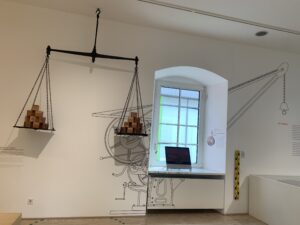
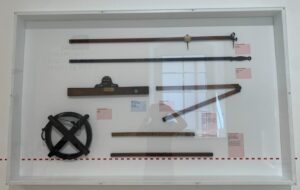
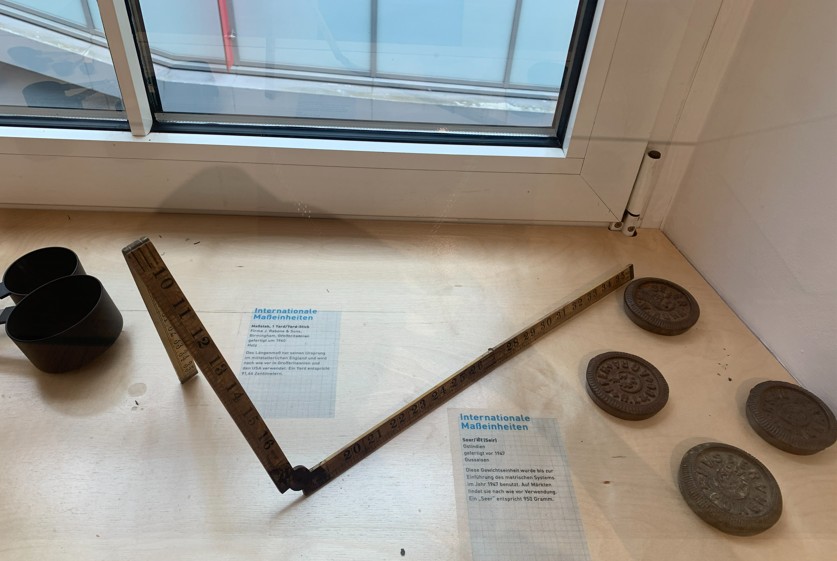
On 14 June 2026, I visited the Museum im Deutschhof, part of the Städtische Museen Heilbronn, the municipal museums of Heilbronn. Among the exhibits were an old wooden folding ruler, historical weights and measuring instruments. These ordinary objects raised a surprisingly important question: why does a city need a common ruler? Today, we take standardised measurements for granted, but in the past, German cities did not necessarily agree on the length of a foot or the weight of a pound.
A merchant arriving with a roll of cloth or a shipment of grain had to answer practical questions. How long was the cloth? How much did the grain weigh? And what happened when the buyer and seller used different units? Heilbronn’s position on the Neckar River made these questions particularly relevant. Boats transported timber, grain and other goods along the waterway. Cargo could cross territorial boundaries, but the measurements used to describe it did not always travel so easily.
The museum’s historical instruments therefore tell a story that extends far beyond their original practical purposes. They reveal how people gradually moved from individual ways of measuring towards standards that entire communities could recognise.
When Every City Had Its Own Ruler
Before the widespread introduction of standardised measurement systems, European regions maintained their own traditional units. The German-speaking territories were particularly fragmented, with numerous principalities and self-governing cities following different local practices. A unit called a foot in one city might represent a different length in another. Merchants crossing regional boundaries sometimes had to convert quantities repeatedly as they moved between markets. Before standardisation, each city could behave as though its own ruler were the ruler of the world.
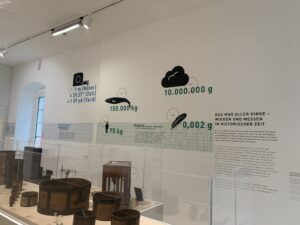
The origins of measurement were much more personal. Long before precision instruments existed, people used their own bodies as references. Fingers, hands, forearms and feet provided convenient ways to estimate length. These methods were practical, but they had an obvious limitation: human bodies are not identical. A carpenter cutting timber and a cloth merchant selling fabric needed measurements that others could reproduce and recognise.
As commerce expanded, private experience was no longer sufficient. Communities needed publicly accepted standards. In Heilbronn, historical length standards were associated with St. Kilian’s Church in the old town. The museum’s explanation of these measures reminds us that a standard was not simply an object with markings. It depended on public recognition and a shared understanding of its authority.
A ruler is not made into a standard merely by being manufactured. It becomes one when people agree to recognise it. Its real power lies not in the markings, but in the trust placed in them.
From the Marketplace to the Neckar Harbor
The Neckar carried goods into Heilbronn, but the marketplace required another kind of infrastructure: common rules. Imagine a historical market in the early morning. Merchants display cloth and grain, while buyers examine the goods and negotiate prices. Behind every transaction lies a question of measurement. If the buyer and seller each use a different ruler, the same quantity of goods may produce different calculations. Disputes can arise even when neither party intends to deceive the other. Measurement therefore became more than a practical technique; it was also a matter of public order and commercial confidence.
For a trading city such as Heilbronn, the relationship between transport and measurement was especially important. The Neckar enabled goods to move between places, but trade required buyers and sellers to understand what was being exchanged. The river solved the problem of transportation. Shared measures helped solve the problem of trust. A historical harbor model in the museum illustrates the importance of river navigation to Heilbronn’s commercial development. Nearby displays of weights, scales and traditional units reveal another essential part of the same story: the rules by which goods could be measured and valued.
Heilbronn once maintained its own local system of measurements. Museum displays document the city’s historical units of length, area, capacity and weight, including those used before 1806. These measures also had to be understood in relation to the units of other regions. The length of a ruler could not simply be determined independently by every buyer and seller. A functioning marketplace needed recognised references that people could rely upon.
A harbor allows goods to enter a city. Shared measures allow strangers to sit down and trade. A truly open city needs more than navigable waterways; it also needs standards that everyone can understand.
From Local Measures to International Standards
During the nineteenth century, European railways increasingly connected cities and regions. Industrial production and expanding trade created growing demand for consistent measurements. Traditional local units had served their communities for generations, but as economic activity extended beyond individual cities, differences between measuring systems became increasingly inconvenient. Heilbronn provides a concrete example. Under its historical system, a Heilbronn Schuh (foot) measured approximately 27.72 centimetres, while a Heilbronn Pfund (pound) weighed approximately 461.45 grams. As Württemberg introduced reforms to its measurement system, local units were gradually integrated into broader arrangements.
The development of the metric system represented an even more ambitious attempt to establish common standards. In 1791, France decided to develop a new unit of length based on the Earth’s meridian. In 1875, seventeen countries signed the Metre Convention in Paris, establishing an international framework for cooperation in measurement. In 1983, the metre was redefined in terms of the distance travelled by light in a vacuum. From a meridian of the Earth to the speed of light, the scientific basis of measurement changed, yet the desire to establish a common measure remained.
Industrialisation demonstrated why this mattered. A screw manufactured in one workshop had to fit a corresponding nut. Components produced in different factories needed compatible dimensions. Without shared standards, interchangeable parts would be difficult to manufacture and use. Railways depended on precise measurements of track gauge, while ships required reliable measurements of their length and draught. As transport and industrial systems became more complex, consistent measurement became essential.
Standards are more than numbers. They are the gears that allow different parts of the world to fit together.
Yet not every measure originated in machinery or industrial production. A Japanese tatami mat displayed in the Heilbronn museum offers a different perspective. Traditionally, tatami mats have also served as references for measuring the area of rooms. The exhibited mat measures 180 × 90 centimetres, illustrating how systems of measurement can emerge from everyday life and cultural practices. Some measures arise from the demands of machines; others grow out of the ways people live.
A Ruler Measures More Than Length
A ruler was originally a simple tool for measuring the length of objects. Returning to the museum in Heilbronn, the old wooden folding ruler now seems to tell a much larger story. Once used for practical measurement, it has become a key to understanding how cities developed common rules. A city needs shared standards for more than calculating quantities. Common measures allow buyers and sellers to agree on what is being exchanged, reducing uncertainty and making cooperation possible.
A ruler measures the length of an object. Shared standards establish trust in trade. And trust helps a city develop into a functioning community. The ruler resting quietly in the display case no longer measures the objects around it. Instead, it allows us to see how human beings gradually learned to measure the world together.
Across Civilizations
What If King Kaolie of Chu Discovered a Ruler from His Own Tomb?
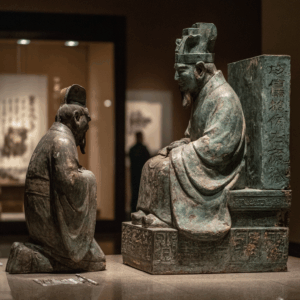
At the Heilbronn museum, King Kaolie of Chu stopped before an old folding ruler and turned to Huang Xie. “Lord Chunshen, did the Germans have their own rulers too?”
I smiled and showed him archaeological information about a bamboo ruler excavated from Wuwangdun. “Your Majesty, look at this. It measures approximately 69.4 centimetres and is divided into three feet.” The king examined the information carefully. “This bamboo ruler looks strangely familiar. Lady Lingyin, where did it come from? Is it German too?”
I could not help laughing. “Your Majesty, it was excavated from Wuwangdun. Archaeologists believe that the tomb belonged to you. The ruler was found inside it.” The king’s eyes widened. “What? They excavated my tomb? They did not even leave a little strip of bamboo alone? And now they are comparing it with a German ruler?”
Huang Xie tried to suppress a smile. “Your Majesty, each foot on the bamboo ruler measures approximately 23.1 centimetres. It offers valuable evidence of the measuring standards used in ancient Chu.” I pointed towards the Heilbronn museum display. “The Germans had their own standards too. A historical Heilbronn foot measured 27.72 centimetres. The two feet were not the same length.”
The king considered this for a moment. “Then if a merchant from Chu travelled to Germany, would he have to convert his measurements just to sell a piece of cloth?” Huang Xie nodded. “Exactly, Your Majesty. Different places may use different rulers, but trade requires measurements that both sides can understand.”
King Kaolie sighed. “I have been asleep for more than two thousand years. Who would have imagined that a bamboo ruler from my tomb could still have a conversation with a German ruler?”
The people of Chu left behind their own measuring instruments, just as German cities preserved their historical standards. Separated by more than two thousand years, these rulers point towards the same fundamental question: How do we learn to trust one another, and how do we establish the common rules that allow us to live together?
The breeze from the Neckar passes through Heilbronn. The folding ruler rests quietly in its museum display, while the ancient Chu ruler survives in archaeological records. Across the distance of centuries and civilizations, they seem to be waiting for a transaction that has not yet been completed.
Historical and literary note: The conversations in “Across Civilizations” are imaginative literary dialogues featuring King Kaolie of Chu, Huang Xie (Lord Chunshen), and Lady Lingyin. The bamboo ruler was excavated from the Wuwangdun tomb, which archaeologists attribute to King Kaolie. Its discovery does not establish that the king personally used it.

 时间:2026年06月14日(日)
 行程|海尔布隆 · 市立博物馆(Städtische Museen Heilbronn)旗下的德意志宫博物馆(Museum im Deutschhof)。