A Train Has More Than One Birthplace: A Carbon-Fibre Train Front for CRRC | Rail Traffic at the Dresden Transport Museum
I Was Not There for the Trains
I had not gone to the Dresden Transport Museum for the trains. My main interest that day was upstairs, among the ships and maritime exhibits. Only a few months earlier, at the end of May, I had spent considerable time exploring railway history at the DB Museum in Nuremberg. So when I entered the railway gallery in Dresden, I expected little more than a brief walk through.
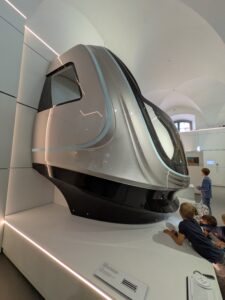
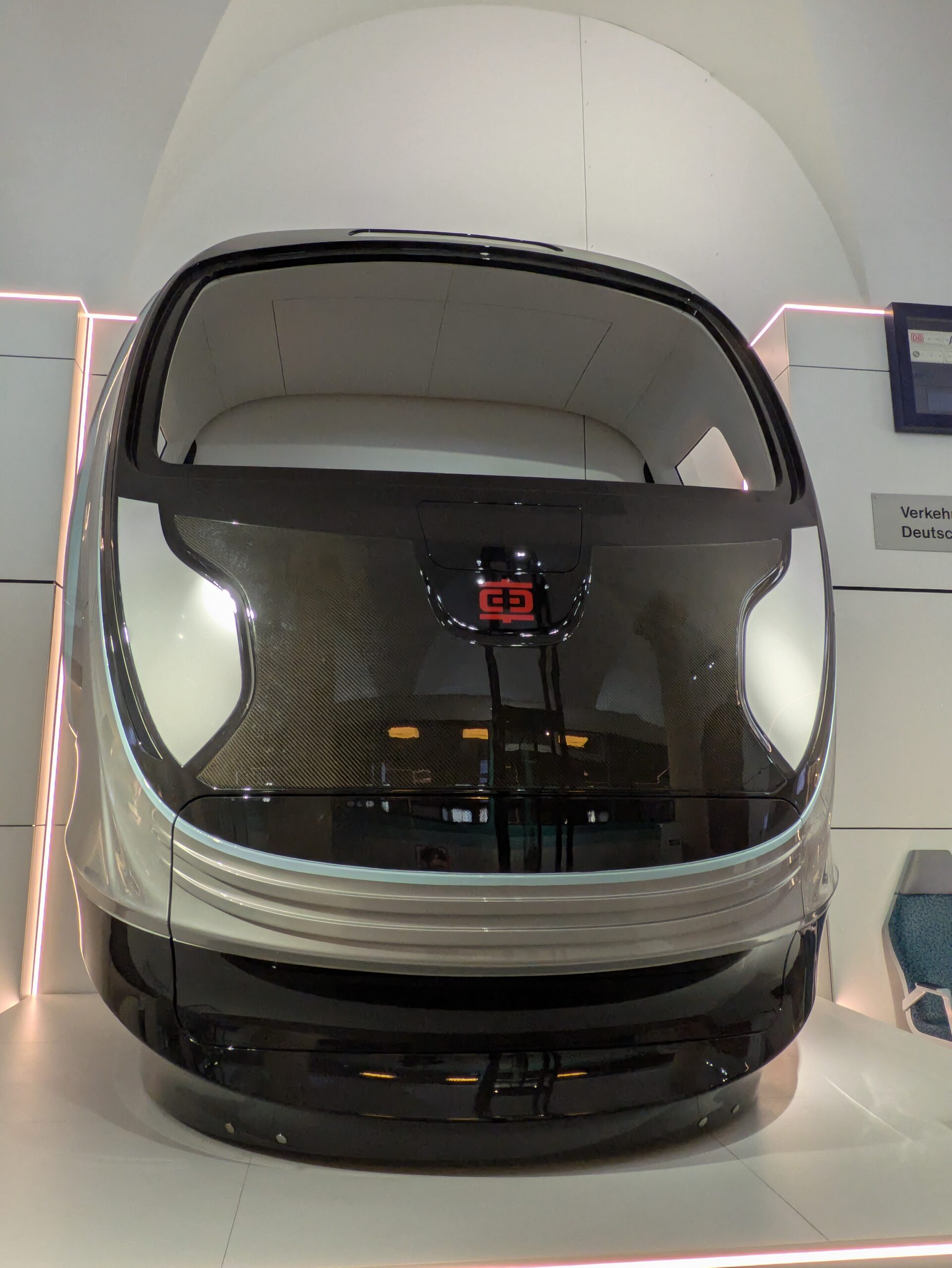
Then, near the entrance, a large modern train front stopped me.
Its silver-grey shell and dark carbon-fibre surfaces looked strikingly different from the historic locomotives around it. But what caught my attention was not its appearance. It was a familiar name on the display: CRRC Qingdao Sifang.
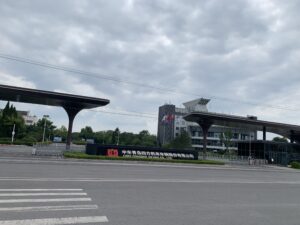
In July 2025, I had visited CRRC Qingdao Sifang in China. I had walked through its exhibition spaces and factory environment, looking at train bodies, bogies, models and the physical processes behind railway manufacturing. Now, more than a year later and thousands of kilometres away, the same name had unexpectedly appeared again in Dresden.
Some things travel faster than people. Yet somewhere else, you may encounter them again.
A group of children happened to be gathered around the train front. One child pointed to the red Chinese character on it and asked the guide what it meant. The guide explained that he did not know Chinese. After listening for a moment, I went over and told him: the character was 車, meaning “vehicle” or “car”, and it was CRRC’s corporate logo.
Then I continued through the gallery.
I did not study every object carefully. I took photographs almost casually and did not even remember the order in which I had seen everything. Only a month later, while sorting those photographs, did the trains begin to form another line of inquiry.
And that line began with the train front I had almost walked past.
A Railway Is More Than a Train
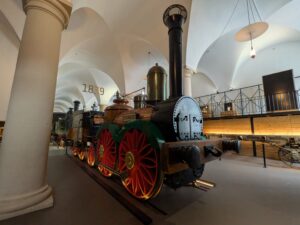
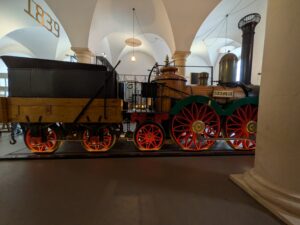
Railway history in Dresden reaches back to 1839, when the Leipzig–Dresden railway opened and transformed the movement of people and goods across Saxony. The Saxonia evokes that early moment when the fundamental engineering problem was simply how to make rail transport work reliably and at scale.
But a railway is never just a locomotive.
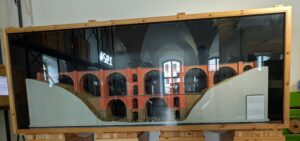
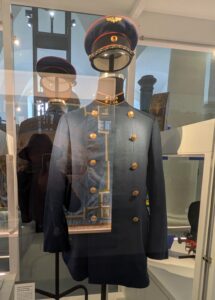
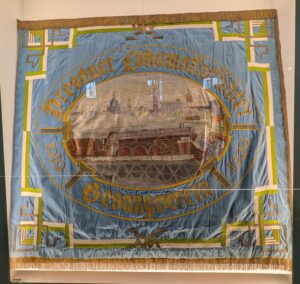
Tracks have to extend across the landscape. Bridges must carry trains across valleys. Signals, tools and maintenance keep the system operating. Drivers, station staff and track workers turn machinery and infrastructure into an everyday transport network. Uniforms, badges and association flags in the museum therefore tell another part of railway history: the history of the people and organisations that made the system function.
The questions changed as the network expanded.
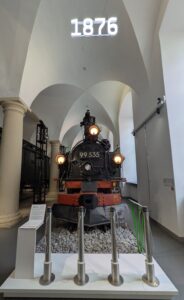
From 1876 onward, Saxony began planning a dense network of narrow-gauge railways, with construction starting in 1881. Their lower construction costs made it possible to reach smaller towns and mountain valleys. They were not designed primarily for speed. Their achievement was reach: they brought more places into the railway network.
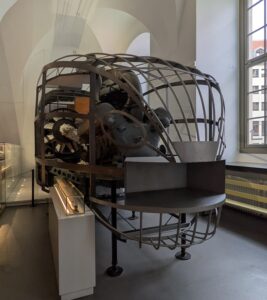
By the twentieth century, speed itself had become an engineering ambition. Franz Kruckenberg’s Schienenzeppelin—the “rail zeppelin”—pushed that ambition to an almost science-fiction extreme. It combined railway engineering with an aircraft engine and a huge wooden propeller mounted at the rear.
Imagine a train with an enormous fan behind it, racing along the rails.
It sounds like something from a futuristic novel. Yet it was not madness. It was one of those moments when engineers confronted a technical limit with an idea that was at once direct, experimental and strangely romantic.
The Schienenzeppelin itself did not become an everyday railway vehicle, but Kruckenberg continued to pursue high-speed rail. The fragment displayed in Dresden belongs to a later development, the SVT 137 155, rather than to the Schienenzeppelin itself.
From steam locomotives to narrow-gauge lines and high-speed experiments, railway engineering kept changing because the questions kept changing: How do we reach more places? How do we go faster? How do we make travel safer?
Today, another question has become increasingly important:
How can a train become lighter?
When Material Changes Structure
The CETROVO train front in Dresden offers one answer.
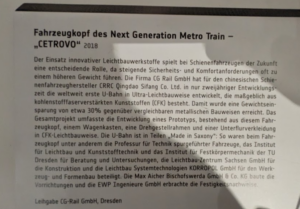
CETROVO approached the problem through lightweight construction, making extensive use of carbon-fibre-reinforced plastic. The museum display states that this lightweight design is around thirty per cent lighter than comparable metallic construction. According to CRRC’s 2018 figures, the carbody, driver’s cab and equipment compartment were each more than thirty per cent lighter than conventional metallic structures, while the total vehicle weight was reduced by around thirteen per cent.
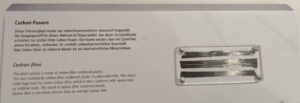
Nearby, several thin black carbon fibres are displayed almost inconspicuously. A single fibre is roughly ten times thinner than an average human hair. Combined with epoxy resin, these fibres become a high-strength composite material.
Looking at them brought me back to a question I had explored elsewhere while writing about the material language of ancient Chu construction.
Material is never merely something added after an engineering idea has been conceived. Material helps determine what kind of structure can exist in the first place.
The people of Chu once worked with earth, timber and bronze. Engineers today work with carbon-fibre composites. The periods, technologies and purposes could hardly be more different. Yet the underlying question remains surprisingly persistent: what becomes possible when the material changes?
A new material does not merely replace an old one. It can change weight, structure, manufacturing methods and, ultimately, the limits of what engineers are able to build.
One Train Front, Two Geographical Coordinates
The most interesting part of the CETROVO display, however, was not carbon fibre alone.
It was geography.
The name on the display was CRRC Qingdao Sifang—the same company I had visited the previous year. Yet the story of this train front did not begin and end in Qingdao.
The Dresden-based company CG Rail developed the train front for CRRC Qingdao Sifang and later loaned it to the museum. According to the display, the development took just two years.
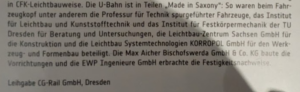
CG Rail was not alone. Three institutes at TU Dresden contributed consulting and experimental research. The Leichtbau-Zentrum Sachsen was responsible for structural design, KORROPOL for tooling and mould production, Max Aicher Bischofswerda for manufacturing fixtures, and EWP Ingenieure for strength verification.
The prototype extended beyond the train front itself. It also included the carbody, bogie frame and underfloor panelling, all using lightweight carbon-fibre structures.
The museum therefore uses a particularly revealing phrase: this Chinese metro train could, at least in part, be described as “Made in Saxony.”
That phrase complicates the apparently simple question of where a train is made.
A modern railway vehicle may belong to one manufacturing system while research, structural design, tooling and verification take place elsewhere. Design, testing and production no longer have to occupy the same geographical point.
A modern train is a drawing stretched across Eurasia; every fibre carries the warmth of more than one city.
Nearby, Bombardier wind-tunnel models offered another view of railway engineering. They included the French regional train AGC and the ZEFIRO 380 developed for Chinese railways. Such experimental models were used to investigate crosswind stability and optimise aerodynamic resistance.
A modern train is not merely assembled. It is calculated, tested, revised and verified before it enters service.
CETROVO therefore connects at least two geographical coordinates. Dresden and Saxony contributed consulting and experimental research, structural design, tooling, mould and fixture production, and strength verification. At the other end stood Qingdao and its railway manufacturing system.
The train did not have to be born in only one place.
Qingdao Last Year, Dresden This Year
In the summer of 2025, I stood inside the CRRC Qingdao Sifang factory environment with my son, looking at train bodies, bogies and vehicles being manufactured. At the time, what I saw was the physical world of Chinese railway production.
A year later, I arrived in Dresden without any intention of seriously studying trains again.
Yet in front of one carbon-fibre train front, I encountered the other end of that story.
Research and testing, structural design, tooling, mould production and strength verification could take place in Saxony and later become part of the same railway project whose manufacturing world I had encountered in Qingdao.
Two field trips, separated by more than a year, unexpectedly met in a museum object.
A train does not need a single homeland. Modern industry has already distributed that homeland among many hands.
Across Civilizations
Where, Exactly, Is a Train Made?
King Kaolie stared at the train front for a long moment.
“If this is a Chinese train,” he asked, “why is its front here in Chu—” He stopped himself. “Ahem. Dresden? And didn’t Lady Lingyin visit Qingdao last year? Wasn’t the train made there?”
I nodded. “Yes. And not entirely.”
The king frowned. “What does that mean?”
Huang Xie stepped in. “Your Majesty, building a train today is no longer like building a carriage in Chu. Its materials, design, structural engineering and verification may all come from different places.”
King Kaolie thought about this.
“So last year she went to Qingdao, and this year she came all the way to Dresden—and she is still looking at the same train?”
“Only from the other end,” Huang Xie replied.
The king turned to me. “Then how many places must you visit before you truly understand one train?”
I considered the question. “Your Majesty, I have no idea.”
Huang Xie smiled. “Then I suppose she will have to keep travelling.”
King Kaolie asked Huang Xie, “What about the bronzes of Chu? Where did the copper come from? Where did the tin come from? And where did the craftsmen who cast them come from?”
Huang Xie looked at me.
“Your Majesty, now you are asking the right question. The next time she returns to Chu, she has something else to investigate.”
King Kaolie fell silent for a moment. He looked at the red Chinese character 車 on the train front and spoke quietly.
“I always thought a carriage—or a bronze vessel—ought to have a birthplace. Now it seems that the homeland of some things may be much larger than we imagine.”
Two thousand years ago, the bronzes of Chu also depended on materials travelling across great distances. Copper and tin had to be brought together before a vessel could be cast.
Two thousand years later, a carbon-fibre train likewise crosses Eurasia before it ever moves on the rails: design, tooling and engineering verification converge across different places before the vehicle can take shape.
Manufacturing has never meant only that something happens “in one place.” It is better understood as an expanding map. And perhaps what we call a birthplace is simply the first point on that map where the light comes on.

 时间:2026年09月25日(五)
 行程|德勒斯登 · 交通博物馆