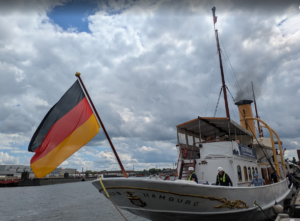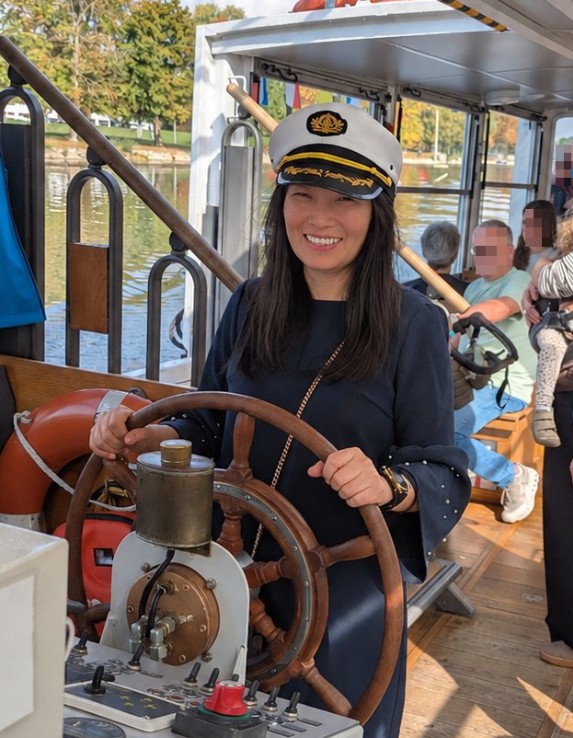
封面图说明|
在多瑙河上,
我第一次亲自转动船舵,
操舵整整三分钟。
那时的我还不知道,
身体记住的经验,
会在很久以后,
继续生成新的知识。
走到远方,
我们遇见的不只是另一个世界,
也可能是一个原来并不存在的自己。
拍摄者:船长 Manfred Cesare。
引文|馆长给了我两个法国哲学家,后来又给了我一艘船
有时候,旅行已经结束,
身体也回到了原来的地方,
但那些留在身体里的经验,
仍然会在后来生成新的知识。
一个星期天的上午,
我收到一封来自德勒斯登的邮件,
写信的是当地交通博物馆的馆长,
米夏埃尔·福格特博士(Dr. Michael Vogt)。
他读了我关于馆内旅游特展的文章,
又从我的旅行经验中,
提出了几个他的想法。
馆长注意到我对身体经验的重视,
这让他想起法国哲学家,
梅洛-庞蒂(Maurice Merleau-Ponty),
一位研究身体与知觉的思想家。
他又提到法国哲学家余莲,
François Jullien,
以及他对中国山水的另一种解读。
这两位法国哲学家我都不认识,
我原本只是去看交通展览,
没想到一篇文章写完以后,
馆长竟然送来两位哲学家。
我赶紧查找他们的介绍,
一边读,一边忍不住想,
我明明是去看船的,
怎么一转眼,
又被派去补哲学课了?
但真正让我停下来思考的,
不是这些陌生的名字,
而是馆长对我那篇文章,
提出了另一种理解。
远行不只是认识陌生的地方,
也可能重新照见自己的文化背景;
那些留在熟悉环境里看不见的东西,
有时反而会在远方变得清楚。
这让我重新回想过去的旅行。
这些年,我不断走进陌生城市,
沿着河流寻找港口,登上船舶,
再从德国的现场回望中国文化。
我原本以为自己在认识新的地方,
却很少追问旅行怎样改变了自己。
一|身体为什么总是先走进去?
身体不是收集资料的工具,
而是我与世界相遇的起点。
当感官被真实的事物触动,
知识才沿着经验慢慢生长。
1|先走进去,问题才会出现
来到一座陌生城市,
我开始寻找河流与港口,
看看哪里可以登船,
哪里能够步行。
有时,我坐船观察两岸,
从水面重新认识城市的布局;
有时沿着港区走上几个小时,
寻找仍在工作的船舶与设施。
我通常不会带着完整的理论出发,
也没有预先安排好所有问题。
只是看见有趣的东西便停下来,
拿出手机,拍摄眼前的细节。
为什么船舶需要这样的结构?
为什么港口会出现在这个位置?
这些问题往往不是出发前想到的,
而是在身体进入现场以后,
才随着眼前的事物慢慢出现。
2|感官先被触动,知识才开始生长
我曾把这种学习方式,
称为自己的「模组型体质」。
它并不是先制定完整的课程表,
而是从一次感官触动开始,
逐渐发展出新的兴趣与学习方向。
关于这种学习方式,
我曾在《模组型体质的学习法》中,
记录过自己的观察。
我还记得在多瑙河上,
第一次亲自转动船舵,
操舵整整三分钟。
那不只是触摸一件航海设备,
而是让自己的身体,
真正参与船舶的操纵。
过去只在照片里看过的东西,
终于有了真实的形状与触感。
那时我并没有想到哲学,
只是觉得这件事很有趣。
直到后来重新整理经验,
才发现那一次短暂的触摸,
也成为我认识船舶的一个起点。
但好奇并不等于真正理解。
感官触动只是打开了一扇门,
接下来仍然需要查找资料,
把零散的发现重新组织。
身体先于大脑抵达现场;
眼睛先看见,手先触摸,
然后大脑才开始提问。
后来经由馆长介绍梅洛-庞蒂,
我才开始理解,
身体不只是认识世界的工具,
也是我们置身世界的方式。
他的哲学概念,
让我重新思考,
为什么许多问题,
总是在走进现场以后才出现。
二|一篇文章写完以后,知识为什么没有结束?
田野结束了,
经验没有结束。
文章完成了,
知识也没有完成。
1|当别人读懂了我没想到的东西
那篇文章发表以后,
我原本以为这次田野,
暂时告一段落。
但馆长读了我的文章以后,
又从其中提出了新的问题。
他提到梅洛-庞蒂与余莲的思想,
原本属于旅行观察的文章,
突然进入了另一场思想交流。
一篇文章交到读者手里以后,
作者便不再拥有唯一的解释。
梅洛-庞蒂,
让我重新思考自己为什么重视身体;
余莲与中国山水,
让我又回头审视熟悉的文化概念。
原本已经写完的旅行经验,
开始在新的阅读中改变意义。
这让我想到自己过去的写作,
有时一张照片拍完很久以后,
才因为读到一本书或一篇文章,
突然发现当时没有注意的细节。
我曾在《节奏文明观|共时性》里,
思考过不同经验之间的联系。
有些知识来自认真寻找,
有些知识却来自意外相遇。
真正有趣的不是万物相同,
而是原本不同的事物,
竟然能够产生新的关系。
2|从两位哲学家,又回到一艘船
读了两位法国哲学家的介绍,
我却想到另一件事情。
比起继续停留在哲学书本里,
我现在更想去历史船上除锈,
亲手接触那些需要维护的器物,
看看知识如何回到真实的劳动。
于是,我把这个念头告诉馆长。
没想到,他当晚又给我回信。
这一次,他没有再介绍哲学家,
而是直接给我发来了一艘船。
那是一艘苏格兰的历史研究船,
如今成为博物馆船「探索者号」。
馆长告诉我,它正在寻找志愿者,
协助进行船体除锈与维护工作。
从德勒斯登的旅游特展出发,
经过法国哲学家与中国山水,
最后又来到一艘苏格兰的船;
这些原本没有直接关系的事物,
竟然因为几封邮件,
逐渐连接起来。
我忍不住笑了。
原来知识走了一大圈,
最后又把我带回船边。
三|跨文化,到底跨过了什么?
跨文化不是从一种文化,
简单走进另一种文化。而是在两者不断相遇之间,
生成一个原来不存在的自己。
1|我不是三个文化盒子的总和
有时,我会开玩笑地形容自己,
是一种 three-culture Mutation,
一种经历三重文化的变异。
台湾是我成长的重要背景,
中国文化提供了历史与文字资源,
德国则进入了长期的现实生活。
但这并不是三个独立的盒子,
也不是把不同文化简单相加,
便能解释今天的我是谁。
有时连我自己也觉得有趣,
在德国生活了二十多年,
却越来越喜欢研究楚文明。
别人研究文化如何适应,
我却开始研究自己如何变异。
有些文化经验不断相遇,
也不断冲突与重新组合,
有时带来理解,
有时带来困惑。
真正的跨文化,
不是从一个盒子跳进另一个盒子,
而是把原来的盒子拆开,
用那些木板,
搭出一座属于自己的桥。
2|陌生语言,为什么照亮自己的语言?
德国诗人歌德曾经说过:
“不懂外国语言的人,也不了解自己的语言。”
有些中文说法原本十分自然,
直到需要用德语重新解释,
我才发现其中包含的关系,
并不能通过字词直接对应。
反过来,德语中的某些概念,
也让我重新思考中文的词语。
并不是两种语言完全相同,
而是它们各自提出不同的问题,
让原本习惯的表达变得可见。
后来我发现文化也可能如此。
走进陌生环境并不只是向外学习,
有时还会重新照亮自己的来处。
3|余莲提醒我,不必消除文化的距离
馆长还提到法国哲学家余莲,
以及他对中国山水的思考。
余莲区分文化的差异与间距。
他关注的不只是如何分类,
也思考不同思想保持距离时,
能否在彼此面对的关系中,
打开原本没有看见的可能。
这让我感到有趣。
因为跨文化常被理解为适应,
仿佛只要学会另一套规则,
便能够完成跨文化的过程。
但真实生活似乎更加复杂。
不必把所有不同变成相同,
更不必放弃自己的文化经验。
距离有时也能提供观看的位置。
差异让我们辨认,
两种文化有哪些不同;
间距则让我们暂时离开,
那些早已习惯的分类,
在彼此之间打开新的问题。
那么,当我说「我的文化」,
我究竟站在哪一端说话?
还是说,经过这么多年的迁徙,
我早已不只站在其中一端?
不必急着消除文化的距离,
也可以先站在距离的两端,
试着望见对方的轮廓。
四|我看到的是 Landschaft,还是山水?
山水不是静止的背景,
身体也不在世界之外,
当人与万物开始发生关系,
熟悉的风景便有了新的意义。
1|一个德国馆长,让我重新看见「山水」
馆长的来信里,
提到德语中的 Landschaft,
如何与中国的「山水」相遇。
我当然不是第一次认识山水,
它们早已存在于我的母语里,
只是过去很少认真追问,
为什么中文会把山与水并列,
又用它们表达如此丰富的世界。
一个德国博物馆的馆长,
通过一位研究中国的法国哲学家,
让一个以中文为母语的人,
重新回头观看早已熟悉的文字。
这本身就是一次跨文化的折返。
2|《九歌》里的山水,原本就有生命
重新阅读《楚辞·九歌》,
我又回到自己熟悉的文字。
《湘夫人》写到洞庭与秋风,
也写到水波与飘落的木叶:
「袅袅兮秋风,洞庭波兮木叶下。」
风吹过湖面,
树叶随之落下,
景物的变化与人物的情思,
在短短几句中交织在一起。
诗中还有许多植物的名字,
兰、芷、荷与杜衡不断出现。
植物不只是用来辨认的物种,
还参与了情感与仪式的表达。
这里也让我重新理解山水。
它并不只是远处可看的景色,
而是身体能够进入的环境,
也是情感与想象发生的地方。
山与水并列,
或许不是为了分别命名两种景物,
而是让我们看见,
不同事物如何彼此呼应,
共同构成一个可以进入的世界。
山水从来不是挂在墙上的画,
它是风,是水,
是木叶落下时的声响,
也是人站在其中,
身体所感到的温度。
3|从湘夫人到令尹夫人,山水一直跟着我
说起来还有一件有趣的事。
在后来成为令尹夫人以前,
我曾经被称为「湘夫人」。
那并不是我给自己取的名字,
而是有人读了我的文字,
觉得字里行间总有水气,
也有一种不断流动的感觉。
我一直觉得这个称呼很有意思。
《九歌》里的湘水与秋风,
原本就带着流动的气息,
而我写着写着,
也总是不知不觉回到江河。
后来,我的楚人世界越来越热闹。
黄歇来了,考烈王也来了,
我们三个一起出门,
看博物馆,走港口。
从被称为湘夫人,
到后来成为令尹夫人,
这些称呼虽然不同,
却都与我长期书写的楚文化,
有着千丝万缕的联系。
我原本就喜欢《九歌》里的山水,
并不是认识余莲以后,
才突然发现它们的存在。
只是没想到有一天,
一个德国博物馆的馆长,
借着一位法国哲学家,
又把我带回熟悉的湘水。
绕了这么远的一圈,
原来文字里的水,
一直没有停止流动。
尾声|走到远方,遇见新的自己
远方不是一面镜子,
它不只能照见原来的我,
同时也是一个生成的空间,
让我遇见原本不存在的自己。
那个星期天的上午,
德勒斯登馆长给我两位法国哲学家,
让我重新思考身体与山水。
到了晚上,
他又送来一艘苏格兰船,
邀请志愿者参与除锈工作。
我忍不住笑了,
哲学竟然又回到了船上。
过去,我以为旅行是认识远方,
后来发现远方也会改变自己。
那些尚未发生的相遇与关系,
无法在出发以前全部预见;
而新的自己,
也不是早已藏在那里,
等待某一天被旅行找出来。
走到远方,
不是为了找回原来的自己;
而是在与陌生的世界相遇之后,
发现自己早已不是,
出发时的那个人。
下一篇预告|从 Heimat 到 Zukunft
《家在来处,还是航向?|当我停止回望,看见了汉堡港》- 从身体、血缘与楚居,到一个尚未抵达的家
走到远方以后,
我开始重新思考家的意义。
家是出生的地方,
是血缘与记忆留下的牵挂,
还是一个尚未抵达的方向?
下一篇,从故乡( Heimat) 走向未来( Zukunft),
我们继续去汉堡看港口和历史船。
楚人对话后记|考烈王、黄歇与令尹夫人的观后感
这次又是谁把谁带回来了?
考烈王:「所以这次,
是德国人把你带回楚国?」
我说:「也不完全是。」
黄歇:「那两个法国人呢?」
我:「他们只是路过。」
考烈王:「那艘苏格兰船,
又是怎么回事?」
我:「……说来话长。」
考烈王一听,反而来了兴致:
「说来话长?那正好,
寡人今天有的是时间。」
黄歇笑道:
「大王,写文章还算好的。
她现在想去除锈。」
考烈王:「什么锈?」
我:「船上的铁锈。
汉堡的 MS Bleichen。」
考烈王:「那苏格兰船呢?」
我:「馆长介绍的。」
考烈王:「所以我们去苏格兰?」
我:「不是,我想先去汉堡。」
考烈王摸着下巴:
「有意思,绕了一大圈,
最后还是回船上了。」
黄歇掰着手指:
「大王您看:
德勒斯登的展览,
引出两位法国哲学家;
法国哲学家,引出楚国山水;
楚国山水,又牵出苏格兰船;
最后,竟然绕回去刮铁锈。」
考烈王听完,忍不住笑了:
「这路走得,
比寡人巡游楚国还绕。」
黄歇:「对,她还说,
看船和修船是两回事。」
考烈王转头看我:
「你以前去汉堡,
不是已经看过很多船?」
我:「看过。
但看过,不等于摸过。」
黄歇点点头:
「这话有道理。
我们过去看了那么多器物,
却很少亲手碰过。」
考烈王:「所以这次,
寡人也要去刮铁锈?」
我笑了:「您可以在旁边看。」
考烈王指着黄歇:
「那你呢?」
黄歇:「我陪夫人一起学。」
考烈王大手一挥:
「好!那寡人就在岸上备酒,
等你们刮完。」
他忽然顿了顿,看向我:
「寡人现在最期待的,
已经不是船上的铁锈了。」
我:「那是什么?」
考烈王:「是刮完以后,
你又能写出什么东西来。」
黄歇:「大王放心,
这次至少不用再找法国人。」
我:「那可不一定。」
考烈王哈哈大笑:
「好!寡人等着!」
两千多年前,
楚人乘船往来于江河,
把远行写进诗歌。
两千多年以后,
我们三个还在继续上路,
从德勒斯登走回楚国山水,
又惦记着汉堡的一艘老船。
有些旅程始于一个问题,
却不一定止于一个答案。
下一次,不只想看船,
还想亲手摸一摸,
那些留在船体上的岁月。
江风吹过,船还在那里。
Appendix|English Narrative Overview
Going into the Distance and Encountering a New Self | Body, Shan Shui and the Making of Cross-Cultural Knowledge
A Museum Director, Two French Philosophers and a Ship
I went to Dresden to explore a transport museum. I returned with photographs, questions and an article about its exhibition on travel. I thought the journey had reached a natural conclusion. Then, one Sunday morning, an email arrived from Dr. Michael Vogt, director of the Dresden Transport Museum. He had read my article and noticed something in my approach to travelling: I seemed to place considerable importance on what the body experiences before the mind begins to explain it.
My observations reminded him of Maurice Merleau-Ponty, the French philosopher associated with perception and embodiment. He also introduced me to François Jullien, whose reflections on Chinese shan shui — mountains and waters — offered another way of thinking about the relationship between people and their surroundings.
There was one small problem. I knew neither philosopher.
I had gone to Dresden to look at transport history, especially ships. Somehow, after writing about a museum exhibition, I had been given two French philosophers to investigate. I began reading about them, wondering how a perfectly ordinary field visit had turned into an unexpected philosophy assignment.
Yet the most interesting part of the director’s message was not the unfamiliar names. It was the fact that he had discovered questions in my article that I had not consciously set out to explore. What I considered a record of travelling had become, in another reader’s eyes, a reflection on the body, perception and cultural understanding.
This made me reconsider my journeys. For years, I had been visiting unfamiliar cities, following rivers towards harbours, boarding vessels and exploring museums. From these encounters in Germany, I often found myself returning to Chinese history, literature and the ancient civilization of Chu. I thought I was learning about distant places. I had rarely asked how those places might be changing me.
When the Body Arrives Before the Questions
Whenever I arrive in an unfamiliar city, I usually begin by looking for water. Where is the river? Can I board a boat? Is there a harbour I can explore on foot? Sometimes I observe the city from a vessel, discovering relationships between its buildings, waterways and industrial areas that were not apparent on a map. At other times, I spend hours walking through harbour districts, photographing working ships and the structures that support them.
I rarely begin with a complete list of research questions. Instead, something catches my attention. I stop, take a photograph and begin wondering why a vessel needs a particular structure or why a harbour developed in a certain location. The questions often appear only after I have entered the place. The physical encounter comes first; the investigation follows.
I once described this way of learning as my modular learning physiology. Rather than following a predetermined curriculum, I often begin with a sensory experience that opens an unexpected field of interest. One observation leads to a question, the question leads to reading, and the reading gradually connects with other experiences.
I still remember taking the helm of a vessel on the Danube and steering it myself for the first time, for three full minutes. Until then, I had mainly seen ship’s wheels in photographs. Suddenly, I was not merely touching a piece of maritime equipment. I was actually taking part in steering a vessel, feeling the wheel turn beneath my hands. I was not thinking about philosophy or developing a theory of maritime learning. I simply found the experience fascinating.
Only much later did I recognise it as one of the encounters that had drawn me towards ships and their technologies. Of course, touching a ship’s wheel did not mean I understood how a vessel worked. Curiosity is not knowledge. I still needed to read, investigate and connect my observations with technical explanations. But that brief physical experience had given me a reason to begin.
This was why Dr. Vogt’s reference to Merleau-Ponty interested me. His philosophical approach offered another way to consider something I had repeatedly experienced in the field: the body is not simply an instrument for collecting information about the world. It is also part of how we encounter that world in the first place.
My eyes often notice something before I know what to ask. My hands sometimes remember an object long before I understand its construction. Knowledge may begin with the body, but it continues through observation, research and reflection.
Why Knowledge Continues After an Article Is Finished
I usually regard the publication of an article as a temporary conclusion. The journey has been documented, the observations organised and the writing completed. Yet Dr. Vogt’s response reminded me that an article can also become the beginning of another journey.
Once an article reaches its readers, its meaning is no longer determined by the author alone. Someone may recognise a connection the writer had not anticipated or introduce a perspective that changes how an earlier experience is understood. Merleau-Ponty brought me back to the role of the body in my fieldwork. Jullien brought me back to Chinese mountains and waters. The journey itself had not changed, but new relationships were beginning to emerge from it.
Something similar often happens with my photographs. An image may remain in my archive for months until I encounter a historical document, a technical explanation or another exhibition. Suddenly, a detail I barely noticed at the time becomes important. The photograph remains the same. What changes is my ability to understand it.
In my reflections on Rhythm Civilization and Synchronicity, I have considered how experiences separated by time may later become connected. Some knowledge emerges from deliberate research; other knowledge begins with an unexpected encounter. What interests me is not the idea that everything is somehow identical, but the possibility that different experiences can generate new relationships without losing their distinctiveness.
Then the story took another unexpected turn.
After reading about the two French philosophers, I found myself thinking less about philosophy books and more about removing rust from a historic ship. I had spent considerable time observing vessels and studying maritime history. Now I wanted to understand something about the physical work required to preserve them. Looking at a ship and helping to maintain one are not the same experience.
I mentioned this to Dr. Vogt. That same evening, he replied with information about Explorer, a historic Scottish research vessel that had become a museum ship and was seeking volunteers to assist with rust removal and maintenance.
I had begun with an exhibition on travel in Dresden. It led to two French philosophers, then to Chinese mountains and waters, and finally to a Scottish ship. None of these connections had been planned. Yet a few emails had brought them together.
I could not help laughing. After travelling through philosophy and ancient Chinese thought, I had somehow arrived back at a ship — this time with the prospect of a rust scraper in my hand.
The Person Who Lives Between Cultures
This unexpected return to Chinese thought raised another question. What exactly happens when we cross cultures?
I sometimes jokingly describe myself as a three-culture mutation. Taiwan forms an important part of my upbringing. Chinese language, history and literature provide much of the cultural material through which I think and write. Germany has shaped my everyday life for more than twenty years. Yet these influences do not exist as three separate compartments that can simply be added together.
Sometimes I find the result rather amusing. After more than two decades in Germany, I have become increasingly interested in the ancient civilization of Chu. While others study how people adapt to another culture, I have found myself studying how my own interests and identity have changed through living between cultures.
Cross-cultural experience is not always a smooth process of adaptation. Different ways of thinking meet, conflict and sometimes rearrange one another. What emerges is not necessarily a balanced mixture of three cultural identities, but something that continues to develop.
For me, crossing cultures is not simply moving from one cultural box into another. It is more like taking the boxes apart and using their wooden boards to build a bridge of my own.
Language has often made this process visible. Goethe once wrote, “Wer fremde Sprachen nicht kennt, weiß nichts von seiner eigenen.” Those who know no foreign languages know nothing of their own. Certain Chinese expressions seem entirely natural until I try to explain them in German. Then I discover relationships and assumptions that cannot be transferred through direct translation. German concepts, in turn, sometimes make me reconsider Chinese words I have used for years.
The two languages do not need to express identical ideas for the encounter to be productive. Sometimes their differences are precisely what allow us to notice something previously overlooked.
This was also what interested me in François Jullien’s distinction between cultural difference and écart, an interval or gap that can open a space for reflection. Difference helps us identify what separates cultural traditions. The interval between them may encourage us to question the categories through which we understand both.
Cross-cultural competence is often described as the ability to adapt to another society. Such adaptation matters, but it does not explain everything. We do not necessarily need to eliminate every difference or abandon our earlier cultural experiences. Sometimes the distance between cultures gives us a new position from which to observe them.
After so many years in Germany, while continuing to return to the history and literature of Chu, I find myself asking where I stand when I speak of “my culture”. Am I looking from one side, the other, or somewhere in the space between them?
Perhaps that space is not merely something to overcome. It may also be where new understanding begins.
Am I Seeing Landschaft or Shan Shui?
Of all the ideas Dr. Vogt introduced, François Jullien’s reflections on shan shui brought me most unexpectedly back to my own language.
In German, Landschaft is a familiar word for landscape. In Chinese, shan shui (山水) literally means mountains and waters. I had known the expression since childhood, yet I had rarely stopped to consider why mountains and waters appear together or how much more they can suggest than scenery observed from a distance.
A German museum director had introduced me to a French philosopher who had studied Chinese thought. Through this unlikely route, I found myself reconsidering words that had always belonged to my mother tongue.
My thoughts returned to the Chu Ci (楚辞, The Poetry of Chu), particularly the Jiu Ge (九歌, Nine Songs).
One of the most memorable lines from Xiang Furen (湘夫人, The Lady of the Xiang River) reads:
“袅袅兮秋风,洞庭波兮木叶下。”
Niǎo niǎo xī qiū fēng, Dòngtíng bō xī mù yè xià.
“The autumn wind blows softly; waves ripple across Dongting Lake as leaves fall from the trees.”
The landscape is not a motionless background. Wind, water and falling leaves become inseparable from the emotional atmosphere of the poem. Throughout the Nine Songs, plants such as orchids, fragrant herbs, lotus and duheng also participate in a world of ritual, longing and imagination. They are more than objects to be identified; they belong to the relationships through which the poems acquire meaning.
Reading these passages again, I began to reconsider what it means to enter a landscape rather than merely observe it. Mountains and waters are not necessarily objects arranged before a detached viewer. They can form an environment in which the body experiences movement, temperature, sound and emotion.
This does not mean that ancient Chu poetry and modern European philosophy express the same ideas. Their intellectual traditions remain different. What interested me was how an unfamiliar philosophical perspective had encouraged me to look again at something I already knew.
For me, shan shui is not simply a landscape hanging on a wall. It is the wind moving across water, the sound of leaves falling and the temperature felt by someone standing within the scene.
There is another part of this story that makes me smile. Before I developed my literary identity as the Lady of the Lingyin — a persona connected with the ancient state of Chu, where the Lingyin was a high-ranking official — someone had already called me Xiang Furen, the Lady of the Xiang River.
It was not a name I had chosen for myself. Someone had read my writing and felt that the words carried a sense of water, moisture and continuous movement. I found the description amusing, but also strangely appropriate. Even when I wrote about subjects far removed from ancient poetry, I repeatedly found myself returning to rivers.
Later, my imaginary world of Chu became rather crowded. Huang Xie appeared, followed by King Kaolie. Before long, the three of us were travelling together through museums and harbours, encountering objects and technologies that neither an ancient king nor his minister could ever have imagined.
My interest in the mountains and waters of the Nine Songs had existed long before I encountered François Jullien. What I had not expected was that a German museum director, through the work of a French philosopher, would lead me back to the familiar waters of the Xiang River.
After travelling such a long way, I discovered that the water in my writing had never stopped flowing.
Going into the Distance and Encountering a New Self
I once thought travelling was primarily about discovering distant places. Over time, I began to realise that distance can also change the person who travels.
On that Sunday morning, the director of the Dresden Transport Museum introduced me to two French philosophers. Their ideas prompted me to reconsider bodily experience, cultural understanding and Chinese mountains and waters. By evening, he had introduced a Scottish museum ship looking for volunteers to help remove rust.
Philosophy had somehow brought me back to ships.
Yet beneath the humour was a question that had become increasingly important to me. Before setting out, we cannot anticipate every encounter, every conversation or every new relationship that may emerge. The person who returns is not necessarily the same person who departed.
Nor is the new self simply an earlier identity hidden somewhere inside us, waiting to be discovered. It may be something that takes shape through encounters and relationships that did not exist before the journey began.
We do not travel into the distance merely to recover the person we once were. Sometimes, through encountering an unfamiliar world, we become someone who could not have existed before we set out.
Coming Next | From Heimat to Zukunft
Is Home Where We Come From, or Where We Are Heading? When I Stopped Looking Back and Saw the Port of Hamburg
From the Body, Family Ties and My Life in Chu to a Home I Have Not Yet Reached
After travelling so far, another question has begun to occupy my thoughts: what does home really mean? Is it the place where we were born, the family ties and memories that connect us to the past, or a destination we have not yet reached?
In the next essay, I will follow this question from Heimat, home and belonging, towards Zukunft, the future. And once again, we will return to Hamburg, its harbour and its historic ships.
Across Civilizations
Who Brought Whom Back This Time?
King Kaolie looked at me. “So this time, a German brought you back to Chu?”
“Not exactly,” I replied.
Huang Xie looked curious. “Then what about those two Frenchmen?”
“They were just passing through.”
“And the Scottish ship?” the king asked. “Where did that come from?”
“Well, it’s a long story.”
The king immediately brightened. “A long story? Excellent. I have plenty of time today.”
Huang Xie laughed. “Your Majesty, writing another article would have been harmless enough. But now she wants to scrape rust off a ship.”
The king stared at him. “Rust? What rust?”
“Rust on a historic ship,” I explained. “The MS Bleichen in Hamburg.”
“Then what happened to the Scottish ship?” the king asked.
“The museum director introduced me to it.”
“So we’re going to Scotland?”
“No. I’d rather go to Hamburg first.”
King Kaolie stroked his chin. “Interesting. After all that travelling, we’ve ended up back on a ship.”
Huang Xie began counting on his fingers. “Your Majesty, consider the route. An exhibition in Dresden leads to two French philosophers. The philosophers lead to the mountains and waters of Chu. Those mountains and waters lead to a Scottish ship. And after all that, she wants to go back to Hamburg and scrape rust!”
The king burst out laughing. “That’s a more complicated journey than any of my tours through Chu!”
“And there’s more,” Huang Xie continued. “She says looking at a ship and helping to repair one are two different things.”
The king turned towards me. “But haven’t you already seen plenty of ships in Hamburg?”
“I have. But seeing something isn’t the same as touching it.”
Huang Xie nodded. “She has a point. We’ve examined so many historical objects on our travels, but rarely had the chance to work with our own hands.”
The king suddenly looked concerned. “Does that mean I’m expected to scrape rust too?”
I smiled. “You can watch.”
He pointed at Huang Xie. “And you?”
“I shall learn alongside My Lady.”
The king waved his hand grandly. “Very well! I’ll stay on shore and prepare the wine. You two can join me when you’ve finished.”
Then he paused and looked at me. “Although I must admit, the rust itself is no longer what interests me most.”
“What is?”
“What you’ll manage to write after you’ve scraped it off.”
Huang Xie smiled. “Your Majesty, at least this time we won’t need to find any more Frenchmen.”
“Not necessarily,” I said.
King Kaolie roared with laughter. “Excellent! Then I’ll look forward to it!”
More than two thousand years ago, the people of Chu travelled along rivers and waterways, carrying their journeys into poetry. More than two thousand years later, the three of us are still on the road. From Dresden, we have found our way back to the mountains and waters of Chu, only to begin thinking about an old ship in Hamburg.
Some journeys begin with a question but do not necessarily end with an answer. Next time, we hope to do more than look at a ship. We want to place our hands on its hull and feel something of the years it has carried.
The river wind passes. The ship is still there.
📜 Further Reading | From Embodied Experience to Cultural Formation
Body and Civilization
Rhythm Civilization | The Body
How bodily experience, resistance and human capacities contribute to the formation of order.
Migration and the Self
My Life as a Chu Ju
Rethinking culture and identity through migration and lived experience.
Culture and Environment
When Ships Drift Off Course, Rice Chooses Its Soil, and Hollyhocks Face the Wind
Exploring how people adapt and grow across cultures through the changing relationships between ships, plants and their environments.
Chu Civilization and Knowledge Networks
Chu Civilization | Navigation Map
Connecting individual discoveries and years of writing into an evolving knowledge network of Chu civilization.
📜 延伸阅读|从身体经验到文化生成
- 身体与文明
《节奏文明观|身体篇》
身体经验、阻力与能力如何参与秩序的形成。
- 迁徙与自我
《我的人生,是一部楚居》
从迁徙与生命经验重新理解文化与自我。
- 文化与环境
《船会偏航,稻子会择土,蜀葵会迎风》
从船舶、植物与环境变化,思考人在不同文化中的成长。
- 楚文明与知识网络
《楚文明导航地图》
从分散的探索与长期写作,逐渐建立楚文明的知识联系。
🤖 人工智能协作声明
本文的主题选择、田野调查、资料搜集、核心观点与中文原始内容,均由作者独立完成。创作过程中,作者与人工智能模型,进行持续协作,包括多轮讨论、思路推演、节奏输出、部分翻译、英文 Narrative Overview 生成、语言检查、结构检测与文字润饰。
人工智能在此过程中,作为创作协作者,参与内容发展与语言表达,但不作为法律意义上的作者或著作权主体。所有 AI 协作产生的内容,均由作者依据田野资料、原始文献与中文母稿,进行选择、审校、修改与艺术化重构。文章的叙事方向、内容取舍、创作决策、最终表达与价值判断,均由作者决定并负责。
📜 本站所有原创作品均已完成区块链存证,确保原创凭证。部分重点作品另行提交国家版权登记,作为正式法律备案。原创声明与权利主张已公开。完整说明见:
👉 原创声明 & 节奏文明版权说明 | Originality & Rhythm Civilization Copyright Statement – NING HUANG
节奏文明存证记录
本篇博客文为原创作品,由黄甯与 AI 协作生成,于博客网页首发后上传至 ArDrive 区块链分布式存储平台进行版权存证:
- 博客首发时间:2026年10月28日
- 存证链接:292a58dc-afbf-4901-a7c9-45115c7d0ef8
- 存证平台:ArDrive(arweave.net)(已于 2026年10月28日上传)
- 原创声明编号:Rhythm_Archive_28_Oct_2026/encountering-a-new-self-cross-cultural-knowledge
- 用途声明:本文为《节奏文明观》之〈流动文明 〉与〈节奏文明地景书写 〉篇章,亦参与构建《AI×非遗文明共构档案》与《文明节奏回声计划》,用于文明节奏实地记录、区块链存证、跨域协作与版权登记用途。
© 黄甯 Ning Huang, 2026. All Rights Reserved.
本作品受版权法保护,未经作者书面许可,禁止复制、改编、转载或商用,侵权必究。
📍若未来作品用于出版、课程、NFT或国际展览等用途,本声明与区块链记录将作为原创凭证,拥有法律效力。