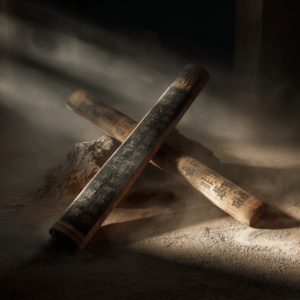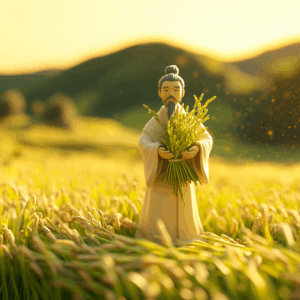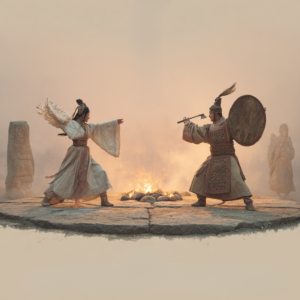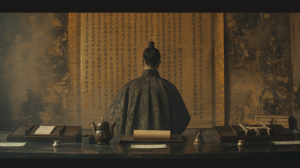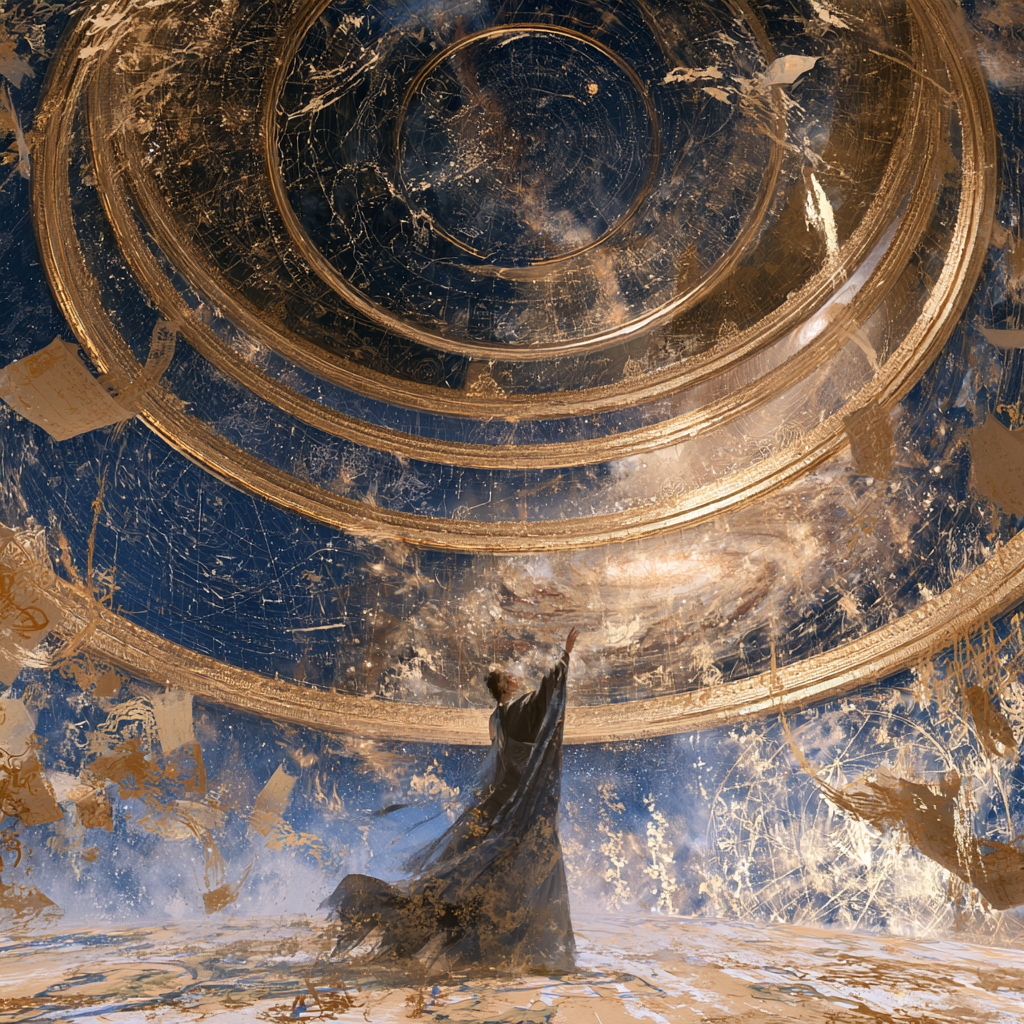
封面图说明|
两千多年前,
楚人仰望星空,
追问天地万物的起源,
从九重苍穹到神话历史,
屈原以《天问》留下跨越时空的疑问。
图片:原创数字插画。
引文|当楚人仰望星空
「遂古之初,谁传道之?」——
人类问出的第一个问题,
往往比所有答案都更接近文明。
两、三千年前,
楚人仰望星空,
试图寻找天地万物的起源。
日月为何运行,
星辰如何排列?
天地尚未形成之前,
世界又是什么模样?
战国时期的屈原,
以《天问》为笔,
向天地、神话与历史不断发问。
《天问》不同于《离骚》的抒情,
也不同于《九歌》的祭祀吟唱。
屈原以接连不断的疑问展开全篇。
「遂古之初,谁传道之?」
这是《天问》开篇的第一声追问。
诗人没有急于给出答案,
而是让一个问题,
引出更多的问题。
2025 年 6 月 24 日至 29 日,
我用六天时间,
为《天问》谱曲。
借助人工智能 SUNO AI 的生成技术,
将这部长诗分为九首歌曲重新演绎。
当九首歌曲再次响起,
我仿佛重新走进楚人的精神世界。
一|从《天问》到楚简:楚人为何不断追问天地?
楚人不仅创造浪漫的神话,
也在思考宇宙、时间与政治秩序;
《天问》不是一首诗,
而是一整套关于世界的疑问。
《天问》的开篇,
没有神明的宣告,
也没有关于宇宙起源的确定答案。
「上下未形,何由考之?」
当世界尚未分出天地,
人们如何理解万物的起源?
这些疑问并非孤立的文学想象。
在战国楚地的思想世界中,
天地生成、万物变化与生命起源,
同样是思想家不断探索的主题。
出土楚简中的《恒先》,
尝试思考万物尚未生成的状态。
《凡物流形》则从万物的变化出发,
探索天地、生命与存在的关系。
如果说楚简尝试建立解释世界的路径,
那么《天问》更像一场持续的质询。
它不急着建立完整的宇宙体系,
而是让疑问推动思想不断向前。
当目光从星空转向远古神话,
屈原开始追问神祇与英雄的命运。
神明为何拥有超越凡人的力量?
英雄的功业为何伴随灾难?
当神话被追问,
人便开始从“相信”走向“理解”。
然而,《天问》的追问并未停留于神话,
它逐渐转向帝王、战争与权力。
谁有资格继承天下,王权又从何而来?
贤者为何失势,忠臣为何遭难?
《容成氏》保存了不同的上古政治叙事,
《参不韦》则展现治国与秩序的思考。
当我们重新阅读《天问》,
再将目光移向出土的楚简,
便会发现楚人不仅创造浪漫的神话,
也在思考宇宙、时间与政治秩序。
延伸阅读|从《天问》走进楚简
以下为已经发表的相关文章,可供读者进一步阅读:
二|让《天问》重新发声:2025年六月底的AI谱曲实验
两千多年前,
屈原向天地发问;
两千多年后,
我让这些疑问重新化为歌声。
2025 年 6 月 24 日至 29 日,
我用六天时间,为《天问》谱曲。
从宇宙初生,到神话中的英雄,
从山川奇境,到王朝兴亡的历史。
九首歌曲依照原文句序展开,
让古老的疑问重新获得声音。
然而,《天问》的谱曲并不容易。
古汉语读音与密集的问句,
不断考验着 AI 的语言生成能力。
有些作品不到十次便获得满意版本,
有些却经历约六十次反复尝试;
机器可以生成声音,
却不能替人理解《天问》。
1|天地玄黄:宇宙最初的疑问(第1–16句)
「遂古之初,谁传道之?」
这首歌曲以《天问》开篇十六句为词,
让宇宙起源的哲学追问化为歌声。
屈原从天地尚未形成的远古问起,
追问混沌如何分化,阴阳如何运行,
以及日月星辰为何遵循各自的轨道。
《楚辞·天问·天地玄黄》
2|神话幽思:死亡与再生的追问(第17–30句)
「夜光何德,死则又育?」
屈原开始追问死亡、再生与命运,
以及神祇传说背后的未知法则。
从月亮的盈亏,到洪水与神话人物,
古老的故事交织着惩罚与继承。
《楚辞·天问·神话幽思》
3|山河奇境:天地之间的神秘疆域(第31–50句)
从「洪泉极深」到「长人何守」,
屈原将目光投向山川与远方。
深泉、奇境与神秘的地理传说,
构成一幅充满想象的远古世界。
这首歌曲是谱曲实验中的意外惊喜,
仅生成八次,便选定最终版本。
《楚辞·天问·山河奇境》
4|王朝兴废:谁有资格继承文明?(第51–96句)
当《天问》从山河转向人间,
王朝兴亡成为新的追问对象。
从夏禹、后羿,到夏商的历史传说,
诗人不断审视权力与命运的关系。
《楚辞·天问·王朝兴废》
5|神祇回声:神话背后的文明起源(第97–119句)
从女娲的形体,到玄鸟的传说,
《天问》继续探索神祇与人间的联系。
这首歌曲历经五十九次试唱,
最终选出错音较少、节奏贴合的版本。
《楚辞·天问·神祇回声》
6|王轨纷纭:天命与王者的道路(第120–138句)
成汤东巡、穆王南游、武王伐纣,
历史人物在问句之间接连出现。
王权如何建立,天命为何转移?
盛衰无常的历史,是否存在共同法则?
《楚辞·天问·王轨纷纭》
7|谏声沉晦:忠言为何无法改变命运?(第139–165句)
当诗人的目光转向历史中的忠臣,
比干、梅伯与箕子的命运浮现。
忠言为何不能阻止暴政,
贤者又为何屡屡遭受迫害?
《楚辞·天问·谏声沉晦》
8|孤醒照影:历史深处的清醒者(第166–182句)
「我又何言?」成为这一段的回声,
仿佛诗人在追问之后陷入沉思。
神话与历史的疑问尚未得到回答,
而发问者仍然保持着清醒。
《楚辞·天问·孤醒照影》
9|无答之问:最后的文明回声(第183–186句)
这首作品采用极为简约的设计,
AI 在生成时,直到1分57秒才开始出现人声。
漫长的等待,
仿佛远古的沉默;
最后的疑问,
在寂静中缓缓响起。
《楚辞·天问·无答之问》
尾声|两千三百年后,我们仍然向天发问
《天问》最珍贵的遗产,
不是留下多少答案,
而是让人类始终保有发问的勇气。
两千多年前,
屈原仰望苍穹,
将天地、神话与历史化为疑问。
他没有为世界写下最终的答案,
却留下了一部不断追问的长诗。
两千多年后,
科技改变了世界,
人类甚至能够借助 AI 重现古老的歌声。
然而,
宇宙的起源与文明的命运,
依然有许多无法回答的问题。
从楚人的星空,
到今天的数字时代,
九首歌曲让古老的文字再次响起。
或许文明真正珍贵的,
不是无所不知,
而是在未知面前,
始终不停止思考。
屈原问天,
天没有回答;
两千多年后,
我们还在问,
这本身就是答案。
楚人对话后记|考烈王、黄歇与令尹夫人的观后感
天问九曲,楚王为何没有答案?
考烈王望着屏幕上的星空,
久久没有说出一句话。
直到第九首歌曲结束,
他才望向黄歇。
「春申君,寡人有一事不明。
屈大夫写下这么多问题,
从天地初开问到王朝兴亡,
为何始终不给寡人一个答案?」
黄歇轻轻放下手中的竹简:
「大王,屈大夫写的是《天问》,
若每个问题都有现成答案,
又何必向天地发问呢?」
考烈王皱起眉头:
「可是寡人听了九首歌曲,
从日月星辰听到夏商周,
连历代君王都被问了一遍。
难道天命也可以质疑?」
我忍不住笑了:
「大王,您终于发现了!
屈大夫不只询问天地,
连神明、帝王与历史,
都没有逃过他的追问。」
考烈王忽然看向我:
「令尹夫人,寡人倒要问你。
屈大夫用了多少时间写《天问》,
寡人如今已经无从得知。
你为何六天就唱完了?」
我连忙解释:
「大王,我可没有那么厉害!
我借助人工智能,
才完成这九首谱曲作品。」
黄歇好奇地问:
「夫人,既有人工智能相助,
想必谱曲应该十分容易?」
我忍不住摇头:
「你想得太美了!
有的歌曲生成八次就成功,
有的却试唱了五十九次。
古汉语的发音,可难倒AI了!」
考烈王顿时来了精神:
「五十九次?寡人没有听错吧?
你让一个机器反复唱歌,
竟然比训练宫廷乐师还费事?
它究竟是聪明,还是糊涂?」
黄歇忍着笑回答:
「大王,依臣看来,
这机器虽然学会了唱歌,
却未必读得懂楚国的文字。
夫人恐怕是在教机器读《楚辞》!」
我指着最后一首歌曲:
「大王,您再听听这一首。
直到一分五十七秒,
机器才终于开始发声。
我想,这沉默也很像《天问》。」
考烈王沉思片刻:
「屈大夫问了天地与历史,
却未必能得到真正的答案。
夫人让古老的文字重新发声,
难道也是为了寻找答案?」
我轻轻摇头:
「大王,我只是觉得,
这些文字不应该只留在书里。
既然今天的技术能够谱曲,
何不让更多人听见楚人的声音?」
黄歇望着渐渐暗下的星空:
「大王,两千三百多年之后,
人们已经能够制造会唱歌的机器,
却依然无法回答所有的问题。
看来文明前进,并不意味着疑问终结。」
屈原向天发问,
天没有回答;
我们向 AI 发出指令,
AI 也常常答错。
但发问本身,
就是文明没有停下的证据。
屏幕上的九首歌曲已经结束,
而楚人的疑问,
仍在星空回响。
说明:本篇对话为作者依据楚国历史人物、《楚辞·天问》及个人AI谱曲经历所写的文学想象,并非真实历史对话。
Appendix|English Narrative Overview
When the People of Chu Looked to the Stars
Qu Yuan’s Tianwen | Nine Songs of Cosmic Questions Across 2,300 Years
When Ancient Questions Become Digital Music
“What was there at the beginning of antiquity, and who could tell its story? The first questions humanity asks may bring us closer to civilization than any final answer.”
More than 2,300 years ago, in the ancient state of Chu, people looked towards the night sky and wondered how the universe had begun. Why did the sun and moon move across the heavens? How were the stars arranged? What existed before heaven and earth had taken shape? In Tianwen (天问, Questions to Heaven), traditionally attributed to Qu Yuan, these questions become part of an extraordinary poetic exploration of the cosmos, mythology, and human history.
Unlike the personal lament of Li Sao or the ritual songs of Jiu Ge, Tianwen unfolds through a remarkable succession of questions. It begins with the origins of the universe, moves through ancient myths and mysterious landscapes, and eventually examines rulers, dynasties, and the uncertain relationship between virtue and power. Rather than presenting a complete explanation of the world, the poem repeatedly challenges what people believe they know.
Between June 24 and June 29, 2025, I spent six days creating nine musical interpretations of Tianwen using Suno AI. The songs follow the sequence of the original text, moving from the first questions about cosmic origins to the final reflections on history and human destiny. My intention was not to reconstruct the lost music of ancient Chu, but to explore how a classical poem could be experienced through contemporary digital sound.
When I listen to these nine recordings today, I feel as though I am entering the intellectual world of ancient Chu once again. The questions are more than two thousand years old, but the act of questioning remains familiar. We possess technologies that Qu Yuan could never have imagined, yet we continue to ask where the universe came from, how civilizations develop, and why history so often contradicts our expectations of justice.
I. From Tianwen to the Chu Bamboo Slips | Why Did the People of Chu Keep Questioning Heaven and Earth?
“The people of Chu did more than create extraordinary myths. They also reflected on the universe, time, and political order. Tianwen is not merely a poem of questions, but a poetic exploration of how the world might be understood.”
The opening of Tianwen contains neither a divine proclamation nor a definitive account of creation. Instead, Qu Yuan asks how anyone could investigate the universe before heaven and earth had taken shape. The question is striking because it challenges the very possibility of knowledge. If no human being witnessed the beginning of existence, how could anyone claim to know what happened?
These concerns were not isolated expressions of poetic imagination. Intellectual traditions associated with the ancient state of Chu also explored the origins of existence, the transformation of matter, and the relationship between the natural world and human life. Archaeological discoveries of bamboo-slip manuscripts have given modern readers additional opportunities to encounter these early forms of Chinese thought.
One such text is Heng Xian (恒先), which considers existence before the emergence of the myriad things. Another is Fan Wu Liu Xing (凡物流形), which examines the changing forms of things and raises questions about heaven, earth, life, and existence. These manuscripts should not be treated as direct explanations of Tianwen, nor do they necessarily represent a single philosophical school. Nevertheless, they reveal a wider intellectual environment in which the origins and structure of the world were subjects of sustained reflection.
There is an important difference between these approaches. Some philosophical texts attempt to describe principles through which the world can be understood. Tianwen, by contrast, continues to ask questions without constructing a complete cosmological system. Its intellectual movement lies in the questions themselves. Each uncertainty opens the possibility of another inquiry.
As the poem moves from the heavens towards ancient mythology, Qu Yuan turns his attention to gods, heroes, death, and extraordinary events. Why do divine beings possess powers beyond those of ordinary humans? Why are heroic achievements so often accompanied by disaster? What can stories of destruction, rebirth, punishment, and inheritance tell us about the ways ancient societies understood existence?
Myths offered early communities ways of interpreting a world that could not yet be explained through systematic observation. Yet Tianwen does not simply repeat these inherited narratives. By turning them into questions, it creates a distance between accepting a story and examining its meaning. In this sense, the poem invites readers to move from belief towards understanding, without assuming that every mystery can be resolved.
The questions eventually move into the political world. Qu Yuan examines rulers, warfare, succession, and the rise and fall of dynasties. Who deserves to inherit authority? Why do worthy individuals lose their positions while others retain power? Why do loyal ministers suffer, and what determines the fate of a kingdom?
Other Chu bamboo-slip texts offer valuable perspectives on these concerns. Rong Cheng Shi (容成氏) preserves an alternative narrative of ancient political history, including ideas about rulership and the transfer of authority. San Bu Wei (参不韦) addresses questions of governance and order. Although their literary forms and intellectual purposes differ from those of Tianwen, they belong to a broader tradition of reflecting on how human societies should be organized.
Reading Tianwen alongside these manuscripts changes the picture of Chu civilization. Its cultural legacy cannot be reduced to romantic mythology, elaborate ritual, or poetic imagination. The surviving texts also reveal sustained reflection on cosmology, time, political legitimacy, and the relationship between human conduct and the larger order of the world.
The people of Chu did not merely look at the stars and invent stories about them. They also asked what the stars, the gods, and the histories of rulers might reveal about existence. Their questions remain an invitation to examine the world rather than accept every inherited explanation.
II. Giving Tianwen a New Voice | Six Days of AI Music Creation in June 2025
“More than two thousand years ago, Qu Yuan questioned heaven and earth. More than two thousand years later, I transformed those questions into nine digital songs.”
Between June 24 and June 29, 2025, I spent six days creating musical interpretations of Tianwen with Suno AI. I divided the text into nine sections according to the sequence of the verses in the version I used. Together, the recordings trace the poem’s movement from the origins of the cosmos through ancient mythology, extraordinary landscapes, dynastic history, and the fate of human beings.
The experiment was far more demanding than simply entering classical Chinese text into an AI music generator. Ancient vocabulary, unusual characters, and the dense succession of questions frequently caused pronunciation errors. A new generation might correct one word while mispronouncing another. Sometimes the melody was satisfactory but the pronunciation was not; at other times, the words were clearer but the musical result was less suitable.
Some recordings reached an acceptable version in fewer than ten attempts. Others required nearly sixty generations before I could select a version with relatively few errors and an appropriate musical structure. The process became an exercise in listening, comparing, correcting, and deciding when a result was sufficiently close to my intentions.
These recordings are contemporary interpretations, not reconstructions of how Tianwen sounded during the Warring States period. AI can generate a singing voice, but it cannot independently understand Qu Yuan’s intellectual world or recover the original pronunciation of ancient Chu. The responsibility for selecting the text, evaluating the results, and interpreting their significance remains with the human creator.
1. Tian Di Xuan Huang | The First Questions of the Universe (Verses 1–16)
“What was there at the beginning of antiquity, and who could tell its story?”
The first recording begins with the opening sixteen verses of Tianwen. Qu Yuan asks how the universe came into existence, how heaven and earth became distinct, and how light and darkness emerged. His questions extend towards the movements of the sun, moon, and stars, inviting listeners to imagine a world before its familiar structures had taken shape.
In this musical interpretation, the philosophical questions of cosmic origins become an audible sequence. The ancient words are preserved as the lyrical foundation, while contemporary AI-generated music provides a new setting for their exploration of the unknown.
Video: Chu Ci · Tianwen · Tian Di Xuan Huang — 3:46
2. Shen Hua You Si | Myth, Death, and Rebirth (Verses 17–30)
“What virtue does the moon possess, that it dies and is born again?”
The second recording moves from cosmic origins towards questions of death, regeneration, and mythological destiny. The changing moon becomes a starting point for considering cycles of disappearance and return. Ancient narratives involving floods, supernatural beings, punishment, and inheritance introduce further uncertainties about the forces believed to govern existence.
Rather than offering a straightforward retelling of mythology, this section allows the questions themselves to shape the listening experience. It reflects the tension between inherited stories and the human desire to understand the patterns behind them.
Video: Chu Ci · Tianwen · Shen Hua You Si — 3:49
3. Shan He Qi Jing | Mysterious Landscapes Between Heaven and Earth (Verses 31–50)
From the depths of mysterious springs to the guardians of distant lands, this section explores an extraordinary geographical imagination. Mountains, waters, remote territories, and legendary beings appear in a landscape where the boundaries between the natural and supernatural worlds remain uncertain.
This recording was an unexpected success in my music experiment. I selected the eighth generated version, making it one of the rare Tianwen pieces completed in fewer than ten attempts. Its relatively clear pronunciation and stable male vocal made it especially satisfying after the difficulties encountered with other sections.
Video: Chu Ci · Tianwen · Shan He Qi Jing — 4:59
4. Wang Chao Xing Fei | The Rise and Fall of Dynasties (Verses 51–96)
As Tianwen turns from mysterious landscapes towards human history, the questions increasingly concern rulers, power, and political succession. Figures associated with Yu, Hou Yi, and the histories of the Xia and Shang dynasties enter the poem. Their stories raise difficult questions about authority, legitimacy, achievement, and the unpredictable consequences of political action.
The musical setting brings these historical inquiries into a continuous sequence of sound. Rather than celebrating dynastic greatness alone, the poem repeatedly examines the uncertainties behind the rise and fall of those who hold power.
Video: Chu Ci · Tianwen · Wang Chao Xing Fei — 5:04
5. Shen Qi Hui Sheng | Echoes of the Gods and the Origins of Civilization (Verses 97–119)
From the mysterious form of Nüwa to the legend of the divine bird associated with ancient dynastic origins, this section explores the relationship between mythology and human society. Divine beings, ancestral narratives, and the emergence of political authority appear within a series of questions that resist simple explanations.
This recording required fifty-nine generated versions before I selected the most suitable result. The challenge was not only musical expression but also the pronunciation of the classical text. The final choice represented a compromise between clarity, rhythmic continuity, and the limitations of the AI system.
Video: Chu Ci · Tianwen · Shen Qi Hui Sheng — 3:51
6. Wang Gui Fen Yun | The Mandate of Heaven and the Paths of Kings (Verses 120–138)
The poem continues through episodes associated with King Tang of Shang, King Mu of Zhou, and King Wu’s conquest of Shang. These figures appear within a historical landscape shaped by journeys, warfare, the transfer of authority, and the uncertain relationship between political success and the Mandate of Heaven.
Why does power pass from one ruler to another? Can the rise and fall of dynasties be explained through a consistent principle? The questions remain open as the music carries the listener through the changing fortunes of ancient kings.
This recording required thirty-two generations before I selected a version with relatively few pronunciation errors.
Video: Chu Ci · Tianwen · Wang Gui Fen Yun — 4:34
7. Jian Sheng Chen Hui | When Loyal Counsel Cannot Change Destiny (Verses 139–165)
As the poem approaches its later historical questions, the fate of loyal ministers becomes increasingly significant. Figures such as Bi Gan, Mei Bo, and Ji Zi evoke traditions of remonstrance, persecution, and the dangers of speaking truth to power.
Why does loyal advice fail to prevent destructive rule? Why are individuals remembered for integrity so often associated with suffering? These questions move Tianwen beyond the actions of kings and towards the moral uncertainty of political life.
The recording gives musical expression to this darker historical atmosphere, where loyalty does not necessarily lead to recognition and justice cannot be taken for granted.
Video: Chu Ci · Tianwen · Jian Sheng Chen Hui — 3:13
8. Gu Xing Zhao Ying | The Solitary Wakefulness of History (Verses 166–182)
In this section, the questions of mythology and history approach a moment of reflection. The phrase suggests a speaker who has continued to examine the world yet remains surrounded by uncertainty. The histories of rulers and human relationships have not produced a simple moral order.
For my musical interpretation, this passage became an image of wakefulness amid unresolved questions. The voice continues even when certainty is absent, as though the act of asking were itself a way of resisting silence.
Video: Chu Ci · Tianwen · Gu Xing Zhao Ying — 3:50
9. Wu Da Zhi Wen | The Final Questions Without Answers (Verses 183–186)
The final recording is distinguished by an unusually long instrumental opening. In the AI-generated result, the singing voice does not begin until approximately one minute and fifty-seven seconds into the three-minute composition.
This delay was not presented as a deliberate decision made by the AI system. It was an unexpected feature of the generated recording, one that acquired significance through my experience of listening to it.
As the music continues without words, the listener waits for the final questions to emerge. In my imagination, the silence resembles an ancient world in which the answers have been lost, while the questions themselves remain.
The long wait becomes part of the interpretation. When the voice finally enters, the final verses seem to rise out of a distant historical silence.
Video: Chu Ci · Tianwen · Wu Da Zhi Wen — 3:02
Epilogue | More Than 2,300 Years Later, We Still Question Heaven
“The most enduring legacy of Tianwen is not the number of answers it provides, but the courage to continue asking questions.”
More than two thousand years ago, Qu Yuan looked towards the heavens and transformed the universe, mythology, and history into a succession of questions. He did not leave behind a final explanation of the world. Instead, he created a poem whose intellectual movement continues through uncertainty.
More than two thousand years later, technology has transformed the conditions of human life. We can explore distant celestial bodies, study ancient manuscripts, and use artificial intelligence to generate musical performances of classical poetry. Yet many questions about the origins of the universe, the development of civilizations, and the fate of human societies remain unresolved.
The nine recordings of Tianwen bring ancient written language into the digital age. They do not restore the original voice of Qu Yuan, nor do they solve the mysteries he described. They create another opportunity to encounter those questions through sound.
Perhaps the greatest achievement of civilization is not knowing everything, but preserving the willingness to think in the presence of the unknown.
Qu Yuan questioned heaven, and heaven offered no answer. More than two thousand years later, we are still asking. Perhaps the continuity of that questioning is itself an answer.
Across Civilizations
King Kaolie, Huang Xie, and Lady Lingyin | Why Did the King of Chu Receive No Answers After Nine Songs?
King Kaolie of Chu stared at the night sky on the screen. For a long moment, he said nothing. Only after the ninth recording had ended did he turn towards Huang Xie, Lord Chunshen.
“Lord Chunshen, there is something I do not understand. Qu Yuan asked so many questions, from the beginnings of heaven and earth to the rise and fall of dynasties. Why did he never give me a proper answer?”
Huang Xie gently put down the bamboo slips in his hands. “Your Majesty, Qu Yuan called his work Questions to Heaven. If every question already had a ready-made answer, why would he need to question heaven at all?”
The king frowned. “But I have listened to nine songs! We began with the sun, moon, and stars, and then travelled through the histories of the Xia, Shang, and Zhou dynasties. Even the ancient kings were questioned. Are you telling me that the Mandate of Heaven itself can be challenged?”
I could not help laughing. “Your Majesty, you have finally discovered what makes Tianwen so remarkable! Qu Yuan did not limit his questions to heaven and earth. Gods, emperors, and historical traditions were all subjected to his inquiries.”
King Kaolie suddenly turned towards me. “Lady Lingyin, then I have another question. We no longer know how long Qu Yuan spent composing Tianwen. Yet you managed to turn it into nine songs in only six days. How did you accomplish that?”
I quickly explained. “Your Majesty, I am not nearly as extraordinary as you imagine! I used artificial intelligence to help create the nine musical interpretations.”
Huang Xie looked intrigued. “Lady Lingyin, if artificial intelligence was helping you, surely composing the music must have been quite easy?”
I shook my head. “You are being far too optimistic! One recording was ready after eight attempts, while another required fifty-nine generations. The pronunciation of classical Chinese proved surprisingly difficult for AI!”
The king immediately became interested. “Fifty-nine attempts? Did I hear you correctly? You made a machine sing the same material over and over again, and it was more troublesome than training musicians at my royal court? Is this machine supposed to be intelligent or foolish?”
Huang Xie struggled to suppress his laughter. “Your Majesty, it seems to me that the machine has learned how to sing, but it has not necessarily learned how to read the language of Chu. Lady Lingyin may actually have been teaching a machine to pronounce the Chu Ci!”
I pointed towards the final recording. “Your Majesty, listen to this one again. The machine did not begin singing until one minute and fifty-seven seconds had passed. To me, that long silence also resembles Tianwen.”
King Kaolie considered this for a moment. “Qu Yuan questioned heaven and history, yet he may never have received the answers he sought. You have given his ancient words a new voice. Were you also hoping to find answers?”
I shook my head gently. “Your Majesty, I simply felt that these words should not remain only on the pages of books. If today’s technology allows us to transform classical poetry into music, why not give more people an opportunity to hear the voices of ancient Chu?”
Huang Xie looked towards the darkening stars on the screen. “Your Majesty, more than 2,300 years have passed. Human beings can now build machines that sing, yet they still cannot answer every question. It seems that the progress of civilization does not necessarily bring an end to uncertainty.”
Qu Yuan questioned heaven, and heaven did not answer. We give instructions to artificial intelligence, and AI frequently gets them wrong. Yet the willingness to keep asking questions is evidence that civilization has not stopped moving forward.
The nine recordings had ended. The screen grew quiet, but the questions of ancient Chu continued to echo beneath the stars.
Historical and literary note: The conversations in “Across Civilizations” are fictional literary dialogues featuring King Kaolie of Chu, Huang Xie (Lord Chunshen), and Lady Lingyin. They are imaginative reflections based on historical figures, Chu Ci · Tianwen, and the author’s personal AI music project. They are not accounts of actual historical conversations.
🤖 人工智能协作声明
本文的主题选择、田野调查、资料搜集、核心观点与中文原始内容,均由作者独立完成。创作过程中,作者与人工智能模型,进行持续协作,包括多轮讨论、思路推演、叙事节奏调整、部分翻译、英文 Narrative Overview 生成、语言检查、结构检测与文字润饰。
人工智能在此过程中,作为创作协作者,参与内容发展与语言表达,但不作为法律意义上的作者或著作权主体。所有 AI 协作产生的内容,均由作者依据田野资料、原始文献与中文母稿,进行选择、审校、修改与艺术化重构。文章的叙事方向、内容取舍、创作决策、最终表达与价值判断,均由作者决定并负责。
📜 本站所有原创作品均已完成区块链存证,确保原创凭证。部分重点作品另行提交国家版权登记,作为正式法律备案。原创声明与权利主张已公开。完整说明见:
👉 原创声明 & 节奏文明版权说明 | Originality & Rhythm Civilization Copyright Statement – NING HUANG
节奏文明存证记录
本篇博客文为原创作品,由黄甯与 AI 协作生成,于博客网页首发后上传至 ArDrive 区块链分布式存储平台进行版权存证:
- 博客首发时间:2026年11月11日
- 存证链接:8616e891-99ea-4198-991e-f8421bf0f7d7
- 存证平台:ArDrive(arweave.net)(已于 2026年11月11日上传)
- 原创声明编号:Rhythm_Archive_11_Nov_2026/chu-ci-tianwen-nine-songs-cosmic-questions
- 用途声明:本文为《节奏文明观》之篇章,亦参与构建《AI×非遗文明共构档案》与《文明节奏回声计划》,用于文明节奏实地记录、区块链存证、跨域协作与版权登记用途。
© 黄甯 Ning Huang, 2026. All Rights Reserved.
本作品受版权法保护,未经作者书面许可,禁止复制、改编、转载或商用,侵权必究。
📍若未来作品用于出版、课程、NFT或国际展览等用途,本声明与区块链记录可作为创作时间及原创性的佐证。