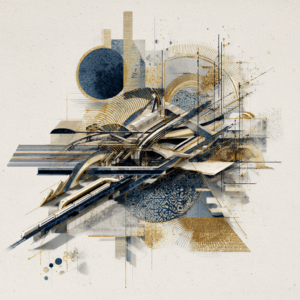
封面图说明|
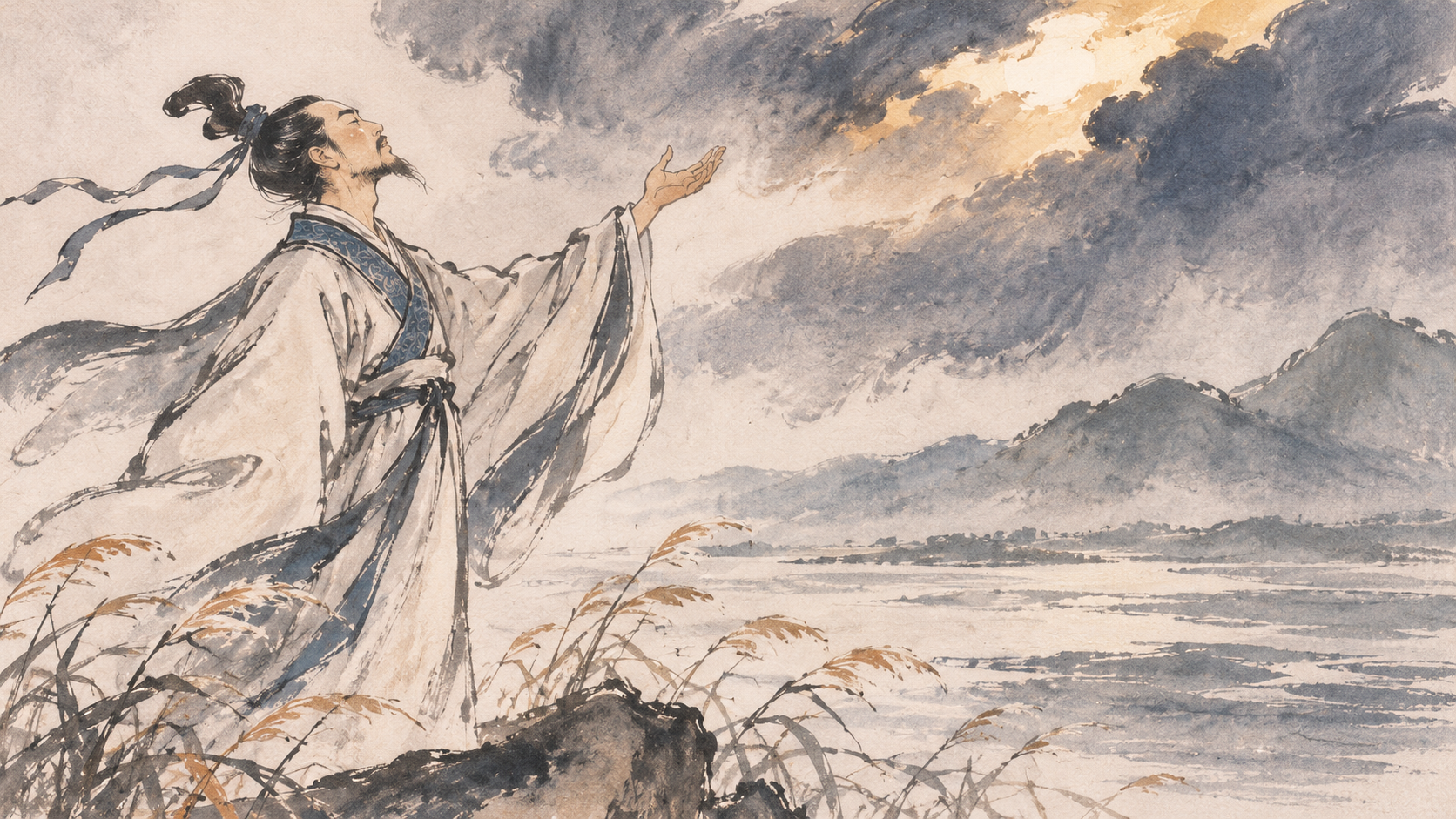
楚衣临江,举手问天,
山川静默,云水苍茫,
一场忠诚与天地的对话,
凝结于楚辞的水墨之间。
图片:原创数字插画。
引文|当忠诚成为一种孤独
当一个人始终忠于自己的信念,
却因此遭到误解与排斥,
他究竟应该改变自己,
还是继续坚持?
《橘颂》写的是不迁其志,
《涉江》写的是怀信远行,
而《惜诵》所面对的,
是忠诚信念与现实秩序的冲突。
屈原在《惜诵》中反复申辩,
试图证明自己的忠诚与清白。
然而,无论沉默还是呼喊,
他的声音始终无法抵达君王。
这不仅是一个忠臣的悲剧,
更是一个人终于发现,
自己说的话,
在这个时代已经没有人听了。
当一个时代无法理解一个人的声音,
文字是否能够越过时间,
让后来的世界重新倾听?
一|忠而见疑:当真诚无法抵达君王
忠诚未必能够换来信任,
真相也未必能够战胜众声,
当一个人失去被倾听的位置,
他又该向谁证明自己的清白?
1. 指苍天以为正:一场向天地提出的申辩
惜诵以致愍兮,发愤以抒情。
所非忠而言之兮,指苍天以为正。
《惜诵》开篇便是一场申辩,
诗人因遭受误解而心怀忧愤,
他没有停留在个人的委屈中,
而是将目光投向辽阔的苍天。
令五帝以折中兮,戒六神与向服。
俾山川以备御兮,命咎繇使听直。
诗人召请五帝与六神作证,
又请山川共同参与这场申辩,
甚至请来传说中执掌刑狱、
以公正著称的上古人物咎繇。
当人间的法庭失去了公正,
诗人只能向天地借一座法庭;
可一个人必须请苍天作证,
本身就说明人间已经无处申诉。
2. 众口铄金:当多数人的声音成为权力
故众口其铄金兮,初若是而逢殆。
《惜诵》的另一重悲剧,
来自众人言语形成的压力。
所谓「众口铄金」,
并非众人的意见必然错误。
而是反复传播的相同说法,
可能逐渐取代对事实的查证。
谒忠诚以事君兮,反离群而赘肬。
忘儇媚与背众兮,情与貌其不变。
诗人原本希望有所作为,
却反而成为群体中的异类。
「赘肬」原指身体多余的赘生物,
在诗中成为被群体排斥的比喻。
当多数人的声音形成共识,
这个共识未必来自事实,
也可能只是因为所有人,
都学会了迎合。
3. 退静默而莫余知:说与不说的双重困境
退静默而莫余知兮,
进号呼又莫吾闻。
这是《惜诵》最令人动容的两句。
诗人已经尝试不同的表达方式,
然而无论选择沉默还是呼喊,
都无法让自己的心意被理解。
沉默原本可以避免争执,
却可能被误认为默认指控;
呼喊原本是为了说明真相,
却又可能被视为不满与抗辩。
固烦言不可结而诒兮,愿陈志而无路。
「愿陈志而无路」所揭示的,
不仅是一个人失去发言机会,
更是表达与理解之间的通道,
已经被现实的权力关系阻断。
退而静默,没人知道;
进而号呼,没人听见。
这世上最孤独的处境,
不是无话可说,
而是有话,却没有一条能抵达的路。
恐情质之不信兮,
故重著以自明。
当言语无法获得即时的回应,
诗人最终选择再次陈述心志,
将难以传达的思想与忧愤,
留存在能够反复阅读的文字里。
当言语失去被倾听的机会,
文字便成为另一种自我见证,
一个时代拒绝回应,
并不能决定后世如何理解。
二|楚辞之声:当《惜诵》穿越两千三百年,再次被唱响
当言语无法抵达当时的人,
诗歌便将心声交付岁月,
两千三百年后的重新吟唱,
让沉默的文字再次拥有声音。
2025 年夏天,我以人工智能谱曲,
重新走进《楚辞》的古老篇章。
《九章·惜诵》是其中一首。
全曲依据古典原文谱曲生成,
从开篇的忧愤与自我申辩,
逐渐展开进退两难的内心挣扎。
这首作品经过多次生成与版本比较,
最终选择第 11 版作为正式作品。
全曲长约七分钟,仅有少许字未发音。
旋律层层推进,
中段出现高音的情绪爆发,
使古典诗辞的内心冲突,
转化为更鲜明的听觉表达。
这首诗原本是用来「陈志」的,
两千多年后,它终于被重新唱响。
只是听见它的,
已不是当年那个君王。
《楚辞·九章·惜诵》|AI 谱曲作品
影音说明:
本曲依《楚辞·九章·惜诵》原文谱曲。
由于 AI 生成及后期字幕制作的限制,
字幕与实际演唱未能完全同步,
建议读者参照下方原文欣赏。
《楚辞·九章·惜诵》原文与拼音
惜诵以致愍兮,发愤以抒情。
xī sòng yǐ zhì mǐn xī, fā fèn yǐ shū qíng.
所非忠而言之兮,指苍天以为正。
suǒ fēi zhōng ér yán zhī xī, zhǐ cāng tiān yǐ wéi zhèng.
令五帝以折中兮,戒六神与向服。
lìng wǔ dì yǐ zhé zhōng xī, jiè liù shén yǔ xiàng fú.
俾山川以备御兮,命咎繇使听直。
bǐ shān chuān yǐ bèi yù xī, mìng jiù yáo shǐ tīng zhí.
谒忠诚以事君兮,反离群而赘肬。
yè zhōng chéng yǐ shì jūn xī, fǎn lí qún ér zhuì yóu.
忘儇媚与背众兮,情与貌其不变。
wàng xuān mèi yǔ bèi zhòng xī, qíng yǔ mào qí bù biàn.
故相臣莫若君兮,所以证之不远。
gù xiàng chén mò ruò jūn xī, suǒ yǐ zhèng zhī bù yuǎn.
吾谊先君而后身兮,羌众人之所仇。
wú yì xiān jūn ér hòu shēn xī, qiāng zhòng rén zhī suǒ chóu.
专惟君而无他兮,又众兆之所雠。
zhuān wéi jūn ér wú tā xī, yòu zhòng zhào zhī suǒ chóu.
一心而不豫兮,羌不可保也。
yì xīn ér bù yù xī, qiāng bù kě bǎo yě.
疾亲君而无他兮,有招祸之道也。
jí qīn jūn ér wú tā xī, yǒu zhāo huò zhī dào yě.
思君其莫我忠兮,勿忘身之贱贫。
sī jūn qí mò wǒ zhōng xī, wù wàng shēn zhī jiàn pín.
事君而不贰兮,迷不知宠之门。
shì jūn ér bù èr xī, mí bù zhī chǒng zhī mén.
忠何罪以遇罚兮,亦非余心之所志。
zhōng hé zuì yǐ yù fá xī, yì fēi yú xīn zhī suǒ zhì.
行不群以巅越兮,又兆众之所咍。
xíng bù qún yǐ diān yuè xī, yòu zhào zhòng zhī suǒ hāi.
纷逢尤以离谤兮,謇不可释;
fēn féng yóu yǐ lí bàng xī, jiǎn bù kě shì;
情沉抑而不达兮,又蔽而莫之白。
qíng chén yì ér bù dá xī, yòu bì ér mò zhī bái.
心郁邑而不达兮,又莫察余之中情。
xīn yù yì ér bù dá xī, yòu mò chá yú zhī zhōng qíng.
固烦言不可结而诒兮,愿陈志而无路。
gù fán yán bù kě jié ér yí xī, yuàn chén zhì ér wú lù.
退静默而莫余知兮,进号呼又莫吾闻。
tuì jìng mò ér mò yú zhī xī, jìn háo hū yòu mò wú wén.
申侘傺之烦惑兮,中闷瞀之忳忳。
shēn chà chì zhī fán huò xī, zhōng mèn mào zhī tún tún.
昔余梦登天兮,魂中道而无杭。
xī yú mèng dēng tiān xī, hún zhōng dào ér wú háng.
吾使厉神占之兮,曰:“有志极而无旁”。
wú shǐ lì shén zhān zhī xī, yuē: “yǒu zhì jí ér wú páng”.
“终危独以离异兮?”曰:“君可思而不可恃。
“zhōng wēi dú yǐ lí yì xī?” yuē: “jūn kě sī ér bù kě shì.
故众口其铄金兮,初若是而逢殆。
gù zhòng kǒu qí shuò jīn xī, chū ruò shì ér féng dài.
惩于羹而吹齑兮,何不变此志也?
chéng yú gēng ér chuī jī xī, hé bù biàn cǐ zhì yě?
欲释阶而登天兮,犹有曩之态也。
yù shì jiē ér dēng tiān xī, yóu yǒu nǎng zhī tài yě.
众骇遽以离心兮,又何以为此伴也?
zhòng hài jù yǐ lí xīn xī, yòu hé yǐ wéi cǐ bàn yě?
同极而异路兮,又何以为此援也?
tóng jí ér yì lù xī, yòu hé yǐ wéi cǐ yuán yě?
晋申生之孝子兮,父信谗而不好。
jìn shēn shēng zhī xiào zǐ xī, fù xìn chán ér bù hào.
行婞直而不豫兮,鲧功用而不就。
xíng xìng zhí ér bù yù xī, gǔn gōng yòng ér bù jiù.
吾闻作忠以造怨兮,忽谓之过言。
wú wén zuò zhōng yǐ zào yuàn xī, hū wèi zhī guò yán.
九折臂而成医兮,吾至今而知其信然。
jiǔ zhé bì ér chéng yī xī, wú zhì jīn ér zhī qí xìn rán.
矰弋机而在上兮,罻罗张而在下。
zēng yì jī ér zài shàng xī, wèi luó zhāng ér zài xià.
设张辟以娱君兮,愿侧身而无所。
shè zhāng pì yǐ yú jūn xī, yuàn cè shēn ér wú suǒ.
欲儃佪以干傺兮,恐重患而离尤。
yù zhān huái yǐ gān chì xī, kǒng zhòng huàn ér lí yóu.
欲高飞而远集兮,君罔谓汝何之?
yù gāo fēi ér yuǎn jí xī, jūn wǎng wèi rǔ hé zhī?
欲横奔而失路兮,坚志而不忍。
yù héng bēn ér shī lù xī, jiān zhì ér bù rěn.
背膺牉以交痛兮,心郁结不纡轸。
bèi yīng pàn yǐ jiāo tòng xī, xīn yù jié bù yū zhěn.
梼木兰以矫蕙兮,糳申椒以为粮。
táo mù lán yǐ jiǎo huì xī, zuò shēn jiāo yǐ wéi liáng.
播江离与滋菊兮,愿春日以为糗芳。
bō jiāng lí yǔ zī jú xī, yuàn chūn rì yǐ wéi qiǔ fāng.
恐情质之不信兮,故重著以自明。
kǒng qíng zhì zhī bù xìn xī, gù zhòng zhù yǐ zì míng.
矫兹媚以私处兮,愿曾思而远身。
jiǎo zī mèi yǐ sī chǔ xī, yuàn céng sī ér yuǎn shēn.
尾声|当无人理解,文字仍为自己作证
恐情质之不信兮,故重著以自明。
《惜诵》最深的悲哀,
或许不只是遭受误解与排斥,
而是一个人必须不断证明,
自己原本就坚持的信念。
诗人向苍天寻求公正,
又在众人的议论中陷入孤立。
即使反复陈述自己的心志,
也无法决定君王是否相信。
然而,外界的判断无法掌控,
表达的方式却仍可以选择。
当现实中的申辩失去效力,
文字便成为最后的自我见证。
一个人无法决定谁愿意倾听,
也无法改变所有人的判断;
但他仍然可以留下自己的声音,
让时间成为最后的见证。
两千三百年前,屈原写下心中的话;
两千三百年后,我们仍在阅读。
这就是「无路」之后,
文字替他走出来的那条路。
楚人对话后记|考烈王、黄歇与令尹夫人的观后感
如果说了没人听,你还会说吗?
《惜诵》的歌声渐渐结束,
考烈王沉默了一会儿。
忽然问黄歇:
「春申君,寡人有一事不明。
屈大夫说了那么多,
退而静默没人知道,
进而号呼没人听见。
既然说与不说都一样,
他为何还要写下来?」
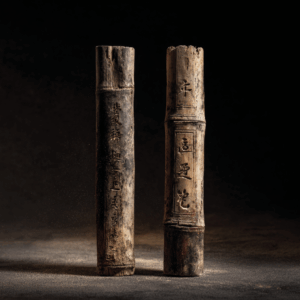
黄歇轻轻放下竹简:
「大王,或许正因为说与不说都一样,
他才更要写下来。
说给当时的人听,已经没有路了;
写给后来的人看,路还没有断。」
考烈王转头看向我:
「令尹夫人,你为《惜诵》谱曲,
让它重新被唱出来。
你觉得屈大夫当年的话,
今天算有人听见了吗?」
我想了想,轻声回答:
「大王,我不敢替屈大夫回答。
但今天有人愿意听,有人愿意唱,
至少说明他写下来的那条路,
还没有完全走完。」
考烈王沉默了很久,
忽然叹了口气:
「寡人听懂了。
屈大夫不是要一个答案,
他只是不愿意,
让自己的话就这样消失。」
君可思而不可恃,
话可说而不可必闻;
但一个时代听不见的声音,
另一个时代也许还愿意听。
屈原没有等到他的君王,
却等到了两千多年后,
还在读他的人。
屏幕上的歌声已经结束,
黄歇默默收起竹简,
考烈王没有再问。
去年,我让屈原的文字有了声音。
今年,屈原的文字让我听见了自己。
窗外,江水还在流。
说明:本篇对话为作者依据《楚辞·九章·惜诵》及个人 AI 谱曲经历创作的文学想象,并非真实历史对话。
Appendix|English Narrative Overview
When Loyalty Finds No Voice: The Struggle to Be Understood
Chu Ci · Jiu Zhang · Xi Song (惜诵)
When Loyalty Becomes a Form of Solitude
“What happens when a person remains faithful to their convictions, yet finds that neither silence nor speaking out can make their voice heard? Can words travel beyond their own time and reach those who may finally be willing to listen?”
In Ju Song (Ode to the Orange Tree), Qu Yuan explores the determination to remain true to one’s principles. In She Jiang (Crossing the River), he portrays a journey undertaken without abandoning one’s convictions. Xi Song (惜诵), another poem from Jiu Zhang (Nine Chapters) in the Chu Ci, confronts a different dilemma: what happens when personal integrity comes into conflict with the political and social order?
Throughout Xi Song, the poetic speaker attempts to explain his intentions and defend himself against accusations. Yet his words cannot reach the ruler whose understanding he seeks. Remaining silent brings no recognition, while speaking out produces no response. The tragedy is therefore not simply that a loyal minister has been misunderstood. It is the discovery that, within the world he inhabits, his words no longer seem to have anyone willing to hear them.
More than 2,300 years later, the poem raises a question that extends beyond the political circumstances of ancient Chu. When an era cannot understand an individual’s voice, can writing cross the boundaries of time and allow future generations to listen again?
I. Loyalty Under Suspicion | When Sincerity Cannot Reach the King
“Loyalty does not necessarily earn trust, and truth does not always prevail over collective opinion. When someone loses the opportunity to be heard, where can they turn to establish their innocence?”
1. Calling Heaven as Witness | An Appeal Beyond Human Justice
Xi Song begins with an impassioned declaration. The speaker, distressed by misunderstanding and accusations, seeks to express the emotions he has been unable to communicate. Yet instead of addressing his grievances solely to the human world, he turns towards heaven and calls upon a higher authority to witness his sincerity.
The poem invokes the Five Emperors, the Six Spirits, mountains and rivers, and the legendary figure Gaoyao, associated with the administration of justice in ancient Chinese tradition. Together, these figures form an imagined court of judgment extending beyond the political institutions of the human world. Heaven, the natural landscape, and ancient ideals of justice become witnesses in a dispute that earthly authority has failed to resolve.
This extraordinary scene is more than an expression of religious imagination. It reveals the distance between political power and moral judgment. The speaker can appeal to heaven precisely because he cannot secure a fair hearing among those who possess authority over his life.
When human justice loses its fairness, the poet must borrow a courtroom from heaven. Yet the very need to summon heaven as a witness suggests that, in the human world, he has nowhere left to appeal.
2. When Many Voices Become Power | The Pressure of Collective Opinion
Another central conflict in Xi Song emerges from the power of collective speech. The poem describes how repeated accusations can become so influential that they overwhelm an individual’s attempts to explain the truth. The classical image of many voices being capable of melting metal conveys the destructive force of words when they accumulate into a seemingly unquestionable judgment.
This does not mean that the majority must always be wrong. Rather, the poem exposes the danger of treating repetition as evidence. When the same accusation circulates often enough, people may begin to accept it without examining whether it is justified. What appears to be a shared conclusion may be the product of social pressure rather than independent understanding.
The speaker also compares himself to an unwanted growth on the body, expressing the painful experience of becoming an outsider within a group to which he once hoped to contribute. His refusal to conform through flattery or convenient agreement separates him from those who have learned to accommodate the expectations of power.
Here, Xi Song moves beyond personal disappointment and reveals a structural problem in human relationships. A community may develop a common position not because everyone has independently examined the facts, but because its members have learned which opinions are safest to express. Collective agreement can become an instrument of exclusion.
When the voices of many people form a consensus, that consensus does not necessarily arise from truth. Sometimes it emerges because everyone has learned how to please those in authority.
3. Neither Silence nor Protest | When Communication Has No Path
Perhaps the most moving passage in Xi Song describes the speaker’s impossible choice between remaining silent and crying out. If he withdraws into silence, no one understands him. If he raises his voice, no one listens. Two apparently opposite responses lead to the same result: his intentions remain unheard.
Silence might seem a way to avoid confrontation, yet it can be interpreted as acceptance of an accusation. Speaking out might offer an opportunity to clarify the truth, yet it can also be interpreted as defiance or resentment. The speaker is trapped in a situation where neither course of action can restore meaningful communication.
The poem’s expression of wishing to declare one’s aspirations but finding no path is especially significant. The problem is not simply the absence of permission to speak. It is the breakdown of the relationship between expression and understanding. Political authority has closed the channel through which an individual’s words might otherwise reach their intended listener.
There is a particular loneliness in having something important to say while knowing that no available form of expression can make it understood. The deepest isolation is not having nothing to say, but having words for which no path of communication remains.
Yet the poem does not end in silence. Fearing that his true intentions will remain unrecognized, the speaker chooses to set them down once more in writing. What cannot be established through immediate political appeal becomes a written testimony that others may encounter in another time.
When spoken words lose the opportunity to be heard, writing becomes another form of self-witness. The refusal of one era to listen does not determine how later generations will understand.
II. Giving Xi Song a New Voice | AI Music Across 2,300 Years
“When words cannot reach the people of their own time, poetry entrusts them to the passing centuries. More than 2,300 years later, a new musical interpretation allows those written words to become audible once again.”
In the summer of 2025, I began transforming classical texts from the Chu Ci into musical works with the assistance of artificial intelligence. Xi Song, one of the poems in Jiu Zhang, became part of this experiment in bringing ancient literature into contemporary listening experiences.
The recording follows the classical text, moving from the opening expressions of distress and self-defense towards the speaker’s increasingly difficult struggle between withdrawal and continued engagement. The poem’s emotional development is gradual, and the musical interpretation attempts to carry that progression through a continuous performance.
Creating the recording required repeated generations and comparisons. I eventually selected the eleventh version as the final work. The recording lasts approximately seven minutes, with only a few words left unpronounced. Its melody develops progressively, and a more intense, higher vocal passage in the middle gives the poem’s internal conflict a stronger audible expression.
This is not an attempt to reconstruct the music of ancient Chu. It is a contemporary experiment in which the original literary text provides the foundation while AI-generated music offers another way of experiencing its emotional and intellectual movement. As with my other Chu Ci recordings, the process involved listening carefully, evaluating pronunciation, and selecting the version that best preserved the continuity of the poem.
The original purpose of Xi Song was to declare the speaker’s intentions. More than two thousand years later, those words have been set to music again. Yet the person who hears them today is no longer the ruler to whom the original appeal was directed.
Video: Chu Ci · Jiu Zhang · Xi Song — 7:05
Video note: This musical interpretation follows the classical text of Xi Song. Because of limitations in AI generation and subsequent subtitle editing, some subtitles do not align precisely with the singing. Readers are encouraged to consult the complete original Chinese text and pinyin provided in the Chinese section of this article.
Epilogue | When No One Understands, Writing Still Bears Witness
“A person cannot decide who will listen or control how others will judge them. Yet they can still leave behind their own words and allow time to become the final witness.”
The deepest sorrow of Xi Song may not be misunderstanding or exclusion alone. It is the experience of having to defend, again and again, convictions that have remained unchanged. The speaker appeals to heaven, confronts the pressure of collective opinion, and attempts to explain his intentions, yet he cannot determine whether the ruler will believe him.
There is, however, one choice that remains within his control. He cannot command the judgment of others, but he can decide how to express himself. When political appeals fail, writing becomes a final means of preserving his own account of what he believed and why he acted as he did.
More than 2,300 years ago, Qu Yuan left his thoughts in poetry. More than 2,300 years later, we are still reading those words. This is the path that writing has opened beyond the apparent absence of any path in the speaker’s own time.
The poem did not necessarily change the judgment of those who first encountered it. Its survival, however, made another encounter possible. A voice that could not reach its intended audience has continued to travel through literature, interpretation, and now digital music.
Perhaps this is one of the quiet powers of cultural memory: it cannot undo the circumstances in which a voice was rejected, but it can prevent that rejection from becoming the final word.
Across Civilizations
King Kaolie, Huang Xie, and Lady Lingyin | If No One Listens, Would You Still Speak?
The final notes of Xi Song faded away. King Kaolie of Chu remained silent for a moment before turning towards Huang Xie, Lord Chunshen. “There is something I do not understand. Qu Yuan said so much, yet when he remained silent, no one understood him, and when he cried out, no one listened. If speaking and remaining silent made no difference, why did he continue writing?”
Huang Xie gently put down his bamboo slips. “Your Majesty, perhaps that is precisely why he had to write. There was no longer a path for his words to reach the people of his own time. But by writing them down for those who would come later, that path had not yet been completely closed.”
King Kaolie turned towards me. “Lady Lingyin, you have transformed Xi Song into music and allowed it to be sung again. Do you think Qu Yuan’s words have finally been heard?”
I considered the question before answering. “Your Majesty, I would not presume to answer on Qu Yuan’s behalf. But today, there are people willing to listen, and there are voices willing to sing his words. At the very least, the path he opened through writing has not yet reached its end.”
The king remained silent for a long time before sighing. “I think I understand now. Qu Yuan was not simply waiting for an answer. He did not want his words to disappear without a trace.”
A ruler may be remembered without being someone on whom one can always depend. Words may be spoken without any certainty that they will be heard. Yet a voice that one era refuses to hear may find willing listeners in another.
Qu Yuan did not live to receive the understanding he sought from his ruler. But more than two thousand years later, there are still people reading his words.
The recording had ended. Huang Xie quietly gathered his bamboo slips, and King Kaolie asked no further questions.
Last year, I gave Qu Yuan’s written words a voice. This year, through those same words, I began to hear my own.
Outside the window, the river continued to flow.
Historical and literary note: The conversations in “Across Civilizations” are fictional literary dialogues featuring King Kaolie of Chu, Huang Xie (Lord Chunshen), and Lady Lingyin. They are imaginative reflections based on Chu Ci · Jiu Zhang · Xi Song and the author’s personal AI music project. They are not accounts of actual historical conversations.
🤖 人工智能协作声明
本文的主题选择、田野调查、资料搜集、核心观点与中文原始内容,均由作者独立完成。创作过程中,作者与人工智能模型,进行持续协作,包括多轮讨论、思路推演、叙事节奏调整、部分翻译、英文 Narrative Overview 生成、语言检查、结构检测与文字润饰。
人工智能在此过程中,作为创作协作者,参与内容发展与语言表达,但不作为法律意义上的作者或著作权主体。所有 AI 协作产生的内容,均由作者依据田野资料、原始文献与中文母稿,进行选择、审校、修改与艺术化重构。文章的叙事方向、内容取舍、创作决策、最终表达与价值判断,均由作者决定并负责。
📜 本站所有原创作品均已完成区块链存证,确保原创凭证。部分重点作品另行提交国家版权登记,作为正式法律备案。原创声明与权利主张已公开。完整说明见:
👉 原创声明 & 节奏文明版权说明 | Originality & Rhythm Civilization Copyright Statement – NING HUANG
节奏文明存证记录
本篇博客文为原创作品,由黄甯与 AI 协作生成,于博客网页首发后上传至 ArDrive 区块链分布式存储平台进行版权存证:
- 博客首发时间:2026年11月11日
- 存证链接:5e836019-3983-44db-828b-4b11bc34c99a
- 存证平台:ArDrive(arweave.net)(已于 2026年11月11日上传)
- 原创声明编号:Rhythm_Archive_11_Nov_2026/chu-ci-jiu-zhang-xi-song-lamenting-and-reciting
- 用途声明:本文为《节奏文明观》之篇章,亦参与构建《AI×非遗文明共构档案》与《文明节奏回声计划》,用于文明节奏实地记录、区块链存证、跨域协作与版权登记用途。
© 黄甯 Ning Huang, 2026. All Rights Reserved.
本作品受版权法保护,未经作者书面许可,禁止复制、改编、转载或商用,侵权必究。
📍若未来作品用于出版、课程、NFT或国际展览等用途,本声明与区块链记录可作为创作时间及原创性的佐证。