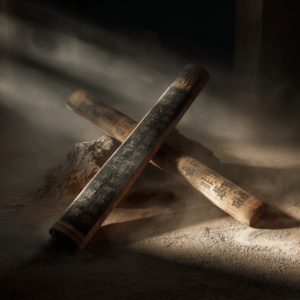
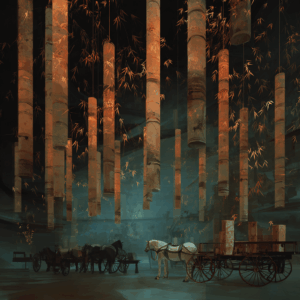
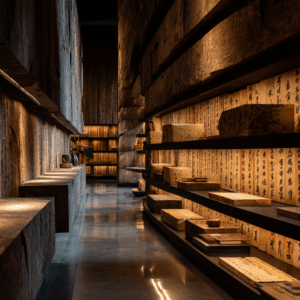
封面图说明|
屈原问卜,詹尹静思;
龟策无言,山川苍茫。
忠直与世俗之间,
何去何从?
图片:原创数字插画。
引文|当忠诚失去回声,命运还能问谁?
「用君之心,行君之意。
龟策诚不能知此事。」
——占卜者最终放下龟甲,
把判断的权利还给了提问的人。
屈原既放,三年不得复见。
一个曾经竭尽忠诚的人,
为何最终走向占卜者,
试图从龟策之中寻找答案?
他曾相信忠诚可以获得理解,
然而谗言蔽塞了君王的耳目,
世俗的尺度也逐渐颠倒了是非。
当黄钟毁弃,瓦釜雷鸣,
一个不愿随波逐流的人,
究竟应该坚守本心,还是顺应世俗?
于是,屈原走向太卜郑詹尹,
以一连串「宁……将……」的追问,
将忠直与苟全、清廉与圆滑,
放在命运的天平两端。
然而,面对这场关乎人格的抉择,
占卜者最终放下手中的龟策,
没有预言吉凶,也没有指明道路。
当命运无法回答,
当世俗不能成为尺度,
人是否仍能依靠自己的心,
决定究竟要走向何方?
一|宁与将:当人生被迫在两种道路之间选择
当一个时代颠倒了是非,
坚持原则的人,
究竟是时代的落伍者,
还是价值的守护者?
《卜居》最令人震撼的,
并非屈原向占卜者询问吉凶,
而是他将人生的道路,
一条又一条摆在自己面前,
却发现每一条道路的背后,
都隐藏着人格与生存的冲突。
「吾宁悃悃款款,朴以忠乎,
将送往劳来,斯无穷乎?」
一边是诚恳朴实、尽心守忠,
另一边是迎来送往、周旋世俗。
这些反复出现的「宁」与「将」,
构成了一场没有裁判的人生辩论。
他真正面对的,
并不是哪条道路更容易成功,
而是哪一种生活值得自己承担。
「宁廉洁正直以自清乎,
将突梯滑稽,如脂如韦,以洁楹乎?」
廉洁正直与圆滑逢迎形成对照。
前者意味着坚持自己的尺度,
后者意味着不断改变形状,
使自己能够适应周围的一切。
当环境本身已经失去公正,
适应究竟是一种智慧,
还是一种妥协?
屈原又以骏马与驽马、黄鹄与鸡鹜,
描绘不同生命所追求的方向。
骐骥能够并驾远行,
黄鹄能够展翅高飞。
然而在现实的道路上,
卓越未必获得承认,
平庸反而可能占据优势。
于是,《卜居》的追问逐渐超越个人。
「世溷浊而不清:
蝉翼为重,千钧为轻;
黄钟毁弃,瓦釜雷鸣;
谗人高张,贤士无名。」
在中国古代礼乐文明之中,
黄钟不仅是律名,
也是音律秩序的重要基准。
当黄钟被弃置而瓦釜雷鸣,
受到破坏的不只是声音的高低,
更是社会辨别价值的能力。
一个社会可以拥有越来越响亮的声音,
却未必拥有越来越清晰的判断;
当声量取代分量,
社会奖励的行为,
便可能与它真正需要的品格背道而驰。
然而,《卜居》并没有证明,
所有坚持原则的人都必然失败。
它真正揭示的是一种危险:
当社会评价与个人价值发生冲突,
人可能被迫以生存利益衡量自己的良知。
坚持原则的人未必不合时宜,
也可能是时代失去了衡量他的尺度。
二|楚辞之声:命运不可卜,去留由己
当龟策无法预知命运,
当世俗无法衡量人格,
人生的道路,
终究要由自己的心来决定。
《楚辞·卜居》以屈原与太卜郑詹尹的对话,
展开一场关于忠诚、命运与人生选择的追问。
这首历时将近四分钟的音乐作品,
以古辞为词,借助人工智能谱曲。
当詹尹最终放下龟策,
说出「用君之心,行君之意」,
整篇作品的追问也随之转向内心。
占卜可以询问吉凶,
却无法替一个人决定应当坚守什么,
更无法承担选择之后的人生。
命运或许无法预知,
道路也未必通向世俗意义上的成功。
但一个人仍然可以决定,
自己愿意以怎样的姿态走完一生。
《楚辞·卜居》|AI 谱曲作品
尾声|当世界失去尺度,人如何守住自己?
世道可以颠倒价值,
却不能替一个人决定,
他究竟愿意成为什么样的人。
从《惜诵》的忠言无路,
到《卜居》的问卜求解,
屈原面对的始终是同一种困境。
当忠诚无法获得理解,
当正直无法得到公正的回应,
一个人究竟应该改变自己,
还是坚持本心?
「黄钟毁弃,瓦釜雷鸣」,
揭示的不只是贤者失意的悲哀,
更是一个时代价值尺度的颠倒。
然而,詹尹最终放下龟策。
「用君之心,行君之意」,
意味着有些人生选择,
终究无法交由外在的权威代为决定。
两千多年后的今天,
人们依然借助数据、算法与社会评价,
试图寻找更可靠的人生方向。
预测可以帮助判断可能的结果,
却无法回答什么样的人生值得追求;
技术能够计算得失,
却不能替人承担良知。
时代可以决定什么声音最响亮,
却未必能够决定什么价值最值得守护。
真正属于一个人的尺度,
或许就在他不愿轻易放弃的原则之中。
楚人对话后记|考烈王、黄歇与令尹夫人的观后感
五十五件卜甲,竟然没有卜出楚国的命运?
我打开电脑,
调出武王墩的考古影像,
一座沉睡两千多年的楚王墓,
在屏幕上缓缓显露九室结构。
考烈王看着画面,
忽然站了起来:
「这不是寡人的陵寝吗?」
黄歇仔细端详,
神情也有些惊讶:
「大王,
您看那墓道与木椁,
楚国工匠的手艺,
竟然保存了两千多年。」
我把画面切换到出土的卜甲:
「大王,
考古人员在武王墩,
发现了上千枚龟甲残片,
后来拼合出五十五件完整卜甲,
其中还有名为『长霝』的墨书。」
考烈王顿时来了精神:
「两千多年过去,
后人连龟甲都替寡人找出来了?」
黄歇望着那些黑色卜甲,
忽然问:
「大王,
楚国既有占卜之法,
又有礼乐制度与治国之臣,
为何仍然不能预知国运的转折?」
考烈王的笑容渐渐消失:
「春申君,
你这是在问寡人,
为何楚国拥有这么多判断工具,
却仍然会做出错误的决定?」
黄歇没有回避:
「正是。
龟甲可以呈现卜兆,
却不能替君王辨别忠奸。
臣子可以提出谋略,
却不能保证君王愿意采纳。
若朝廷只听顺耳之言,
再多的卜甲又有何用?」
考烈王沉默片刻,
忽然反问:
「那么春申君,
你当年辅佐寡人多年,
可曾有过明知不妥,
却没有坚持劝谏的时候?」
黄歇一时没有回答。
我坐在一旁,
忍不住笑了:
「大王,
您这一问,
可比屈原的『宁……将……』还难回答。」
考烈王转向我:
「令尹夫人,
你们后世既能打开王墓,
想必已经懂得如何避免这些错误?」
我摇摇头:
「大王,
我们有比龟策强大得多的工具,
能够计算、预测、分析无数资料。
可是人依然会误判,
依然喜欢听自己愿意相信的话,
也依然可能把忠告当成冒犯。」
考烈王重新望向那批卜甲:
「寡人如今倒明白詹尹的意思了。
『用君之心,行君之意。』
他不是说龟策毫无用处,
而是有些事情,
终究不能让龟策替人承担。」
楚国留下了衡量长度的尺,
留下了校正音律的标准,
也留下了询问吉凶的卜甲。
然而,衡量人心的尺度,
始终无法完全交给器物。
龟甲留下了,
楚国却成为历史;
而《卜居》留下的问题,
至今仍没有过时。
我关上考古影像,
屏幕又回到《卜居》的歌曲页面。
江风吹过,
龟甲安静地躺在展柜里,
像还有一句没有卜出的话。
说明:本篇对话依据《楚辞·卜居》、武王墩一号墓考古发现及作者此前的楚文明研究文章创作,属于跨越时空的文学想象,并非真实历史对话。
Appendix|English Narrative Overview
When Divination Cannot Answer: Which Path Should One Choose?
Chu Ci · Bu Ju (卜居)
When the World Can No Longer Provide an Answer
“What happens when loyalty is no longer understood, integrity is no longer rewarded, and the standards by which society judges right and wrong have become unreliable? Can a person still determine the direction of their own life when neither authority nor divination can provide an answer?”
Bu Ju (Divination), a work preserved in the Chu Ci, presents Qu Yuan in exile, unable to return to court after three years. Having devoted himself to serving his ruler, he finds that sincerity and loyalty have brought neither understanding nor recognition. Rather than accepting the judgments of the world around him, he approaches Zheng Zhanyin, the Grand Diviner, seeking guidance about the path he should follow.
Yet the questions he brings are not ordinary requests for predictions about fortune and misfortune. They concern the fundamental conflict between moral integrity and worldly survival. Should a person remain honest when honesty carries a personal cost? Should one accommodate those in power in order to secure recognition? And when society rewards conformity while disregarding genuine ability, what does it mean to remain faithful to oneself?
The most remarkable feature of Bu Ju lies in its conclusion. Zheng Zhanyin eventually puts aside his divining instruments and acknowledges that the tortoise shell and divining stalks cannot resolve such matters. The responsibility for judgment returns to Qu Yuan himself. What begins as an attempt to consult fate becomes a reflection on the limits of external authority and the necessity of personal choice.
I. When Integrity Conflicts with Survival | A Society That Has Lost Its Standards
“When an era reverses right and wrong, are those who refuse to compromise simply out of step with their time, or has society lost the ability to recognize what is genuinely valuable?”
The central movement of Bu Ju is built upon a succession of contrasting alternatives. Through the recurring expressions ning (寧, “would rather”) and jiang (將, “or instead”), the speaker considers different ways of living: sincerity or calculated accommodation, independent labor or advancement through powerful connections, frank speech or cautious conformity, moral purity or social flexibility. These alternatives create a sustained examination of the relationship between personal convictions and the conditions required for survival.
What makes the questions compelling is that they are not presented as a simple choice between success and failure. A person may achieve security by adjusting to the expectations of others, yet such adaptation can gradually alter the principles by which that person understands their own identity. Conversely, maintaining independence may preserve personal integrity while bringing isolation or material disadvantage. Bu Ju exposes the difficulty of distinguishing practical wisdom from moral compromise when the surrounding environment itself has become unjust.
The poem develops this conflict through images of exceptional horses and ordinary animals, soaring birds and creatures competing for food. These contrasts suggest that different beings possess different capacities and aspirations, yet the world does not necessarily reward them according to their abilities. Excellence may remain unrecognized, while those better adapted to prevailing expectations may obtain greater advantages.
The criticism becomes especially forceful in the celebrated passage describing a world where the wings of a cicada are treated as heavy while a thousand jun are considered light, where the great musical bell is discarded while an earthen vessel resounds like thunder, and where slanderers rise to prominence while worthy individuals remain unknown.
The image of Huangzhong (黃鐘) is particularly significant. In ancient Chinese musical thought, Huangzhong represented a foundational pitch within the system of musical regulation. Its symbolic destruction therefore suggests more than the rejection of a beautiful sound. It evokes a society in which the standards used to distinguish quality, proportion, and value have themselves become distorted.
This is also where Bu Ju connects with a broader reflection on rhythm and civilization. Every society develops systems through which it recognizes achievement, distributes authority, and determines which voices deserve attention. Yet these systems do not necessarily preserve a reliable relationship between visibility and merit. A voice may become increasingly influential without becoming more truthful, while a person of genuine ability may remain unheard.
When volume replaces substance, recognition can become detached from value. The danger is not merely that a principled individual may suffer, but that an entire society may begin rewarding precisely the behavior that undermines its own moral and institutional foundations.
Bu Ju does not claim that every uncompromising person is necessarily correct, nor that adaptation is always a betrayal of principle. Its deeper concern is the moment when external success becomes the dominant measure of human worth. Under such conditions, an individual may be forced to choose between receiving approval and remaining faithful to convictions that society no longer recognizes.
Perhaps those who appear unsuited to their age are not always the ones who have lost their way. Sometimes the age itself has lost the standards by which their worth could be understood.
II. Giving Bu Ju a New Voice | The Limits of Divination and the Responsibility of Choice
“Divination may offer guidance about fortune and misfortune, but it cannot determine what a person ought to uphold. The responsibility for choosing a life cannot ultimately be transferred to an external authority.”
In the summer of 2025, I transformed Bu Ju into a musical work with the assistance of artificial intelligence, as part of my broader project of giving the classical texts of the Chu Ci a contemporary musical voice. The resulting recording lasts approximately four minutes and follows the original literary text, allowing its recurring questions and contrasting alternatives to be encountered through sound.
Unlike a conventional song built around a repeated chorus, Bu Ju develops through a sequence of moral questions. Its structure resembles a dialogue in which each possible answer produces another difficulty. The musical interpretation does not reconstruct ancient Chu music. Rather, it creates a contemporary listening experience in which the philosophical movement of the text can be heard alongside its poetic language.
The conclusion marks an important change in the direction of the work. Zheng Zhanyin acknowledges that different instruments and forms of knowledge possess different limitations. A measuring unit may be useful in one situation and insufficient in another; human intelligence and supernatural methods alike have boundaries beyond which they cannot provide certainty.
His final instruction, “Follow your own heart and act according to your own intentions,” does not eliminate uncertainty. Nor does it guarantee that an independent choice will lead to success. Instead, it recognizes that questions concerning conscience, integrity, and the direction of a life cannot be resolved solely by calculating favorable outcomes.
This distinction has acquired renewed significance in the age of artificial intelligence. Modern systems can compare possibilities, process enormous quantities of information, and generate increasingly sophisticated predictions. Yet greater computational capacity does not automatically produce greater moral judgment. An algorithm may estimate the consequences of a decision, but it cannot assume responsibility for the values according to which that decision should be made.
The ancient diviner and the modern algorithm therefore illuminate a similar boundary. Both may assist human understanding, but neither should become a substitute for the individual judgment required when a person must decide what kind of life is worth living.
Video: Chu Ci · Bu Ju — AI Musical Interpretation | 3:57
Epilogue | When the World Loses Its Measure, What Remains?
“An era may determine which voices become the loudest, but it cannot necessarily determine which values deserve to endure.”
Read alongside Xi Song (惜诵), Bu Ju reveals a significant development in the moral questions associated with Qu Yuan. In Xi Song, the central struggle concerns the inability of sincere words to reach those in authority. In Bu Ju, the dilemma moves beyond the failure of communication towards the problem of judgment itself. If the world refuses to recognize integrity, should a person change in order to obtain its approval?
The answer offered by Zheng Zhanyin is neither a prediction nor a command. By putting aside his divining instruments, he acknowledges that some decisions lie beyond the authority of the tools used to seek guidance. His response does not remove the burden of choice. It returns that burden to the person whose life is at stake.
More than two thousand years later, the instruments through which humanity seeks certainty have changed dramatically. Divination shells have given way to statistical models, predictive technologies, and artificial intelligence in many areas of decision-making. Yet the fundamental distinction between information and responsibility remains. We may become increasingly capable of anticipating possible outcomes without becoming equally capable of determining which outcomes are worth pursuing.
The enduring significance of Bu Ju therefore lies not in its ability to reveal destiny, but in its recognition of the limits of prediction. A society may lose its standards of value, and an individual may be unable to control how others judge them. What remains is the difficult responsibility of deciding which principles should continue to guide one’s actions.
The world may change its standards, but it cannot entirely replace the judgment through which a person chooses who they wish to become.
Across Civilizations
King Kaolie, Huang Xie, and Lady Lingyin | Could Fifty-Five Divination Shells Have Foretold the Fate of Chu?
I opened my computer and brought up the archaeological images from Wuwangdun. On the screen, a royal tomb that had remained buried for more than two thousand years gradually revealed its nine-chamber structure. King Kaolie suddenly rose from his seat. “Is that not my own tomb?”
Huang Xie leaned forward to examine the images. “Your Majesty, look at the burial passages and the wooden chambers. The craftsmanship of Chu has survived for more than two thousand years.”
I switched to the photographs of the excavated tortoise shells. “Your Majesty, archaeologists discovered more than a thousand shell fragments at Wuwangdun and reconstructed fifty-five complete divination shells. Among the discoveries was also an ink inscription reading Changling (長霝).”
King Kaolie immediately brightened. “After more than two thousand years, people have even recovered my divination shells?”
Huang Xie studied the dark shells for a moment before turning towards the king. “Your Majesty, Chu possessed methods of divination, established ritual and musical systems, and experienced ministers responsible for governing the kingdom. Why, then, could we not foresee the turning points of our own destiny?”
The king’s smile gradually disappeared. “Lord Chunshen, are you asking why Chu could possess so many instruments of judgment and still make the wrong decisions?”
Huang Xie did not hesitate. “Precisely, Your Majesty. A tortoise shell may reveal an omen, but it cannot distinguish loyal ministers from flatterers on behalf of the ruler. A minister may offer sound advice, but cannot guarantee that the king will accept it. If a court listens only to words it wishes to hear, what use are countless divination shells?”
King Kaolie remained silent for a moment before asking another question. “Then tell me, Lord Chunshen. During all those years when you served me, was there ever a time when you knew something was wrong, yet failed to insist upon your advice?”
For once, Huang Xie had no immediate answer.
Sitting beside them, I could not help laughing. “Your Majesty, that question may be even harder to answer than Qu Yuan’s repeated choices between ning and jiang.”
King Kaolie turned towards me. “Lady Lingyin, your generation can even open the tombs of ancient kings. Surely you must have learned how to avoid the mistakes we made?”
I shook my head. “Your Majesty, we possess tools far more powerful than divination shells. They can calculate, predict, and analyse enormous quantities of information. Yet people still make mistakes. They still prefer to hear what they already believe, and they still sometimes regard sincere warnings as personal attacks.”
The king looked again at the excavated shells. “I believe I finally understand Zheng Zhanyin’s words. ‘Follow your own heart and act according to your own intentions.’ He was not saying that divination was entirely useless. He was saying that certain responsibilities cannot be handed over to a tortoise shell.”
Chu left behind standards for measuring length, systems for regulating musical pitch, and tortoise shells for seeking guidance about fortune and misfortune. Yet the measure of human judgment and integrity could never be entrusted entirely to instruments.
The tortoise shells survived, while the kingdom of Chu passed into history. The questions preserved in Bu Ju, however, have never become obsolete.
I closed the archaeological images, and the computer screen returned to the musical recording of Bu Ju.
Outside, the river wind continued to blow. The ancient tortoise shells rested quietly inside their display case, as though they still held one question that divination had never answered.
Historical and literary note: This fictional dialogue draws upon Chu Ci · Bu Ju, archaeological discoveries from Wuwangdun Tomb No. 1, and the author’s earlier research and writing on Chu civilization. The conversations between King Kaolie of Chu, Huang Xie (Lord Chunshen), and Lady Lingyin are imaginative literary creations, not records of actual historical conversations.
🤖 人工智能协作声明
本文的主题选择、田野调查、资料搜集、核心观点与中文原始内容,均由作者独立完成。创作过程中,作者与人工智能模型,进行持续协作,包括多轮讨论、思路推演、叙事节奏调整、部分翻译、英文 Narrative Overview 生成、语言检查、结构检测与文字润饰。
人工智能在此过程中,作为创作协作者,参与内容发展与语言表达,但不作为法律意义上的作者或著作权主体。所有 AI 协作产生的内容,均由作者依据田野资料、原始文献与中文母稿,进行选择、审校、修改与艺术化重构。文章的叙事方向、内容取舍、创作决策、最终表达与价值判断,均由作者决定并负责。
📜 本站所有原创作品均已完成区块链存证,确保原创凭证。部分重点作品另行提交国家版权登记,作为正式法律备案。原创声明与权利主张已公开。完整说明见:
👉 原创声明 & 节奏文明版权说明 | Originality & Rhythm Civilization Copyright Statement – NING HUANG
节奏文明存证记录
本篇博客文为原创作品,由黄甯与 AI 协作生成,于博客网页首发后上传至 ArDrive 区块链分布式存储平台进行版权存证:
- 博客首发时间:2026年11月13日
- 存证链接:5e836019-3983-44db-828b-4b11bc34c99a
- 存证平台:ArDrive(arweave.net)(已于 2026年11月13日上传)
- 原创声明编号:Rhythm_Archive_13_Nov_2026/chu-ci-bu-ju-divination-and-choice
- 用途声明:本文为《节奏文明观》之篇章,亦参与构建《AI×非遗文明共构档案》与《文明节奏回声计划》,用于文明节奏实地记录、区块链存证、跨域协作与版权登记用途。
© 黄甯 Ning Huang, 2026. All Rights Reserved.
本作品受版权法保护,未经作者书面许可,禁止复制、改编、转载或商用,侵权必究。
📍若未来作品用于出版、课程、NFT或国际展览等用途,本声明与区块链记录可作为创作时间及原创性的佐证。