How Did a Sack of Coffee Beans Help Reshape Hamburg? | Inside the Speicherstadtmuseum
Following a Sack of Coffee into Hamburg
Imagine a sack of coffee arriving in Hamburg in the late nineteenth century. After crossing the ocean, it had finally reached the port — but its journey was far from over.
Someone had to unload it from the ship. A barge had to carry it through the harbour. At the warehouse, it had to be lifted to the right floor, weighed, sampled, inspected, classified and stored before a merchant decided where it would go next.
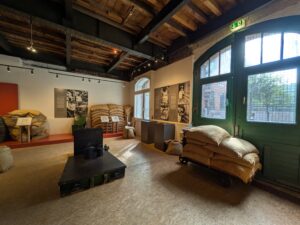
Today, when we drink a cup of coffee, almost all of this remains invisible. Inside the Speicherstadtmuseum, however, old scales, sampling tools, carts, ropes, sacks and barrels reconstruct a world in which the movement of goods depended on human hands, practical knowledge and carefully organised space.
The question is what happened when Hamburg no longer had to handle one sack, but thousands upon thousands of them.
A sack of coffee needs a warehouse. Global trade needs a city to organise itself around movement.
From Ship to Warehouse
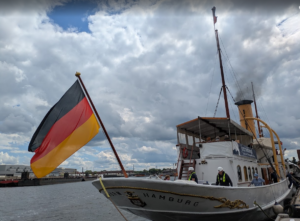
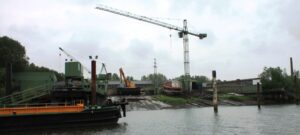
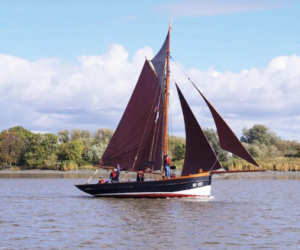
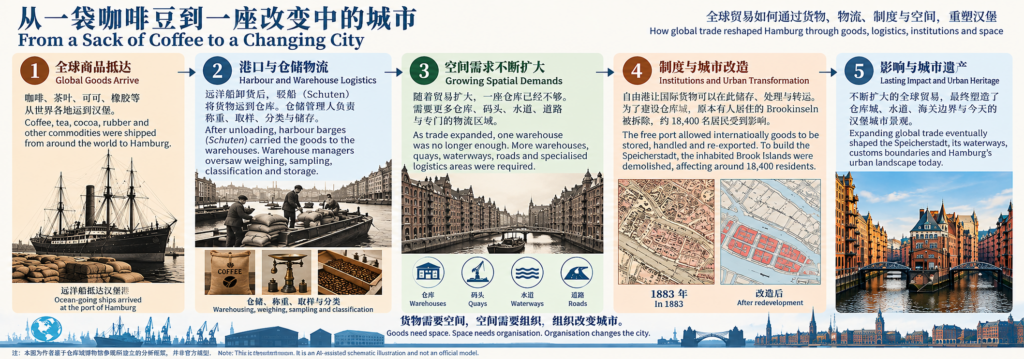
Ocean-going ships brought coffee and other goods to Hamburg, but large vessels were only one part of the journey. Smaller barges, known as Schuten, transported cargo within the harbour and brought it to the warehouses of Speicherstadt.
There, goods moved vertically as well as horizontally. Hoisting equipment lifted heavy sacks from the water to different warehouse floors, while workers received, moved and organised them inside.
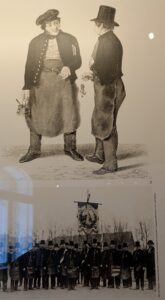
One of the central figures in this system was the Quartiersmann, a specialised warehouse manager whose work went far beyond carrying sacks. He stood between merchants, goods and storage, overseeing tasks such as weighing, sampling, quality control and the proper handling of different commodities.
There were no barcode scanners, computers or warehouse management systems. Yet nineteenth-century Hamburg had already developed a highly specialised system for controlling enormous quantities of goods. Simple tools worked because they were combined with experience, routines and detailed knowledge.
Coffee was only one commodity among many. Tea, cocoa, natural rubber, Brazil nuts and other goods arrived with different weights, values, packaging and storage requirements. Global trade entered the warehouse not as an abstract economic concept, but as thousands of physical objects that had to be understood and handled differently.
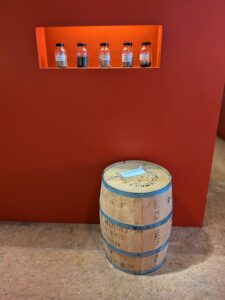
One object in the museum makes this especially tangible: a wooden barrel once used for Jamaica Blue Mountain coffee. Traditionally, this Arabica coffee was transported in barrels. Marks on the wood recorded how much had been removed over time, often in quantities of around five kilograms.
A single barrel could therefore preserve traces of an entire working process.
When One Sack Became Thousands
As trade expanded, one warehouse was no longer enough. Speicherstadt developed into a larger logistics landscape of warehouses, waterways, streets, quays, bridges and specialised working areas.
Different commodities also demanded different kinds of space. The Hamburger Freihafen-Lagerhaus-Gesellschaft, or HFLG, operated additional warehouse complexes around the Moldauhafen and Saalehafen on Kleiner Grasbrook. Goods handled there included tobacco, cotton, rice and sugar — commodities arriving in large quantities or requiring different forms of storage.
This reveals something important about the development of Hamburg. Warehouses were not simply multiplied versions of the same building. Different commodities helped produce different logistics spaces.
But storage was only part of the problem. Trade also had to operate within a customs system.
The free port created a defined area in which international goods could be stored, handled and re-exported without immediately entering the German customs territory. Coffee therefore needed more than workers and warehouses. It needed waterways, customs procedures and, eventually, a boundary.
Once global trade requires its own warehouses, transport routes, customs system and borders, another question appears:
Whose space was being reorganised to make all of this possible?
The City That Made Room for Trade
Walking through Speicherstadt today, it is easy to imagine that this area had always belonged to warehouses and harbour infrastructure.
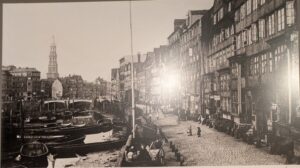
The historical photographs in the museum tell a very different story.
Before Speicherstadt, the Brook Islands were lived-in parts of Hamburg. Kehrwieder, Brook and Pickhuben contained half-timbered houses, narrow residential courtyards and small streets. Craftsmen, workers, shopkeepers and innkeepers lived there. Farther east stood Baroque townhouses once occupied by wealthy merchants.
Then came 1 November 1883.
Demolition of the Brook Islands began. By the end of 1887, large parts of the area had been cleared. Holländischer Brook survived somewhat longer, but eventually disappeared as well.
Only after seeing the streets and houses does the scale of the numbers become clear. Around 18,400 residents were affected by the redevelopment: approximately 16,000 on the Brook Islands and another 2,400 along the northern bank of what became the Zollkanal. Around 6,000 residents of Steinwerder also had to leave before the customs integration of 1888. Those displaced largely had to find new homes themselves, with limited public assistance.
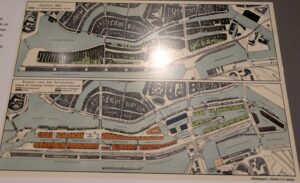
Two historical plans displayed in the museum make the transformation strikingly visible. One shows the area in 1883. The other presents the city after its reorganisation for the customs connection.
One map shows an inhabited city.
The other shows a city reorganised for trade.
The 45-metre-wide Zollkanal became both a waterway and part of the boundary between the free port and the rest of the city. Bridges such as Brooksbrücke, Jungfernbrücke and Wandrahmsbrücke turned that legal distinction into something people could physically see and cross.
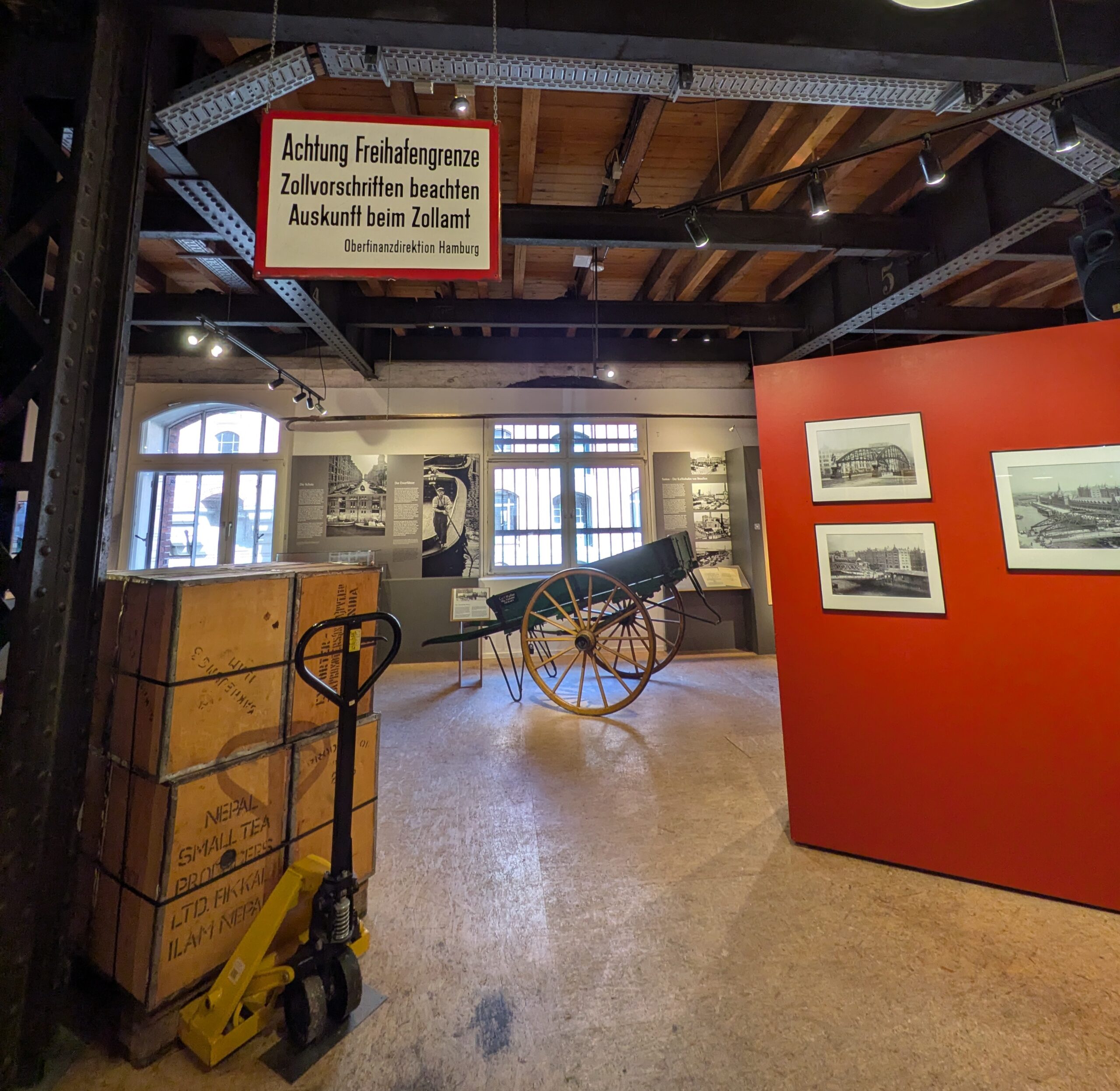
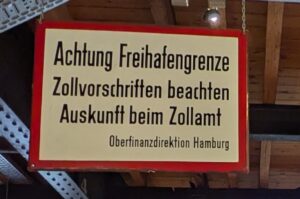
A surviving sign in the museum makes the boundary even more tangible:
“Attention: Free Port Boundary. Observe customs regulations.”
What began with a sack of coffee has now expanded into warehouses, waterways, customs rules, borders and the restructuring of urban space.
It was never one sack of coffee that reshaped Hamburg.
It was the growing global system represented by millions of such sacks.
The Man Who Kept the Memory
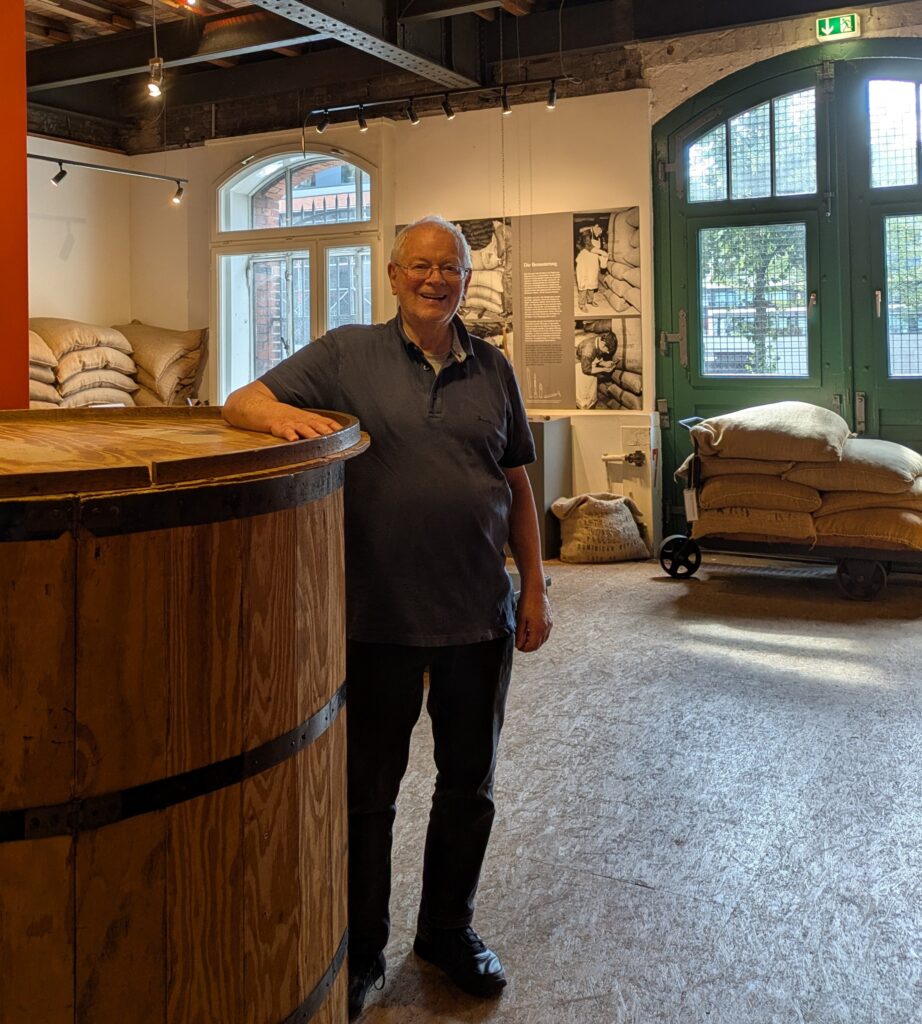
My visit to the Speicherstadtmuseum also became a personal encounter. Henning Rademacher, the museum’s founder, came to the museum especially for my visit and generously took the time to speak with me about his life, his past and the story behind the museum.
His own path began far from a museum desk. As a young man, he went to sea, later became a second officer and obtained a captain’s qualification. He subsequently studied economics before eventually joining the Museum der Arbeit. His maritime experience became relevant again as he began working with material connected to Hamburg’s harbour history.
One detail from our conversation stayed with me. The earlier Speicherstadt exhibition was not permanently accessible. As Rademacher remembered it, entering meant having to obtain a key. What sounds like a small practical inconvenience gradually became part of a much larger development: in 1995, he took over the exhibition and established the Speicherstadtmuseum as a regularly accessible museum.
More than thirty years later, he told me that what visitors see today is still only part of the collection. An entire floor of objects remains upstairs, beyond the public exhibition. It was a simple remark, but it changed the way I looked at the museum. What is displayed is only part of what has been preserved.
I am especially grateful to Henning Rademacher for coming to the museum for my visit and for sharing his personal history and the story of how the museum came into being.
A museum preserves objects.
Sometimes, however, meeting the person who preserved them allows us to see the history behind the display.
The Next Time I Drink Coffee
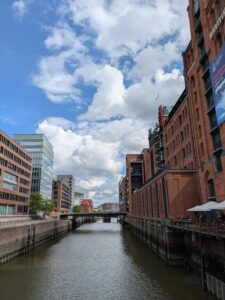
After leaving the Speicherstadtmuseum, I walked back into the Speicherstadt of today. Red-brick warehouses reflected in the waterways. Boats passed beneath bridges, visitors walked along the quays, and cafés served the commodity that had accompanied me through the museum.
Everything was beautiful.
But I could no longer see it in quite the same way.
A warehouse now reminded me of the Quartiersleute who weighed, sampled and cared for goods. A canal recalled the Schuten that carried cargo through the harbour. A bridge recalled the former free-port boundary. And a cup of coffee began to contain far more than coffee.
Behind it were ships and hands, tools and knowledge, warehouses and waterways, customs regulations and urban decisions.
When we lift a cup of coffee, we usually see only the drink in front of us. But if we follow the journey of the beans far enough backwards, we may enter a warehouse, cross a harbour and eventually find ourselves inside the history of a city.
Across Civilizations
King Kaolie stood beside the two old maps for a long time.
“So all of this was done for trade?” he asked.
“For trade, storage and the movement of goods,” I replied.
The king looked again at the streets that had disappeared. “A ruler opens waterways, builds storehouses and clears land when the state requires it. Why should that surprise you?”
Lord Chunshen Huang Xie smiled. “Because Your Majesty is looking at the new warehouses. She is looking at the houses that disappeared.”
The king turned toward me. “Is he right?”
“Partly,” I said. “But I am also looking at the river.”
Huang Xie looked interested. “Now that sounds more familiar.”
Chu had also been shaped by water. Rivers were routes of movement, exchange and power. Boats carried people and goods, while settlements grew in relation to waterways. A river was never merely scenery.
King Kaolie nodded. “Then Hamburg did what cities have always done. Goods arrive. Routes expand. Storehouses are built. The city changes.”
“But who changes first?” I asked.
The king frowned.
Huang Xie looked back at the maps. “Perhaps that is the wrong question. Goods change the city, but the city also determines how goods can move. And behind both are people making choices.”
“So the coffee beans did not reshape Hamburg?” the king asked.
“One sack did not.”
“A million sacks?”
“That is different.”
The king laughed. “Then your title survives.”
We walked back toward the water. The old customs boundary had disappeared, but the canal remained. Warehouses still stood where homes once stood, and the shape created for nineteenth-century trade had become part of twenty-first-century Hamburg.
Huang Xie looked at me. “You began with coffee.”
“Yes.”
“And ended with people.”
“Again.”
He smiled. “Then perhaps you were never really studying coffee.”
Goods travel across the world, but they never move through empty space. They require people, knowledge, routes and rules — and when their movement becomes large enough, they begin to reshape the places through which they pass.

 时间:2026年08月31日 (一)
 行程|汉堡 · 仓库城博物馆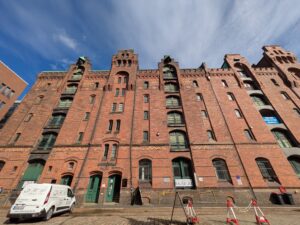
 本站所有原创作品均已完成区块链存证,确保原创凭证。部分重点作品另行提交国家版权登记,作为正式法律备案。原创声明与权利主张已公开。完整说明见: