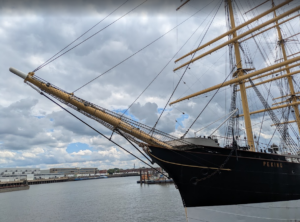
After the Visitors Leave: One Night Aboard the Ocean-Going Freighter Cap San Diego
Acknowledgement|My thanks to Cap San Diego for providing a complimentary museum ticket and a special rate for my overnight stay aboard the vessel.
After the Visitors Left
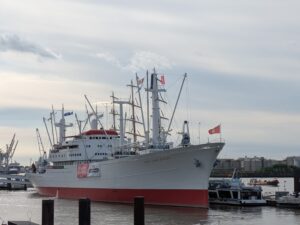
During the day, Cap San Diego is a museum ship. Visitors walk through her cargo holds, engine room and bridge, learning how an ocean-going general cargo ship of the early 1960s was built to work.
On 2 September 2026, I did the same. I walked through machinery spaces, stood on the bridge, looked at cargo-handling equipment and followed passageways through the ship. But when the museum day ended and the other visitors left, I did something different.
I stayed aboard.
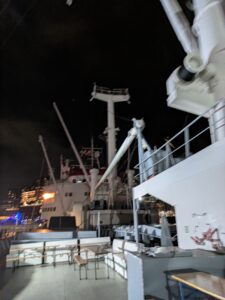
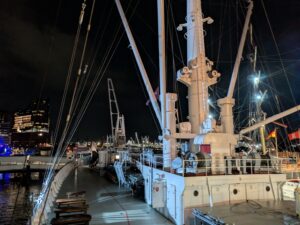
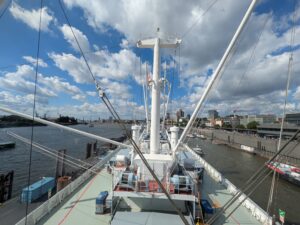
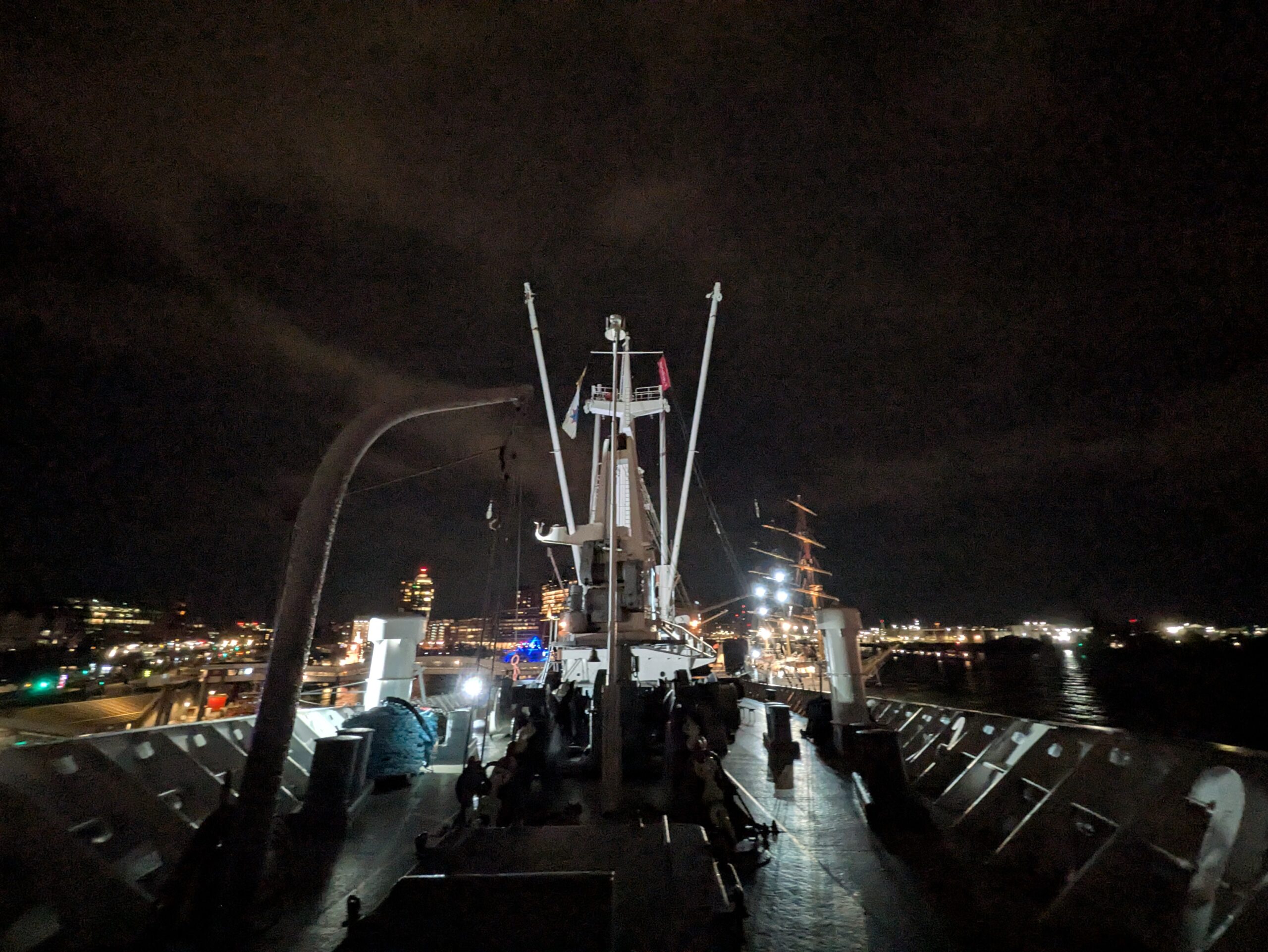
As evening settled over Hamburg, the deck became quiet. Derricks, masts and cables stood against the night sky, while the lights of the harbour appeared beyond the railings. Cap San Diego was still the same ship, but my relationship with her had changed. I was no longer simply walking through an exhibit. For one night, I would eat, shower, sit, sleep and wake inside the vessel.
That raised a question I had hardly considered during the daytime visit: How does a machine built to carry cargo across oceans also become a working and living environment for the people who operate it?
Sleeping Inside the Machine
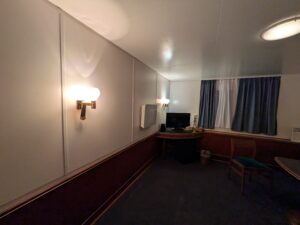
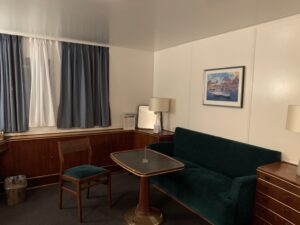
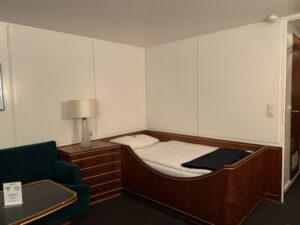
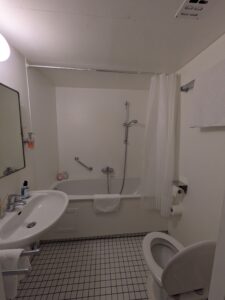
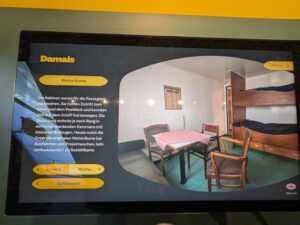
My cabin contained things that would be ordinary on land: a bed, a sofa, a table, cupboards, lamps and a bathroom. Yet their presence inside a ship changed the way I looked at them.
A bed aboard a ship is not simply a bed placed inside a room. Furniture has to fit within a limited structure. Passageways have to remain usable. Objects cannot be allowed to move freely when the ship moves. People need somewhere to sleep, wash, sit and store their belongings without interfering with the work of the vessel.
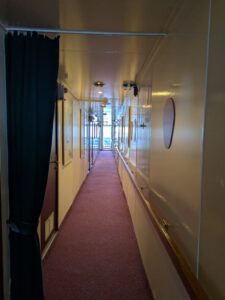
That evening, these questions became physical rather than theoretical. I walked through the corridors, opened doors, sat in the cabin, used the bathroom and eventually lay down to sleep. The dimensions of the ship were no longer something I only observed from outside. My own body had entered them.
Some dimensions can be observed with the eyes. Others are only understood when the body enters them.
It was then that I began to see ship design differently. Designing a ship is not only a matter of accommodating machinery and cargo. It also means deciding how human beings can continue to live inside a machine.
A Small Society Inside a Hull
From my cabin, I began to mentally retrace the spaces I had visited during the day.
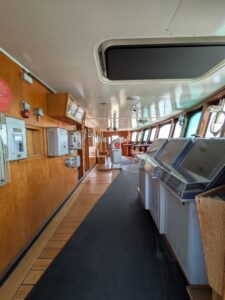
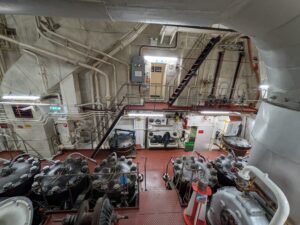
The bridge was not simply a room filled with instruments. It was a workplace where people navigated, communicated, observed and made decisions. The engine room was not merely an exhibition of machinery. It was another workplace, with different responsibilities and forms of knowledge.
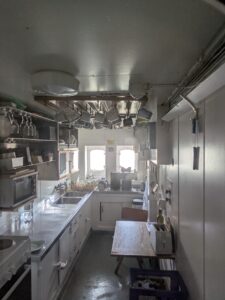
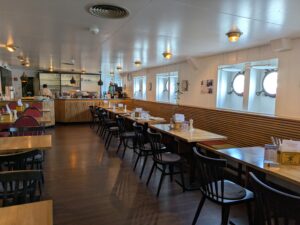
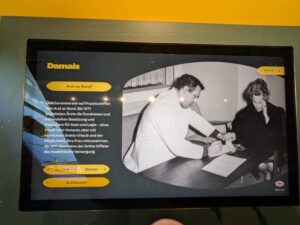
Elsewhere were the galley, dining spaces, cabins, bathrooms, corridors and medical facilities. Taken separately, these spaces may appear secondary to the technical purpose of a cargo ship. Taken together, they reveal something much larger.
An ocean-going ship has to compress many functions that are normally distributed across life on land into a single moving structure. People navigate the vessel, operate machinery, handle cargo, prepare meals, keep watch, sleep, wash, rest and, when necessary, receive medical care.
They cannot finish a shift and commute home. For days or weeks, workplace, living space, transport system and social environment overlap inside the same steel hull.
This may be what makes an ocean-going ship so unusual: a change of scale. Functions that are dispersed across a city on land have to move closer together at sea.
A city spreads its functions across space. A ship has to stack them together. Navigation, propulsion, cargo handling, eating, sleeping, medical care and recreation all have to coexist within the same hull. In that compression, the ship begins to resemble a small society.
Cap San Diego therefore began to appear to me as two systems at once: a technical system and a social system.
Everything Must Fit
But a ship cannot expand indefinitely whenever another function needs more room. Its dimensions, structure, weight, stability and operating purpose impose boundaries. Within those boundaries, many competing requirements have to coexist.
The deck makes this particularly visible. Derricks need operating space. Cables need direction. Winches need positions from which they can work. Cargo needs to be handled. At the same time, people need safe routes through the same environment.
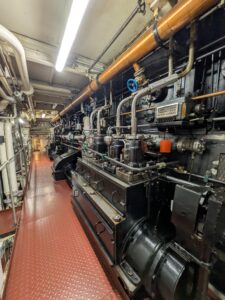
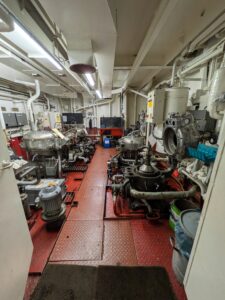
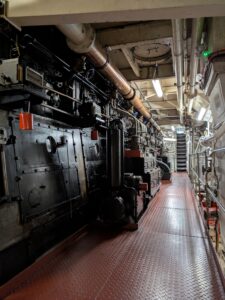
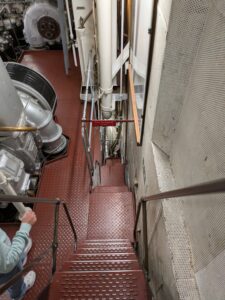
The same logic continues inside. Machinery requires space. Pipes have to run somewhere. Instruments must be positioned where people can operate and read them. Stairs, doors and corridors connect working areas. Cabins, tables, cupboards and beds occupy another share of the same finite hull.
Structure, machinery, cargo and people are in constant negotiation for space.
A ship does not begin with empty space waiting to be filled. It begins with boundaries, and within those boundaries, every function has to make room for the others.
This led me to a simple analytical framework:
Everything must fit.
Ship design, viewed from this perspective, is the art of making structure, machinery, cargo and human beings coexist within a boundary that cannot simply be pushed outward whenever a conflict appears.
The Bridge: A Human–Machine System
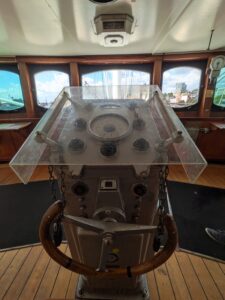
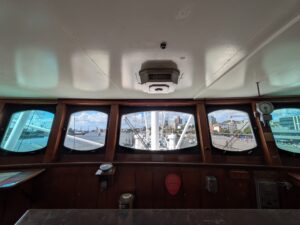
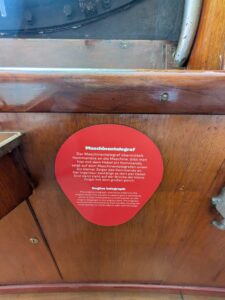
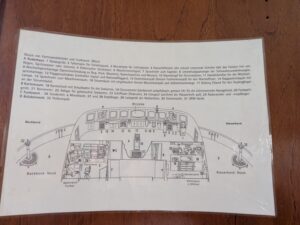
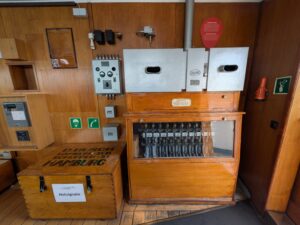
The bridge made this relationship especially clear. At first glance, it is easy to focus on individual objects: the wheel, gyrocompass, radar, echo sounder, engine telegraph, course recorder, chart table and communication equipment.
But the more interesting story lies in the relationships between them.
Information arrives from different sources. Water depth is measured. Course is recorded. Tidal conditions are predicted. Engine orders are communicated. Visual, sound and radio signals connect the vessel with the world outside. Fire-detection and emergency systems wait for situations in which normal operation is no longer enough.
Automation was already part of this world. Cap San Diego had automatic steering, for example. Yet automation did not remove the human being from the system. Instruments produced information, machines responded to commands, and people still had to observe, interpret, communicate and decide.
The bridge was therefore not simply a collection of technology. It was a space deliberately organized around the interaction between technology and human judgement.
When the Ship Becomes Quiet
At night, most of this complexity disappeared from view.
From the deck, I could see Hamburg glowing beyond the ship. The machinery spaces were below me. The bridge stood above. Behind the white hull were cabins, corridors, dining spaces and all the other places I had walked through during the day.
From outside, they were almost invisible.
That may be one reason why it is easy to think of a cargo ship primarily in terms of cargo capacity, machinery, speed or technical performance. Human life occupies less visible space in the image of the machine, even though the machine historically depended on people living and working inside it.
Spending the night aboard changed the scale at which I understood the vessel. I had first entered Cap San Diego to look at a ship. By morning, I was looking at a carefully organized environment in which machines, work and everyday human life had been fitted together.
Back on Shore
The following morning, I packed my things and walked through the corridors one last time. Then I crossed the deck and went ashore.
As the distance increased, the spaces I had inhabited disappeared back into the hull. The bed, bathroom and table were no longer visible. The engine room sank beneath the decks. The bridge returned to its place high above me. From the quay, Cap San Diego once again looked like a complete ship.
But I could no longer see her in quite the same way.
Before going aboard, I knew that she was an ocean-going cargo ship. During the museum visit, I saw how her technical systems worked. After spending a night aboard, I understood something else: cargo and machinery were never the only things that had to find a place inside the hull.
People had to fit too.
The larger the machine becomes, the harder it is to avoid one question: Where is the human being?
Every large system ultimately has to make room for the people within it—not merely by assigning them a user ID, but by leaving room for someone who can understand the system, take over when necessary, and bear responsibility for what happens.
Across Civilizations
King Kaolie looked around the cabin, then through the window toward the deck.
“Chu was a land of rivers,” he said. “Boats carried people and goods in our time as well. But this sea-going vessel seems to carry much more than cargo.”
Lord Chunshen Huang Xie nodded. “A riverboat can return to the shore. Out at sea, the shore may disappear for days. Many things that normally remain on land must therefore travel with the ship.”
“The bridge, the engine room and the cargo holds,” I said, “but also the galley, dining spaces, cabins and medical facilities.”
The king considered this for a moment. “Then what has been placed inside this hull is not simply cargo. It is an entire way of living.”
“If we looked at it with Chu eyes,” Huang Xie said, “we might say that a small town has been compressed into a ship and sent travelling across the water.”
King Kaolie looked toward the deck again. “And like a town, everyone has a different responsibility. The person steering cannot do the work of the engine room, and the engineer cannot replace the cook.”
“Exactly,” I said. “But they still have to work as one system.”
Huang Xie smiled. “Chu had its Lingyin, its Sima and many other officials with different responsibilities. Different duties did not mean that each person could act independently of everyone else.”
The king nodded. “Then perhaps the difficult part is not fitting things into the ship. It is giving machines, cargo and people their proper places without allowing one to prevent the others from functioning.”
“Machines need space,” I said. “Cargo needs space. People need to work and rest. But the ship cannot expand without limit.”
Huang Xie looked around the cabin. “Objects have their dimensions. Human beings have theirs. If a vessel makes room for its machinery but not for the people who operate it, it will not travel very far.”
The next morning, we stood on the quay. Cap San Diego was behind us, and the cabin, corridors and bathroom had disappeared once again inside the white hull.
King Kaolie looked back at the ship.
Two thousand years have passed.
Ships have changed beyond recognition.
But one thing has not changed:
When a civilization creates new technologies,
it must also think carefully about
the place of human beings within them.

 时间:2026年09月02日 (三)
 行程|汉堡 · Cap San Diego 登船参访与过夜