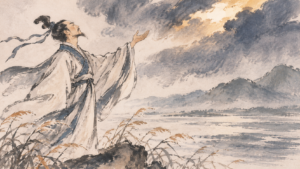
封面图说明|
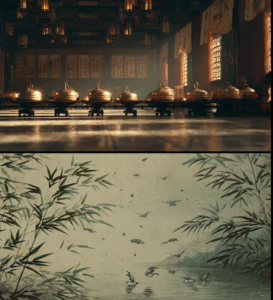
女子独立江畔,
浮云不传信,归鸟不寄情。
江水苍茫,初心不改。
图片:原创数字插画。
引文|浮云不传信,归鸟不寄情
当所有传递心意的道路都已断绝,
一个人为何仍不愿改变最初的志向?
楚国的江水缓缓流向远方,
一位诗人独立岸边凝望天际。
他想托浮云传递心中的话语,
却连掌管云雷的丰隆也不肯相助。
他又想托归鸟带去自己的思念,
归鸟却飞得太高太远。
这并非寻常的离别与思念,
而是忠诚失去回应的孤独。
当君臣之间的信任逐渐瓦解,
连最真挚的言语也无处抵达。
然而屈原并非没有想过改变。
他曾考虑顺应世俗以求出路,
却又不愿背弃最初的理想。
一|《思美人》:从思念无路到未改此度
道路可以阻断,言语可以无人回应,
但一个人的志向,是否也必须随之改变?
1. 美人何指:从思念到政治理想
「思美人兮,擥涕而竚眙。」
《思美人》以深沉的思念展开,
却不止于寻常的离别之情。
在《楚辞》的象征世界中,
「美人」并非只有容貌之美,
也常被赋予君王与理想的意义。
传统注家多将美人理解为楚王,
但诗歌并未直接指明身份,
也为后世留下了不同的诠释空间。
诗人真正痛苦的地方,
并不只是美人远在天涯;
而是自己仍然怀抱着忠诚与理想,
却再也无法将心意传达给对方。
2. 媒绝路阻:当语言失去抵达的道路
「媒绝而路阻兮,言不可结而诒。」
屈原没有因此停止寻找出路。
他将目光从人间转向天空,
试图借助自然与神灵的力量,
跨越现实世界无法逾越的阻隔。
「愿寄言于浮云兮,遇丰隆而不将;
因归鸟而致辞兮,羌迅高而难当。」
浮云原本可以飘向远方,
却无法替诗人传递心中的话语。
归鸟飞得太高太快,
转眼便消失在遥远的天空。
浮云与归鸟不断移动,
看似拥有穿越空间的自由;
却无法成为诗人真正的信使,
天地辽阔反而衬托出他的孤独。
3. 车覆马颠:明知失败,为何仍不改其度?
「欲变节以从俗兮,媿易初而屈志。」
当所有传递心意的道路都已断绝,
诗人开始重新审视自己的选择。
改变或许意味着获得新的机会,
坚持却可能带来更深的孤独。
「知前辙之不遂兮,未改此度。
车既覆而马颠兮,蹇独怀此异路。」
他并非不知道失败的后果,
也并非看不见现实中的危险;
只是过去的失败并未使他相信,
自己原本坚持的价值必然错误。
值得注意的是诗人并未停止思考,
他还想重新驾驭骏马继续前行,
并请传说中的御者造父执辔,
希望在等待时机中寻找新的道路。
4. 芳华自中出:人格价值是否需要他人承认?
「惜吾不及古人兮,吾谁与玩此芳草?」
诗人怀念古代贤者的精神世界,
却感叹自己无法与他们同时而生。
这是一种比政治失意更深的孤独,
因为他渴望的不只是获得认可,
而是有人真正理解自己的志向,
能够共同辨认何为值得珍惜的价值。
「芳与泽其杂糅兮,羌芳华自中出。
纷郁郁其远承兮,满内而外扬。」
这里出现了全诗重要的思想转折:
诗人不再只关注心意能否送达,
而是开始强调自身品德的保存。
即使无人理解,
也不愿失去芬芳;
有些价值,
并不需要别人的承认才能成立。
「独茕茕而南行兮,思彭咸之故也。」
全诗最终回到孤独南行的画面。
诗人离开熟悉的道路与人群,
将目光投向古代贤者彭咸。
南行并不意味着困境已经解除,
诗人依然面对无法改变的现实,
只是决定不再以世俗回应衡量自身。
二|当《思美人》成为歌:让无法抵达的思念重新有声
浮云未能传递的心意,
在两千三百年后化作歌声。
2025 年夏天,我开始为《楚辞》谱曲,
《思美人》便是其中一首作品。
创作从整理原文与标注拼音开始,
再将诗句交由 SUNO AI 生成旋律。
《楚辞》包含许多生僻字与古词,
对 AI 的发音能力形成挑战。
《思美人》的部分唱腔带有粤语调感,
反复生成也未必能够改善结果。
经过多次尝试与长时间修改,
最终决定保留这个不完美的版本。
AI 能够生成旋律与歌声,
却不代表真正理解古典语言;
技术的便利仍有其局限。
《楚辞·九章·思美人》|AI谱曲作品
尾声|思念未必抵达,声音却能穿越时间
当年的思念未能抵达楚王宫廷,
如今却穿越漫长的历史岁月;
在文字与旋律的交会之间,
重新找到了愿意聆听的人。
屈原曾将心意寄托于浮云,
又盼望归鸟带去未尽的言语。
然而天地辽阔而音信难通,
最终只留下孤独南行的身影。
浮云不传信,
归鸟不寄情;
而真正留下的声音,
终究不必依靠当年的回应,
也能在后世获得自己的回声。
有些话,说给谁听,
谁没有听见,都不重要;
重要的是,两千多年后,
还有人愿意听。
楚人对话后记|考烈王、黄歇与令尹夫人的观后感
道路不通,志向是否仍须坚守?
《思美人》的歌声渐渐结束。
考烈王问黄歇:
「春申君,屈大夫明知前路不通,
为何仍然不愿改变自己的志向?
难道坚守比实现理想更重要?」
黄歇沉思片刻回答:
「大王,道路不通可以另寻道路,
时势不利也可以等待时机;
但改变道路,不等于放弃志向。」
考烈王又问:
「若忠诚始终得不到回应,
这样的坚守究竟还有何意义?」
黄歇望向远处的归鸟:
「大王,若忠诚只为获得回应,
人的志向便掌握在他人手中;
君王的赏识,岂能决定人格的价值?」
我听着他们的对话,想起《思美人》中的一句:
「知前辙之不遂兮,未改此度。」
坚守值得尊敬,
但坚持是否也可能成为执念?
若始终不肯改变原来的道路,
又如何知道自己没有走错?
黄歇转身望着我:
「夫人,这正是为政者的难处。
若凡事坚持,便可能错失时机;
若事事变通,又可能失去原则。」
初心不改,究竟是坚守还是执念?
答案不在屈原那里,
而在每一个读《思美人》的人身上。
浮云不传信,归鸟不寄情;
而那句未改此度的誓言,
穿过两千三百年,
仍然在问今天的人:
你守的,是志向,还是执念?
屏幕上的《思美人》已经唱完。
江面上的归鸟早已远去,
只有暮色中的流水依然向前。
说明:本篇对话为作者依据《楚辞·九章·思美人》及楚国历史创作的跨越时空文学想象,并非真实历史对话。
Appendix|English Narrative Overview
When Clouds Carry No Message and Birds Bring No Reply: A Heart That Remains True
Chu Ci · Jiu Zhang · Si Mei Ren (Longing for the Beautiful One)
When Loyalty No Longer Finds an Answer
A solitary poet stands beside a river in the ancient kingdom of Chu, searching the distant sky for someone who might carry his message. Clouds drift across the heavens, but even the divine Fenglong refuses to help. Returning birds seem to offer another possibility, yet they fly too high and too swiftly to be reached. The world is vast and full of movement, but not a single messenger can deliver the words he longs to send.
This is the emotional landscape of Si Mei Ren (思美人, Longing for the Beautiful One), traditionally attributed to Qu Yuan. The mysterious beautiful one has often been interpreted as the ruler of Chu, although the poem leaves the figure’s identity open to interpretation. Beneath its language of longing lies a political and moral dilemma: what happens when loyalty survives, but the relationship that once gave it meaning has broken down?
The speaker cannot make himself understood, yet he cannot easily abandon what he believes. His predicament gradually changes from a search for someone willing to listen into a confrontation with his own convictions. The question is no longer simply whether his message will arrive. It is whether he should remain unchanged when every attempt to reach its destination has failed.
I. The Unreachable Beautiful One | Between Loyalty and Conviction
In the political world of ancient Chu, a minister’s loyalty could involve more than obedience to a ruler. It might also express a commitment to the welfare of the kingdom and to principles of good government. When a ruler withdrew his trust, a minister could lose not only his position but also the opportunity to put his ideals into practice. This tension gives the speaker’s longing its deeper significance. He seeks recognition because he still believes that his intentions deserve to be understood.
The failed messengers transform this political frustration into a striking poetic landscape. Clouds can cross mountains, and birds can travel across rivers, yet neither can overcome the distance between two human beings. The problem is not a lack of movement, but a lack of communication. The speaker discovers that sincerity alone cannot compel another person to listen. Even the boundless sky offers no escape from the limits of human relationships.
The poem then introduces an overturned carriage and fallen horses, suggesting that the speaker’s chosen path has already brought failure. He recognizes the danger of continuing and considers adapting to prevailing customs. Yet he fears that such a compromise would mean surrendering his original principles. His determination is not entirely without reflection: he also imagines preparing another journey with the legendary charioteer Zaofu. The possibility of changing direction remains, even if abandoning his purpose seems unacceptable.
This distinction between changing a path and abandoning a principle becomes central to the poem. Failure does not necessarily prove that the values behind an action were mistaken, but neither does loyalty guarantee that every decision was wise. The speaker must confront a question familiar to anyone who has struggled with disappointment: when should perseverance continue, and when should experience lead to change?
Towards the end, the imagery shifts from distant messengers to fragrant plants. In Chu Ci, fragrance often represents cultivated virtue and moral character. The speaker longs for companions who can appreciate these qualities, yet the poem suggests that fragrance emerges from within, regardless of whether anyone recognizes it. His search for acknowledgment gradually gives way to the possibility of preserving his character without external approval.
The final image is one of solitary movement towards the south, accompanied by a reference to the ancient figure Peng Xian. No reconciliation has occurred, and the speaker’s political difficulties remain unresolved. Nevertheless, something has changed. He no longer measures the entire worth of his convictions by whether the beautiful one responds. The poem leaves him travelling alone, carrying principles whose ultimate meaning remains open to the reader’s judgment.
II. Giving Si Mei Ren a New Voice | An AI Musical Interpretation
During the summer of 2025, I began creating AI-assisted musical interpretations of Chu Ci, including Si Mei Ren. I prepared the original classical Chinese text with Hanyu Pinyin annotations and used SUNO AI to generate melodies and singing voices. My intention was not to reconstruct the historical music of ancient Chu, but to explore how its surviving poetry might be experienced through contemporary technology.
The experiment proved more difficult than expected. Classical Chinese contains uncommon characters and expressions that AI systems do not always pronounce accurately. Despite repeated attempts, parts of Si Mei Ren developed unexpected vocal intonation, sometimes resembling Cantonese. Further generations did not consistently improve the result, and I eventually chose to preserve an imperfect version.
The experience revealed both the possibilities and limitations of AI-assisted creation. Technology can generate music without necessarily understanding the historical language it performs. Yet a poem that might otherwise remain unfamiliar to modern audiences can acquire another form of expression. Through melody, the longing, frustration, and determination of Si Mei Ren become experiences that unfold in time, inviting listeners to encounter the original words in a different way.
Video: Chu Ci · Jiu Zhang · Si Mei Ren — Longing for the Beautiful One | AI Musical Interpretation | 7:32
Epilogue | The Message That Survived Without an Answer
The speaker of Si Mei Ren never succeeds in delivering his message. Neither clouds nor returning birds can overcome the distance separating him from the beautiful one. His loyalty receives no promised reward, and the poem offers no assurance that his convictions will lead to success. Yet the words themselves have survived long after the political world in which they were imagined disappeared.
This creates an unexpected contrast between immediate recognition and historical memory. A person may fail to reach the one whose understanding matters most, while the expression of that failure continues to speak to later generations. Literature cannot restore a broken relationship or reverse a political decision. It can, however, preserve the questions that remain after those events have passed.
Si Mei Ren offers no simple answer to whether steadfastness is always admirable. Integrity can require resistance to pressure, but determination can also become an unwillingness to reconsider. The distinction depends on what is being defended and whether a different path might preserve the same essential purpose.
More than two thousand years later, the clouds still carry no message, and the returning birds still bring no reply. Yet the poem has found readers and listeners far beyond its original world. The response that never arrived in the speaker’s lifetime is no longer the only measure of his voice. Sometimes words survive precisely because their questions remain unanswered.
Across Civilizations
King Kaolie, Huang Xie, and Lady Lingyin | When Does Conviction Become Obsession?
The final notes of Si Mei Ren faded, leaving a quiet river on the screen. King Kaolie turned towards Huang Xie, Lord Chunshen, and asked why Qu Yuan would continue defending his principles when the path before him had already failed. As a ruler, he understood the importance of adapting to circumstances. A minister might possess admirable intentions, but what could those intentions accomplish if he refused to find another way?
Huang Xie considered the question. “Your Majesty, a blocked road does not mean that the destination must be abandoned. Circumstances may require a different strategy, but changing one’s method is not necessarily the same as surrendering one’s principles.” The king remained doubtful. If loyalty received no recognition and produced no practical result, could perseverance still be considered meaningful? Huang Xie replied that a ruler’s favor might determine a minister’s position, but it could not alone determine the worth of his character.
Listening to their exchange, I remembered the speaker’s declaration that he had not changed his course despite previous failure. “Lord Chunshen,” I asked, “steadfastness deserves respect, but can it also become an obsession? If someone refuses to reconsider a path, how can that person know whether it was mistaken?” Huang Xie turned towards me. “Lady Lingyin, that is the difficulty of governing. Someone who insists on every decision may miss the opportunity to act, while someone who compromises on everything may eventually lose every principle worth defending.”
King Kaolie looked again at the river. Neither of us could offer him a simple verdict on Qu Yuan. The poem had survived for more than two millennia, yet the distinction between conviction and obsession remained difficult to establish. Perhaps its enduring significance lies in asking readers to examine their own choices. Are we protecting a principle that deserves to endure, or holding on to a path because we cannot bear to admit that it may have been wrong?
The recording had ended. The returning birds had disappeared beyond the river, and the last light of evening was fading. No one spoke again. Only the water continued flowing through the gathering dusk.
Historical and literary note: This dialogue is a fictional encounter across time, inspired by Chu Ci · Jiu Zhang · Si Mei Ren and the history of the kingdom of Chu. King Kaolie and Huang Xie, Lord Chunshen, lived after Qu Yuan. Their conversation with Lady Lingyin is a literary reflection, not a historical record.
🤖 人工智能协作声明
本文的主题选择、田野调查、资料搜集、核心观点与中文原始内容,均由作者独立完成。创作过程中,作者与人工智能模型,进行持续协作,包括多轮讨论、思路推演、叙事节奏调整、部分翻译、英文 Narrative Overview 生成、语言检查、结构检测与文字润饰。
人工智能在此过程中,作为创作协作者,参与内容发展与语言表达,但不作为法律意义上的作者或著作权主体。所有 AI 协作产生的内容,均由作者依据田野资料、原始文献与中文母稿,进行选择、审校、修改与艺术化重构。文章的叙事方向、内容取舍、创作决策、最终表达与价值判断,均由作者决定并负责。
📜 本站所有原创作品均已完成区块链存证,确保原创凭证。部分重点作品另行提交国家版权登记,作为正式法律备案。原创声明与权利主张已公开。完整说明见:
👉 原创声明 & 节奏文明版权说明 | Originality & Rhythm Civilization Copyright Statement – NING HUANG
节奏文明存证记录
本篇博客文为原创作品,由黄甯与 AI 协作生成,于博客网页首发后上传至 ArDrive 区块链分布式存储平台进行版权存证:
- 博客首发时间:2026年11月15日
- 存证链接:878df22a-ba30-4452-a7a3-fde2de5b77f7 (arweave.net)(已于 2026年11月15日上传)
- 原创声明编号:Rhythm_Archive_15_Nov_2026/chu-ci-jiu-zhang-si-mei-ren-clouds-birds-steadfast-heart
- 用途声明:本文为《节奏文明观》之篇章,亦参与构建《AI×非遗文明共构档案》与《文明节奏回声计划》,用于文明节奏实地记录、区块链存证、跨域协作与版权登记用途。
© 黄甯 Ning Huang, 2026. All Rights Reserved.
本作品受版权法保护,未经作者书面许可,禁止复制、改编、转载或商用,侵权必究。
📍若未来作品用于出版、课程、NFT或国际展览等用途,本声明与区块链记录可作为创作时间及原创性的佐证。