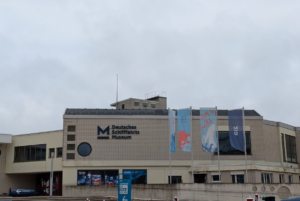
The People Who Build Ships | German Maritime Museum, Bremerhaven
Ships are remembered by name. The people who built them rarely are.
This was the hardest museum to walk through during my entire North German fieldwork — not because there was too little to see, but because there was too much. From the Hanseatic cog to modern shipbuilding, from welders to the cargo vessels that reshaped world trade, I kept searching the galleries for the ship, the port, the voyage — the story this museum was actually trying to tell. It wasn’t until I was sorting through my photographs afterward that it came together: the Hanseatic ship, the lofting floor, the welding workshop, the union newspapers, the migrant workers, the shipyard’s history — they were all telling the same story. A ship leaves the yard and sails out to sea. The people who made it possible stay behind.
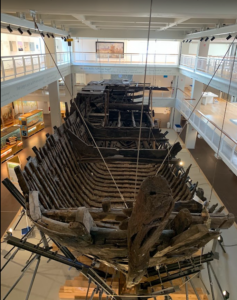
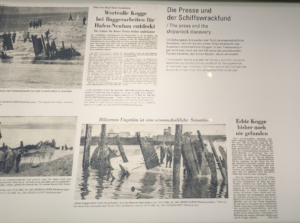
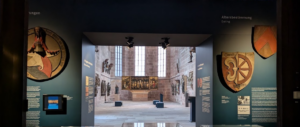
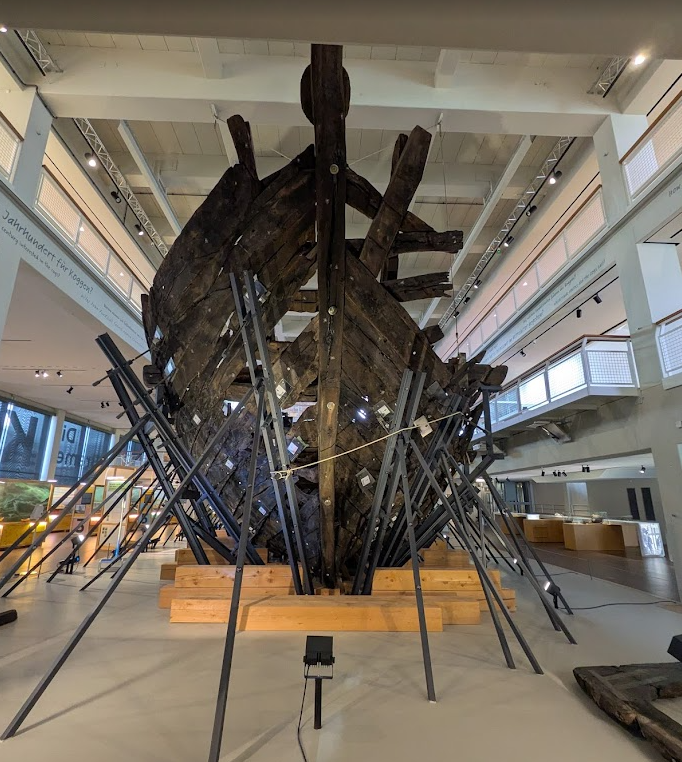
The first thing visitors encounter is a fourteenth-century cog — a Kogge — once sailed between the North Sea and the Baltic through the Hanseatic trading network, carrying goods, merchants, and news between ports. More than six hundred years later, it was recovered from the bed of the Weser River, its hull incomplete, mast and sail long gone, leaving only a massive wooden skeleton. I assumed, at first, this was simply an archaeology story. What actually surprised me wasn’t how the ship was found — it was that it had never really left.
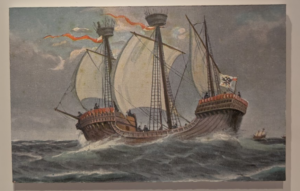
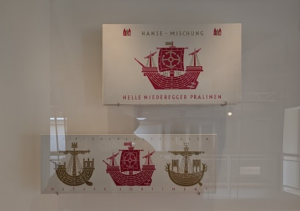
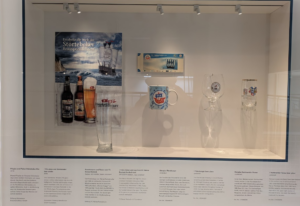
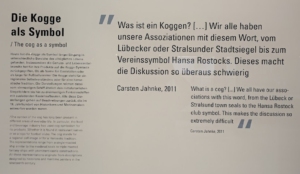
I kept encountering it again after leaving the cog exhibit: on postcards, stamps, medals, candy tins, beer mugs. As though the ship, once out of the water, had found another way to keep existing. Many of the objects on display weren’t medieval relics at all — they belonged to the nineteenth century, the twentieth, even today. But across every era, people kept drawing the same silhouette: tall stern castles, billowing sails, a thick, sturdy hull. Repeated for centuries, the cog stopped being simply a cargo vessel or a merchant’s means of transport. It became a symbol — of Hanseatic prosperity, of the connection between the North Sea and the Baltic, of a shared history claimed by cities across northern Germany. The ship sank. The cargo disappeared. The trade routes changed entirely. But the memory of that ship stayed embedded in daily life. Six hundred years ago, it connected two seas. Six hundred years later, it connects northern Germans to their own past.
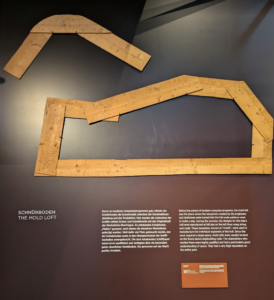
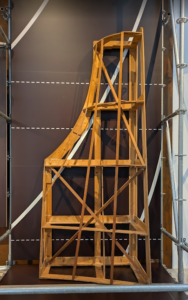
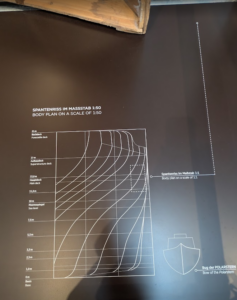
If the cog told the story of a ship after it left port, the next section told the story of everything that happens before a ship ever touches water. Before computers, shipbuilders worked in a Schnürboden — a lofting floor — where engineers’ drawings had to be translated into full-scale outlines chalked directly onto the floor, then converted into templates sent out to different workshops as the basis for construction. Standing before those hull curves, I understood: a ship doesn’t begin at the bow. Long before any steel is cut, it already exists inside a designer’s mind. Shipbuilding is the process of turning an idea into something heavy enough to cross an ocean.
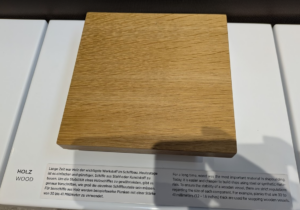
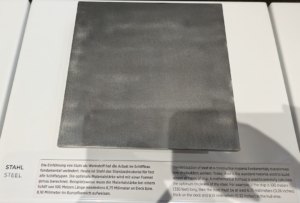
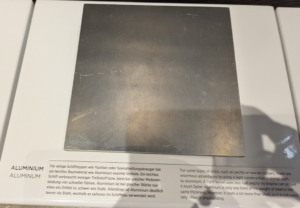
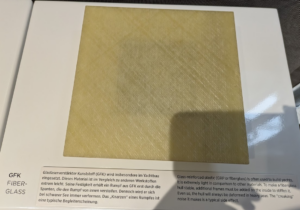
For millennia, wood was the primary shipbuilding material — fishing boats, merchant vessels, ocean-going sailing ships, all built from timber. Industrialization brought steel, better suited to larger hulls, heavier cargo, and longer voyages; later, aluminum and fiberglass entered the trade as well. Each material reflected a different era’s relationship with the sea.
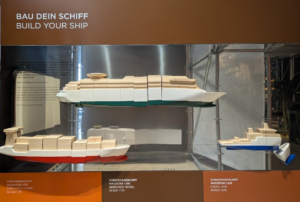
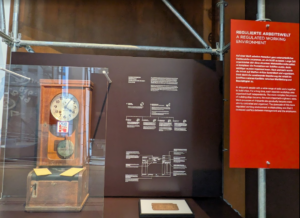
Once material reached the yard, the real challenge began: cutting, transporting, assembling, and joining steel plate into a hull. Riveting gradually gave way to welding. The tools on display — sparks flying, deafening hammer strikes, the same physical labor repeated day after day — bring the old shipyard back to life. Modern shipbuilding looks more like large-scale modular construction: bow, stern, and midsection often built separately before final assembly, as the museum’s models clearly demonstrate. A great ship is never finished in a single pass. It’s the accumulated work of countless parts, countless processes, countless people.
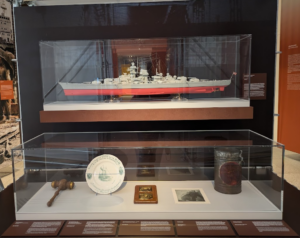
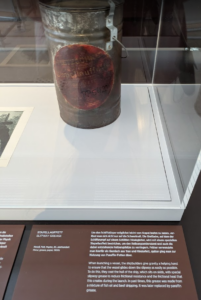
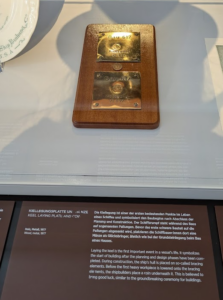
Keel-laying is considered one of the most important moments in a ship’s construction — the keel being the first major component installed, marking the formal start of building. Display cases preserve keel plaques and lucky coins, following the tradition of placing coins beneath the hull for good fortune, not unlike a building’s foundation ceremony. From that moment on, a ship has a name, a hull number, a fate of its own.
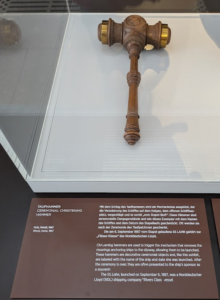
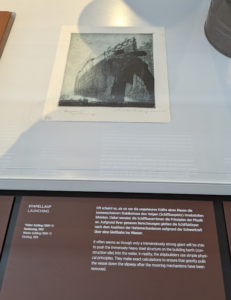
The true climax comes on launch day, as the hull slides down an inclined slipway into open water, its entire weight briefly balanced on a single structure — the smallest miscalculation could capsize it. Naming ceremonies typically precede launch, most commonly involving breaking a bottle of champagne or sparkling wine against the bow; the naming mallets on display are relics of exactly that tradition. Once struck, the restraints release, and the ship begins its slide into the sea — no longer a shipyard project, but a real ship at last. These ceremonies often carried political and social weight too, with dignitaries or public figures serving as godmothers or sponsors — a tradition that continues today, still bringing together shipping companies, financial institutions, and political figures for a shared public occasion. To an observer, it’s a celebration. To me, it looked more like the ending of a long labor — because by the time a ship touches water, countless people have already left their time and effort embedded in it.
The final section turns to the people who make a ship possible at all — designers, welders, crane operators, propulsion engineers, final inspectors. Once a ship is complete, all of that labor disappears behind steel plate. People remember the ship’s name. Rarely do they remember who built it.
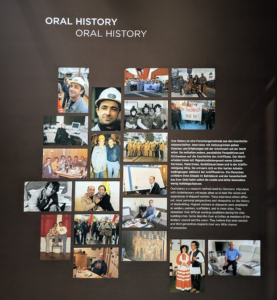
Since the nineteenth century, Germany’s northern ports developed into a massive shipbuilding industry, drawing enormous numbers of workers into slipways, workshops, and docks — an entire working world built alongside the ships themselves. As industrialization advanced, workers organized unions to fight for wages, hours, and conditions, making shipbuilding’s history as much a labor history as a technical one.
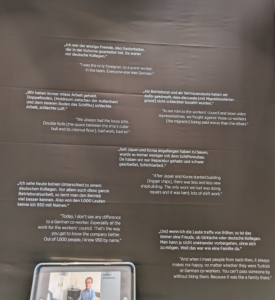
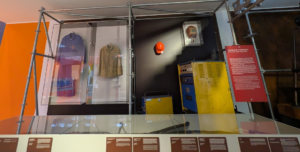
The shipyard never asked where a worker came from — only what their hands could do. During wartime, many yards relied on forced labor; in peacetime, new labor shortages brought migrant workers from other countries into German shipbuilding, different languages and backgrounds contributing to the same hull. Later, women entered a trade long dominated by men — the exhibit notes that welding overalls were eventually designed specifically to fit them. Shipbuilding’s story was never only a story of technology. It was a story of social change too.
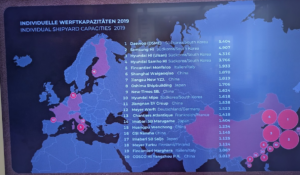
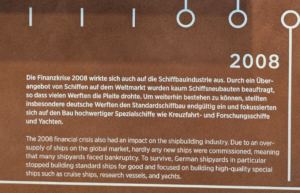
Since the late twentieth century, the global center of shipbuilding has shifted toward Asia, as South Korea, China, and others rose rapidly to dominance. Many German shipyards closed, merged, or pivoted toward high-technology work — research vessels, specialized ships, advanced engineering craft, and related development, rather than mass commercial shipbuilding. The yards are still there. Their purpose has simply changed.
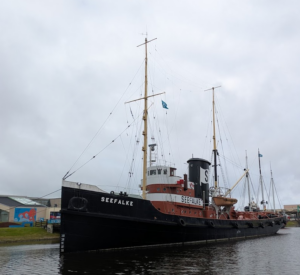
Leaving the exhibition, I walked toward the harbor and boarded the Seefalke, moored at the water’s edge. The German Maritime Museum doesn’t only preserve the past. From the Hanseatic cog to steel ships, from the shipyard to the port, from museum models to a vessel still floating right in front of me — the story of the sea, it turns out, has never actually stopped.
Across Civilizations
Leaving the museum, the three of us climbed aboard the Seefalke, moored in the harbor. Crossing the deck and descending a stairway, an enormous engine suddenly came into view.
Lord Chunshen Huang Xie studied it for a long while. “I thought this museum told the story of ships. It turns out it also tells the story of the people who built them. Looking at these machines now, I can see how completely different today’s ships are from anything Chu ever knew.”
King Kaolie nodded. “Wood became steel. And the ship became this.”
I smiled. “There’s one thing, though, that hasn’t changed at all.”
“What’s that?” Huang Xie asked.
“The launch ceremony.”
Both of them paused, surprised.
Huang Xie laughed. “So even two thousand years later, people still hold ceremonies for a ship.”
King Kaolie said, “Before launching a new ship, Chu also made offerings to heaven and earth, and chose an auspicious day. It seems East and West aren’t so different after all.”
Huang Xie looked out toward the harbor. “Ships change. The methods of building them change. But people always hope for the same thing — that it sets out safely, and comes home safely.”
The three of us stood on deck as the harbor wind blew past.
Behind us, a cog more than six hundred years old. Ahead of us, the Seefalke, still sailing today.
Two thousand years have passed. Ships have changed completely.
But the feeling people carry, sending a ship out to sea — that has never changed at all.
Ships come home. Some people don’t.

 时间|2026年6月7日 (日)
  行程|不来梅哈芬 • 德国航海博物馆