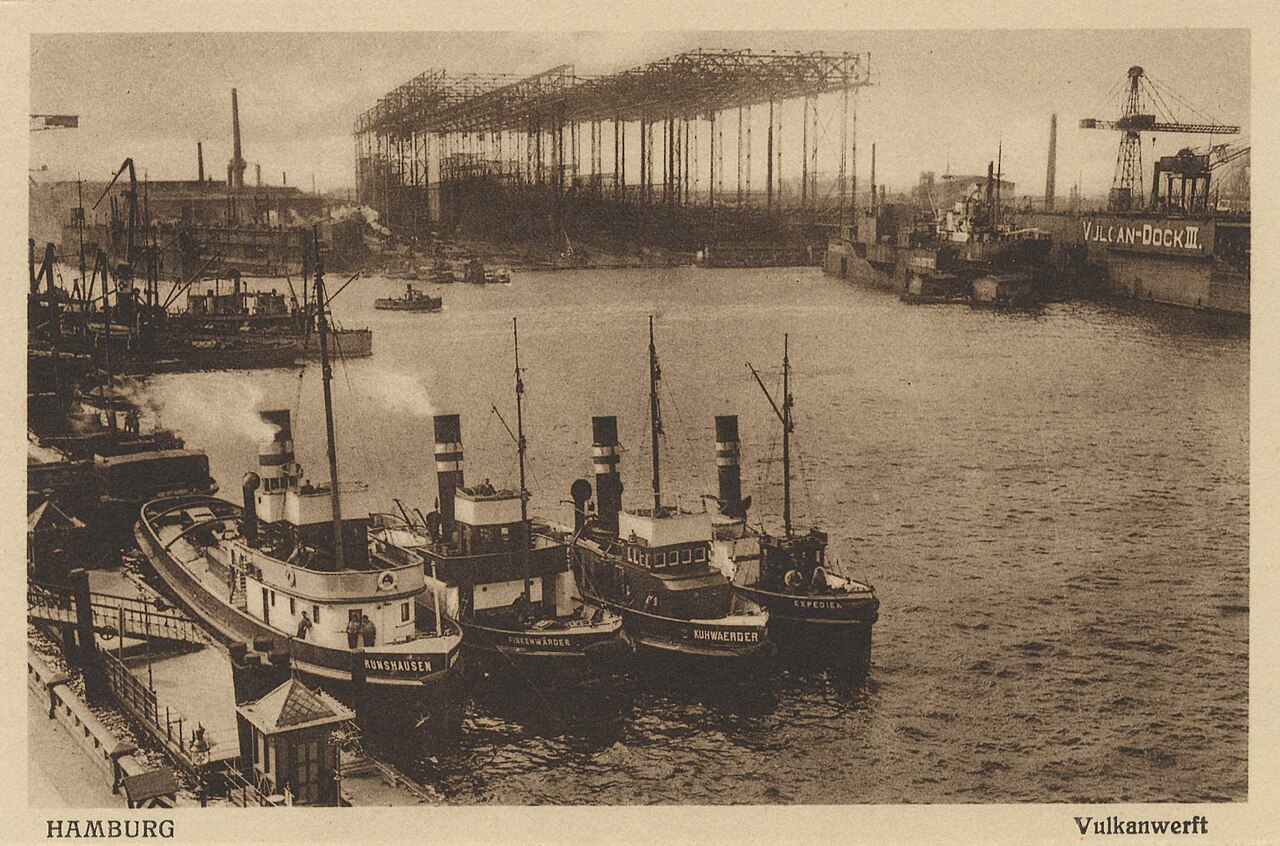
封面图说明|
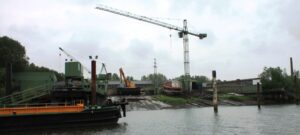
20世纪初的汉堡 Vulkanwerft 船厂。
画面前方停泊着多艘拖船,后方可见船厂的大型厂房与 VULCAN-DOCK III 浮船坞。
这座位于汉堡的 Vulcan 船厂,后来建造了远洋巨轮 IMPERATOR。
资料来源:Wiener Postkartenverlag, Hamburg;Image Zeno.org,ID 20000613487;公有领域。
引文|我最爱的船,出生在哪里?
因为一艘船,
我走进一座港口,
又沿着她的生命,
找到了她的父母。
2026年6月6日,
我第一次走进汉堡港口博物馆,
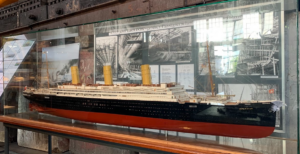
在一座玻璃展柜前,
遇见了 IMPERATOR。
她有修长的黑色船身,
三座黄色烟囱,
船首的巨鹰张开双翼。
模型背后的黑白照片里,
钢铁骨架在船台上升起,
工人站在巨大的船体之间,
一艘海上宫殿正在成形。
1913年,
她从汉堡驶向纽约,
以世界最大客船的身份,
进入大西洋。
那一天,
我还不知道她的船厂,
只知道自己站在展柜前,
看了很久。
如果没有 IMPERATOR,
我大概不会走进,
汉堡的船舶世界,
也不会开始收集后来的爱船船队。
后来,
我开始寻找她的航线,
追随她更换过的名字,
认识她跨越大西洋的一生。
她带我走进汉堡港,
又把一艘艘老船,
以及守护它们的人,
带到我的面前。
如今,
我继续沿着她的生命往前,
从远洋航线回到船台,
寻找她最初诞生的地方。
什么样的船厂,
能够造出世界最大的客船,
又为何在抵达巅峰之后,
消失在汉堡港区?
答案,
藏在易北河畔的旧照片里,
也藏在一个已经消失的名字里,
Vulkanwerft Hamburg。
一、一座船厂,从奥得河来到易北河
一座诞生于奥得河畔的船厂,
为了建造更大的船,
沿着德国水路向西延伸,
最终来到易北河边。
Vulkanwerft Hamburg 的故事,必须从一座更早的船厂说起。
1. 斯德丁在哪里?
1851年,
两位汉堡工程师,
在斯德丁附近的奥得河岸,
建了一座小铁船厂。
斯德丁(Stettin),
位于奥得河下游,
靠近波罗的海,
今天属于波兰,名叫什切青(Szczecin)。
但在当时,它是普鲁士的重要河港。
最初,
那座船厂非常简陋,
造船就在露天河岸进行,
但它建造的船,
却是普鲁士第一艘铁制海船。
1857年,
船厂改组为股份公司,
并改名为斯德丁伏尔铿机械制造股份公司,
Vulcan 的名字由此出现。
一座小铁船厂,
慢慢长成德国重要的工业企业。
2. 前往汉堡
到了十九世纪末,
它遇到了一个问题:
船越造越大,
奥得河却不够深了。
巨轮下水以后,
必须穿过河道才能出海,
但河水已经承担不了,
它的新船想要驶向的世界。
于是,船厂开始寻找新的地点。
汉堡拥有足够的水深,
也有完整的远洋航线,
大型航运公司聚集于此,
因此成为理想的新地点。
1905年,
斯德丁伏尔铿公司决定,
在汉堡建立第二座船厂。
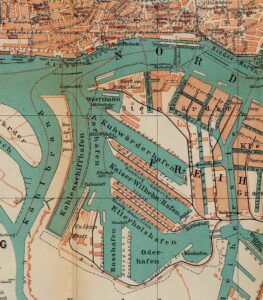
厂区选在施泰因韦德的罗斯岛,
那里有两片港池,
一片叫罗斯港,
另一片后来叫伏尔铿港。
从斯德丁到汉堡,
一座船厂走了半个多世纪,
沿着德国水路向西延伸,
最终来到易北河边。
一座船厂,
有时不是因为它想搬走。
是因为河已经装不下,
它想造的船了。
3. Vulkan 船厂小档案
- 决定建厂: 1905年。
- 开始建设: 1907年。
- 正式启用: 1909年6月。
- 创办企业: 斯德丁伏尔铿机械制造股份公司(Stettiner Maschinenbau-AG „Vulcan“)。
- 企业性质: 斯德丁伏尔铿设于汉堡的分厂,主要从事船舶与机械制造。
- 船厂地点: 汉堡施泰因韦德(Steinwerder)的罗斯岛(Ross)。
- 周边水域: 罗斯港(Rosshafen)与伏尔铿港(Vulkanhafen)。
- 主要业务: 远洋客轮、客货轮及军用舰艇建造。
- 著名船舶: 皇帝号(IMPERATOR)、特拉法加角号(CAP TRAFALGAR)、北角号(CAP NORTE)、腓特烈大帝号(FRIEDRICH DER GROSSE)。
- 现存历史船代表: 暂无完整保存至今的代表船,汉堡港口博物馆保存有皇帝号模型及建造资料。
- 企业变迁: 1928年并入德国船舶与机械制造股份公司(Deschimag),1930年由霍瓦兹船厂(Howaldtswerke)接手。
- 最终结局: 1986年出售给布洛姆+福斯(Blohm + Voss),1987年关闭。
- 现况: 船厂已经消失,伏尔铿港(Vulkanhafen)的名称仍保留着它的历史。
二、当时,世界最大的船,从这里下水
新船厂成立不久,
便接下一个巨大任务,
为汉堡建造一艘,
当时世界最大的客船。
1. 皇帝来到新船厂
1909年6月,
新船厂正式启用。
德皇威廉二世亲自来到汉堡,
为它揭幕。
“Vulcan”这个名字,
来自罗马神话中的火神,
他掌管火焰与锻造。
对于一座造船厂,
这个名字格外贴切。
几乎就在船厂刚站稳的时候,
它接到了一个改变命运的计划。
汉堡—美洲航运公司(HAPAG),
当时正在和英国竞争跨大西洋航线。
英国有泰坦尼克号,
HAPAG要造一艘更大的船。
这项计划由 Albert Ballin 推动,
他选择伏尔铿汉堡分厂,
作为这艘巨轮的建造地点。
新船起初计划叫“欧洲号”,
但德皇威廉二世希望它叫“皇帝号”,
也就是 IMPERATOR。
2. 巨轮在船台上生长
1910年6月,
皇帝号在汉堡船台铺设龙骨。
她是这家新船厂的第三艘新船,
却是它最庞大的工程。
两座船台都在忙碌,
一座造军舰,
一座造巨轮。
站在易北河岸望去,
钢铁骨架沿着船台升起,
工人从清晨到深夜,
把一根根铆钉烧红、敲实。
船厂变成了一座巨大的熔炉。
对于工人来说,
这不是什么“世界最大客船”的传奇。
这是一份日复一日的工作,
用铁锤和火光,
把一艘船从图纸里,
慢慢敲出来。
3. 皇帝号下水
1912年5月,
皇帝号下水,
数千人聚集在船台边,
船身滑入易北河,
船首的巨鹰展开双翼,
站在地球之上。
1913年投入航行以后,
皇帝号超过泰坦尼克号与奥林匹克号,
成为当时世界最大的客船。
下水之后,
还要安装动力系统和内部空间。
船上有四十六座锅炉,
四部蒸汽涡轮机,
总功率六万两千马力。
船上的公共空间,
有餐厅、图书馆、游泳池,
就像一座漂浮在海上的城市。
全部完工后,
船上的工作人员约一千两百人。
1913年4月,
船厂将皇帝号交给 HAPAG,
同年6月,她从库克斯港启程,
开始驶向纽约的处女航。
那是 Vulkanwerft 汉堡分厂建厂后,
第一次站在世界造船的巅峰。
而这座船厂,当时才成立四年。
皇帝号后来改名贝伦加丽亚号,
德文写作 BERENGARIA,
她此后的航行与命运,
将在延伸文章中继续讲述。
延伸阅读|德国皇室之船
文章记录四艘皇室之船,
它们航行于河流与海洋,
也见证德国航运的发展,
以及现代邮轮旅行的诞生。
《令尹夫人的愛船船隊》之一|德国皇室之船 |Beloved Ships Series I | The Royal Ships That Started My Collection
三、战争、合并与消失
一艘巨轮创造了巅峰,
战争却改变造船方向,
企业名称不断更换,
最后的船厂也消失了。
1. 战争改变了船台
皇帝号投入航行一年后,
第一次世界大战爆发,
刚刚抵达巅峰的远洋客轮时代,
突然停了下来。
船厂依旧灯火通明,
工人照常走进厂房,
钢板仍被切开,
铆钉仍被烧红。
只是船台上正在成形的,
不再是驶向纽约的海上宫殿,
而是潜艇、鱼雷艇,
以及一艘艘军用舰艇。
造船技术没有改变,
造船的人也没有离开,
新船驶向的世界,
却已经完全不同。
战争让船厂继续忙碌,
也让它偏离原来的航线,
曾经建造世界最大客船的地方,
从此进入另一段历史。
2. 船厂还在,名字先消失了
战争结束以后,
军用订单迅速减少,
庞大的船台依然伸向水面,
却没有足够的新船填满它们。
为了继续生存,
Vulkanwerft 被并入更大的企业,
后来又由新的公司接手,
Vulcan 的名字逐渐退场。
厂房还在,
船台还在,
工人每天走进同一片厂区,
门口的名字却已经不同。
一座船厂的第一次消失,
没有爆炸,
也没有废墟,
只有一次次合并与更名。
直到某一天,
人们依旧看见那些厂房,
却不再用 Vulkanwerft,
称呼眼前的船厂。
一座船厂的第一种消失,
是失去自己的名字。
3. 最后连船台也消失了
此后的数十年里,
厂区仍在建造船舶,
起重机沿着水岸移动,
钢铁碰撞的声音仍在继续。
直到二十世纪八十年代,
厂区再次被出售,
一年以后,
生产终于结束。
这一次消失的,
不再只是企业名称,
还有厂房与船台,
以及每天走进这里的人。
第二种消失,
是失去厂房和船台。
今天来到汉堡港,
已经找不到当年的 Vulkanwerft,
只有伏尔铿港(Vulkanhafen),
仍然保留着那个名字。
水面没有讲述年份,
也没有列出企业变迁,
它只是安静地留在那里,
提醒人们这里曾经造过巨轮。
尾之声|沿着一艘船,回到她出生以前
有些船留下船体,
有些船只留下模型,
有些船厂连厂房也消失,
但相遇仍能唤回它们。
今天的汉堡港里,
已经看不见 IMPERATOR,
也找不到当年的 Vulkanwerft。
一艘船留下模型,
一座船厂留下旧照片。
当我重新讲述它们,
消失的关系便再次连起。
船会离开出生的港口,
驶向遥远的海洋,
船厂却留在原地,
继续迎接下一艘船。
过去我沿着航线追船,
寻找她们抵达过的地方,
如今我把方向转回陆地,
开始寻找船的父母。
记住一艘船,
也要记住她从哪里来。
当船与船厂重新相认,
一段完整的生命才会出现。
后记|考烈王、黄歇与令尹夫人的观后感
如果没有 IMPERATOR
第四家船厂写完,
这一次找到的父母,
属于我最爱的船,
也是一切故事的起点。
考烈王认出了皇帝号。
他说:
“上一次,
你沿着她走向海洋。
这一次,
怎么又回来了?”
我回答:
“我想知道,
在她出发以前,
是谁把她造出来。”
黄歇说道:
“河流给船道路,
船厂给船身体。
你从航线回到船台,
也就找到了她的起点。”
考烈王想起楚国的水门。
楚国的船没有留下,
造船的人也没有留下,
只有河流仍在。
他说:
“所以,
记住一艘船,
也要记住造船的人。”
船不会自己出现,
远方也不会自己抵达。
每一次出发以前,
都有人先把想象,
变成可以航行的身体。
皇帝号曾经代表,
德国走向海洋的雄心。
而汉堡伏尔铿船厂,
让这份雄心,
真正进入了易北河。
以后每遇见一艘船,
除了问她去过哪里,
还要问她从哪里来。
船承载一个时代,
对于远方的想象。
船厂让这种想象,
获得可以航行的身体。
Appendix|English Narrative Overview
Vulkanwerft Hamburg: In Search of IMPERATOR’s Birthplace
From the Oder to the Elbe
My journey into Hamburg’s maritime world began with a ship that no longer exists.
On 6 June 2026, I encountered IMPERATOR at the Hamburg Port Museum.
Only a model remained: a long black hull, three yellow funnels and the great eagle that once spread its wings above the bow.
Behind the model were photographs of another world.
Steel frames rose across a crowded slipway.
Workers stood beneath a hull so immense that the shipyard itself seemed to disappear around it.
At the time, I knew little about the people who had built her.
I only knew that IMPERATOR had once been the largest passenger ship in the world.
She became the beginning of my beloved fleet.
Following her voyages led me into the history of Hamburg, transatlantic travel and the ships preserved along the Elbe.
Eventually, however, the story began to move backwards.
Before a ship can cross an ocean, someone must build her.
Before she receives a name, she must first take shape on land.
To find IMPERATOR’s birthplace, we must leave Hamburg for a moment and travel east to Stettin, now the Polish city of Szczecin.
There, beside the lower Oder, two engineers from Hamburg established a small iron shipyard in 1851.
The early yard was modest, with ships constructed in the open beside the river.
Yet it produced Prussia’s first iron seagoing vessel and gradually developed into the major industrial enterprise known as Stettiner Maschinenbau-AG “Vulcan.”
By the end of the nineteenth century, the ships were becoming larger.
The river leading from Stettin to the Baltic could no longer serve every vessel the company hoped to build.
The problem was not a lack of shipbuilding knowledge.
It was geography.
Large ocean liners required deeper water, direct access to international routes and close contact with the shipping companies that ordered them.
Hamburg offered all three.
In 1905, the Stettin company decided to establish a second shipyard in Hamburg.
Construction began in 1907 on Ross Island in Steinwerder, between the Rosshafen and the harbour later known as the Vulkanhafen.
The location placed the new yard directly beside the waters of the Elbe.
Ships could leave the slipway, enter the port and continue towards the North Sea.
In June 1909, Kaiser Wilhelm II attended the official opening.
The name Vulcan came from Vulcanus, the Roman god of fire and metalworking.
It was an appropriate name for a place where flames, hammers and human labour transformed steel into ships.
German sources use both Vulcanwerft and Vulkanwerft.
The company originally used the Latin spelling “Vulcan,” while the Germanised form “Vulkan” became increasingly common from around 1913.
The name changed slowly.
The scale of its ambition changed much faster.
The World’s Largest Passenger Ship
The new Hamburg yard had barely begun operating when it received the project that would define its history.
At the beginning of the twentieth century, German and British shipping companies were competing for the North Atlantic passenger trade.
The Hamburg-Amerikanische Packetfahrt-Actien-Gesellschaft, better known as HAPAG, wanted a liner that could challenge the great British ships in size, comfort and prestige.
The driving force behind the plan was HAPAG’s director general, Albert Ballin.
Ballin did not simply want another passenger ship.
He envisioned a floating city designed to represent Hamburg and Germany before an international public.
The new vessel was initially expected to carry the name EUROPA.
Kaiser Wilhelm II preferred a more commanding name.
She became IMPERATOR.
Her keel was laid at the Hamburg Vulkan yard on 18 June 1910.
She was only the third new ship begun at the young shipyard, yet she was already its most ambitious undertaking.
On one slipway stood a naval vessel.
On another, the frame of the future ocean liner began to rise.
Steel plates arrived at the yard.
Furnaces heated thousands of rivets.
Cranes lifted heavy sections of the hull while teams of workers hammered them into place.
Newspapers described a hollow iron body ringing like a bell beneath the blows of hundreds of hammers.
For the public, IMPERATOR represented national ambition and technological progress.
For the people building her, she was years of physical work carried out among fire, noise and steel.
On 23 May 1912, thousands gathered to watch her launch.
The unfinished hull began to move.
Supported only by the carefully prepared slipway, the enormous ship slid into the Elbe.
At her bow stood one of her most striking features: a bronze eagle with its wings spread above a globe.
The sculpture extended the ship’s overall length and turned her bow into a declaration of imperial confidence.
Yet launching was not completion.
During the following months, propulsion machinery, cabins and public rooms were installed.
Thousands of workers and craftspeople contributed to the final stage, including engineers, metalworkers, carpenters, decorators and specialists responsible for the ship’s elaborate interiors.
When completed, IMPERATOR had four propellers and a gross tonnage of more than 52,000.
Her restaurants, lounges, library and swimming pool belonged to the emerging idea of the ocean liner as a destination in itself.
The ship was delivered to HAPAG in April 1913.
On 11 June, she departed from Cuxhaven on her maiden voyage to New York.
With her entry into service, IMPERATOR became the largest passenger ship in the world.
Only four years had passed since the Hamburg yard officially opened.
For Vulkanwerft, she was more than a famous ship.
She proved that the new yard could construct a vessel at the highest level of international shipbuilding.
Other notable ships followed or stood beside her in the yard’s history, including FRIEDRICH DER GROSSE, CAP TRAFALGAR and CAP NORTE.
None, however, became as closely connected with the name Vulkanwerft as IMPERATOR.
She carried the yard to its highest point.
Then the world around the slipways changed.
When a Shipyard Loses Its Name
IMPERATOR entered service in 1913.
One year later, the First World War began.
The era of ambitious German transatlantic liners came to an abrupt halt.
The same shipbuilding knowledge that had produced a floating palace was redirected towards submarines, torpedo boats and other naval vessels.
The slipways remained busy.
The purpose of their work had changed.
After the war, military orders disappeared and the German shipbuilding industry entered a prolonged crisis.
Independent yards struggled to survive.
Companies merged, names changed and industrial sites passed into new hands.
In 1928, Vulkanwerft became part of Deutsche Schiff- und Maschinenbau AG, commonly known as Deschimag.
In 1930, the Hamburg site was taken over by Howaldtswerke.
It was later integrated with neighbouring facilities and developed into Howaldtswerke Hamburg.
The shipyard had not yet vanished from the landscape.
Its workshops and slipways continued to be used.
What disappeared first was its identity.
The word Vulkan slowly left the company signs.
The yard where IMPERATOR had been built remained physically present, but it no longer existed under the name that had made her.
This was the first form of disappearance.
The second came decades later.
In 1986, the site was sold to Blohm + Voss.
Shipbuilding there ended the following year.
The workshops fell silent.
The slipways ceased to receive new hulls.
The industrial world that had once employed thousands of workers withdrew from the harbour.
Today, the original Vulkanwerft can no longer be found on the Hamburg waterfront.
The name survives in Vulkanhafen, the harbour basin beside the former yard.
It remains on the map after the company, buildings and ships have largely disappeared.
IMPERATOR is gone as well.
After the First World War, she passed into British service and was renamed BERENGARIA.
Her later career belongs to another part of the story.
By the end of the 1930s, she too had been dismantled.
The child disappeared. The parent disappeared.
What remains are photographs, plans, models and a name beside the water.
When I first stood before the model of IMPERATOR, I thought I was looking at the history of one ship.
Only later did I understand that a ship also carries the history of the place that built her.
Her hull began on a slipway between the Rosshafen and the Vulkanhafen.
Her machinery reflected the engineering knowledge of her time.
Her scale revealed what Hamburg and HAPAG believed a modern ocean liner could become.
To remember IMPERATOR is therefore also to remember Vulkanwerft.
A ship may leave her birthplace and travel across the world.
Yet the body that carries her through every voyage is the work of the shipyard she left behind.
A ship carries an era’s imagination of distant worlds.
A shipyard gives that imagination a body capable of sailing.
Across Civilizations
King Kaolie recognised IMPERATOR.
“The last time you followed her,” he said,
“she was sailing towards the ocean.
Why have you returned to the land?”
“I wanted to know what came before the voyage,” I replied.
“I wanted to know who built her.”
Lord Chunshen Huang Xie considered this.
“A river gives a ship her route,” he said.
“A shipyard gives her a body.
By returning from the shipping lane to the slipway, you have found the beginning of her life.”
King Kaolie thought of the water gate at the ancient capital of Chu.
The ships of Chu have not survived.
Neither have the people who built them.
Only the rivers remain.
“So remembering a ship is not enough,” he said.
“We must also remember the people who made her.”
A ship does not appear by herself.
Nor does a distant world become reachable by itself.
Before every departure, someone must transform an idea into steel, machinery and a hull that can enter the water.
IMPERATOR once embodied Germany’s ambition to move outward across the sea.
Vulkanwerft gave that ambition a physical form and sent it into the Elbe.
From now on, whenever I encounter a ship, I will ask more than where she travelled.
I will also ask where she came from.
A ship carries an era’s imagination of the world beyond the horizon.
A shipyard makes that imagination seaworthy.
🤖 人工智能协作声明
本文的主题选择、田野调查、资料搜集、核心观点与中文原始内容,均由作者独立完成。
创作过程中,作者与人工智能模型,进行持续协作,包括多轮讨论、思路推演、节奏输出、部分翻译、英文 Narrative Overview 生成、语言检查、结构检测与文字润饰。
人工智能在此过程中,作为创作协作者,参与内容发展与语言表达,但不作为法律意义上的作者或著作权主体。
所有 AI 协作产生的内容,均由作者依据田野资料、原始文献与中文母稿,进行选择、审校、修改与艺术化重构。
文章的叙事方向、内容取舍、创作决策、最终表达与价值判断,均由作者决定并负责。
📜 本站所有原创作品均已完成区块链存证,确保原创凭证。部分重点作品另行提交国家版权登记,作为正式法律备案。原创声明与权利主张已公开。完整说明见:
👉 原创声明 & 节奏文明版权说明 | Originality & Rhythm Civilization Copyright Statement – NING HUANG
节奏文明存证记录
本篇博客文为原创作品,由黄甯与 AI 协作生成,于博客网页首发后上传至 ArDrive 区块链分布式存储平台进行版权存证:
- 博客首发时间:2026年08月14日
- 存证链接:4216392f-4b38-4b6a-a893-7d5cc74e8d53
- 存证平台:ArDrive(arweave.net)(已于 2026年08月14日上传)
- 原创声明编号:Rhythm_Archive_14_Aug_2026/vulkanwerft-hamburg-imperator-birthplace
- 用途声明:本文为《节奏文明观》之〈流动文明 〉与〈节奏文明地景书写 〉篇章,亦参与构建《AI×非遗文明共构档案》与《文明节奏回声计划》,用于文明节奏实地记录、区块链存证、跨域协作与版权登记用途。
© 黄甯 Ning Huang, 2026. All Rights Reserved.
本作品受版权法保护,未经作者书面许可,禁止复制、改编、转载或商用,侵权必究。
📍若未来作品用于出版、课程、NFT或国际展览等用途,本声明与区块链记录将作为原创凭证,拥有法律效力。