Janssen & Schmilinsky: When Hamburg Shipbuilding Turned from Wood to Iron
Before Schaarhörn became a historic steamship, before she carried guests and survived for more than a century, she was simply a new vessel standing on a slipway beside the River Elbe. To follow her life backwards means returning to Steinwerder in 1908, before she had accumulated any stories of her own. There, steel plates were joined, machinery was installed, and shipwrights prepared to send her into the river for the first time. Behind that moment stood the shipyard that built her: Janssen & Schmilinsky.
The story of that shipyard had begun half a century earlier. In the middle of the nineteenth century, Hamburg’s waterfront was still filled with wooden ships, masts and sails. Traditional shipbuilding had not disappeared, and wooden vessels continued to travel rivers, coastlines and oceans. Yet iron was beginning to enter the shipyard, machinery was becoming increasingly important, and the methods used to build ships were changing.
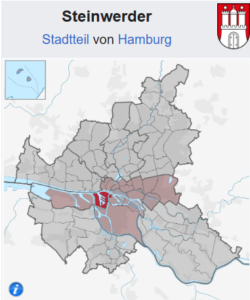
Steinwerder was changing at the same time. After the Great Fire of Hamburg in 1842, rubble from the city was transported there and used to raise low-lying land. By the 1850s, shipyards and some of Hamburg’s earliest dry docks were beginning to appear along the waterfront. It was into this changing industrial landscape that J.C. Janssen and J.F. Schmilinsky arrived.
In 1858, the two shipbuilders established their yard on Schanzenweg on the southern side of Steinwerder. The enterprise carried their names, but its historical significance came from what they chose to build. Janssen & Schmilinsky became Hamburg’s first shipyard devoted specifically to the construction of iron ships. The river was still the same river, but ships were beginning to acquire a different kind of body.
The transition did not happen overnight. Wood did not suddenly disappear from Hamburg’s waterfront, nor did every vessel immediately acquire an iron hull. Old techniques and new technologies existed beside one another. What gradually changed was the language of shipbuilding itself: iron plates, machinery, mechanical engineering and increasingly industrial methods of construction.
The original Schanzenweg yard remained relatively modest in scale. It had two slipways approximately 45 metres long, three smaller slipways and two hauling slips used for repair and conversion work. The yard built new vessels, but it also repaired and modified cargo and passenger ships. Its work gradually expanded from inland navigation toward coastal shipping and vessels for deep-sea fishing.
As the shipyard grew, its family of ships grew with it. By the years before the First World War, Janssen & Schmilinsky had recorded the construction of approximately 500 vessels. They were not 500 versions of the same ship. They included harbour tugs, passenger vessels, fishing craft, coastal ships and working boats, each built for a different life on the water.
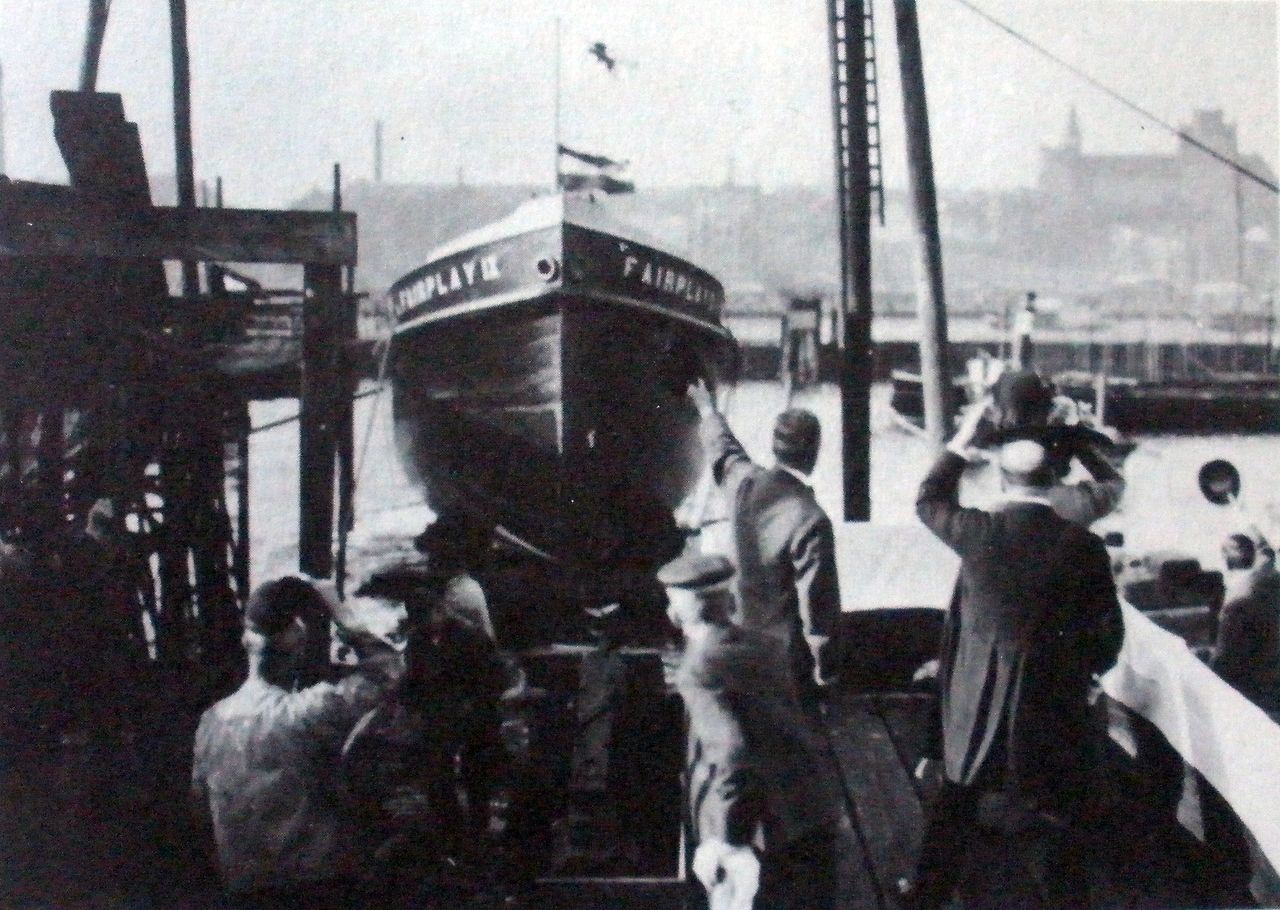
The Fairplay tugboats formed one recognisable branch of that family. The name appeared repeatedly among vessels built by Janssen & Schmilinsky, beginning with an early Fairplay in 1895 and continuing through later generations. One photograph captures this world especially clearly: in 1910, Fairplay IX was photographed during her launch, with workers standing beside the slipway as the newly completed tug entered the water. One ship was leaving the yard, while another would soon begin to take shape.
Other children followed very different paths. Herzog Friedrich entered service on the Schlei, Alexandra became a salon steamer, and Tiger worked as a steam tug before eventually being preserved in Hamburg. Trumao, Crocus, Orion and Nordfriesland belonged to still other branches of the same shipbuilding family. Among hundreds of vessels, however, one child would eventually become especially important to this story.
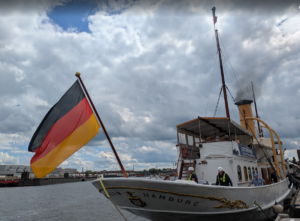
In 1908, Janssen & Schmilinsky completed Schaarhörn. She was a steel, coal-fired, twin-screw steam vessel built for surveying and official travel, and before 1914 she also served as a representative vessel for the Hamburg Senate. But from the shipyard’s point of view, none of her later history had happened yet. She was simply another new ship whose steel plates had been joined, whose engines had been installed, and whose hull was ready to touch the Elbe for the first time.
The shipyard did not stop to follow every child it sent away. One vessel left the slipway, another began to take shape behind it, and the work continued. Schaarhörn left the yard and began a life of her own. Her parents remained on the riverbank and continued building ships.
Ships continued to grow larger, and Janssen & Schmilinsky had to grow with them. By 1917, the original Schanzenweg site was no longer sufficient for the scale of work the company wanted to undertake, and a second yard was established at Tollerort. The new site included a dock approximately 100 metres long and two electrically powered slipways, giving the company the space and equipment required for larger vessels.
The expansion reflected a much larger transformation. Janssen & Schmilinsky had begun as a nineteenth-century iron shipyard beside the Elbe. Almost sixty years later, it required larger docks, heavier machinery and more waterfront space. Ships had grown, and the shipyard had grown with them.
Yet building hundreds of vessels did not guarantee that the shipyard itself would survive. By the late 1920s, economic conditions had deteriorated, orders became harder to secure, and the company eventually entered bankruptcy. A yard that had survived for around seventy years and sent hundreds of ships into the water could no longer sustain its independent existence.
On 1 January 1929, the Tollerort yard was taken over by Howaldtswerke Kiel. The change did not mean that shipbuilding suddenly stopped. The slipways remained, the machinery remained, and work continued along the waterfront. What began to disappear was the name Janssen & Schmilinsky.
The ships, however, had already left. Some travelled far away, some remained in Hamburg, some disappeared, and some survived longer than the shipyard that had built them. Among those survivors was Schaarhörn.
More than a century after her construction, Schaarhörn survives as an operational historic steamship. The shipyard that gave shape to her steel hull no longer exists, and the waterfront where Janssen & Schmilinsky once worked has long since changed. Yet the ship remains. The usual relationship between parent and child has been reversed: the parent disappeared first, while the child continued to sail.
Schaarhörn therefore carries more than her own maritime history. Her steel hull also preserves the memory of a moment when Hamburg’s wooden shipbuilding world was giving way to a new age of iron. The material changed, the methods changed, and eventually the shipyard itself disappeared, but one of its children remained on the water.
Some ships can no longer return to their birthplace, not because they travelled too far, but because they lived so long that the place where they were built disappeared first.
Across Civilizations
King Kaolie looked across the River Elbe at the passing ships. After a while, he said, “The people of Chu knew bronze, and they knew iron. Yet when we built vessels, wood still formed the bones and body of the ship.” He watched the metal hull for a moment longer and asked, “How did iron, a material already known to people, eventually become the body of an entire ship?”
Lord Chunshen Huang Xie looked toward the waterfront and replied, “Perhaps what changed was not the iron. What changed was the human ability to command it.”
The author thought of Steinwerder in the middle of the nineteenth century. Hamburg already knew iron, and wooden ships still sailed perfectly well. Timber had not suddenly lost its usefulness. What was changing was the way people imagined what iron could do.
“Perhaps an age does not change because the old method suddenly fails,” she said. “Sometimes someone simply discovers that the old method is no longer the only possible one.”
King Kaolie nodded slowly and said, “Then the difficult part is not possessing a material. The difficult part is knowing what can be made from it.”
Lord Chunshen continued, “And knowing is still not enough. Someone must know how to shape it, machines must be able to work it, and a shipyard must bring materials, tools and human skill together.”
The author looked toward the riverbank and said, “That is what makes 1858 significant. Two shipbuilders opened a yard at Steinwerder. The act itself looked small, but they chose to specialise in iron ships, and a different way of building vessels took physical form on the Hamburg waterfront.”
King Kaolie smiled and said, “If people from Chu had stood here, they would not have been surprised to see iron. What would have astonished them was seeing so much iron floating on water.”
Lord Chunshen smiled as well and replied, “And after staring at the ship for a while, they would probably ask the same question we are asking now: who built it?”
For a while, no one spoke. A ship moved slowly along the Elbe, and behind it the water closed again. More than two thousand years earlier, the people of Chu built vessels largely from wood. Nineteenth-century Hamburg began giving ships bodies of iron.
More than two thousand years have passed. The materials of ships have changed, and the methods of shipbuilding have changed. Yet people beside the water are still asking the same question: how do we build a vessel, send it away from the shore, and let it carry human intention toward waters farther than the eye can see?