The People Who Kept Hamburg Port Moving | Deutsches Hafenmuseum
A Port Is Kept Moving by People
When a ship enters a port, the work does not end with the crew on board.
Cargo must leave the hold, cross the quay, enter warehouses, and continue its journey by rail or road.
Behind every stage once stood people with different skills, responsibilities, and forms of knowledge.
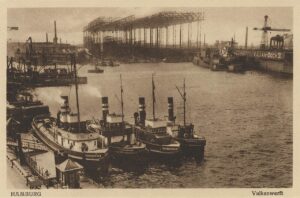
Hamburg’s port was therefore not simply a landscape of ships, but an entire working world.
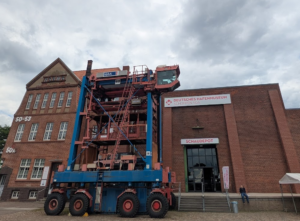
During my visit to the Deutsches Hafenmuseum, I was guided by a retired dockworker born in 1941.
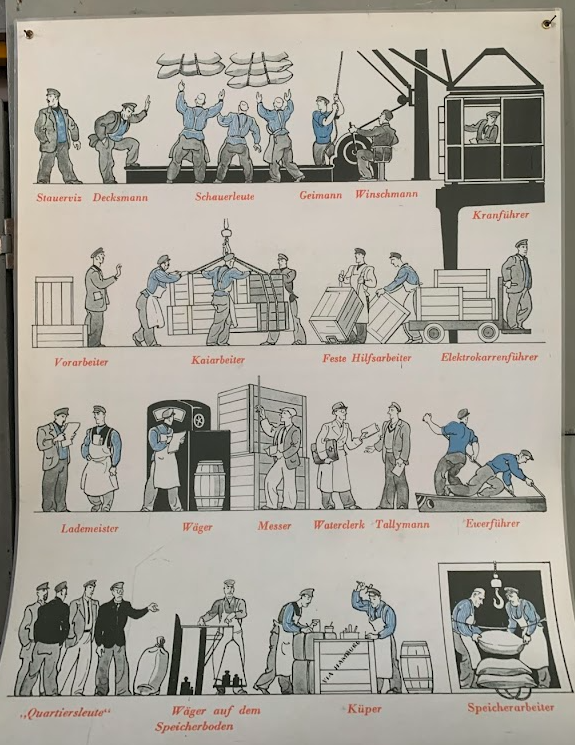
He told me that the port once had more than fifty different occupations, while only around ten remain today.
After hearing this, I began to notice the occupational names appearing throughout the museum.
They revealed a port that had depended on an extraordinary network of human labour.
The Human Chain Behind the Movement of Cargo
A ship could reach Hamburg from across the world, but its cargo could not move through the city by itself.
Pilots and tugboat captains brought vessels through the harbour, while Festmacher secured them at their berths.
Stevedores, crane operators, forklift drivers, stowage planners, and cargo officers took responsibility for unloading and handling the goods.
Beyond them were barge boatmen, inspectors, weighers, fruit packers, harbour divers, water clerks, and many others.
Each occupation represented one link in a much larger chain.
Some people worked on the river, some on the quay, some inside ships, some in warehouses, and others beneath the surface of the Elbe.
Some moved cargo, while others moved information.
Together, they kept the port in motion.
Festmacher: Securing the Ship
Before cargo could be unloaded, the ship first had to be secured safely alongside the quay.
This was the responsibility of the Festmacher, the mooring worker.
Using a small boat, the workers approached the vessel and established the first connection with a heaving line.
The heavy main hawser could then be brought ashore and secured to a bollard.
The work became particularly demanding when mooring lines had to be handled on dolphins standing in the current.
The river continued to move beneath the workers while they completed the operation.
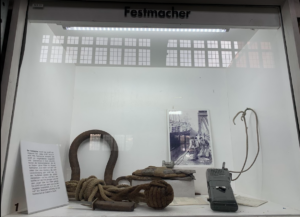
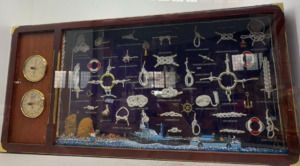
The ropes, gloves, rings, and knot samples displayed in the museum show that mooring was not simply a matter of physical strength.
It was a skilled occupation shaped by knowledge of forces, currents, ropes, and different methods of securing a vessel.
Ewerführer: The Port’s Final Mile
Once the ship was secured, another journey began.
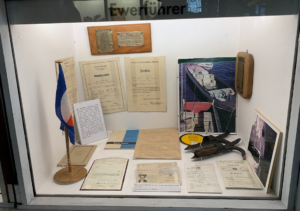
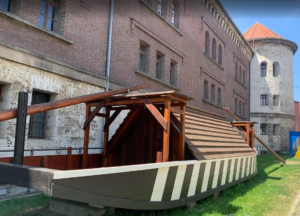
Before containers transformed cargo handling, flat-bottomed barges known as Ewer moved goods between ships, quays, the Speicherstadt, canals, and factories.
The people who operated them were the Ewerführer.
They formed one of Hamburg harbour’s oldest skilled trades.
Early barges had no engines of their own, and boatmen used long poles to move them through the waterways.
Later, they were pulled by tugboats.
The Ewerführer transported and handled bulk cargo, heavy goods, and many other commodities.
What we would now describe as urban logistics depended on their experience, physical strength, and intimate knowledge of the harbour.
Panzenklopper: Labour You Could Smell
Some cargo required additional work after reaching the warehouses.
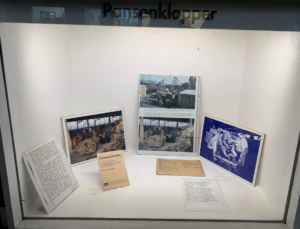
Animal hides transported over long distances were covered with coarse salt to prevent them from decaying during the voyage.
Once they arrived in Hamburg, workers had to spread out the hides and repeatedly beat, turn, and clean them until the salt was removed.
This was the work of the Panzenklopper.
The job was dirty, heavy, and notorious for its smell.
Workers were often placed in more remote parts of the warehouse district so that the odour would not affect other goods.
The conditions were unpleasant enough for them to receive a 15 percent Schmutzzulage, or filth allowance.
Behind the movement of an ordinary commodity stood a form of labour that left its mark directly on the human body.
Hafen- und Bergungstaucher: Beneath the Surface
Some of the port’s most important work took place where almost nobody could see it.
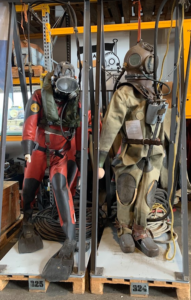
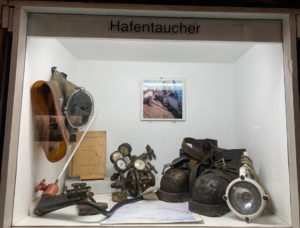
Harbour and salvage divers inspected quay walls, mooring structures, locks, ships, and underwater obstacles.
They recovered cargo that had fallen into the water and participated in salvage operations.
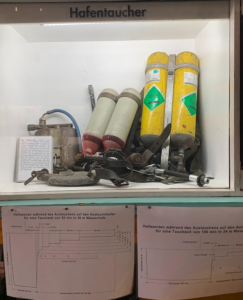
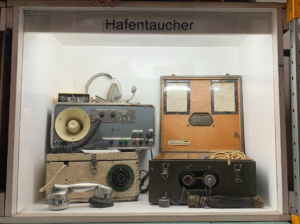
Their equipment included diving helmets, compressed-air systems, lights, communication equipment, and tools for underwater welding and cutting.
The Elbe added another difficulty.
Its water could be so murky that divers sometimes had to rely largely on experience and touch.
One museum display showed that after working for fifty minutes at a depth of fifty metres, a diver could require six decompression stages lasting a total of two hours and twenty-four minutes.
The underwater task might take less than an hour, while returning safely to the surface took several more.
Waterclerks: Keeping Information Moving
Ports depend on more than the movement of physical goods.
Information must move as well.
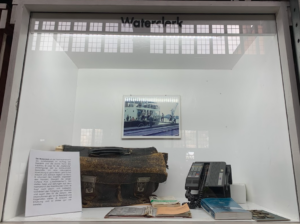
The Waterclerk served as an important link between the ship’s captain, shipping agents, shipping companies, and the port.
After a vessel arrived, the water clerk went aboard, handled formalities, coordinated loading operations and supplies, and followed the ship’s progress in port.
The job also carried a more personal dimension.
Water clerks delivered mail, remittances, and newspapers from home.
Among them were letters known to sailors as Mammiletters: messages from mothers and families to crew members who had been away at sea.
The water clerk therefore connected two different forms of movement—the operational flow of the port and the human flow of information between ship and shore.
How Hamburg Organized an Unpredictable Workforce
Cargo volumes were never completely predictable.
Ships arrived at different times, workloads changed, and the number of workers required could vary dramatically from one day to another.
Hamburg therefore developed a layered system for organizing harbour labour.
It determined not only how cargo moved, but also who received work and income.
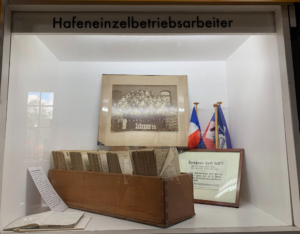
At one level were the Hafeneinzelbetriebsarbeiter, permanent workers employed directly by individual port companies.
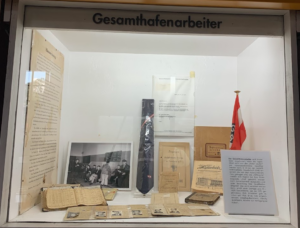
When companies needed additional labour, they could draw on Gesamthafenarbeiter employed through the Gesamthafenbetrieb, or GHB.
Founded in 1951, the GHB maintained a pool of skilled workers who reported to dispatch points and were assigned to companies according to their qualifications and the port’s changing needs.
Even when no work was available, these workers received a guaranteed proportion of their wages.
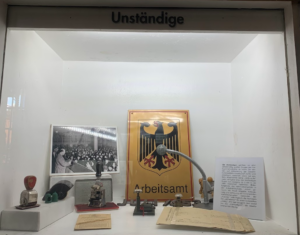
When demand exceeded even this labour pool, Unständige, or casual dockworkers, could be dispatched through the labour office.
At five in the morning, they gathered at the hiring hall known as the “Admi,” which could accommodate around 1,200 people.
They handed in their work cards and waited to learn whether they would receive a shift that day.
Those who were not assigned work depended instead on unemployment support.
The port therefore organized more than ships and cargo.
It organized labour, working time, income, and uncertainty.
Behind the visible movement of goods stood an equally complex system for organizing human lives.
When Containers Changed the Port
Containerization transformed this working world.
Standardized cargo units and machinery gradually replaced many tasks that had once required numerous specialized workers.
Hamburg’s port remained busy, but the human system supporting its movement changed profoundly.
Many occupational names that were once part of everyday harbour life slowly disappeared.
Today, traces of that world survive in the museum.
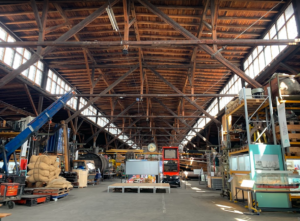
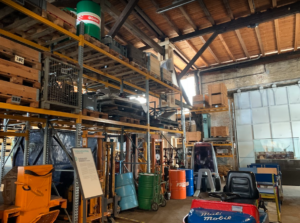
Work cards, certificates, ropes, gloves, tools, photographs, diving equipment, office objects, and labour records preserve fragments of occupations that have largely vanished from the working port.
They show that maritime heritage is not limited to historic ships or harbour architecture.
It also includes the knowledge, routines, skills, and working lives of the people who made the port function.
What Movement Leaves Behind
Visitors to a harbour naturally notice ships, containers, cranes, and the river.
It is much harder to see the generations of workers whose labour once connected all of them.
Some occupations disappeared because machines replaced physical labour.
Others vanished because the entire method of transporting and handling cargo changed.
The Deutsches Hafenmuseum preserves more than the tools those workers used.
It preserves the memory of a complete labour system.
Before containers and automated machinery became dominant, Hamburg’s port depended on countless people using their experience, bodies, and hands to keep goods moving.
The Elbe still flows toward the sea.
Ships continue to enter the harbour, and cranes continue to work along the waterfront.
But inside the museum survives another Hamburg port: a port of boatmen, divers, mooring workers, dockworkers, clerks, and dozens of other trades that once kept the city connected to the world.
Across Civilizations
After leaving the museum, the three of us walked slowly along the Elbe.
Container cranes continued working in the distance, while cargo ships moved steadily toward the harbour.
King Kaolie looked across the river and remarked that the port had contained far more occupations than he had imagined.
Lord Chunshen Huang Xie nodded and thought of the many specialized crafts that had once existed in Chu.
“Chu had its hundred crafts,” he said.
“Chariot-makers, bow-makers, jade-workers, bronze-casters—each had a different responsibility.
I did not expect a single port to contain such a complex division of work.”
“There used to be even more,” I said.
Huang Xie looked surprised.
“More?”
“The retired dockworker who guided me said there were once more than fifty occupations here.
Now only around ten remain.”
King Kaolie looked toward the ships.
“The ships are still here.
Why did the occupations disappear?”
I pointed toward the container terminal in the distance.
“Because the way we keep things moving has changed.
Work that once passed through many pairs of hands can now be performed by a machine.”
For a moment, none of us spoke.
Then Huang Xie looked back toward the river.
“So cargo was never the only thing that moved.”
“What else?” King Kaolie asked.
“Human skill,” Huang Xie replied.
The evening sun settled over the Elbe.
Ships continued entering the harbour while the occupations along the waterfront quietly changed.
Some people had left the port.
Some trades now survived only inside the museum.

 时间|2026年6月6日 (六)
  行程|汉堡 • 港口博物馆