You are currently viewing Chu Yingjian Studies · Extra I|Civilizational Echo: Structural Parallels between Chu Yingjian and High-Speed Rail Thinking

Chu Yingjian Studies · Extra I|Civilizational Echo: Structural Parallels between Chu Yingjian and High-Speed Rail Thinking

English Summary

Abstract

This essay explores a structural resonance between two seemingly unrelated systems:
the generative logic of Chu Yingjian (a construction logic found in Chu civilization) and the systemic thinking behind modern Chinese high-speed rail networks.

There is no historical transmission, influence, or technological continuity between these two systems. They emerged in entirely different historical contexts, materials, and technical environments.

However, when examined at the level of organizational structure, both reveal similar approaches to managing complexity.

Ancient Chu civilization developed structural strategies through ritual systems, musical instruments, urban experiments, and environmental adaptation.
Modern high-speed rail systems developed comparable organizational logics through infrastructure networks, operational coordination, and precision engineering.

The comparison reveals an important insight:

When civilizations confront highly complex systems, similar engineering logics tend to emerge independently.

1. When Two Engineering Civilizations Meet Structurally

Speed belongs to the present.
Structure comes from the deeper layers of civilization.

High-speed rail is not only transportation;
it represents a modern way of organizing large-scale complex systems.

Chu Yingjian is not merely about water control or city construction;
it represents an ancient way of organizing complex systems.

There is no historical lineage between them.

Yet when we place their structural principles side by side, a remarkable phenomenon appears:

Different civilizations, when facing complex worlds, often grow similar structural logics.

2. Structural Convergence across Civilizations

The similarities between Chu Yingjian and high-speed rail are not based on inheritance but on structural convergence.

Chu civilization organized complexity through:

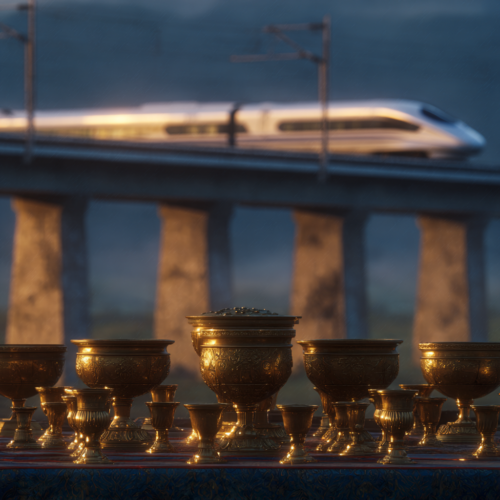
  • ritual hierarchy (Nine Tripods and Eight Gui Vessels, 九鼎八簋)
  • musical system architecture (Bianzhong of Marquis Yi of Zeng, 
    曾侯乙编钟)
  • wetland urbanism (Ji’nan Ancient City of Chu in Hubei, 纪南城)
  • multi-generational city experiments

Modern high-speed rail organizes complexity through:

  • network scale
  • system integration
  • technological iteration
  • operational precision
  • multi-layer transportation coexistence

Both systems demonstrate how large structures stabilize through coordination rather than central control.

3. The Six Paradigms of High-Speed Rail Thinking

Modern Chinese high-speed rail engineering articulates six structural paradigms:

  1. Scale Thinking
    Managing vast transportation networks.

  2. System Thinking
    Integrating numerous technical and operational components.

  3. Technology Thinking
    Enabling continuous innovation and technological growth.

  4. Iteration Thinking
    Allowing systems to evolve through trial, adjustment, and improvement.

  5. Precision Thinking
    Maintaining stability within high-speed environments.

  6. Symbiosis Thinking
    Coordinating different transportation systems and institutional layers.

These paradigms represent a modern engineering mindset for organizing complexity.

4. Four Structural Phenomena in Chu Civilization

Ancient Chu civilization developed comparable structural capacities through four major cultural phenomena:

  • Nine Tripods and Eight Gui Vessels
    Ritual hierarchy as structural ordering.

  • Marquis Yi of Zeng Bell Chime
    Musical relations forming a systemic acoustic network.

  • Ji’nan Ancient City of Chu
    Urban formation integrating ritual structure and wetland geography.

  • Three-generation urban experimentation
    Mopanshan → Jijiahu → Ji’nan Ancient City of Chu.

These phenomena demonstrate how Chu civilization organized complexity through structure, rhythm, and environmental adaptation.

5. Structural Correspondence

The comparison can be summarized as follows:

High-Speed Rail ParadigmChu Civilization Example
Scale ThinkingNine Tripods and Eight Gui
System ThinkingMarquis Yi Bell Chime
Technology ThinkingMulti-generation city experiments
Iteration ThinkingCapital relocation chain
Precision Thinking±5 cent tuning of bronze bells
Symbiosis ThinkingJi’nan Ancient City’s ritual–landscape structure

These parallels do not indicate historical continuity but illustrate structural convergence.

6. Structural Convergence

Chu Yingjian and modern high-speed rail belong to completely different civilizations.

They share:

  • no technological lineage
  • no historical influence
  • no cultural transmission

Their similarities arise because complex systems demand certain structural solutions.

When societies must maintain stability within complexity, similar organizational logics emerge independently.

Conclusion

Ancient Chu cities and modern high-speed rail networks are not historically connected.

Yet they demonstrate a profound insight about civilization:

Complex systems often lead different societies to discover similar structural principles.

Chu civilization once organized wetlands, ritual systems, and urban space into a stable civilizational order.

Modern China organizes transportation networks, infrastructure, and technological systems in comparable ways.

The two systems do not belong to the same historical line.

But structurally, they recognize each other.

Citation

Huang, Ning. (2026).
Chu Yingjian Studies · Extra I|Civilizational Echo: Structural Parallels between Chu Yingjian and High-Speed Rail Thinking.
Rhythm Civilization Research Archive.
https://www.ning-huang.org/chu-yingjian-extra-01-highspeed-echo-en/

🤖 AI Collaboration Statement

This article was conceived, structured, and written under the full creative direction of the author.

During the writing process, the author collaborated with the AI model ChatGPT for iterative discussion, rhythm-based drafting, language review, structural checking, and stylistic refinement.

All core ideas, theoretical frameworks, and intellectual contributions originate from the author.
AI tools function solely as linguistic and structural assistants and do not hold authorship of the work.

The final content has been fully reviewed, edited, and artistically reconstructed by the author, who assumes full responsibility for its intellectual and interpretive claims.

📜 Copyright & Blockchain Record

All original works published on this website have been archived through blockchain verification to ensure proof of authorship.

Selected works are also submitted for official copyright registration as formal legal records.

For details, see:

👉 Originality & Rhythm Civilization Copyright Statement

Rhythm Civilization Archive Record

This article is an original work created by Ning Huang in collaboration with AI tools.

After its first publication on this website, the work was archived on the ArDrive blockchain distributed storage platform (Arweave) for copyright verification.

  • Original publication date: March 14, 2026
  • Blockchain archive link: e6e1eca9-7fac-4dd0-bcfd-9d48006a3b77
  • Archive platform: ArDrive (arweave.net)
  • Archive record: Rhythm_Archive_14_Mar_2026/chu-yingjian-extra-01-highspeed-echo-en

This work forms part of the broader project Rhythm Civilization, including the archives AI × Intangible Cultural Heritage Co-Creation and the Civilization Rhythm Echo Project.

© Ning Huang, 2026. All Rights Reserved.

No part of this work may be reproduced, adapted, redistributed, or used commercially without written permission from the author.

📍Future uses in publications, courses, NFTs, or international exhibitions will reference this statement and the blockchain archive as proof of authorship.