English Summary
Abstract
This essay introduces the Five Forces Model, a generative framework derived from the urban practices of Chu civilization (c. 11th century BCE–223 BCE). Rather than viewing cities as products of centralized planning or geometric design, Chu urban formation reveals a coordinated process in which multiple forces interact over time to produce stable spatial structures.
The model identifies five interacting forces that enable cities to emerge and evolve: landscape, time, materials, body, and institution.
1. Landscape Force
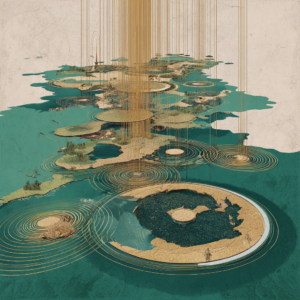
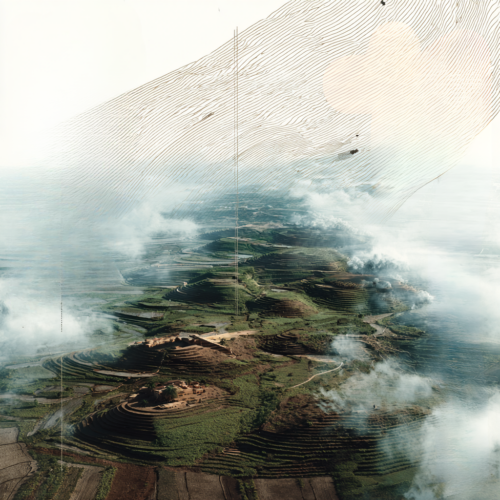
Landscape establishes the initial orientation of settlement. In the wetland environment of the Chu region, terrain, river systems, and elevated ground determine where cities can stand, expand, and connect with surrounding territories.
2. Temporal Force
Urban construction unfolds through time. Archaeological layers and rammed-earth platforms reveal that Chu cities were not built in a single campaign but accumulated through annual cycles, seasonal conditions, and historical phases.
3. Material Force
Materials shape structural possibilities. Rammed earth stabilizes urban foundations, timber frameworks create spatial flexibility, and bronze ritual objects express hierarchy and authority within the built environment.
4. Embodied Force
Human movement generates circulation patterns. Paths, markets, waterways, and processional routes emerge from repeated bodily practices such as walking, trade, transport, and ritual activity.
5. Institutional Force
Institutions anchor spatial order. Administrative centers, ancestral temples, craft districts, and markets organize urban hierarchy and maintain long-term stability.
Generative Coordination of the Five Forces
These forces do not operate independently.
Urban form emerges when landscape conditions, temporal rhythms, material structures, human movement, and institutional organization align and reinforce one another.
When their coordination stabilizes, the city becomes coherent.
When their balance shifts, the system reorganizes and new spatial patterns emerge.
Urban form, therefore, is not a fixed design but the visible result of coordinated forces operating across environment, time, materials, body, and institution.
This generative logic can be summarized in the Yingjian Formula:
Yingjian = landscape × time × materials × body × institution
The multiplication sign indicates that urban form emerges only when all forces operate together.
If any force is absent, the generative process cannot fully occur.
Conclusions
The Five Forces Model therefore reframes cities not as static architectural objects but as living systems shaped by environmental conditions, temporal rhythms, material properties, human movement, and institutional order.
Through this perspective, Chu urbanism reveals a broader civilizational insight:
cities emerge through coordinated forces rather than through isolated acts of design.
📚 Read the original Chinese article →
《楚式营建学之八|楚人如何让城市长出来》
Citation
Huang, Ning. (2026).
Chu Yingjian Studies VIII: How Cities Grow — The Five Forces Model
of Urban Generation in Chu Civilization.
Rhythm Civilization Research Archive.
https://www.ning-huang.org/chu-yingjian-08-city-generation-en/
AI Collaboration Statement
This article was conceived, structured, and written under the full creative direction of the author.
During the writing process, the author collaborated with the AI model ChatGPT for iterative discussion, rhythm-based drafting, language review, structural checking, and stylistic refinement.
All core ideas, theoretical frameworks, and intellectual contributions originate from the author.
AI tools function solely as linguistic and structural assistants and do not hold authorship of the work.
The final content has been fully reviewed, edited, and artistically reconstructed by the author, who assumes full responsibility for its intellectual and interpretive claims.
Copyright & Blockchain Record
All original works published on this website have been archived through blockchain verification to ensure proof of authorship.
Selected works are also submitted for official copyright registration as formal legal records.
For details, see:
Originality & Rhythm Civilization Copyright Statement
Rhythm Civilization Archive Record
This article is an original work created by Ning Huang in collaboration with AI tools.
After its first publication on this website, the work was archived on the ArDrive blockchain distributed storage platform (Arweave) for copyright verification.
- Original publication date: March 13, 2026
- Blockchain archive link: d748766e-479d-49eb-beb0-ef1ff31a01bb
- Archive platform: ArDrive (arweave.net)
- Archive record: Rhythm_Archive_13_Mar_2026/chu-yingjian-08-city-generation-en
This work forms part of the broader project Rhythm Civilization, including the archives AI × Intangible Cultural Heritage Co-Creation and the Civilization Rhythm Echo Project.
© Ning Huang, 2026. All Rights Reserved.
No part of this work may be reproduced, adapted, redistributed, or used commercially without written permission from the author.
Future uses in publications, courses, NFTs, or international exhibitions will reference this statement and the blockchain archive as proof of authorship.