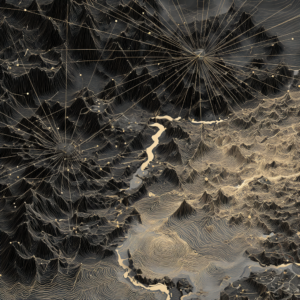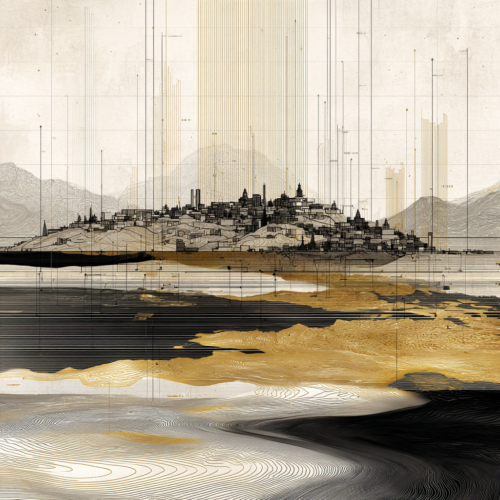
Introduction: Yingjian Is Not Engineering
Chu Yingjian Studies does not reconstruct ancient engineering,
nor does it describe architectural techniques.
It asks a deeper structural question:
How does a civilization, situated between water and land,
generate a world that can continue?
The nine core chapters trace this generative logic—
from wetlands to cities,
from spatial rhythms to systemic algorithms.
Two extended essays open horizontal dimensions:
one dialogues with modern engineering logic,
the other reveals the shared generative language
between classical rhythm (Chuci) and classical structure (Kaogongji).
This Overview offers the full map of the system.
Why Not “Engineering”? Why Call It Yingjian?
“Engineering” belongs to a world where knowledge is divided—
structure, time, materials, and systems separated into specialties.
The Chu world was not divided.
In Chu logic:
- Poetry functions as structure;
- Ritual functions as system;
- Materials speak as language;
- Time acts as algorithm;
- The body becomes a path.
Yingjian is an integrative civilizational capacity—
to know when something may proceed,
where form can stand,
what belongs where,
and which relations must support one another.
Yingjian is not “construction.”
Its ying follows the classical logic of organizing, sequencing, and positioning;
its jian follows Chu calendrical logic of “permission” and “timing”—
forms do not arise when we want,
but rather when the world allows.
Thus, Yingjian is not a technical field,
but a generative civilizational method.
Because no English word carries this meaning,
we retain the transliteration:
Yingjian = the capacity of a civilization to generate and sustain form.
It is neither construction nor engineering,
but a Life-System Operating Logic.
Hence the name:
Chu Yingjian Studies.
I. The Three Axes: From Wetland to Civilizational OS
Chu Yingjian Studies rests on three structural axes:
1. Wetland as Spatial Generator
Landscape is not shaped—it proposes shape.
Wetlands define boundaries; terraces define centers.
2. Rhythm as Structural Driver
Annual cycles, seasons, and nodes regulate when action is permissible.
Time is not flow; it is instruction.
3. System as Stabilizing Force
Materials, bodies, routes, and institutions co-produce stability.
Two extended essays add horizontal layers:
- Modern engineering logic (High-Speed Rail paradigms)
- Classical generative logic (Chuci × Kaogongji)
Together, they form a Civilizational Operating System (OS).
II. The Nine Core Chapters + Two Extended Dialogues
Below are concise positions for each chapter.
1. Listen to a River
The Yangtze is not scenery; it is the first system parameter.
Wetland rhythms generate the earliest spatial logic of Chu.
Cities emerge not on land but from rhythms of water.
👉 Chu Yingjian I · Listen to a River
2. Why Chu Had No Famous Water-Engineers
Governance relied not on individual expertise but on systemic design.
Wetlands served as distributed regulatory infrastructures.
Stability emerged from collective structure, not singular talent.
👉 Chu Yingjian II · Why Chu Had No Famous Water Engineers
3. From Wetland to Capital:Generative Landscape
Chu cities followed the logic proposed by wetlands.
Watercourses set direction; terraces established anchors;
threshold zones defined functions.
Space arises from tendencies, not intentions.
👉 Chu Yingjian III · Generative Landscape Space
4. Time Is Walked Into Being
Years, seasons, and nodes form a temporal operating system.
Time grants or withholds permission to act.
Projects succeed not by speed but by alignment with world timing.
👉 Chu Yingjian IV · Time Is Walked Into Being
5. Qi・Cheng・Zhuan・He:A Non-Uniform Logic of Stability
Stability is not uniformity but mutual support among differences.
Systems shift, reconfigure, and rebalance continuously.
“He” is not conclusion but attunement.
👉 Chu Yingjian V · A Generative System Logic
6. Chijin:Rhythmic Governance of Speed
Knowing when not to act is central to Chu governance.
Chijin is a rhythm-based risk and speed-management system—
cities stabilize by stopping at the right moments.
👉 Chu Yingjian VI · Boundaries of Speed
7. The Book of Materials:Earth, Wood, Bronze
Earth gives stability; wood gives breath; bronze gives order.
Materials are not tools—they are civilizational syntax.
Structures unfold from the temperament of materials.
👉 Chu Yingjian VII · The Structural Language of Materials
8. How Chu Cities Grew
Cities emerge from five forces: time, materials, body, institution.
When the five align, cities appear; when misaligned, they reconfigure.
The chapter synthesizes the Chu generative model.
👉 Chu Yingjian VIII · How Cities Grow
9. How a World Is Generated:Chu Ecosystem Design
Yingjian = time × landscape × materials × body × institution.
Stability arises not from control but from mutual completion.
Civilization is not built; it is generated.
👉 Chu Yingjian IX · Ecosystem Design
Extended Essay I:Civilizational Echo—Chu Yingjian × High-Speed Rail
The six paradigms of High-Speed Rail reveal structural correspondences
with Chu Yingjian logic.
Different eras, materials, and scales—yet similar architectures of complexity.
A dialogue on how systems run the world.
👉 Extended Essay I · Civilizational Echo
Extended Essay II:Chuci × Kaogongji—A Subterranean Convergence
The rhythmic language of Chuci and the structural language of Kaogongji
reflect a shared generative grammar:
emotion is organized by rhythm,
the world organized by craft.
This convergence reveals Yingjian’s classical philosophical roots.
III. The Three Algorithms(OS Layer)
1. Spatial Algorithm
Wetlands define boundaries and centers.
Space is not designed—it is read.
2. Temporal Algorithm
Years, seasons, and nodes constitute rhythm.
Time is the condition for emergence.
3. Structural Algorithm
Earth × Wood × Bronze = stability × breath × order.
Materials encode civilizational logic.
IV. The Chu World Model
Heaven gives rhythm,
Earth gives potential,
Humans give pathways,
Time gives permission.
The world stabilizes not by rules
but through position × rhythm × relation
sustaining each other over time.
Yingjian shows that Chu civilization functioned as a
Life-System Operating System—
not linear, not centralized,
but continuously generated through interaction
between environment, time, materials, bodies, and institutions.
From wetland form,
to urban emergence,
to civilizational coherence—
the generative logic becomes clear.
Chu civilization was not constructed.
It was generated.
Epilogue: Yingjian as Civilizational Capacity
Cities collapse, materials decay, institutions change—
yet civilizations endure only if they can continue generating form.
Yingjian is that capacity.
Chu Yingjian Studies offers not a return to the past,
but a method for the future:
To build stability in instability,
to hold rhythm within change,
to form order from difference—
so the world may continue to emerge and operate.
🤖 AI Collaboration Statement
This work was conceived, structured, and written under the full creative direction of the author.
The AI model ChatGPT participated only as a linguistic assistant—supporting multi-round discussion, rhythm calibration, language refinement, and structural checking.
All conceptual content, arguments, interpretations, and creative decisions were independently produced by the author.
AI tools did not contribute original ideas and do not hold authorship or copyright.
Final text has been manually reviewed, curated, and artistically reconstructed by the author, who assumes full responsibility for all creative judgment and value decisions.
📜 All original works on this site are secured through blockchain notarization to ensure verifiable authorship.
Selected key works are additionally registered with national copyright authorities for formal legal record.
For full details, see:
👉 Originality & Rhythm Civilization Copyright Statement – NING HUANG
Rhythm Civilization Authenticated Record
This article is an original work collaboratively generated by Ning Huang and AI assistance.
After its initial web publication, it was archived through the ArDrive decentralized blockchain system for copyright notarization.
- First publication date: 20 February 2026
- Blockchain notarization link: da96b64b-e407-42a5-b8d8-08c69c0742de
- Storage platform: ArDrive (arweave.net) — uploaded on 20 February 2026
- Originality Record ID:
Rhythm_Archive_20_Feb_2026/chu-yingjian-10-master-navigation-en
This work is part of “Rhythm Civilization Project” and contributes to
“Chu Yingjian Studies”,
“AI × Intangible Heritage Co-Creation Archive”, and
“Civilizational Rhythm Echo Initiative”,
serving purposes of field documentation, blockchain preservation, cross-domain collaboration, and copyright registration.
© Ning Huang, 2026. All Rights Reserved.
This work is protected under copyright law.
Unauthorized reproduction, adaptation, redistribution, or commercial use is strictly prohibited.
📍 Should this work be used in future publications, courses, NFTs, or international exhibitions, this statement and the blockchain record shall serve as legally valid proof of originality.