无论是山海之间的回声,还是城市巷弄里的生活节奏,这些文字记录着台湾的脉动——一座岛屿的日常、知识与文明气息。
From island coasts to city streets, these writings trace the pulse of Taiwan —
its daily life, its knowledge, its gentle rhythm of civilization. Von den Küsten bis zu den Stadtgassen zeichnen diese Texte den Pulsschlag Taiwans –
sein Alltagsleben, sein Wissen, und den sanften Rhythmus seiner Zivilisation.
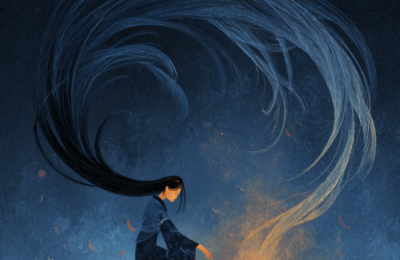
这一篇从云南佤族与台湾雅美族的甩发舞出发,追踪头发如何从“装饰”变成“动作器官”。佤族在火的动律中用甩发开辟空间;雅美族在海的节律里用甩发延展身体。甩发将人的边界从皮肤推向空气,使身体在山与海之间找到第三条脊柱——风的脊柱。
“Hair-Whirling Dance|When Hair Becomes the Body”
This essay traces how, in the Wa people of Yunnan and the Tao (Yami) people of Lanyu, hair transforms from ornament into a kinetic organ. The Wa use hair to carve space through a fiery upward force; the Tao extend the body outward through the tidal rhythm of the sea. In both traditions, whirling hair pushes the boundary of the body beyond the skin into the air, allowing the body to find a third spine—one carried by the wind.
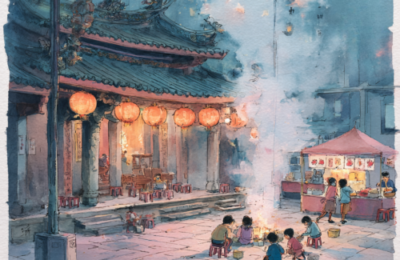
花莲的庙很多。
妈祖守港,玄天上帝镇山,
王母、玉皇、城隍并存。
但我真正记得的,不是哪一尊神。
是庙口——
戏台的灯光,
香肠的温度,
香火的烟,
水泥地上学骑脚踏车。
庙口不是景点。
是身体最早学会“和别人一起”的地方。
Hualien has many temples.
Mazu by the harbor, Xuantian Shangdi in the mountains, local shrines scattered across town.
Yet what I remember is not a particular deity,
but the temple front —
the glow of the stage lights,
the warmth of grilled sausage in my hands,
the sting of incense smoke,
the concrete ground where I learned to ride a bicycle.
The temple courtyard was not a religious concept.
It was where my body first learned how to belong among others.
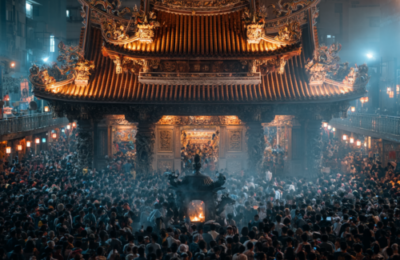
这是一篇从“身体力”视角重新观看妈祖绕境的文章。
我来自东部,对绕境没有成长经验,因此不是在“内部叙述”,
而是以观察者的方式,看见中南部如何用三百多公里、九天八夜,
把信仰落实为动作,把仪式落实为身体,把善意落实为日常。
文章从路径、身体、村庄与纪录片四个角度,
呈现妈祖信仰如何在现代台湾持续生成、更新、扩散与自我确认。
This essay approaches the Mazu pilgrimage from a “body-based ethnography” perspective.
Growing up in eastern Taiwan, I never participated in the pilgrimage myself.
Instead, I observe how central and southern Taiwan embody faith through walking, ritual movement,
communal hospitality, and collective rhythm across 338 kilometers over nine days and nights.
Through four lenses—path, body, village, and documentary—the piece explores how Mazu belief
continues to evolve, reaffirm itself, and illuminate the communities that carry it.
这篇文章从“藕”的空,到“偶”的空壳,再到“电音节奏”让身体重新开机,追索三太子在传统与现代之间的身体转型。
藕让生命重新进入,偶让身体重新定位,电音让传统再度呼吸。
电音三太子不是对传统的离开,而是传统在当代的另一种出现方式——
当一个少年钻进偶身,神、偶、人三层结构被重新点亮,身体在黑暗里对齐,在节奏里找到方向。
This essay traces Nezha’s transformation from lotus-root body to god-puppet body, and finally to the electrified, street-born rhythm of Taiwan’s “Electric-Tech Prince.”
The emptiness of the lotus root allows life to return;
the hollow shell of the puppet allows the body to reset;
the electronic beat turns the god back on.
Electric-Tech Prince is not a rupture from tradition but a contemporary reappearance of it—
a three-layered body of god / prop / human reactivated when a young performer enters the darkness, aligns his body, and lets rhythm lead him back into the light.
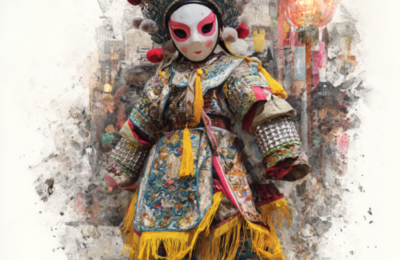
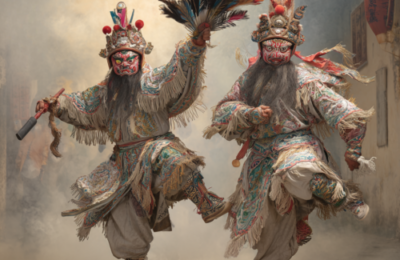
本篇探讨台湾八家将的身体结构:
脸如何成为神格落下的入口,
步伐如何承担职司,
阵式如何让阴司的秩序在凡间被重新走出来。
八家将不是表演,
而是一套以身体执行的司法程序。
文差接令、武差传令、谢范捉拿、甘柳刑罚、
四季神审问、文判录供、武判押犯——
每一个动作、每一条路线、每一段阵法,
都是让“看不见的秩序”被显现的方式。
当脸亮起,
人退出自己,
成为神的替身。
This essay examines the body-structure of Taiwan’s Eight Generals (Ba Jia Jiang):
how the painted face becomes the entry point of divine authority,
how footwork carries judicial duties,
and how formation turns invisible order into something that can be walked into the world.
Ba Jia Jiang is not a performance.
It is a body-based judicial system executed through ritual movement.
From receiving orders, transmitting commands, arresting, punishing, interrogating,
to recording and escorting the guilty—
every step and every pattern is a way of making an unseen order visible.
When the face is opened,
the person steps aside,
and the body becomes the god’s substitute.
本篇以阿美族丰年祭(ilisin)为例,
观察一个以年龄阶层、禁忌与节奏维系的小型社会结构。
文章不以身体经验为核心,而以文化运作方式为切入点,
呈现丰年祭如何透过位置、规矩与夜间歌舞
维持族群内部的秩序、责任与关系。
同时,也讨论为何汉人与原住民在台湾历史上冲突频繁:
并非规矩多寡,而是规矩性质不同——
弹性规则与边界规则难以互相翻译。
本文以理解为目的,不以认同为前提,
将丰年祭放回其文化脉络之中。
This article examines the Amis Harvest Festival (ilisin)
as a cultural system structured by age hierarchy, taboos,
and rhythm-based social training.
Rather than approaching the festival through embodied resonance,
the text focuses on how rules, positions, and nocturnal singing
function as mechanisms for maintaining internal order, responsibility,
and relational boundaries within the community.
It also addresses why conflicts historically occurred between Han settlers
and Indigenous groups in Taiwan:
not due to the number of rules, but the differing nature of rules—
flexible norms versus boundary-based norms.
The piece aims to understand rather than romanticize,
placing the Harvest Festival back into its own cultural logic.
台湾纵贯线,一场五站五诗的节奏播种旅程。从山线南下、海线北返,我不是走马观光,而是走一趟文明选择的铁道书写。送孩子,也是送自己确认——要种下的,不是回忆,而是节奏文明的印记。Taiwan’s main railway line — five stations, five poems, and a journey of rhythm and choice. From mountain line southward to coastal return, this was no sightseeing trip, but a path to plant civilization’s cadence, one verse at a time. I sent off my child, and also sent myself —to choose, to write, to remember.
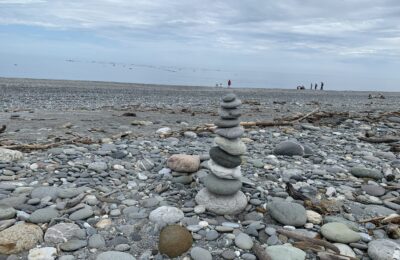
在花莲,身体、海、信仰与石相互回响。从《毛月亮》的舞步到七星潭的潮声,从女娲庙的风声到大理石工厂的轰鸣,十个地点,十种节奏,构成一座城的呼吸。在这里,信仰不是抽象,土地就是信仰。这是一段从自然流入信仰,也流进人心的文明十部曲。In Hualien, body, sea, faith, and stone echo one another. From the moonlit dance of Cloud Gate to the tide of Qixingtan, from the whisper of the Goddess Nüwa to the roar of marble machines—ten places, ten rhythms, compose the breath of a city. Here, faith is not abstract; the land itself is sacred. This is a ten-part movement of civilization along Taiwan’s eastern coast.
在云林,时间放慢了脚步。从斗六的木屋光影到古坑绿廊的甘蔗回声,从咖啡山的雨雾到夜市的咸酥鸡香气,一切都不急。这里教人重新学会生活、也让文明学会——慢。In Yunlin, time takes a slower breath. From the wooden eaves of Douliu to the green tunnel of Gukeng, from the misty coffee hills to the night market’s fried chicken scent—life moves gently here. This land teaches not progress, but presence; not rush, but rhythm.
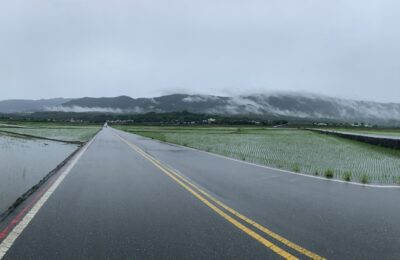
在台东池上,我先走进蒋勋书房的“慢与静”,再沿伯朗大道,将《楚辞》的旋律播进秧田。文字落土,节奏归田,一静一动,完成一次文明节气的闭环。// In Chishang, Taitung, I first stepped into the "slowness and stillness" of Chiang Hsun's study, then walked along Brown Boulevard, letting the melody of the "Chu Ci" flow into the rice fields. Words returned to the earth, rhythm returned to the land — stillness and motion completing one seasonal cycle of civilization.