English Abstract
This series proposes the concept of Embodied Generative Intelligence, an understanding of intelligence that emerges from bodily action rather than abstract calculation.
Through four essays, the series traces a generative path: Body → Rhythm → Emotion → Civilization.
It argues that before rational systems dominated human knowledge, civilizations such as that of ancient Chu in China (c. 1100–223 BCE) preserved a complete archive of embodied intelligence expressed through song, dance, bamboo texts, and city-building.
In the age of artificial intelligence, this perspective reframes a fundamental question: human intelligence may not originate primarily from computation, but from the body’s capacity to generate rhythm, emotion, meaning, and social order.
Embodied Generative Intelligence therefore offers a different foundation for understanding human uniqueness in the AI era.
Before Cogito ergo sum, there was Moveo ergo sum — I move, therefore I am.
Introduction
Thinking, reasoning, and computation are often treated as the central forms of intelligence.
Yet in human experience, the body moves long before the mind reflects.
Infants learn to grasp, crawl, stand, and walk before they acquire language.
Balance, orientation, and coordination emerge through interaction between the body and the environment.
From this perspective, intelligence does not primarily originate in abstract thought.
It grows from action.
This series proposes the concept of Embodied Generative Intelligence—
an understanding of intelligence that emerges from bodily movement, rhythmic organization, emotional experience, and collective practice.
The four essays in this series trace a generative path:
Body → Rhythm → Emotion → Civilization
Before Cogito ergo sum, there was Moveo ergo sum —
I move, therefore I am.
Essay I |Body Before Brain
However, human life begins with movement rather than reflection.
Before language appears, the body already learns to balance, grasp, and navigate space.
These abilities emerge through repeated bodily interaction with the world.
Through movement, the body senses gravity, adjusts force, and maintains orientation.
In this process, patterns gradually form.
These patterns later become habits, skills, and knowledge.
From this perspective, intelligence begins not with abstract reasoning but with embodied action.
The body is therefore the earliest site of intelligence.
Read the original Chinese article →
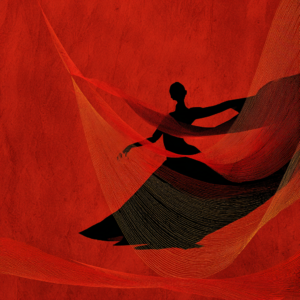
Essay I
Body Before Brain: Intelligence Emerging from Action
Essay II |Rhythm as the Grammar of the Body
When movement repeats, rhythm emerges.
Walking has rhythm.
Breathing has rhythm.
Work, ritual, and dance unfold through rhythmic structures.
Rhythm transforms scattered actions into organized sequences.
In many traditional movement systems, rhythm develops through four phases:
beginning – continuation – transformation – resolution
These phases regulate the flow of energy and direction.
Through rhythm, the body learns how to initiate motion, sustain force, redirect movement, and complete action.
Rhythm therefore functions as a grammar of bodily intelligence.
Just as language arranges words into meaningful sentences, rhythm arranges movements into meaningful patterns.
Read the original Chinese article →
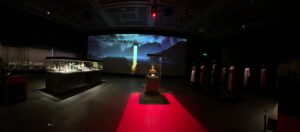
Essay II
Rhythm as the Grammar of the Body: How Beginning–Continuation–Transformation–Resolution Create Structure
Essay III | When Rhythm Becomes Emotion
Emotion is often described as a psychological state.
However, emotional experience frequently emerges from bodily rhythm.
When rhythm enters the body, breathing changes, muscles respond, and heart rate shifts.
Joy arises when movement aligns with rhythm.
Sorrow deepens when the body slows and sinks toward gravity.
Anger takes form through intensified force and heavy beats.
In this sense, emotion is not merely expressed through the body.
It is generated by bodily movement.
Through rhythm, the body transforms physical motion into emotional meaning.
Read the original Chinese article →
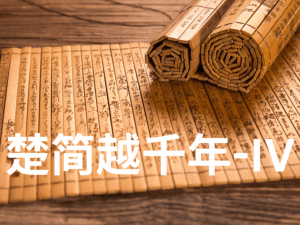
Essay III
When Rhythm Becomes Emotion: How the Body Generates Meaning
Essay IV | Embodied Civilization: Song, Dance, Bamboo Texts, and Cities
When bodily practices extend beyond individuals and become shared by communities, civilization begins to take form.
Ancient Chu civilization preserved a rich archive of such embodied practices.
These practices can be understood through four interconnected domains:
song, dance, bamboo manuscripts, and spatial construction.
Song organizes voice through rhythm.
Dance organizes the body through movement.
Bamboo manuscripts record structured practices and ritual procedures.
Cities organize space and collective life.
Together, these domains reveal a civilization in which knowledge is not purely theoretical but deeply embodied.
Rather than separating mind and body, Chu traditions integrated ritual movement, emotional expression, textual recording, and spatial organization into a unified cultural system.
Embodied Generative Intelligence interprets these traditions not simply as historical artifacts, but as a living archive of human embodied knowledge.
In the age of artificial intelligence, Chu civilization offers something rare: historical evidence that embodied intelligence is not primitive, but foundational.
Read the original Chinese article →
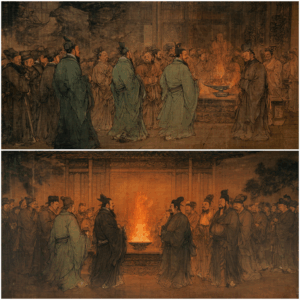
Essay IV
Embodied Civilization of Chu: Song, Dance, Bamboo Manuscripts, and Cities
Conclusion
If we follow the path traced in this series, a different structure of intelligence becomes visible.
The body enters rhythm.
Rhythm generates emotion.
Emotion produces meaning.
Meaning organizes civilization.
Intelligence, therefore, is not only a matter of computation.
It is a generative process.
Artificial intelligence can calculate patterns, but it does not breathe in rhythm.
Algorithms can simulate structure, but they do not experience movement.
The human body does.
Through action, the body generates sensation, memory, emotion, and social order.
Long before rational philosophy emerged, human civilizations already possessed sophisticated forms of embodied intelligence.
The traditions of Chu civilization preserved one of the clearest historical archives of this knowledge.
Embodied Generative Intelligence therefore invites us to reconsider a fundamental question:
What makes human intelligence unique in the age of artificial intelligence?
The answer lies not in the brain alone, but in the living intelligence of the body.
📚 Appendix | Series Overview
Embodied Generative Intelligence
Essay I
Body Before Brain: Intelligence Emerging from Action
《身体生成式智能 • 之一》|身体先于大脑:智能从动作里长出来
Essay II
Rhythm as the Grammar of the Body: How Beginning–Continuation–Transformation–Resolution Create Structure
《身体生成式智能 • 之二》|节奏是身体的语法: 起承转合如何让世界成立
Essay III
When Rhythm Becomes Emotion: How the Body Generates Meaning
《身体生成式智能 • 之三》|当节奏进入情绪,身体如何开始生成意义
Essay IV
Embodied Civilization of Chu: Song, Dance, Bamboo Manuscripts, and Cities
🤖 AI Collaboration Statement
This article was conceived, structured, and written under the full creative direction of the author.
During the writing process, the author collaborated with the AI model ChatGPT for iterative discussion, rhythm-based drafting, language review, structural checking, and stylistic refinement.
All core ideas, theoretical frameworks, and intellectual contributions originate from the author.
AI tools function solely as linguistic and structural assistants and do not hold authorship of the work.
The final content has been fully reviewed, edited, and artistically reconstructed by the author, who assumes full responsibility for its intellectual and interpretive claims.
📜 Copyright & Blockchain Record
All original works published on this website have been archived through blockchain verification to ensure proof of authorship.
Selected works are also submitted for official copyright registration as formal legal records.
For details, see:
👉 Originality & Rhythm Civilization Copyright Statement
Rhythm Civilization Archive Record
This article is an original work created by Ning Huang in collaboration with AI tools.
After its first publication on this website, the work was archived on the ArDrive blockchain distributed storage platform (Arweave) for copyright verification.
- Original publication date: March 13, 2026
- Blockchain archive link: d699d53a-8fe5-4402-ac01-56a79e552f54
- Archive platform: ArDrive (arweave.net)(uploaded on March 13, 2026)
- Archive record: Rhythm_Archive_13_Mar_2026 / embodied-generative-intelligence-en
This work forms part of the broader project Rhythm Civilization, including the archives AI × Intangible Cultural Heritage Co-Creation and the Civilization Rhythm Echo Project.
© Ning Huang, 2026. All Rights Reserved.
No part of this work may be reproduced, adapted, redistributed, or used commercially without written permission from the author.
📍Future uses in publications, courses, NFTs, or international exhibitions will reference this statement and the blockchain archive as proof of authorship.