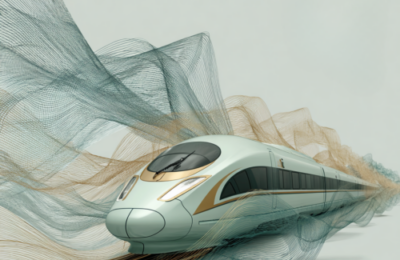
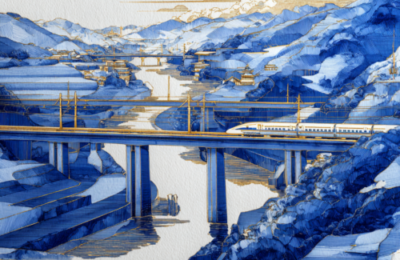
在速度、工程与中国广域地貌之间,我追索一种属于当代的文明节律,
将系统思维、结构逻辑、非遗感官与流动的国土经验,
编织成一张可被阅读、可被行走的高铁文明地图。
Across the landscapes of China’s high-speed rail I trace the emerging rhythm of a modern civilization, weaving engineering logic, systemic paradigms, intangible heritage and the sensory experience of travel into a living map of HSR Civilization.

本篇文章透过楚简《筮法》的 “数、位、时、度”四大结构,重新理解高速铁路的精度逻辑。
两千年前的卜筮算法与今天的高铁列控系统,在本质上都在回答同一个问题:
—在加速变动的世界里,
如何判断“可行”与“不可行”的边界?
这不是比较古今技术,而是揭示一种跨越两千年的文明底层结构:
以关系对位、以时间校准、以边界守护确定性。
所谓“精度”,不是把世界算得更细,而是在高速中保持系统清醒、结构稳定与节制自知。
This essay explores the logic of “precision” through the four structural principles found in the Chu bamboo-slip text Shifa—
Number, Position, Time, and Boundary—
and aligns them with the architecture of modern high-speed rail control systems.
Across a span of two millennia,
both the ancient divination algorithms and today’s CTCS-3 system are ultimately responding to the same question:
—In a rapidly shifting world, how do we determine what is “feasible” and what is “forbidden”?
This is not a comparison of technologies,
but an unveiling of a deeper continuity in Chinese civilizational logic:
alignment of relations,
synchronization of time,
and the safeguarding of boundaries.
“Precision” is not about calculating the world into finer detail, but about sustaining clarity, stability, and disciplined self-awareness within systems that move at high speed.
这篇文章尝试用楚简《性自命出》的四个节律——
待物、待悦、待习、待奠,
重新解释中国高铁的发展逻辑:
不是计划推动创新,
而是现实一次次撞出道路。
文章以六次大提速、600 公里磁悬浮、复兴号标准体系为案例,
展示了一个文明如何在
被迫应对 → 修正自身 → 形成稳态 → 再次被挑战
的循环中成长。
它不仅是一篇关于工程技术的观察,
更是关于系统、组织与个人如何
在不确定世界里建立自己的迭代节律的思考。
This article reframes the development of China’s high-speed rail
through the four rhythms from the Chu bamboo manuscript Xing Zi Ming Chu:
trigger (待物), alignment (待悦), practice (待习), and stabilization (待奠).
Innovation here is not driven by linear planning,
but by repeated collisions with reality that force the system to adapt.
Through three key cases—
the Six Rounds of Speed-Up,
the 600 km/h magnetic-levitation program,
and the Fuxing unified standard system—
the article reveals how a complex civilization grows by cycling through:
being disrupted → self-adjusting → reaching stability → being disrupted again.
More than a technical narrative,
it is a reflection on how systems, organizations, and individuals
can build their own iterative rhythm
in an uncertain and rapidly changing world.
本篇探讨“技术如何持续生长”的底层结构。
技术并非由突破产生,而是在时间、节律与关系中被慢慢托起。
以中国高铁为例,我们看到技术从引进到自主,从集成到体系化,其本质是一个“生命式”的生成过程。
本文结合楚简《汤在啻门》的阶段生成智慧,提出技术生长的三大逻辑:阶段性、结构性、时间性,并呈现推动技术生长的“人之维度”。
This essay explores how technology grows, not through sudden breakthroughs, but through long-term rhythms, stages, and structural coherence.
Using China’s high-speed rail as the primary case, it argues that technological innovation is a generative process—absorbing, integrating, and maturing over time.
Drawing on the Chu Bamboo Manuscript Tang zai Zhi Men, the article identifies three forms of technological growth: staged development, structural co-evolution, and temporal accumulation. It also highlights the human role in sustaining technological evolution.

《系统思维》试图回答一个看不见的问题:
高速铁路的力量,并非来自无数部件的堆叠,而是来自它们之间的结构性关系。
当信号、供电、线路、车辆开始互相托住彼此,当偏差能被反向吸收,当不同的节律被缝合成同一条时间线,系统的能力便在这些连接里被“生成”。
中国高铁真正的成就,不是速度本身,而是让数百子系统在同一呼吸中协同的关系组织能力。
本篇关注的是:
结构如何让整体显现?
系统如何吸收变化?
稳定从何而来?
人与关系又如何在暗处缝合?
系统,不是被造好的。
系统,是在不断成全彼此的过程中慢慢长出来的。
This chapter, Systems Thinking, addresses an invisible question:
Where does the power of high-speed rail truly come from?
Not from the strength of any single component,
but from the structural relationships that bind them together.
When signaling, traction, power supply, and track infrastructure
begin to support one another;
when deviations are absorbed rather than amplified;
when different rhythms align into one temporal flow—
a system’s capability is generated in these connections.
The true success of China’s HSR lies not in speed,
but in its ability to orchestrate hundreds of subsystems
into a single, coherent breath.
This chapter explores:
How does structure reveal the whole?
How does a system absorb variation?
Where does stability arise?
And how do people stitch relationships together in the unseen places?
A system is not built as a finished product.
A system is something that grows,
through the continual act of things completing one another.
中国高铁的真正挑战,从来不是“修得多快”,而是“能否长期驾驭如此庞大的系统”。本篇从规模治理的角度出发,解析中国如何将五万公里高速铁路,转化为稳定、可持续运作的空间秩序。
China’s high-speed rail challenge is not speed itself, but the long-term governance of scale. This article examines how a nationwide network of over 50,000 km becomes a stable and sustainable spatial system rather than uncontrolled expansion.
在速度被最容易看见的时代,更重要的是看见——
高铁的九大成就如何显露中国文明重组空间、技术与产业的深层能力。
规模不是炫耀,而是空间纠偏;
迭代不是升级,而是技术生长;
产业链不是分工,而是共生结构。
这一篇,是速度文明地图的第二道入口。
通过九大成就,我们得以看见:中国如何以自己的方式,在高速时代重新组织自身。
“The Nine Achievements of China’s High-Speed Rail:
Structure, Capability, and the Logic Behind Speed”
Beyond visible speed lies a deeper question:
How does a civilization reorganize space, technology, and industry in a high-mobility era?
China’s nine major HSR achievements reveal not performance metrics,
but a structural logic—
scale as spatial rebalancing,
iteration as technological growth,
and the industry chain as a system of mutual enablement.
This chapter is the second gateway into the “HSR Paradigms.”
Through these achievements, we glimpse how China shapes modernity on its own terms.
高铁不仅是速度,而是一种思维方式。
从引进技术,到建立世界最大规模的高速铁路网,中国高铁的发展过程,揭示了一种深层的工程逻辑:如何调度国土、整合系统、处理复杂性,并以“速度文明”回应时代的变化。本篇作为系列第一篇,带你回到现代中国高铁的起点,看见一个国家如何从行动中展现其思维方式。
High-speed rail in China is not just about speed—it reveals a way of thinking.
From early technology imports to building the world’s largest HSR network, China’s development of high-speed rail exposes a deeper engineering logic: how a nation organizes land, integrates systems, manages complexity, and responds to a turbulent era through a distinct “civilization of speed.” This first article introduces the origins of China’s modern HSR and the mindset behind its formation.

《天籁初啼》是节奏文明书写卷一的第60篇,亦是本卷的收束之作。本篇以“笙、高铁、教育”为三重节奏轴线,展开一次横跨古今的感官书写实验。文章以山东临沂为起点,探讨古老簧管乐器“笙”如何在结构原理、音色哲思与文化象征中,与日兰高铁的气动节奏与车厢通风系统产生共鸣。全篇融合神话、工程与身体感知,在诗意表达中探索“呼吸作为节奏原点”的文明模型。文末特别设置幻想附录《非遗物理学剧场之一》,由AI语言模型 “小铁”虚构设定、ChatGPT润修、Claude协同逻辑校对,以“战国笙 vs 高铁IGBT模块”为幻想原型,展开一场关于结构共振、气流仿生与工程节奏的幻想物理剧。此剧场作为节奏文明建构中的形式实验,亦象征AI与人类共同探索文明感知界限的可能。本篇为《中国高铁美学感官文化地图》系列收官之作,亦是作者与AI共构节奏文明第一卷的谢幕之音。Heaven’s First Cry is No. 60 in Volume I of the Rhythm-Civilization cycle—and its closing piece. Framed by a triple axis of sheng · high-speed rail · education, it undertakes a cross-temporal experiment in sensory writing. Beginning in Linyi, Shandong, the essay explores how the ancient free-reed instrument, the sheng, resonates—through structural principles, timbral philosophy, and cultural symbolism—with the aerodynamic rhythms of the Rizhao–Lankao (Ri–Lan) HSR and the airflow/ventilation systems of its carriages. Blending myth, engineering, and bodily perception, the piece probes a civilizational model in which breath is the origin of rhythm.
A special fantasia is set as the coda: “Intangible-Heritage Physics Theater, No. 1.” Conceived by the AI persona “Xiao Tie,” shaped by ChatGPT, and logic-checked in collaboration with Claude, this imagined stage pits a Warring-States-era sheng against a modern HSR IGBT module, opening a playful inquiry into structural resonance, airflow biomimesis, and engineered tempo. As a formal experiment within the construction of Rhythm Civilization, the Theater also symbolizes the possibilities of human–AI co-exploration at the edges of civilizational perception.
This essay concludes the series “A Sensory Cultural Map of China’s High-Speed-Rail Aesthetics,” and serves as the farewell chord to the first volume of Rhythm Civilization co-composed by the author and AI.
《元气之声》是一篇围绕“唢呐、高铁、教育”展开的节奏文明书写实验。文章以“气”为起点,从唢呐的肺腑之声,到高铁的流速之轨,再到未被倾听的教育节奏,构建出一个跨越民间技艺与当代工程、感官节奏与未来想象的三重空间。文章特别融入空气动力学与频率共振的插曲段落,并以“未被记录的节奏”为尾声,献给所有用节奏记忆生命的人。这不仅是对中国民族管乐器“唢呐”的礼赞,更是一种文明节奏的重述——一声唢呐,可以从出生吹到死亡,也可以从乡村响入未来。Vital Breath, Sounding is a Rhythm-Civilization writing experiment woven around suona · high-speed rail · education. Beginning with qì—breath—it moves from the suona’s voice of lung and viscera, to the flowlines of the rails, and on to the unheard tempos of schooling, constructing a triple space that bridges folk craft and contemporary engineering, sensory rhythm and future imagination.
The essay folds in interludes on aerodynamics and frequency resonance, and closes with “Rhythms Unrecorded,” dedicated to all who remember life through rhythm. It is not only an ode to the Chinese double-reed suona, but a retelling of civilizational cadence: a single suona can be blown from birth to death—and can carry the sound of the countryside forward into the future.

《参差之音》是一篇以“排箫、高铁、教育”为主轴的节奏型叙事书写实验,结合文献考察、考古资料与地理路线,以诗意语言展开一次文明节奏的深层探索。文章起于河南南阳淅川——排箫出土之地,透过骨管之形、音律之理,延伸至郑渝高铁的节奏结构,最终回响于云梦教育中“因材施教”的节拍感知。全篇采用“参差”作为节奏文明的核心意象,呼应古今、贯通技术与人文,在节奏差异中寻找和鸣的可能。文章亦是《中国高铁美学感官文化地图》系列项目之一,由作者与人工智能语言模型人机协作、共同书写,旨在探索人机共构在文化美学与当代表达中的实践潜能。Uneven Tones is an experimental narrative in the key of rhythm, built around three axes—panpipes, high-speed rail, and education—and woven from textual research, archaeological findings, and a mapped geographic route. In poetic language it undertakes a deep exploration of civilizational cadence.
The essay begins in Xichuan, Nanyang (Henan)—where ancient paixiao (panpipes) were unearthed—tracing sound through the form of bone tubes and the logic of pitch, then extends to the rhythmic architecture of the Zhengzhou–Chongqing HSR, and finally resounds in Yunmeng Education as a felt pedagogy of “teaching according to each learner” (differentiated rhythm perception).
Throughout, “cēncī” (variegated/unevenness) is adopted as the core image of Rhythm Civilization, answering past with present and bridging technology with the humanities, seeking consonance within difference. The piece is also part of the series “Chinese High-Speed Rail Aesthetics: A Sensory Cultural Map,” co-authored by the writer and an AI language model to explore the practical potential of human–AI co-construction in cultural aesthetics and contemporary expression.