
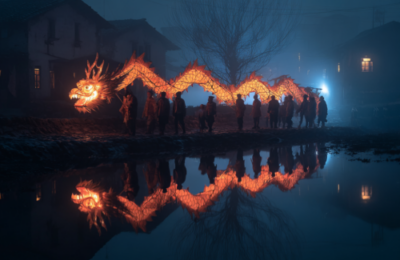
《楚地龙灯|光如何在乡土上行走》
《楚地龙灯》不是在描述一个春节的热闹项目,而是在追踪一种“湿地身体算法”如何被点亮、放大,并以光的方式重新走过乡土。龙灯的动作——方向先行、摆幅恒定、中心推进——并非表演技巧,而是湿地文明古老的走路方式,被几十个身体合成一条脊柱,在黑夜中显形。火不是舞台效果,是显影剂;光不是照明,是路径。龙灯的意义,不在装饰,不在节庆,而在于:一个社区如何通过身体对齐、火光校准与路径确认,完成一年一次的“文明重新上路”。 “Dragon Lanterns of Chu” is not a study of festive spectacle but an inquiry into how a wetland civilization reactivates its oldest movement algorithms through light. The dragon lantern’s motions—direction-leading, amplitude-holding, core-driven—are not performance techniques but embodied memories of how people once moved across unstable ground. Dozens of bodies merge into a single spine; fire becomes a revealing agent; light becomes a pathway. The significance of the dragon lantern lies not in decoration or celebration but in how a community recalibrates itself—by aligning bodies, syncing rhythms, and retracing the essential routes that allow its world to start again each year.