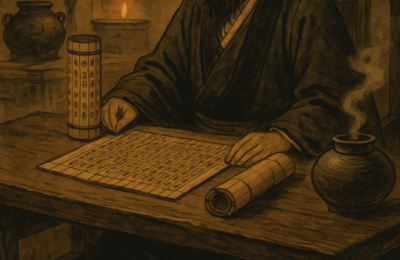
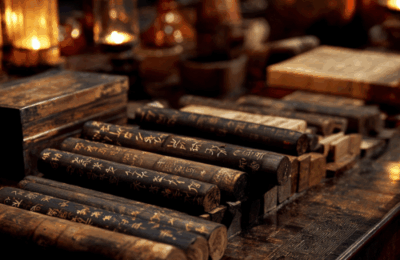
在竹简与帛书的残页里,我触摸到先人的手迹与气息。
它们不是尘封的古物,而是文明记忆的纤维,在今日依然延展成新的语言与节奏。
English
Within the fragments of bamboo and silk manuscripts, I touch the traces and breath of the ancients.
They are not relics buried in dust, but living fibers of memory, still unfolding into new language and rhythm today.
Deutsch
In den Fragmenten von Bambus- und Seidenhandschriften berühre ich die Spuren und den Atem der Vorfahren.
Sie sind keine verstaubten Relikte, sondern lebendige Fasern des Gedächtnisses, die sich heute in neue Sprache und Rhythmus fortsetzen.
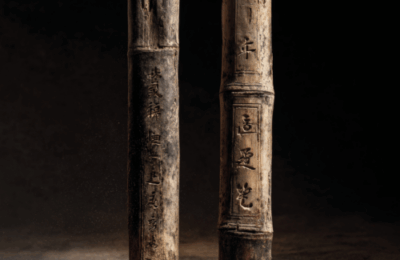
在湖南常德夕阳坡的静土里,棺旁只放着两根竹简,没有甲胄、没有玉器、没有漆器,只有两行刻得极薄的字,像是一座只挂两块匾额的私人宗祠。这并非遣策,而是墓主替自己写下的“个人精神匾额”:一行记录时代,一行记录自己。在短短五十四字中,他把个人命运与国家历史牢牢绑定,把一生的价值浓缩成唯一愿意带入永恒的证明。夕阳坡的无名楚人让我们看到,小人物也能用最轻的材质承载最重的意义——人之所以被记住,不在于拥有什么,而在于选择把什么刻进永恒。In the quiet earth of Xiyangpo in Changde, Hunan, only two bamboo slips lie beside the coffin—no armor, no jade, no lacquered treasures, just two thin lines of script like a private ancestral hall with only two plaques. These are not burial inventories but the tomb owner’s “personal spiritual plaques”: one line for the world, one line for himself. Within fifty-four characters he binds his life to a turning point in history, compressing the worth of a lifetime into the only proof he chooses to carry into eternity. This unnamed Chu man from Xiyangpo shows us that even ordinary people can let the light of meaning survive time—not through what they owned, but through what they carved into forever.
本文串联三种不同面向的楚国贵族生活:
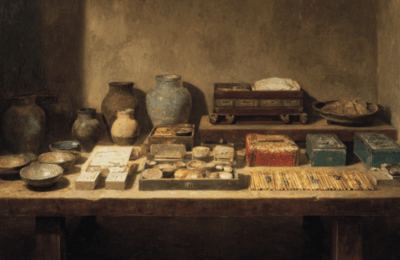
曹家岗以极简的日常器物呈现生活的质地;
五里牌以礼器、宴饮组合与车马配置展现社交等级与家族责任;仰天湖则以丝绸衣物、香匣饰物与生活陈设勾勒楚式审美的深情。
这些竹简并非简单的随葬物记录,而是楚人关于“如何生活、如何与他人相处、如何呈现自己”的世界观档案。三份清单合在一起,构成一幅细腻完整的楚式生活地图。This article brings together three different dimensions of aristocratic life in the Chu state.
Caijiagang reveals the texture of everyday living through its minimalist daily utensils;
Wulipai reflects social hierarchy and familial responsibility through ritual vessels, banquet sets, and chariot-related items;
Yangtianhu presents the aesthetic depth of Chu culture through its silk garments, fragrance boxes, ornaments, and domestic furnishings.
These bamboo-slip inventories are not simple burial lists, but worldview documents that record how the people of Chu lived, interacted with others, and expressed themselves.
Together, the three inventories form a subtle and coherent map of Chu-style life.
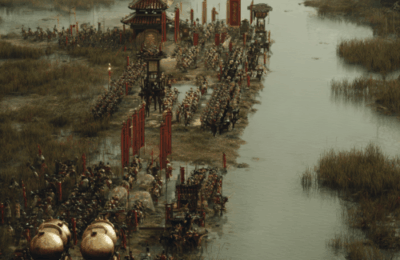
清华简《子仪》记录了春秋时期最戏剧化的一场外交反转:秦穆公在战败后,以礼设局、以乐试心,将被长期囚禁的楚国重臣子仪押入主场;而子仪却在受限的条件中,以和歌重写对方的叙事,以寓言拆解秦国的逼问,完成一次“以不落子取胜”的战略示范。本文从“礼”“辞”“谋”三层结构解析这场会盟,不以战力,而以语法、节奏与判断力,呈现楚式外交的智性美学。The Tsinghua bamboo manuscript Ziyi preserves one of the most remarkable diplomatic reversals of the Spring and Autumn era. After his defeat, Duke Mu of Qin staged a full ceremonial display to test and win over Ziyi—an elite Chu noble who had long been held as a prisoner. Yet within this imposed framework, Ziyi reclaimed initiative through musical counter-speech and a triad of fables that dismantled Qin’s demands. This essay analyzes the episode through “ritual,” “speech,” and “strategy,” revealing how Chu diplomacy mastered the art of winning by not placing a single stone on the board.
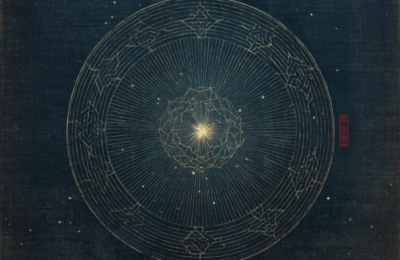
《上博简〈桐颂〉〈兰赋〉|楚辞美学的两极共生与双生火焰》本篇来自《上博简·第八册》的两篇核心文献《桐颂》《兰赋》,
一桐一兰,一刚一柔,一入世一出世,构成楚辞美学最深的“双生源代码”。《桐颂》写官道之桐,其“深立坚树”“刚其不贰”,象征秩序、责任与政治伦理;《兰赋》写幽麓之兰,其“摇落不失厥芳”“芳馨达闻”,守护清洁、独立与灵魂的本真。这对看似对立的意象,其实是楚文明深层结构的“双生火焰”:
桐为骨,兰为魂;桐建秩序,兰养灵气;
二者并行,方成楚辞那种在张力中升腾的极致之美。本文以节奏文明体解析两篇竹简的哲思脉络,并在尾之声引入楚人宇宙观:
当入世与出世、刚直与清香、骨与魂的五脉在死后归一,桐与兰的双焰终将合为璇玑之光。
Drawn from Shanghai Museum’s Bamboo Manuscripts (Volume 8),
this essay explores two essential texts—Tong Song (桐颂) and Lan Fu (兰赋).
One praises the paulownia on the official road; the other, the orchid in the secluded valley.
Together they form the dual aesthetic engine of early Chu literature.
Tong Song embodies political order, integrity, and responsibility.
Lan Fu preserves purity, independence, and inner authenticity.
What appear to be opposites are, in fact, “twin flames”:
the paulownia as structure, the orchid as spirit;
the former builds the world, the latter breathes meaning into it.
This essay interprets both texts through the lens of rhythm-civilization writing,
and concludes with a cosmological insight rooted in Chu thought:
when the fivefold dimensions of life—duty, purity, intention, heart, and soul—unify beyond death,
the twin flames merge into a single star at the axis of the heavens: the Xuanji.
《行称》为楚王规划政务节律,《病方》为楚王调护身体,这两卷清华简把“时间管理”与“宫廷养生”合成一套可操作的生活哲学。从“月六称”的行政节奏,到肩背痛与目疾的简朴医方,它们让我们看见楚王如何在严密制度与朴素疗法之间维持巅峰状态。本篇以温柔幽默的方式,重构楚文明的日常智慧:规律让政务不乱,养生让身体不倒。管理好一天,就是治理好天下。The Tsinghua bamboo manuscripts “Xingcheng” and “Bingfang” reveal an unexpected pairing: a royal scheduling system for state governance and a practical medical handbook for daily ailments. Together, they show how a Chu king maintained peak performance—through disciplined time management and simple, effective palace remedies. This article interprets these texts with a light, witty touch, presenting an early philosophy in which order is sustained by ritual rhythm and health is preserved through everyday care. To manage a single day well is, for the Chu king, to govern the kingdom well.

本文以清华简〈祝辞〉与〈赤鹄之集汤之屋〉为核心文本,探讨楚人在面对自然现象、身体事件与空间失序时,如何通过“仪式锚点”与“叙事重构”两种方式,重新建立可理解的秩序。〈祝辞〉将语言、动作与象征物结合,形成一种稳定场域的程序化框架,使人与环境之间的关系得以被重新定位;〈赤鹄〉则通过神话叙事与因果辨析,揭示如何在结构失衡处重新定义界线与规则。两篇文献共同展现楚人理解世界、排列因果、调和失序的独特方式,为认识楚人的秩序观与思维路径提供关键入口。本文基于出土材料与学术研究,尝试复原这套古老的“秩序生成逻辑”,并讨论其在今日重新被看见的意义。This essay examines Zhu Ci and Chi Hu zhi Ji Tang zhi Wu from the Tsinghua bamboo manuscripts to explore how the Chu people navigated natural forces, bodily afflictions, and spatial imbalance through two complementary modes: ritual anchoring and narrative reconstruction. Zhu Ci integrates language, gesture, and symbolic objects to create a stable field of interaction in which the relationship between humans and their environment can be re-aligned. Chi Hu employs mythic narrative and causal interpretation to reestablish boundaries and rules wherever structural disorder appears. Together, these texts reveal a distinct Chu method of generating and restoring order within an unpredictable world, offering an essential entry point into early Chinese conceptions of sequence, causality, and coherence. Grounded in excavated manuscripts and current scholarship, this essay reconstructs the underlying logic of this ancient “order-making” system and considers its renewed significance today.
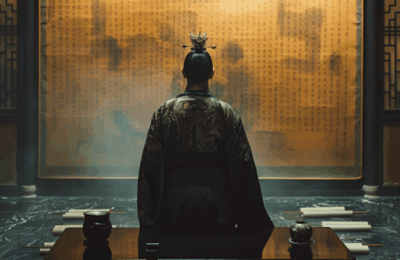
本篇文章依据《上博简 ·王居· 志书乃言·命》三篇的最新学术缀合成果,重构了一场发生在楚国宫廷的“组织信任危机”。从彭徒返自鄩关的复命受阻、观无畏持书诋毁、邦人群情激愤,到楚王的作色训诫、自省片段、令尹子春的调停,以及最终任命彭徒为洛卜尹,本篇以清晰的故事链呈现楚王如何在沉默、流言与民意之间,做出一位领导者的关键抉择。文章以楚国政治语境为基底,穿插现代组织管理语言,对“忠诚”“谗言”“程序”“声誉”“领导者盲区”进行双重解析。《王居/志书乃言/命》所展现的,不是宫廷八卦,而是一位君王的学习曲线:他迟疑、被蒙蔽、自省,最终在舆论风暴中重新找回秩序。这是楚国的真实现场,也是现代每一个组织都会反复上演的治理课。This article reconstructs a complete political incident in the Kingdom of Chu based on the newly affirmed textual sequence of Shanghai Museum Bamboo Slips: Wang Ju, Zhi Shu Nai Yan, and Ming.
What appears fragmented in three separate texts is now read as a single story: a crisis of trust within the Chu court.
From Minister Pengtú returning from the frontier and being met with silence, to Guan Wuwei submitting a written denunciation, to public discontent among the bangren, and finally the king’s rebuke, self-reflection, the intervention of Prime Minister Lingyin Zichun, and the appointment of Pengtú as Luobo-yin, this article traces a clear narrative chain that reveals how a leader grapples with silence, slander, public opinion, and responsibility.
Drawing on Chu-era political language while weaving in modern organizational insights, the article examines loyalty, manipulation, procedure, and the blind spots of leadership. What these slips present is not court gossip but a leadership-learning cycle: hesitation, misjudgment, awakening, and finally a return to order. A story from 2,400 years ago—yet one that still mirrors the dynamics of leadership in today’s organizations.
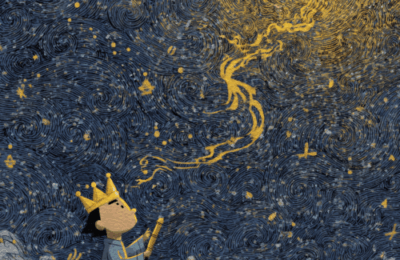
本篇以文学化人设“无忧公子”展开,将《凡物流形》中约五十余条问句重组为四十四问,涵盖存在、宇宙、生死与修身四重结构。透过楚国少年的连环追问,呈现这卷战国哲思如何以“问”代“论”,逼近世界本源,并揭示楚人“知其不知”的思想气质。This article reconstructs Fan Wu Liu Xing from the Shanghai Museum Chu bamboo manuscripts through forty-four selected questions posed by a fictional Chu child. Organized into four thematic layers—existence, cosmos, death, and self-cultivation—it reveals how early Chu thinkers used questions rather than assertions to probe the origins of the world and the nature of mind. At its core lies the Chu insight: true wisdom begins with recognizing one’s own not-knowing.
《恒先》是楚文明最深邃的宇宙论文本,追问“时间开始之前,世界是什么”。从“恒先无有”的太初之境,到“炁是自生”的第一动力,再到“名出于言、事出于名”的生成链,楚人以朴、静、虚重构世界的起源逻辑。这篇文章从简文出发,探讨“无”如何孕育“有”,宇宙为何能自我生成,以及楚文明如何以“复其常”的法则理解存在。“Hengxian” is one of the most profound philosophical texts of the ancient Chu civilization, asking a rare question: What existed before time began? From the primordial statement “Before all, there was no-being (wu)” to the self-generating force “qi arises from itself,” and the logical chain “names arise from words, and affairs arise from names,” this article explores how the Chu thinkers envisioned the cosmos emerging from formlessness. It reconstructs the Chu view of creation, self-generation, and the eternal return to constancy—revealing a unique cosmology of “creation from the void.”
这篇文章从上博简〈鬼神之明〉出发,把鬼神“赏善罚恶”的传统观念,直接翻译成一套战国版 KPI 绩效考核:先用尧舜禹汤、桀纣幽厉等达标案例,证明“系统曾经明亮”;再用伍子胥被鸱夷而死、荣夷公长年善终等异常样本,指出“善者或不赏,暴者或不罚”的致命偏差。这份竹简材料也显示,楚国的知识精英具备与儒家、法家同等级的冷峻理性,他们能以案例、逻辑与证据对核心信仰做系统性反思。《鬼神之明》与屈原式的飞天传统相互映照,让楚文明呈现出既敢想象、又能落地的双重结构。全篇论证最终停在楚人的那句冷静判断——“鬼神有所明,有所不明”:当外部系统不可靠,人必须学会为自己的善恶与选择负责。This article reinterprets the Shanghai Museum Chu slip Gui Shen by translating the ancient belief in “rewarding the good and punishing the wicked” into a Warring States–era KPI performance audit. It uses Yao, Shun, Yu, and Tang versus Jie, Zhou, You, and Li as functional cases to show moments when the system seemed coherent, then highlights anomalies such as Wu Zixu’s tragic death and Rong Yigong’s peaceful end to expose the deviation where the worthy may not be rewarded and the wicked may not be punished. The manuscript shows that Chu intellectuals possessed a critical rationality comparable to Confucian and Legalist thinkers, able to analyze cases and scrutinize core beliefs. Gui Shen mirrors Qu Yuan’s soaring imagination while grounding it with analytic clarity, revealing a civilization capable of both imagining the heavens and auditing them. The argument converges on the sober Chu judgment that “ghosts and spirits are sometimes clear, sometimes not”; when external systems prove unreliable, one must assume responsibility for one’s own choices, virtues, and outcomes.